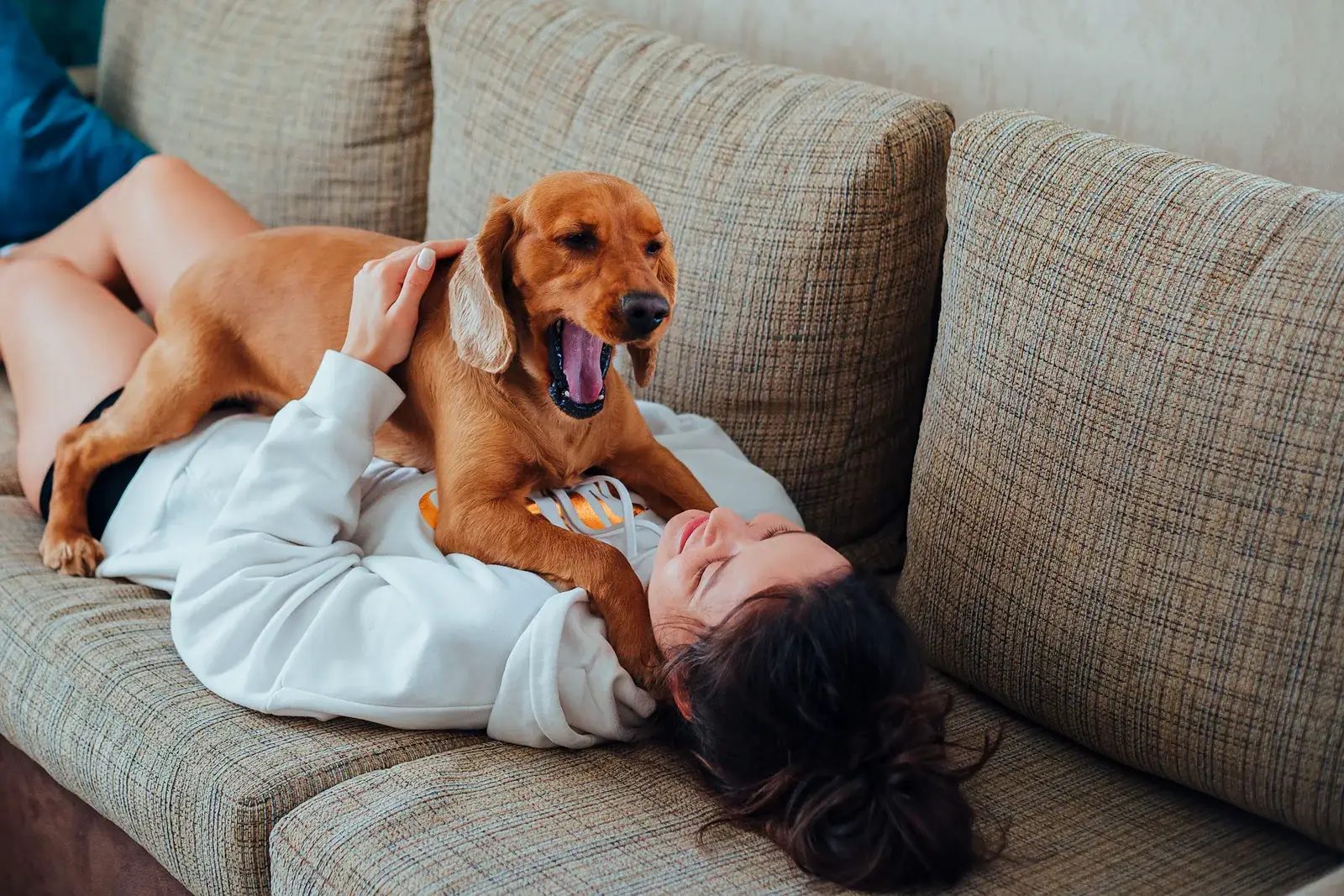
This guide covers 15 of the most searched-for ones. For each, we say what it usually means, when it is normal, and when it is worth a call to a vet or a qualified behaviourist.
A note on certainty: for several of these behaviours, scientists have good studies. For others there are only reasonable theories, and we say so. Your dog is an individual, and context matters more than any general rule.
Quick answer
Most of these behaviours are normal and tied to instinct, comfort, communication or bonding. See a vet if a behaviour is new, sudden, much more frequent than before, or comes with signs of pain, illness or distress. A vet can rule out medical causes, and a behaviourist can help with the rest.
 GuideMy Dog Is Lethargic: Causes and When to Call a VetDog tired, weak or not himself? Normal tiredness vs lethargy, emergency signs, common causes, what to note for the vet and what to avoid.
 GuideBorder Collie behaviour problems and how to train themBorder Collie behaviour and training: why they nip, chase, fixate and fear noise, what to do about each, and a weekly plan for owners.GuideMy Dog Is Lethargic: Causes and When to Call a VetDog tired, weak or not himself? Normal tiredness vs lethargy, emergency signs, common causes, what to note for the vet and what to avoid.
Affection and attention
 GuideMy Dog Has Bad Breath: Causes and What to DoDog breath smells? Gum disease is the usual cause, but sweet or ammonia smells can mean illness.
Why does my dog lick me?
Licking is one of a dog's earliest social behaviours. Puppies lick their mother's mouth, and adult dogs lick as greeting, to show friendliness, to seek attention, or because you taste interesting (salt on skin, food on hands). It can also be a calming habit. No single study explains every case, so read the context: a quick lick at greeting is social, while constant licking of you, floors or itself can point to anxiety or discomfort.
Normal when: brief, at greetings or while you cuddle. Ask a vet or behaviourist when: it is compulsive, hard to interrupt, or the dog also licks surfaces or its own skin raw.
Why does my dog stare at me?
Staring often means "I want something": food, a walk, a game. But dog gaze is also a bonding signal. Nagasawa and colleagues (Science, 2015) found that when dogs gazed at their owners, oxytocin (a hormone linked to bonding) rose in the owners, which in turn raised it in the dogs. The same loop was not seen in hand-raised wolves. A 2016 commentary questioned how far this proves a domestication story, and the sample was small, so treat it as an interesting finding, not a final answer.
Normal when: soft, relaxed eyes, wagging, a sleepy look. Ask a vet or behaviourist when: a hard, fixed stare comes with a stiff body, growling or freezing. That is a warning, not affection. Give the dog space.
Why does my dog lay on my feet?
Most likely it is closeness and comfort: warmth, contact and staying near you. Some dogs use contact to settle, some to keep track of where you are. There is little formal research, so the common explanations are reasonable but not tested.
Normal when: the dog is relaxed and can easily move away. Ask a vet or behaviourist when: the dog guards you from others or shows distress when you move.
Why does my dog always have to touch me?
Many dogs like physical contact: a paw on your leg, a nose under your hand, a head resting on your knee. It can be affection, a request for attention, or a way to feel secure. If it works (you pet them), the dog learns to repeat it. Frequent need for contact can sometimes reflect anxiety or separation distress.
Normal when: the dog is otherwise relaxed, plays and can settle alone for periods. Ask a vet or behaviourist when: the dog panics if you leave the room, paces, drools or destroys things when alone.
Why does my dog follow me everywhere?
Dogs are social animals that evolved to live alongside people. Following you from room to room is normal, especially in breeds bred to work close to a person, such as herding and companion breeds. Dogs also learn that you are where food, walks and company happen. See the Border Collie behaviour guide for a working breed example.
Normal when: the dog follows, then settles and sleeps. Ask a vet or behaviourist when: a previously independent dog suddenly becomes clingy (it can be a sign of pain, vision or hearing loss in older dogs), or being left even briefly causes distress.
Why does my dog bring me toys?
Retrieving and carrying are natural for many dogs, and offering a toy is a way to invite play, greet you, or get attention. Retrievers and spaniels were bred to carry things, so the habit is strong in them. A dog that brings you a toy is usually saying "play with me" or "look what I have". There is no solid study to point to, but the behaviour is consistent and well known to owners and trainers.
Normal when: the dog drops the toy and plays. Ask a vet or behaviourist when: the dog guards toys, growls when you reach for them, or becomes obsessive.
 GuideHow to calm a reactive dogHow to calm a reactive dog: why dogs bark and lunge, what to do in the moment, a step-by-step training plan, what to avoid and when to get help.GuideMy Dog Has Bad Breath: Causes and What to DoDog breath smells? Gum disease is the usual cause, but sweet or ammonia smells can mean illness.
Body and instinct
 GuideBest dog breeds for familiesBest dog breeds for families, small homes, allergies, first-time owners and seniors, ranked from our breed ratings, with honest limits and a table.
Why does my dog eat grass?
Grass eating is common. In a 2008 owner survey by Sueda, Hart and Cliff (Applied Animal Behaviour Science), only about 9 per cent of dogs often looked ill beforehand and about 22 per cent often vomited afterwards, so most grazing is not a dog treating a sick stomach. The cause is still unclear: taste, boredom, fibre or habit. Frantic grazing, repeated vomiting or treated lawns are reasons to call a vet. Read more in why dogs eat grass.
Why does my dog sigh?
A sigh is usually a contented settling-down breath after lying down, or a mild sign of disappointment, for example when you do not get up for a walk. Sighing as an ordinary breathing pattern is common in mammals. Behaviour reviews note that sighing can appear in more than one emotional context, so the same sound can mean relief or frustration. Look at the rest of the body: soft and sleepy means content.
Normal when: after lying down, during rest. Ask a vet when: sighing comes with laboured breathing, coughing, restlessness or a change in sleep.
Why does my dog spin before lying down?
Circling before lying down is an old, common habit. The usual explanation is instinct: to flatten grass or check the spot. A frequently quoted observation from psychologist Stanley Coren is that dogs circled more on a rough, uneven surface than on a smooth one, but the original source and numbers are not documented, so treat this as an unconfirmed report. It is a theory, not a settled fact.
Normal when: one to a few turns, then settling. Ask a vet when: the circling is constant, the dog cannot settle, or it seems painful. Older dogs that pace and circle may have a cognitive condition or discomfort.
Why does my dog roll in smelly things?
Dogs roll in dead animals, droppings and other strong smells. Common theories: masking their own scent (a hunting instinct), carrying interesting smells back to the group, or simply enjoying the smell. None is proven. Dogs experience the world through smell, and an odour that disgusts us can attract them.
Normal when: it happens outdoors and the dog can be called away. Ask a vet when: the dog rolls in something harmful (carcasses, chemicals, faeces from unwell animals) and shows vomiting, diarrhoea or skin irritation afterwards. Constant rolling or rubbing may point to itching or skin disease.
Why does my dog eat poop?
Eating stools is called coprophagia, and it is more common than owners expect. Hart and colleagues (Veterinary Medicine and Science, 2018) analysed two owner surveys and found about 16 per cent of dogs ate stools frequently (at least six times). They found no link with diet or age, coprophagic dogs were as easy to house-train as others, and most of the eating was of fresh stools (up to about 2 days old). Commercial products and behaviour modification had a success rate close to zero in that survey. Puppies often grow out of it. Mothers also clear their pups' droppings.
Normal when: occasional, in young or curious dogs. Ask a vet when: it starts suddenly in an adult, or comes with weight loss, hunger, diarrhoea or a change in appetite, which can point to digestive or nutritional problems. Pick up stools promptly, and ask a vet about worming, because stools can carry parasites.
Why does my dog tilt its head?
The tilt appears to be about listening and attention. Sommese and colleagues (Animal Cognition, 2021) studied 40 dogs. They found that dogs known as "gifted word learners", all Border Collies, tilted their heads when hearing the name of a toy far more often (about 43 per cent of the time) than typical dogs (about 2 per cent). The authors suggest tilting may show attention to meaningful words, though the sample of gifted dogs was only seven, so it is not proof of understanding. Dogs may also tilt to see your face past their muzzle.
Normal when: during a sound, a question or a word they know. Ask a vet when: the tilt is constant, the dog stumbles, loses balance, has eye flicking, or scratches its ears. These can point to ear infections or a balance problem.
Why does my dog kick after peeing?
Kicking the ground after urinating or defecating is usually a scent and visual signal. Dogs have scent glands in their paws, and scratching spreads their scent while leaving a visible mark. This is a widely held explanation, but formal studies are limited. It is not about covering the mess, as with cats.
Normal when: after toileting on walks, especially in male dogs. Ask a vet when: the dog strains, cries when peeing, or toilets very often, which can signal urinary problems.
 GuideMale vs Female Dogs: Differences, Myths and NeuteringMale vs female dogs: what research says about size, trainability and affection, marking, mounting, roaming, and the spay or neuter timing decision.GuideBest dog breeds for familiesBest dog breeds for families, small homes, allergies, first-time owners and seniors, ranked from our breed ratings, with honest limits and a table.
Energy and sound
 GuideHow to Groom a Dog: Brushing, Baths, Nails and CoatsHow to groom a dog at home: coat types, brushing, how often to bathe, cutting nails, ears, teeth, shedding, matting and whether to shave a double coat.
Why does my dog bark at nothing?
Barking at "nothing" is usually barking at something the dog can sense and you cannot: distant sounds, smells, movement. Dogs hear higher frequencies and a wider range than people. Boredom, habit and attention seeking can also play a part. Some breeds bark more by design, and our Beagle and Miniature Schnauzer articles rate barking as High.
Normal when: short alerts that stop when you acknowledge the dog. Ask a vet or behaviourist when: barking is sudden in an older dog (it can be a sign of confusion, pain or sensory change), is non-stop, or happens when alone (possible separation distress).
Why does my dog get zoomies?
"Zoomies" are sudden bursts of fast running, often after a bath, at night or after being cooped up. The technical term is frenetic random activity periods (FRAPs). They look like released energy, excitement or play, and they are common in puppies and young dogs. There is little published research, but the behaviour is widely observed.
Normal when: short, in a safe space, with a dog that then calms down. Ask a vet or behaviourist when: it happens constantly, appears to be linked to anxiety, or the dog gets hurt. Make sure there is room to run and no slippery floor or stairs.
 GuideHow to socialize a puppy or adult dogHow to socialize a puppy or adult dog: the sensitive period, a week-by-week puppy plan, rescue dogs, safe exposure before vaccines, mistakes and a checklist.GuideHow to Groom a Dog: Brushing, Baths, Nails and CoatsHow to groom a dog at home: coat types, brushing, how often to bathe, cutting nails, ears, teeth, shedding, matting and whether to shave a double coat.
When to call a professional
Contact a vet first if:
 GuideDogs in Legends and Fairy TalesDogs in folklore and fairy tales: Black Shuck, The Tinderbox, Saint Guinefort, Panhu, Greyfriars Bobby, Barry and Old Drum, with legend and history kept apart.
- A behaviour is new, sudden or has changed
- The dog seems to be in pain, or is lethargic, off food or drinking more
- There is vomiting, diarrhoea, coughing or laboured breathing
- An older dog becomes confused, restless at night or loses house-training
Contact a qualified behaviourist (via your vet or a recognised professional body) if:
- A behaviour is dangerous (growling, snapping, guarding)
- Anxiety signs appear, such as panic when alone
- The behaviour continues after medical causes are ruled out
Punishing a dog for most of these behaviours rarely helps and can add fear. Reward calm behaviour and meet the dog's exercise and mental needs.
 GuideAdvanced dog trainingAdvanced dog training explained: the 3 Ds, proofing, off-lead recall, formal heel, distance stays, impulse control, tricks, scent work, dog sports and Good Citizen schemes.GuideDogs in Legends and Fairy TalesDogs in folklore and fairy tales: Black Shuck, The Tinderbox, Saint Guinefort, Panhu, Greyfriars Bobby, Barry and Old Drum, with legend and history kept apart.
FAQ
Why does my dog lick me so much?
Mostly affection, greeting, taste and habit. If licking is constant or compulsive, speak to a vet.
Why does my dog stare at me?
It may want something, or it may be bonding. Nagasawa and colleagues (2015) found mutual gaze raised oxytocin in both dogs and owners. A stiff, hard stare is different and needs space.
Is it normal for dogs to eat grass?
Yes. In the Sueda, Hart and Cliff survey (2008), most owners reported their dogs eating plants regularly. See a vet if it comes with vomiting or lethargy.
Why does my dog follow me everywhere?
Dogs are social, and you are their company, food and fun. Normal unless it comes with distress when you leave.
Why does my dog spin before lying down?
Likely an inherited habit tied to preparing a resting place. It is a theory, and no firm study confirms it.
Why do dogs roll in smelly things?
The reason is not proven. Theories include scent masking and enjoyment. Wash off anything toxic and check your dog.
Why does my dog eat poop?
It is fairly common (about 16 per cent of dogs in a 2018 survey). If it is new in an adult dog or comes with other signs, see a vet.
Why does my dog tilt its head?
It seems linked to listening and attention (Sommese 2021). Persistent tilting with imbalance needs a vet.
Why does my dog bark at nothing?
Probably something you cannot hear or smell. Boredom and habit also matter.
Read next
 Family storyToy SpitzRead the family's story: origins, members, DNA
 Family storyPinscherRead the family's story: origins, members, DNA
 Adopt a dogDog Shelters in GermanyTen big cities checked, how adoption works, what it costs
Sources (7)
- Nagasawa M and colleagues. Oxytocin-gaze positive loop and the coevolution of human-dog bonds. Science, 2015. Critical commentary in Frontiers in Neuroscience, 2016.
- Sommese A and colleagues. Studies on dog head tilting and gifted word learners. Animal Cognition, 2021.
- Sueda KLC, Hart BL, Cliff KD. Characterisation of plant eating in dogs. Applied Animal Behaviour Science, 2008.
- Hart BL, Hart LA, Thigpen AP, Tran A, Bain MJ. The paradox of canine conspecific coprophagy. Veterinary Medicine and Science, 2018.
- Stanley Coren, observations on circling before lying down (secondary report, not independently verified).
- Reviews of dog sighing as a behaviour in more than one emotional context (Journal of Veterinary Behavior, reported 2024).
- General dog behaviour guidance from veterinary and animal welfare organisations.