Sometimes it is a faithful companion. Sometimes it is a huge, glowing-eyed guardian of treasure, or a shape on a dark road that nobody wants to meet. Some dogs in this article never lived. Others did, and the stories grew around them until the real animal was hard to see.
This guide keeps the two apart. Each story is labelled as legend, fairy tale, or recorded history, so you know what is solid and what is a good tale. For the gods and monsters of ancient religion (Anubis, Cerberus, Fenrir and others), see dogs in myth. Here we stay with folklore, fairy tales, fables, saints and famous legendary dogs.
Dogs in fairy tales and fables
Fairy tales use dogs in a few repeating ways: the loyal helper, the greedy or foolish animal, and the monstrous guard. All three show up in the tales below.
 GuideDog Clothes: When Dogs Need Coats, and a Short History of Dog FashionDo dogs need coats in winter? When clothes help, when costumes stress a dog, safe fit, reflective gear, and a short history of dog fashion and dog art.
The Tinderbox by Hans Christian Andersen
Andersen's "The Tinderbox" (first published in Danish in 1835) is the best-known fairy tale with fantastic dogs. A soldier meets a witch who sends him down a hollow tree to fetch an old tinderbox. At the bottom he finds three chambers of coins, copper, silver and gold, each guarded by a dog.
The dogs are described by the size of their eyes. In English versions the first has eyes like teacups, the second eyes like mill wheels, and the third eyes as big as the Round Tower of Copenhagen. Translations differ in exact wording, and the Round Tower sometimes appears as a plain "round tower". The soldier sits each dog on the witch's apron and fills his pockets. Later the tinderbox turns out to summon the three dogs, which carry out his wishes and finally save his life.
Two things make these dogs memorable. They are huge, but they are not evil. They obey whoever holds the tinderbox, like guard dogs that serve a household. The story also shows a very old idea: a dog stands at the door of hidden wealth.
Grimm tales with dogs
The Brothers Grimm collected several tales in which a dog is a main character. In "Old Sultan" a farmer plans to get rid of his aging watchdog, and the dog works out a plan with the wolf to win back his place. In "The Dog and the Sparrow" a hungry dog is befriended by a small bird that takes revenge on a carter who hurt him. Both stories treat the dog as a loyal worker who is badly repaid, a theme farm families knew well.
Aesop's fables
Aesop's fables, attributed to a Greek storyteller of the sixth century BCE and retold for two and a half thousand years, give dogs more mixed roles. In one, a dog carries a piece of meat across a stream, sees his reflection, grabs for the "other" piece and loses both. In another, a dog lies in a manger full of hay and will not let the oxen eat it, even though he cannot eat hay himself. The English phrase "dog in the manger" comes from this fable. These dogs are not heroes. They are warnings about greed and spite, which is why dog fables still work as sayings.
Hanasaka Jiisan, the old man who made flowers bloom
In Japan, the folk tale "Hanasaka Jiisan" ("the old man who made flowers bloom") has a dog at its centre. A kind old couple own a dog, often named Shiro in modern retellings, who digs up treasure. A jealous neighbour borrows the dog, finds only rubbish, and kills him. The old man buries the dog, and a tree grows from the grave. Wood from the tree becomes a mortar, and later the old man burns it. The ashes then bring blossoms to bare winter branches.
Retellings differ. In one common version the old man means to scatter the ashes on the grave, but a gust of wind carries them onto the plum and cherry trees, which flower at once. The local lord rewards the old man. The envious neighbour copies him, but the ashes only blow into the lord's eyes, and he is punished. The tale rewards kindness and punishes envy, and the dog is the source of the good luck even after death.
Dogs in other folk tales
Dogs appear in folk tales from many cultures, usually as one of three types: the helper who brings luck, the animal bride or groom, and the guardian of a boundary. Slavic and Russian tales, for example, often include hounds as faithful servants of a hero. Because the details vary so much from collection to collection, this article does not retell any of them. The pattern is what matters. Where there is a gate, a hoard or a sleeping child, a folk tale puts a dog.
 GuideDogs in myth around the worldFrom Anubis and Cerberus to Fenrir, Xolotl and the Tiangou: how cultures across the world imagined dogs as guardians, guides and monsters.GuideDog Clothes: When Dogs Need Coats, and a Short History of Dog FashionDo dogs need coats in winter? When clothes help, when costumes stress a dog, safe fit, reflective gear, and a short history of dog fashion and dog art.
Black dogs of British folklore
The most famous dog legends in Britain are not about heroes. They are about big black dogs seen at night.
 GuideMale vs Female Dogs: Differences, Myths and NeuteringMale vs female dogs: what research says about size, trainability and affection, marking, mounting, roaming, and the spay or neuter timing decision.
Black Shuck
Black Shuck is the best known of these. In East Anglia the name is given to a huge black dog, often said to have glowing eyes, that haunts roads, marshes and church paths. People once treated a sighting as a bad omen.
The core of the legend is a day in 1577. According to the story, on 4 August 1577 during a thunderstorm, a black dog burst into Holy Trinity Church at Blythburgh in Suffolk, killed a man and a boy, and brought down part of the steeple. The same day a similar creature was reported at the church in Bungay. A clergyman, Abraham Fleming, wrote a pamphlet about it called A Straunge and Terrible Wunder, which describes the Bungay event and treats the animal as demonic, perhaps the Devil in animal form.
Here is the legend-versus-history picture:
| Claim | What can be said |
|---|---|
| A violent storm hit both churches on 4 August 1577 | Historians agree both churches were struck by lightning |
| A black dog caused the damage | Church records mention the storm but not a dog |
| The scorch marks on the north door at Blythburgh are the dog's claws | A traditional claim, not a verified one |
| Fleming saw it himself | The local historian Christopher Reeve (1988) noted that Fleming lived in London and may never have visited Bungay |
So the 1577 storm is real, and the dog belongs to the legend. A pamphlet printed soon after the storm is the first written source of the story, which explains why it spread.
 Save
Other black dogs
Black Shuck has many relatives. Folklore collectors record the Barghest in northern England, church grims that were said to guard churchyards, the Gytrash of the north, and, in Wales, the Cŵn Annwn, spectral hounds linked to the Otherworld. The details differ by region and by who is telling the story. This article leans on the Black Shuck record, where a source was checked, and treats the others as a family of similar beliefs rather than as separate documented cases.
What links them is the setting. These dogs belong to crossroads, bridges, churchyards and lonely lanes: places where one world seems to meet another. Some are menacing, some protective. A black dog that walks a lonely traveller home is a very old kind of story too.
Scientists have sometimes tried to link such tales to real dogs. An archaeological find of a large dog skeleton in a ruined castle in Suffolk was reported in the press in 2014 as possibly the dog behind the Shuck legend. This is a good headline and an unproven idea: a large old dog buried in a place that already had a legend is not the same as evidence for the legend.
 GuideAdvanced dog trainingAdvanced dog training explained: the 3 Ds, proofing, off-lead recall, formal heel, distance stays, impulse control, tricks, scent work, dog sports and Good Citizen schemes.GuideMale vs Female Dogs: Differences, Myths and NeuteringMale vs female dogs: what research says about size, trainability and affection, marking, mounting, roaming, and the spay or neuter timing decision.
Dog ancestor legends
 GuideWhy does my dog do that? 15 common behavioursWhy does my dog lick me, stare, eat grass, spin, sigh or roll in smelly things? 15 everyday dog behaviours explained, with when to ask a vet.
Panhu, the dog who became a hero
In southern China, the Yao and She peoples tell a story about Panhu, a dog who is the ancestor of their people. An early written source is the Soushen ji by the Jin dynasty author Gan Bao, which records an origin story for a southern group. In one telling, an old palace maid has an earache, and a physician takes a large insect from her ear. It changes into a coloured dog that people call Panhu (the name means roughly "plate gourd", after the vessel in which the insect was kept).
Panhu helps the emperor, Di Ku in many versions, by killing an enemy general and bringing back his head. As a reward he marries the emperor's daughter. Their children become the ancestors of the Yao and She.
Some details vary. In the oldest surviving telling Panhu may stay a dog. The popular version in which he is covered by a golden bell for days and almost becomes human is often said to be a later addition. For the Yao and She, Panhu is honoured, often as King Pan, and in many communities it is taboo to eat dog meat.
This is a different idea from loyalty. The dog is not a servant here. He is a founder.
 GuideMy Dog Is Lethargic: Causes and When to Call a VetDog tired, weak or not himself? Normal tiredness vs lethargy, emergency signs, common causes, what to note for the vet and what to avoid.GuideWhy does my dog do that? 15 common behavioursWhy does my dog lick me, stare, eat grass, spin, sigh or roll in smelly things? 15 everyday dog behaviours explained, with when to ask a vet.
Saints and holy dogs
 GuideSmartest dog breeds: what the rankings measure and what they missCoren's smartest dog breeds list, what it measured, what newer dog cognition research says, three kinds of dog intelligence and why smart dogs need work.
Saint Guinefort, the dog saint
The only dog ever venerated as a saint by ordinary people, with no church approval, is Saint Guinefort. Our source is a Dominican friar, Stephen of Bourbon, who wrote about him around 1250 while hunting heresy in France.
The story, as Stephen reports it, is about a greyhound owned by a lord near Lyon. The lord returns home to find the cradle overturned and the dog's mouth covered in blood. He kills the dog, and then discovers that the baby is alive and a dead snake lies nearby. The dog had protected the child. Ashamed, the lord buries the dog in a well and plants trees around it.
The historian Jean-Claude Schmitt studied this case in The Holy Greyhound: Guinefort, Healer of Children Since the Thirteenth Century (Cambridge University Press, 1983). Villagers took sick children to the site and performed a ritual to heal them. Stephen considered it heresy, ordered the grave destroyed and banned the cult. Schmitt argues that a healing rite survived locally into the nineteenth century.
Legend and history again:
- Legend: the greyhound and the snake. This is a very old "faithful hound wrongly killed" story. It is already told in the ancient Indian Pancatantra.
- Documented: Stephen's record of a local cult, and the friar's attempt to stamp it out.
The same tale is told of Gelert in Wales. See dogs in myth for that version.
Saint Roch and his dog
Saint Roch, a medieval healer of plague victims, is usually shown with a dog at his side. According to the popular story, a dog brought him bread while he lay ill in the forest. Here the evidence is thin: the story belongs to devotional tradition rather than to a documented record, so it is best read as legend. It is also the reason Roch became a patron of dogs.
 GuideBorder Collie behaviour problems and how to train themBorder Collie behaviour and training: why they nip, chase, fixate and fear noise, what to do about each, and a weekly plan for owners.GuideSmartest dog breeds: what the rankings measure and what they missCoren's smartest dog breeds list, what it measured, what newer dog cognition research says, three kinds of dog intelligence and why smart dogs need work.
Famous loyal dogs: legend and history
 GuideBest dog breeds for familiesBest dog breeds for families, small homes, allergies, first-time owners and seniors, ranked from our breed ratings, with honest limits and a table.
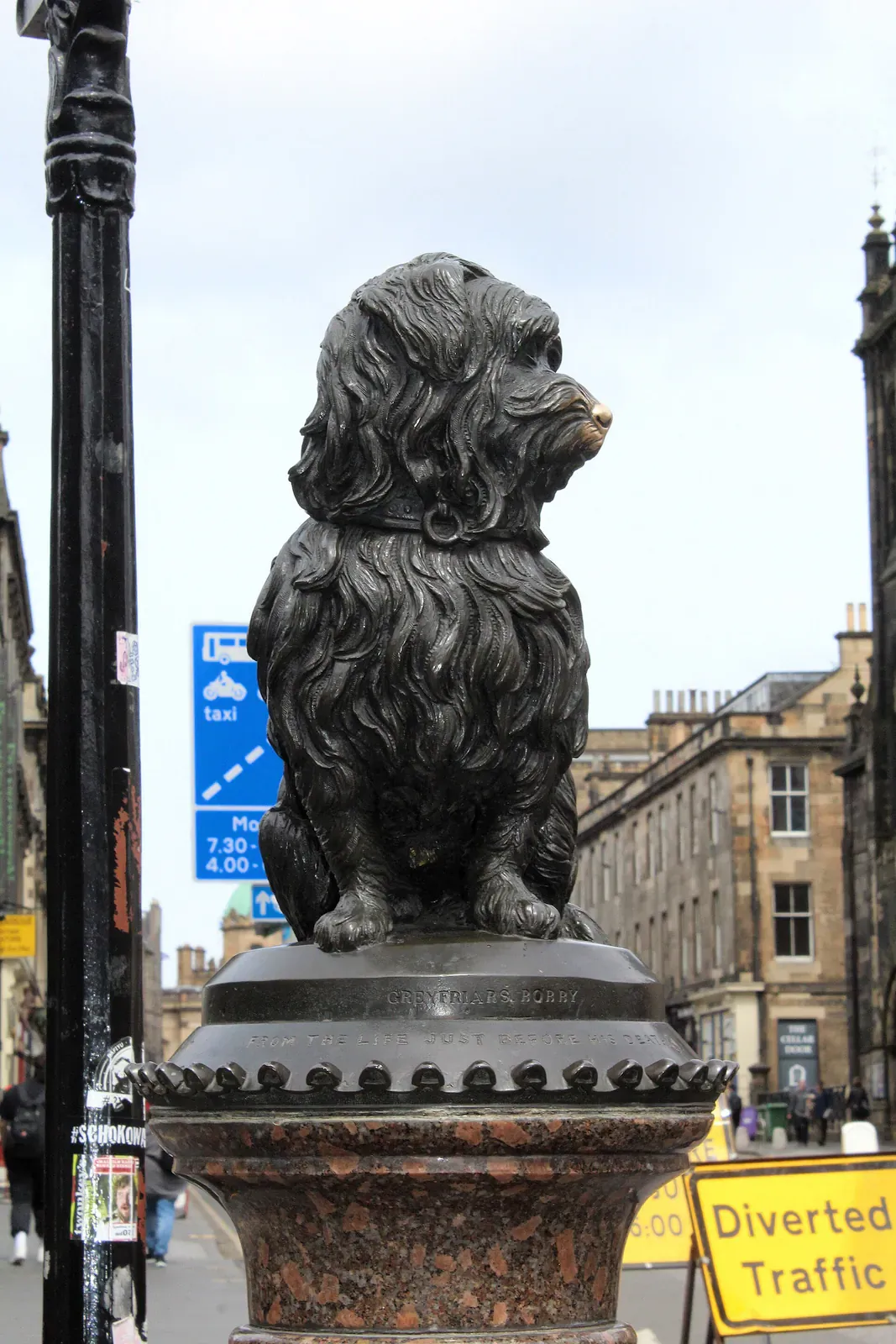
Greyfriars Bobby
Greyfriars Bobby is the most famous loyal dog in Britain. The story goes that a small terrier kept watch over the grave of his master for fourteen years.
What can be said is this. John Gray, known as "Auld Jock", moved to Edinburgh in 1850, worked as a night watchman and died of tuberculosis on 15 February 1858. He was buried in Greyfriars Kirkyard. Bobby, a Skye or Dandie Dinmont type of terrier, died on 14 January 1872. The "fourteen years" are reported, not independently proven.
In 1873 the philanthropist Baroness Burdett-Coutts, who was president of the Ladies' Committee of the RSPCA, asked for permission to put a statue of Bobby on a granite fountain. The sculptor William Brodie made it, and it was unveiled in November 1873 near the kirkyard. The statue is real. The dog is real. The question of how much of the daily vigil happened as told is part of the legend.
 Save
Hachiko
Hachiko, an Akita, is the best-known loyal dog in Japan. The widely told story is that he waited at Shibuya Station in Tokyo for his owner, a university professor, who died while at work and never came home. The waiting went on for roughly ten years, until the dog's death in 1935. A bronze statue of Hachiko was put up at the station while he was still alive. Treat the dates as the commonly told version. The core idea is the same as Bobby's: a dog who keeps a promise nobody asked him to make.
Barry and the Great St Bernard
Barry lived at the hospice on the Great St Bernard Pass in the Alps, the original home of the St. Bernard. He is credited with about forty rescues, but the figure is disputed because careful records were not kept. One source says the number grew over time from about fifteen in his lifetime to as many as seventy-five in later retellings.
Some myths about Barry are well known. The one about the little brandy barrel is actually a later invention. It goes back to a painting by Edwin Landseer from the 1820s or 1830s (sources differ), in which the cask was an added detail. The hospice chronicles do not mention barrels. The tale that Barry died on a rescue is also wrong. He died in Bern in 1814 of old age, and he is now mounted in the Natural History Museum in Bern.
This is a good example of how legends are made: a real dog, a real mountain pass, and then an artist, a newspaper and a hundred years of retelling.
Old Drum and "man's best friend"
Old Drum was a hound in Johnson County, Missouri. He was shot in late 1869 by a neighbour of his owner, Charles Burden, who mistook him for an animal that was killing sheep. Burden took the neighbour to court. His lawyer George Graham Vest gave a closing speech about the loyalty of dogs that was reported across the country and gave the phrase "man's best friend" much of its fame.
The facts: the court case was real and Burden won a small sum, which the Missouri Supreme Court upheld. Only part of the speech survives. A bronze statue of Old Drum stands in Warrensburg, and Missouri has named him its historical dog. A case in a small county court turned a single hound into a national symbol.
 GuideHow to adopt a dog from a shelter or rescueHow to adopt a dog from a shelter or rescue: the process, costs in general terms, choosing a dog, the first weeks and what if it does not work out.GuideBest dog breeds for familiesBest dog breeds for families, small homes, allergies, first-time owners and seniors, ranked from our breed ratings, with honest limits and a table.
Why dogs play these roles
Why do dogs appear in so many tales? Folklorists and historians give a few answers, and the stories themselves point to them.
 ArticleDog Breed Family Tree: How All Dog Breeds Are RelatedThe dog breed family tree from Ice Age wolves to 29 breed families.
- Loyalty. A dog that stays with a person after death, like Bobby or Hachiko, is the opposite of the human world's broken promises. It is a story about devotion that does not need a reward.
- Guarding thresholds. A dog lives at the door, so folk tales put dogs at gates, caves and vaults. Andersen's three dogs and the black dogs at crossroads come from the same habit.
- Omens. A dog hears and smells what people cannot. Many cultures read a howl or a sudden shape on the road as a warning.
- The wronged helper. The faithful hound killed by mistake (Guinefort, Gelert) shows up in many languages. Such stories teach people not to judge in anger.
- Ancestor and trickster. In some cultures, like Panhu's, the dog is a founder. In others it is a greedy or cunning figure, as in the fables.
These roles are rooted in what dogs really do: guard, warn, follow and stay. People watched the real animal for ten thousand years and then built stories on top of it. For a look at what dogs mean in the oldest religions, see dogs in myth.
 GuideHow to calm a reactive dogHow to calm a reactive dog: why dogs bark and lunge, what to do in the moment, a step-by-step training plan, what to avoid and when to get help.ArticleDog Breed Family Tree: How All Dog Breeds Are RelatedThe dog breed family tree from Ice Age wolves to 29 breed families.
FAQ
What is Black Shuck?
Black Shuck is a huge black dog of East Anglian folklore, often said to have glowing eyes. The best-known story is the 1577 storm at Blythburgh and Bungay churches in Suffolk. The storm is documented. The dog is legend.
Is the story of Greyfriars Bobby true?
Part of it. John Gray died in 1858 and was buried at Greyfriars. A terrier named Bobby died in 1872, and a statue was unveiled in 1873. How long Bobby kept his vigil, and how exactly, comes from retelling.
Was Saint Guinefort a real dog?
The dog is a legend, based on a story told across the world. The cult is historical: a Dominican friar recorded it in about 1250, and Jean-Claude Schmitt studied it in 1983.
Did St. Bernards really carry brandy barrels?
No. The barrel comes from a painting, not from the hospice records. Barry was a real dog who is credited with rescues, but the number is disputed.
Which fairy tale has dogs with huge eyes?
Hans Christian Andersen's "The Tinderbox". Its three dogs have eyes like teacups, mill wheels and a round tower.
Who said "man's best friend"?
The phrase is linked to the lawyer George Graham Vest, in a Missouri trial over the shooting of a hound named Old Drum.
Are Hachiko and Greyfriars Bobby the same kind of story?
They are similar: a loyal dog and a grieving vigil. Both are about real dogs with statues, but both have been shaped by retelling.
Read next
 Family storyAlpineRead the family's story: origins, members, DNA
 Family storyNew WorldRead the family's story: origins, members, DNA
 GuideDogs in science and spaceSpace dogs Laika, Belka and Strelka, Pavlov's dogs, Snuppy the clone, the dog genome and scent detection: what dogs did for science, and what it cost them.
Sources (8)
- Abraham Fleming, A Straunge and Terrible Wunder (pamphlet, 1577), as described in accounts of the Black Shuck legend; Christopher Reeve (1988) on Fleming and Bungay.
- Jean-Claude Schmitt, The Holy Greyhound: Guinefort, Healer of Children Since the Thirteenth Century (Cambridge University Press, 1983); Stephen of Bourbon's account of about 1250; review in the New York Review of Books (1981).
- Gan Bao, Soushen ji, as discussed in reference articles on Panhu and dogs in Chinese mythology.
- Hans Christian Andersen, "The Tinderbox" (1835), English translations and reviews.
- Retellings of "Hanasaka Jiisan" published by Nippon.com and the Japan Society (UK).
- Reference and history articles on Greyfriars Bobby (Wikipedia, Historic UK, History Hit).
- Articles on Barry and the Great St Bernard Hospice (AKC, Swiss Post, Irish Times, Swissinfo).
- Articles on Old Drum and George Graham Vest (the Clio, Missouri Secretary of State, Visit Missouri).