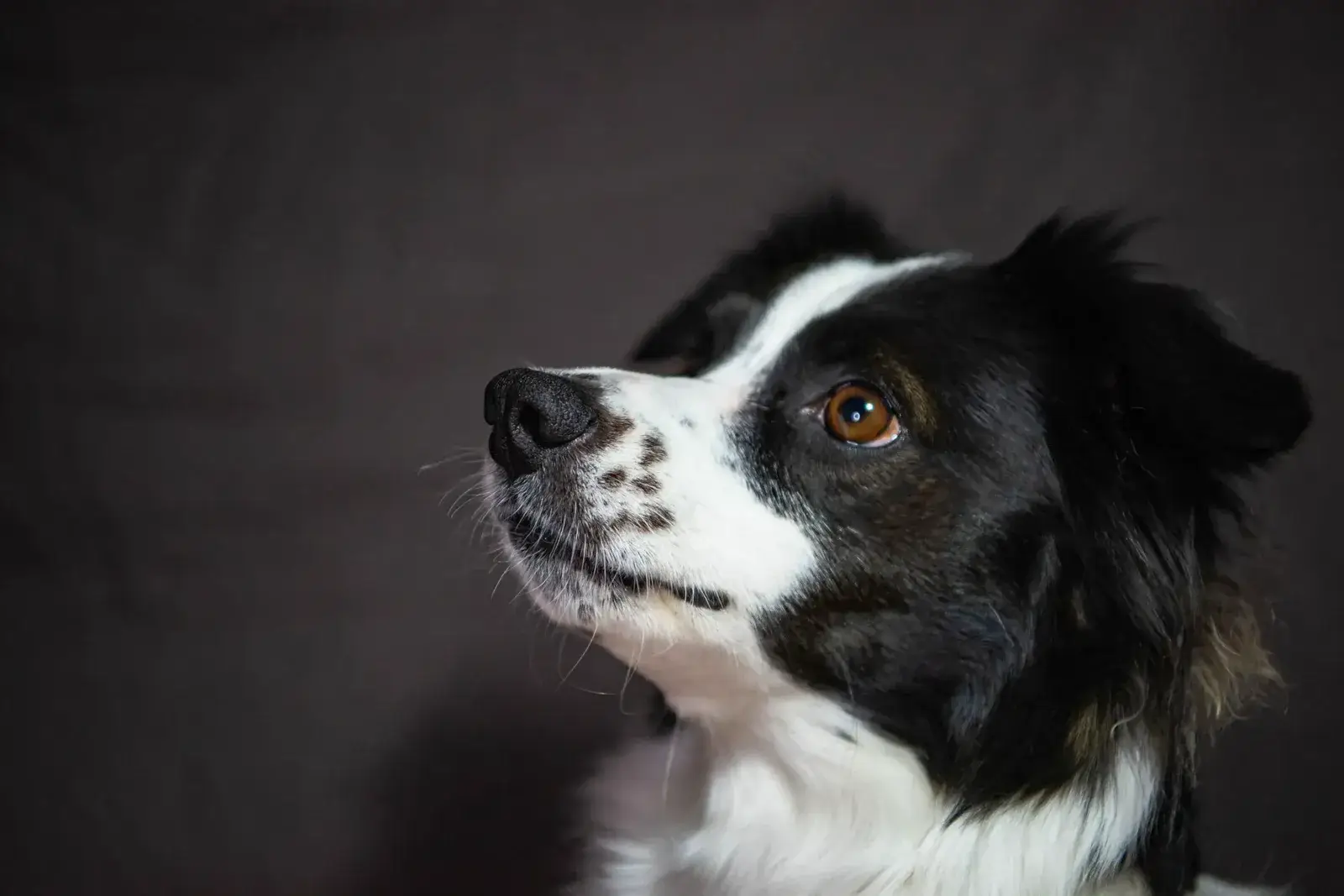
That list comes from psychologist Stanley Coren's 1994 book The Intelligence of Dogs, and it ranks breeds by how fast and how reliably they learn and obey commands, as judged by obedience judges. It does not measure general brainpower, problem solving or social skill, and newer research suggests the breed label explains only a small part of how an individual dog thinks.
This guide covers the Coren ranking and its top ten, how the survey was done and where it falls short, the three kinds of dog intelligence, what modern cognition studies have found, and why a very smart dog is often a harder dog to live with. It ends with a few simple home games, labelled as games, not science.
The Coren ranking
Stanley Coren, a psychologist at the University of British Columbia, published The Intelligence of Dogs in 1994. He asked obedience judges from the American Kennel Club and the Canadian Kennel Club to rate breeds on working and obedience performance. About 200 judges answered (199 in the figure most often cited), roughly half of the judges then working in North America. Breeds were ranked only when enough judges had seen enough dogs of that breed.
 GuideWinter Care for Dogs: Cold, Paws, Antifreeze and IceWinter care for dogs: how cold is too cold, coats, salt and antifreeze, hypothermia, frostbite, frozen ponds, dark walks and holiday hazards.
Coren grouped the breeds into classes. In his description, dogs in the top class understood a new command in fewer than 5 repetitions and obeyed a first command 95 percent of the time or better. Dogs at the bottom needed 80 to 100 repetitions to learn a new command and obeyed a first command about one time in four. These figures are Coren's summary of the judges' impressions, not results from a timed experiment.
 GuideDog Breeds by Country: Which Nations Made the Most?Dog breeds by country: how many breeds each nation produced in the Dogs Atlas data, from the UK and France to Japan, plus national dogs and families.GuideWinter Care for Dogs: Cold, Paws, Antifreeze and IceWinter care for dogs: how cold is too cold, coats, salt and antifreeze, hypothermia, frostbite, frozen ponds, dark walks and holiday hazards.
The top ten
The usual top ten from the survey runs as follows.
 ArticleThe first known dog on every continentEarliest accepted dog on each continent, from Bonn-Oberkassel to the dingo: dates, sites, how dogs arrived and which breeds carry those first dogs.
| Rank | Breed | What it was bred to do |
|---|---|---|
| 1 | Border Collie | Herding sheep |
| 2 | Poodle | Retrieving water birds |
| 3 | German Shepherd | Herding and guarding |
| 4 | Golden Retriever | Retrieving game |
| 5 | Dobermann | Personal protection |
| 6 | Shetland Sheepdog | Herding and farm work |
| 7 | Labrador Retriever | Retrieving game |
| 8 | Papillon | Lap and companion dog |
| 9 | Rottweiler | Driving cattle, guarding |
| 10 | Australian Cattle Dog | Droving cattle |
At the other end of the list, the Afghan Hound is placed in the lowest tier, with most judges rating it among the least responsive to obedience work. Many sighthounds, hounds and primitive breeds sit in the lower half, along with many toy breeds. Our Afghan Hound, Basenji and Chihuahua articles describe how these dogs behave at home, which often looks quite different from their place on the list.
A pattern shows in the table. Almost every top breed was shaped by a job in which a person gave directions at a distance: herding, retrieving, guarding on command. A dog that has been bred for generations to watch a human and respond will do well in an obedience ring. A dog that was bred to hunt alone and make its own decisions will not, however capable it is.
 GuideDogs of Japan: the native breeds and their storiesJapanese dog breeds explained: the six Nihon Ken, the Chin, Tosa, Japanese Spitz and Terrier, Hachiko, wartime near-extinction, DNA and who they suit.ArticleThe first known dog on every continentEarliest accepted dog on each continent, from Bonn-Oberkassel to the dingo: dates, sites, how dogs arrived and which breeds carry those first dogs.
What the ranking measures, and its limits
Coren was open about the fact that his ranking covers only one of three kinds of intelligence (see below). Even for that one, there are limits worth knowing.
 GuideDogs in myth around the worldFrom Anubis and Cerberus to Fenrir, Xolotl and the Tiangou: how cultures across the world imagined dogs as guardians, guides and monsters.
It is opinion, not a test. The ranking is built from judges' impressions. Judges see dogs in the obedience ring, where a certain type of dog is overrepresented. A breed that is rarely trained for obedience is rated from a few dogs, and those dogs may not be typical.
It measures cooperation as much as thinking. A dog that ignores a command is not necessarily slow. It may have decided that the treat on offer is not worth it, or that the human is not worth listening to. Independent breeds look dull in a system that rewards eagerness to please.
It is a population average. A breed rank says nothing certain about the Poodle asleep on your sofa. Within every breed, individual dogs vary a lot.
It depends on the body. A Basset Hound cannot jump a hurdle and a Pug struggles to breathe through a long scent search. Physical limits lower a breed's score in tasks that have nothing to do with thought.
It is old. The data are from the early 1990s and the survey has not been repeated at the same scale. Breed populations have changed since, and the breed popularity lists have moved.
Our own breed articles use the ranking in the same careful way. For example, the Poodle article notes that the result fits the breed's long record in obedience, agility and service work, and the Chihuahua article points out that a lower-half rank for toy breeds describes how fast they learn commands, not how well they remember people and routines.
 GuideLivestock guardian dogs: what they do and who they suitWhat livestock guardian dogs do, how they differ from herding dogs, 40 LGD breeds by country, the DNA evidence, and whether they make good pets.GuideDogs in myth around the worldFrom Anubis and Cerberus to Fenrir, Xolotl and the Tiangou: how cultures across the world imagined dogs as guardians, guides and monsters.
Three kinds of dog intelligence
Coren described three types of dog intelligence. The framework is easy to remember, and it helps to read any "smartest breeds" list.
 GuideDogs in Legends and Fairy TalesDogs in folklore and fairy tales: Black Shuck, The Tinderbox, Saint Guinefort, Panhu, Greyfriars Bobby, Barry and Old Drum, with legend and history kept apart.
Instinctive intelligence is the ability to do what the breed was made for. A herding dog gathers sheep, a pointer freezes at the scent of a bird, a livestock guardian stays with the flock. Nobody taught the dog how, and a dog that performs well at its task is clever in that sense, whatever a book says about obedience. Our guide to livestock guardian dogs shows breeds that do very well here and poorly in an obedience ring.
Adaptive intelligence is the ability to solve problems alone: opening a latch, finding a way around a fence, learning from experience which person has treats. This is the type most owners notice in daily life. It is also the type that gets dogs into trouble, because a dog that can solve problems will solve the problem of a closed bin.
Working and obedience intelligence is the ability to learn from people. This is the one measured in the Coren ranking.
A breed can be strong in one type and weak in another. A Beagle is a strong scent worker (instinctive) and a creative food thief (adaptive), yet it ranks low for obedience. The ranking treats all that as one low number.
 GuideBest dog breeds for familiesBest dog breeds for families, small homes, allergies, first-time owners and seniors, ranked from our breed ratings, with honest limits and a table.GuideDogs in Legends and Fairy TalesDogs in folklore and fairy tales: Black Shuck, The Tinderbox, Saint Guinefort, Panhu, Greyfriars Bobby, Barry and Old Drum, with legend and history kept apart.
What newer research says
Since 1994 the study of dog cognition has become a field of its own. Labs in Budapest, Vienna, Duke University, Arizona and elsewhere test dogs under controlled conditions. A few findings are useful here.
 GuideDog Grooming Competitions and Show Standards ExplainedHow breed standards shape dog grooming, from hand-stripped terriers to Poodle show clips, and how grooming competitions and creative grooming work.
Breed explains only a small part
In 2022 Kathleen Morrill and colleagues, working with the Karlsson lab at the Broad Institute and UMass Chan, published a study in Science that combined owner surveys on 18,385 purebred and mixed-breed dogs with genotyping of 2,155 dogs. Behaviour traits were moderately to highly heritable, but breed explained only about 9 percent of the variation in behaviour between individual dogs. For traits connected to trainability (biddability), breed gave somewhat better predictions than for other traits. In plain words, breed is a hint about how a dog is likely to behave, not a rule.
Breeds do differ on some mental traits
A 2020 study by Gitanjali Gnanadesikan, Brian Hare, Evan MacLean and colleagues combined citizen-science data from Dognition (1,654 dogs of 49 breeds) with breed genetic data. It found breed differences in inhibitory control, communication, memory and physical reasoning, and linked them to genes active in the brain. A companion paper in Animal Cognition in 2020 estimated that traits such as inhibitory control and communication with humans were among the most heritable across breeds. This fits the idea that people have bred dogs for attention to humans and for self-control, and that some lines carry more of both.
One factor or many?
In 2016 Rosalind Arden and Mark Adams tested 68 working Border Collies in Wales on a set of tasks that included detour problems, following a pointing hand and choosing between quantities. Dogs that did well on one task tended to do well on the others, and a general factor accounted for part of the variation. This is the dog version of the "g factor" known from human testing. The result applies to one breed on a short set of tasks. Hare's team, using Dognition data, argued instead for several separate abilities. The debate is not settled.
Word learners
Border Collies feature strongly in the best-known studies of word learning. Rico, a Border Collie studied by Juliane Kaminski, Josep Call and Julia Fischer (Science, 2004), knew the names of over 200 items and could infer the name of a new object by excluding the ones he already knew, a skill called fast mapping, and remembered it weeks later. Chaser, a Border Collie trained by John Pilley, was reported in 2011 (Pilley and Reid, Behavioural Processes) to know the names of 1,022 objects. Both are single dogs, and other scientists have questioned how far the results show true fast mapping, so these are best read as striking case studies, not as a breed average.
A broader test came from Claudia Fugazza and colleagues at Eötvös Loránd University in Budapest. Their 2021 paper in Scientific Reports reported that out of 40 dogs given three months of training, 7 learned toy names with exceptional speed, and they called such dogs gifted word learners. A 2023 follow-up in the same journal collected 41 such dogs from nine countries. Just over half (56 percent) were Border Collies, and the rest were other breeds, including some that are not working dogs. The talent seems to be rare, strongly tied to an intense interest in toys, and not exclusive to one breed.
Big team science
The ManyDogs project runs the same experiment in many labs at once, to avoid the single-lab problem of small samples. ManyDogs 1, published in 2023, tested whether dogs follow a human pointing gesture, using 455 dogs at 20 research sites. Dogs followed pointing above chance, but less for some pointing styles than earlier small studies had reported. The atlas lists breed differences as a future goal that needs large samples. For readers, the message is a healthy one: findings about "what dogs can do" get firmer when many labs repeat them.
 ArticleDog Breed Family Tree: How All Dog Breeds Are RelatedThe dog breed family tree from Ice Age wolves to 29 breed families.GuideDog Grooming Competitions and Show Standards ExplainedHow breed standards shape dog grooming, from hand-stripped terriers to Poodle show clips, and how grooming competitions and creative grooming work.
Smart is not always easy
A high-ranking breed is a good learner, and it is also a dog that gets bored. Dogs bred to work for hours with a person need a replacement for that job in a home.
 GuideMy Dog Keeps Shaking His Head: Ear Infection GuideDog shaking head, scratching ears or smelly ears? Ear infection signs, causes, ear haematoma, emergency signs, what to do and what to avoid.
- Time and work. A Border Collie, Australian Shepherd or Belgian Malinois needs daily exercise and a task, such as training sessions, nose work, agility or herding. Without it, many of these dogs find their own work: chasing cars and children, barking, digging or destroying furniture.
- Quick to learn the wrong thing. A dog that learns in 5 repetitions also learns in 5 repetitions that barking gets attention. Clear, calm, reward-based training matters more with a fast learner. Our guides on training basics and advanced training cover the methods.
- Problem solvers. Smart dogs open gates, unzip bags and watch which cupboard holds the treats.
- Sensitive. Many high-ranked herding and working breeds notice tone and mood closely. Harsh handling can make them anxious.
- Easy to train does not mean easy to own. The German Shepherd and the Dobermann learn fast and need an owner who can give them structure and activity. An independent breed such as the Siberian Husky or the Shiba Inu may suit a calmer owner better, even though it sits lower on the list, because its weaker eagerness to please comes with less drive to be busy every minute.
For an owner, the practical question is not "which breed is smartest" but "which kind of smart can I live with?" A smaller Poodle or Pembroke Welsh Corgi can be a good fit for an active family that enjoys training. A calmer retriever such as the Golden Retriever or Labrador Retriever is easy to train and generally less intense than a herding dog, though both need exercise and mental work.
 GuideHow to Groom a Dog: Brushing, Baths, Nails and CoatsHow to groom a dog at home: coat types, brushing, how often to bathe, cutting nails, ears, teeth, shedding, matting and whether to shave a double coat.GuideMy Dog Keeps Shaking His Head: Ear Infection GuideDog shaking head, scratching ears or smelly ears? Ear infection signs, causes, ear haematoma, emergency signs, what to do and what to avoid.
Smart dogs of other kinds
Several breeds rank in the middle or lower on the Coren list and still show clear intelligence of the other two kinds.
 GuideWhy does my dog do that? 15 common behavioursWhy does my dog lick me, stare, eat grass, spin, sigh or roll in smelly things? 15 everyday dog behaviours explained, with when to ask a vet.
- Scent hounds. A Beagle or a Bloodhound reads smells the way people read text. Detection work in airports and search and rescue relies on this ability.
- Sighthounds. The Greyhound, Saluki and Borzoi judge distance and speed to catch fast prey, and they pick up house routines quickly even though they are not eager to follow orders.
- Guardians. Livestock guardian dogs decide for themselves whom and what to guard. That is exactly the adaptive judgement their owners want.
- Primitive and spitz types. The Basenji is a clever problem solver that will happily outthink a gate.
Treating all of these as "less smart" because they ignored a command in a ring misses the point of what they were bred to do.
 GuideDog Clothes: When Dogs Need Coats, and a Short History of Dog FashionDo dogs need coats in winter? When clothes help, when costumes stress a dog, safe fit, reflective gear, and a short history of dog fashion and dog art.GuideWhy does my dog do that? 15 common behavioursWhy does my dog lick me, stare, eat grass, spin, sigh or roll in smelly things? 15 everyday dog behaviours explained, with when to ask a vet.
Simple tests to try at home
These are games, not scientific tests. They work best with a dog that is relaxed and likes treats, in short sessions, with a stop when the dog loses interest.
 GuideHow to adopt a dog from a shelter or rescueHow to adopt a dog from a shelter or rescue: the process, costs in general terms, choosing a dog, the first weeks and what if it does not work out.
- Hidden treat under a cup. Show a treat, cover it with one of three cups and shuffle nothing. If the dog goes to the right cup, repeat with a longer wait. This checks short-term memory.
- Towel on the head. Drape a light towel over the dog's head and see how long it takes to pull it off. This checks problem solving and patience.
- Detour. Hold a treat on the other side of a low wire fence or a baby gate with an open end. Does the dog press against the barrier or walk around it? Many dogs need practice before they solve it.
- New trick count. Count how many repetitions it takes to teach a simple trick, such as spin or touch a target, with rewards. Compare with a second trick a week later. Dogs usually get faster, which shows they are learning how to learn.
- Names of toys. Teach the names of two or three toys over a few weeks and ask for one by name from a pile. This is a home version of the word-learning studies, and most dogs will get a few names with patience.
None of these gives an IQ number. Any result also depends on the dog's mood, the treat and how you ran the game. The point is to enjoy watching how your own dog thinks.
 GuideIs your dog suited to therapy work?How to make your dog a therapy dog: temperament checklist, first training steps, how Pet Partners, TDI and Pets As Therapy assess dogs, and welfare limits.GuideHow to adopt a dog from a shelter or rescueHow to adopt a dog from a shelter or rescue: the process, costs in general terms, choosing a dog, the first weeks and what if it does not work out.
Where our breed articles fit
Our breed articles state each breed's Coren position only where it is known and explain what it means in daily life. The table below picks out the top-ten breeds we cover, plus two from the lower half for contrast, and what to read beside the rank.
 GuideDog hybrids: what dogs can and cannot breed withCan dogs breed with wolves, coyotes, jackals or foxes? Wolfdogs, coydogs, the Sulimov dog and Dogxim explained, with chromosomes and DNA studies.
| Breed | Coren position | What to read beside it |
|---|---|---|
| Border Collie | 1 | Needs a daily job; word-learning case studies |
| Poodle | 2 | Obedience, agility and service work |
| German Shepherd | 3 | Fast learner; needs structure and activity |
| Golden Retriever | 4 | Easy to train with rewards, good with people |
| Dobermann | 5 | Sensitive, bonded with its owner |
| Shetland Sheepdog | 6 | Alert and vocal; needs training |
| Labrador Retriever | 7 | Eager to please; food-driven |
| Rottweiler | 9 | Needs early training and socialisation |
| Australian Cattle Dog | 10 | High energy; needs work |
| Chihuahua | Lower half for toy breeds | Good memory for people and routines |
| Afghan Hound | Lowest tier | Independent sighthound, not slow |
 GuideHow to calm a reactive dogHow to calm a reactive dog: why dogs bark and lunge, what to do in the moment, a step-by-step training plan, what to avoid and when to get help.GuideDog hybrids: what dogs can and cannot breed withCan dogs breed with wolves, coyotes, jackals or foxes? Wolfdogs, coydogs, the Sulimov dog and Dogxim explained, with chromosomes and DNA studies.
FAQ
What is the smartest dog breed?
On Stanley Coren's 1994 working and obedience ranking, the Border Collie is first. That means it learns commands fastest and obeys most reliably in the opinion of obedience judges. Other studies show that individual dogs of many breeds can be exceptional.
Which dog breeds are the easiest to train?
The Coren top ten, including the Border Collie, Poodle, German Shepherd, Golden Retriever, Dobermann, Shetland Sheepdog and Labrador Retriever, are known for learning quickly and wanting to work with people. Easy to train is not the same as easy to own, because these dogs also need exercise and mental work.
Which dog breeds are the least intelligent?
No breed is dull. The Afghan Hound is placed lowest on the Coren list, but that reflects independence and an ability to work alone, which suit a hunting sighthound. Low obedience rank and low intelligence are different things.
Are mixed-breed dogs less smart than purebreds?
No study we use shows that. The 2022 Science study of 18,385 dogs, which included many mixed-breed dogs, found that breed explains only about 9 percent of the variation in behaviour. A mixed-breed dog can be as quick and as trainable as a purebred.
Is the Coren ranking still accurate?
It is an accurate record of what obedience judges reported in the early 1990s about obedience performance. It is not a general intelligence test, and it has not been repeated at the same scale.
Can a dog be too smart?
Yes, for the wrong home. A fast-learning dog without exercise, training or tasks often invents its own activities. Many owners of high-ranking breeds say the work of keeping the dog busy is the real cost of the intelligence.
How many words can a dog learn?
Most dogs learn a few dozen words and cues through daily life. The Border Collies Rico and Chaser were reported to know over 200 and 1,022 object names, but they are single, intensively trained dogs. A rare group of gifted word learners, studied in Budapest, can learn new toy names very fast.
Do puppies from smart parents turn out smart?
Some traits are heritable, including how well dogs respond to human signals and how they control impulses, according to a 2020 heritability study in Animal Cognition. Even so, a dog's upbringing, training and temperament shape the result. Breed is a starting point, not a promise.
Is there a dog IQ test?
There is no single accepted dog IQ test. Researchers use batteries of tasks, such as detour, memory and choice tasks, and different labs use different ones. Home games can be fun, but they are not scientific tests.
How can I keep a smart dog busy?
Short, regular training sessions, food puzzles, scent games, trick training and a job that suits the breed, such as nose work, agility or herding, all work. Our advanced training guide has ideas.
Read next
Family storyEuropean dogsRead the family's story: origins, members, DNA Family storyUK RuralRead the family's story: origins, members, DNA
 GuideDogs in science and spaceSpace dogs Laika, Belka and Strelka, Pavlov's dogs, Snuppy the clone, the dog genome and scent detection: what dogs did for science, and what it cost them.
Sources (12)
- Coren S. (1994). The Intelligence of Dogs. Free Press.
- Morrill K. and colleagues (2022). Ancestry-inclusive dog genomics challenges popular breed stereotypes. Science, 376.
- Gnanadesikan G.E., Hare B., Snyder-Mackler N., Call J., Kaminski J., Miklosi A. and MacLean E.L. (2020). Breed differences in dog cognition associated with brain-expressed genes and neurological functions. Integrative and Comparative Biology, 60(4).
- Gnanadesikan G.E., Hare B., Snyder-Mackler N. and MacLean E.L. (2020). Estimating the heritability of cognitive traits across dog breeds reveals highly heritable inhibitory control and communication factors. Animal Cognition, 23.
- Arden R. and Adams M.J. (2016). A general intelligence factor in dogs. Intelligence, 55, 79 to 85.
- Kaminski J., Call J. and Fischer J. (2004). Word learning in a domestic dog: evidence for fast mapping. Science, 304.
- Pilley J.W. and Reid A.K. (2011). Border collie comprehends object names as verbal referents. Behavioural Processes, 86.
- Griebel U. and Oller D.K. (2012). Vocabulary learning in a Yorkshire terrier: slow mapping of spoken words. PLoS ONE, 7(2).
- Fugazza C. and colleagues (2021). Word learning dogs (Canis familiaris) provide an animal model for studying exceptional performance. Scientific Reports, 11.
- Fugazza C. and colleagues (2023). Gifted word learner dogs: a citizen science study. Scientific Reports.
- ManyDogs Project (2023). ManyDogs 1: a multi-lab replication study of dogs' pointing comprehension. Animal Behavior and Cognition.
- Dogs Atlas breed articles: Border Collie, Poodle, Golden Retriever and Chihuahua.