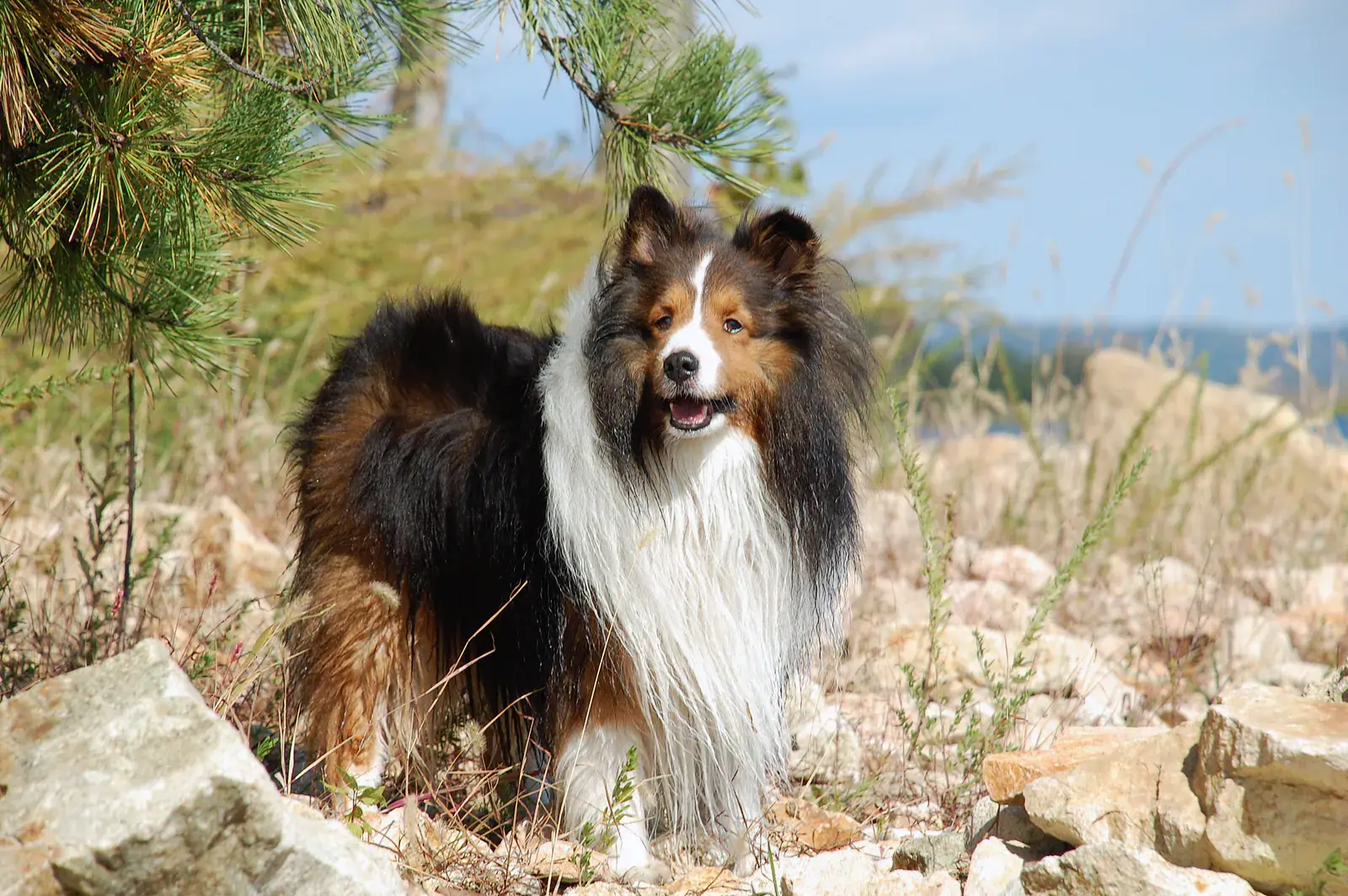
Crofters kept it to guard flocks and gardens, and breeders later added Rough Collie blood to set the look we know now. It is bright, gentle and eager to please, and also a talker, a shedder and a dog that wants a job. Typical lifespan is 12 to 14 years.
Quick facts
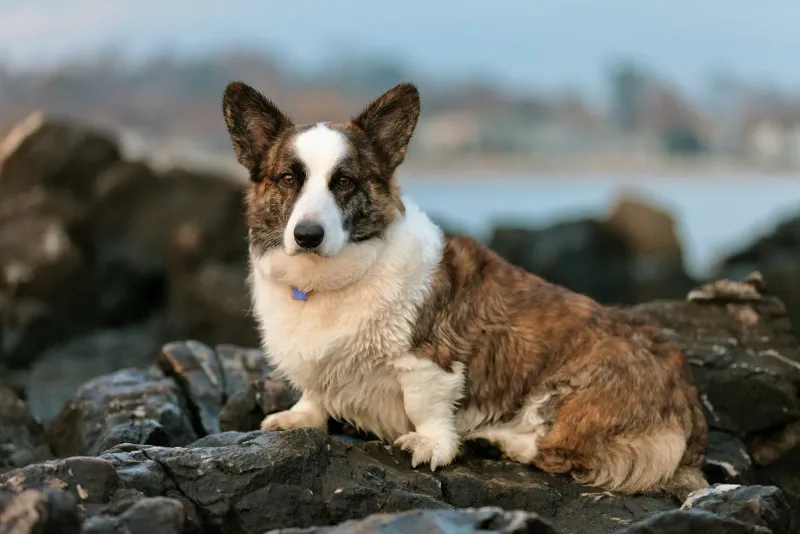 Related breedCardigan Welsh Corgi1200 to 1934 · United KingdomLate Middle Ages
- Other names
- Sheltie, Shetland Collie (old name)
- Origin
- Shetland Islands, Scotland, United Kingdom
- Type
- Herding dog
- Family (DNA clade)
- UK Rural
- Height
- 33 to 41 cm depending on club standard
- Typical weight
- About 7 to 11 kg
- Lifespan
- 12 to 14 years
- Coat
- Long double coat; , tricolour, blue
- Recognised by
- FCI (No. 88), AKC (Herding), UK Kennel Club
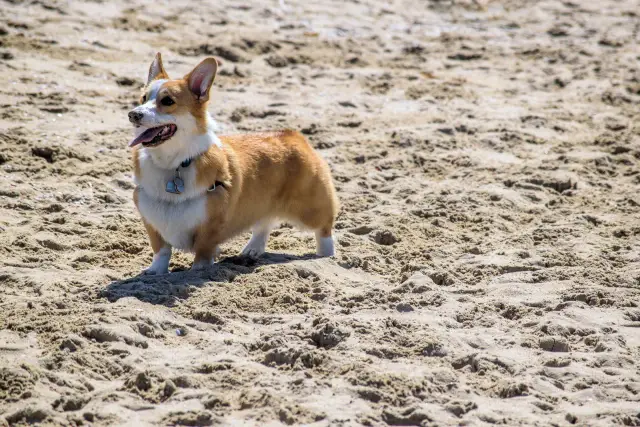
Drawn to scale in real centimetres. Its back reaches about 37 cm, just below your knee; its head about 47 cm, your knee.
Where it sits in the tree
Early Modern Era · 1600 to 1799
Name and origin
 Related breedBorder Collie1800 to 1915 · United KingdomIndustrial Revolution
The name is simple: "Shetland" for the islands, "Sheepdog" for the work. "Sheltie" is the affectionate short form and the name most owners use. An older name, "Shetland Collie", was dropped after a dispute described in the History section.
Competing accounts of the name: some say "Shetland Collie" was simply the first show name, picked because the dogs looked like small Collies. Others stress that the islanders never called them Collies and that the label was a show-ring invention. Both agree the Kennel Club later insisted on "Sheepdog".
Another old name is "Toonie dog". In Shetland a farm or township is a "toon", and the small farm dogs that guarded the crofts were called toonies. The word tells you what the dog was for: a working farm companion on a treeless, windy island, not a show dog.
The dog came from a place that shaped it. Shetland is known for small, tough animals, among them the Shetland pony and the Shetland sheep. The Sheltie fits that pattern of compact island livestock, bred small so it could live on little food and work on steep, rocky ground.

History
 Same eraNova Scotia Duck Tolling Retriever1860 to 1945 · CanadaVictorian Breed Boom
Crofters' dogs on the islands
Before the modern Sheltie there was a local island sheepdog, probably a small spitz type related to the dogs of Iceland and Scandinavia. Fishing and trading boats called at the islands from the 1700s, and the dogs on board mixed with the island stock. Accounts mention Scandinavian herding dogs, a now extinct dog called the Greenland Yakki, black and tan King Charles Spaniels and small working collies from the Scottish mainland. Which of these contributed, and how much, is uncertain, because nobody kept records. Treat the exact list as tradition, not proven fact.
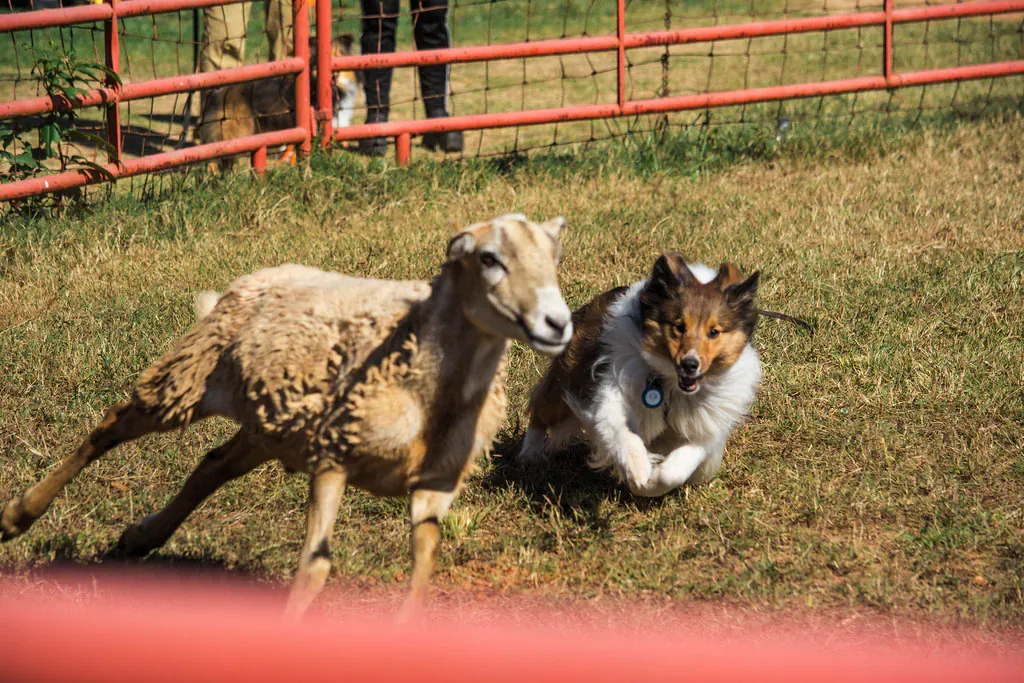
The islanders used the dogs to keep sheep, ponies and poultry away from the small patches of crop. Because grazing was thin, sheep were often kept off the arable land by a dog rather than a fence. A quiet, quick, watchful small dog suited that job. Many of the breed's traits date from this role: alertness, a ready bark to warn off trespassers and a habit of circling and nipping at the heels of moving animals.
Visiting traders also left their mark. One account says the island dogs were crossed with Papillons and Pomeranians owned by a trader. Another reports Pomeranian crosses early in the twentieth century. These are traditions with no behind them.
Collie crosses and the road to a breed
In the early 1900s the island dogs reached the show world. Visitors took puppies to the mainland, and breeders in Shetland and England began to fix a type. James Loggie, a Lerwick breeder, is linked in breed histories to the use of a small Rough Collie in the stock. Mainland breeders also crossed in more Rough Collie, and some accounts mention other breeds such as the Pomeranian. The aim was a "miniature Collie" with a good coat and a refined head. Records say crosses to the Rough Collie went on for decades, up to around the 1940s.
Clubs and the Kennel Club, 1908 to 1914
- 1908: the Shetland Collie Club formed in Lerwick, with James Loggie as first secretary, and wrote a . Loggie's kennel produced early winners: Lerwick Jarl at Crufts in 1910 and the bitch Zesta, a sensation in 1912.
- 1909: the Scottish Shetland Sheepdog Club formed on the mainland with its own stud book and standard. After Loggie left the scene, Charlie Tompson in Scotland carried the breed forward.
- 1909 or 1914: sources disagree on when the Kennel Club recognised the breed. Wikipedia and Purina give 1909 as "Shetland Collie". Other histories say recognition came in 1914, when the first breed standard was approved and the English Shetland Sheepdog Club formed. One source says the Kennel Club refused at first in 1909 and agreed later on condition of a new name; that would reconcile the dates, but no source states it outright.
- The name: Rough Collie breeders campaigned against sharing their breed's name, and the Kennel Club granted recognition on condition the breed be called the Shetland Sheepdog.
- 1911: Purina reports AKC registration under the name Shetland Sheepdog. This date rests on a single source.
- 1948: the present height of 14 in (about 35.5 cm) was agreed, after decades of arguments between a faction that wanted the traditional island dog and one that wanted a Rough Collie in miniature.
The breed was first brought to the United States in the early twentieth century and became very popular there, where it is a regular in the AKC Herding Group.
Relatives and DNA
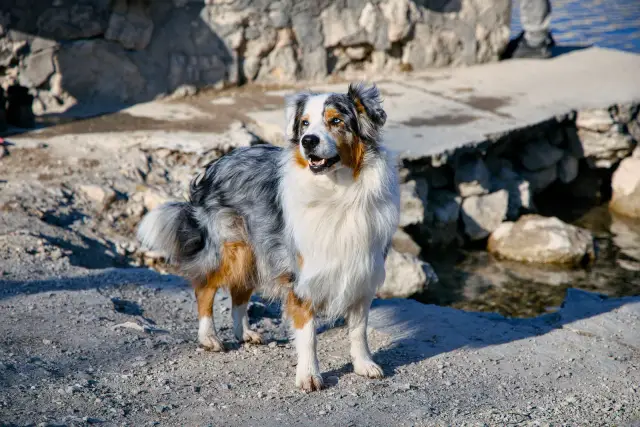
 Same familyAustralian Kelpie1870 to 1902 · AustraliaVictorian Breed Boom
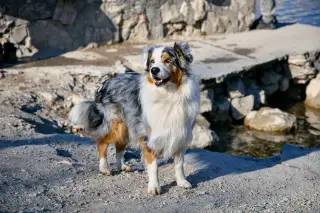
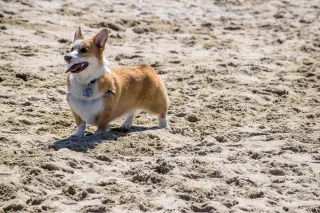
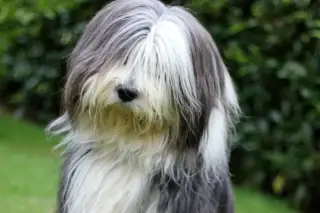
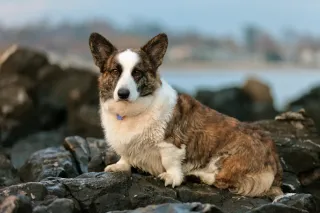
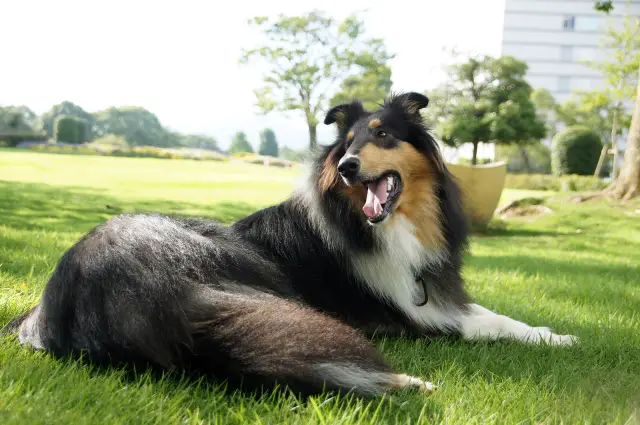
In the 2017 Parker et al. study of 161 breeds, the Shetland Sheepdog sits in the UK Rural , the group of British pastoral dogs. Its closest match by far is the Rough Collie, with about 252 of . Other shares are about 34 Mb with the Australian Shepherd, 31 Mb with the Pembroke Welsh Corgi, 31 Mb with the Bearded Collie, 30 Mb with the Cardigan Welsh Corgi and 28 Mb with the Border Collie. The Nova Scotia Duck Tolling Retriever shares about 21 Mb and is listed in our records as a descendant. In the same records the Rough Collie's own ancestry includes the Borzoi and Saluki, which is why long-legged sighthound blood sits far back in the Sheltie's tree. That fits the breed's history of Collie crosses. Much smaller matches are found with the Australian Shepherd, the Pembroke Welsh Corgi, the Bearded Collie, the Cardigan Welsh Corgi and the Border Collie.
So the popular summary "a miniature Collie" is not far from the truth in DNA terms, but the breed also has its own island roots. Sheltie and Rough Collie are cousins that share much of their genetic background and some health issues. They are not the same dog scaled down. The Sheltie is a distinct breed with its own breed standard and its own temperament.
The UK Rural family page shows how the Sheltie sits beside the Collies and Bearded Collie.
Descend from it · 1
- Rough Collie252.3 Mb 10.5%
- Australian Shepherd33.6 Mb 1.4%
- Pembroke Welsh Corgi31.3 Mb 1.3%
- Bearded Collie30.6 Mb 1.3%
- Cardigan Welsh Corgi29.5 Mb 1.2%
- Border Collie27.9 Mb 1.2%
- Nova Scotia Duck Tolling Retriever20.9 Mb 0.9%
- Australian Kelpie20.2 Mb 0.8%
- Chinook15.4 Mb 0.6%
- Old English Sheepdog14.7 Mb 0.6%
- Australian Cattle Dog11.7 Mb 0.5%
- Airedale Terrier11.0 Mb 0.5%
Source: Parker et al. 2017. Percent of the whole genome.
The breed standard
 Looks relatedOld English Sheepdog1700 to 1888 · United KingdomEarly Modern Era
A breed standard is the written ideal for a breed, the description that kennel club judges and breeders measure dogs against. The standards for the Sheltie agree on the overall picture: a small, long-haired, harmonious herding dog that looks like a Rough Collie in miniature.
| Trait | What the standards say |
|---|---|
| Height | FCI (No. 88) and UK KC: dogs 37 cm, bitches 35.5 cm, with more than 2.5 cm above or below highly undesirable; AKC: 13 to 16 in (33 to 41 cm) |
| Weight | FCI and UK KC: no fixed figure; AKC: no fixed figure, proportionate to height |
| Coat | FCI: long, straight, harsh outer coat with dense soft undercoat; AKC: long, straight and harsh, with mane and frill; UK KC: same, with mane and frill |
| Colours | FCI: sable, tricolour, blue merle, with white and/or tan marks; AKC: black, blue merle, sable, with white and/or tan marks; UK KC: tricolour, blue merle, sable (golden to mahogany), with white and/or tan marks |
| Head | FCI, AKC, UK KC: refined wedge, flat skull |
| Ears | FCI, AKC, UK KC: small, semi-erect, tips fall forward |
The UK Kennel Club and FCI describe the same ideal height, since Britain is the country of origin and wrote the standard. The AKC gives a range instead of one figure for each sex and asks that a dog above or below the range be disqualified, while the UK Kennel Club treats size deviation as a fault, not a disqualification. The practical point: pet Shelties vary in size, and many fall outside the show ideal without any problem.
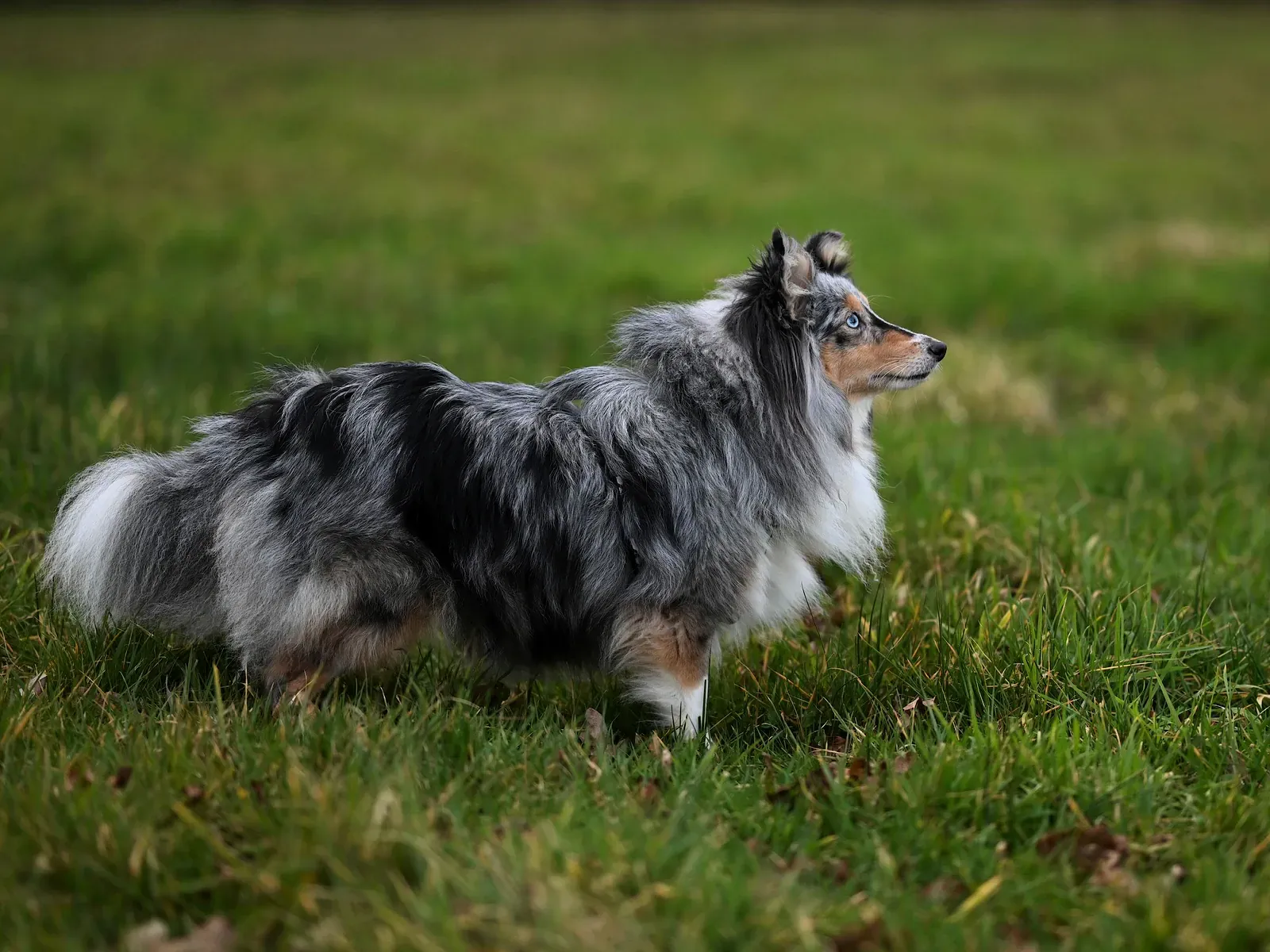
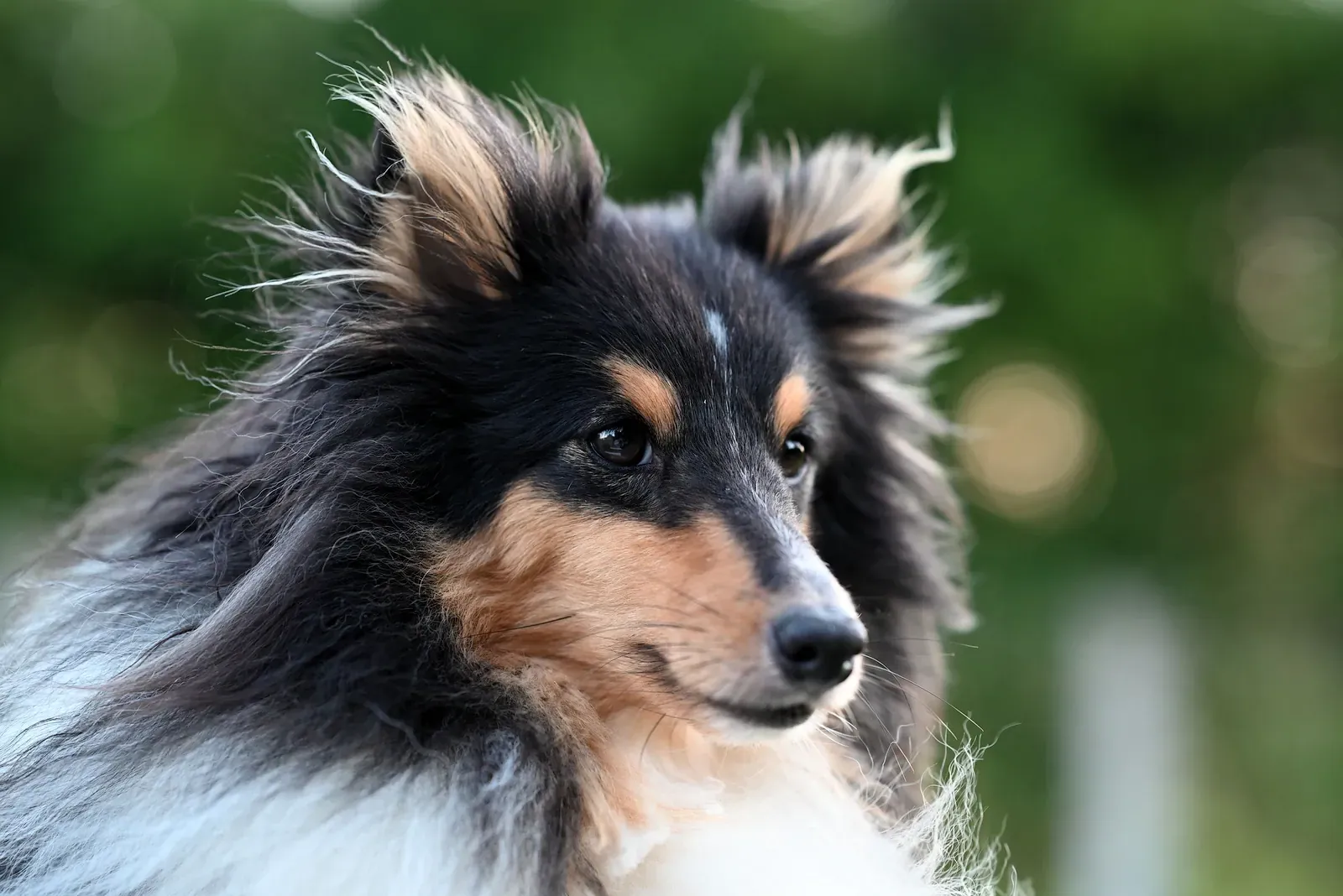
The breed standard colours cover sable (from pale gold to deep mahogany), tricolour (black with white and tan) and blue merle (silvery blue with black patches). Sable and white is the common sight. Blue merle dogs should be bred only to non-merle partners, because two merle parents can produce puppies with hearing and sight problems; this is general merle genetics rather than a Sheltie-only issue.
Temperament
 Related breedAustralian Cattle Dog1840 to 1903 · AustraliaIndustrial Revolution
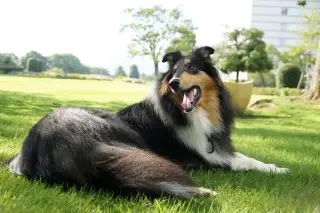
Shelties are bright, sensitive and attached to their people. They learn fast, and are widely seen at the top of obedience, agility and herding trials. They often do well in the same sports as Border Collies, with a gentler style. See the smartest dog breeds for how this breed compares with others on trainability.
Typical traits, as breed clubs describe them:
- Loyal and affectionate. They tend to bond closely with one family and may be reserved with strangers. The standard asks for a dog that is "reserved towards strangers", not aggressive or timid.
- Sensitive. Harsh words or loud household arguments can upset them. They respond best to calm, reward-based training.
- Vocal. Shelties bark. It is the herding and guarding heritage: they alert, they herd, they comment. A bored Sheltie will bark more. Teaching a "quiet" cue early and giving enough exercise and mental work helps.
- Herding instinct. Some will circle or nip at heels of children, other pets or even visitors. This is normal for a herding dog and can be guided with training.
- Eager to please. They aim to work with you, which makes training easy for most people.
Compared with the Rough Collie, a Sheltie is smaller, usually more energetic, more vocal and often quicker to react. Compared with a Border Collie it is usually less intense, though still more driven than many companion breeds.

Health
 Related breedAiredale Terrier1850 to 1880 · United KingdomVictorian Breed Boom
Most Shelties live long and healthy lives. Their median lifespan is among the longer ones for a pedigree dog of their size. The conditions below are the ones breeders screen for and owners can watch for. Knowing them is not a reason to worry, it is the reason good breeders test.
The VetCompass study at the Royal Veterinary College (O'Neill et al., 2013, "Longevity and mortality of owned dogs in England", 5,095 deaths among 102,609 dogs) reported an overall median longevity of 12.0 years across all dogs (interquartile range 8.9 to 14.2). The longest-lived breeds it names are the Miniature Poodle, Bearded Collie, Border Collie and Miniature Dachshund. No separate Shetland Sheepdog median is quoted from that paper. Breed sources put typical lifespan at 12 to 14 years.
The Kennel Club's owner surveys (2010: 15,881 deaths, median 11 years 3 months across breeds; 2018, Lewis et al.: 5,663 deaths, overall median 10.33 years) show how much breeds differ, from 12.71 years for the West Highland White Terrier to 7.67 for the Dobermann. Those surveys have breed tables the Kennel Club can supply on request; we have not quoted a Sheltie figure from them.
| Condition | What it is | How common | What helps |
|---|---|---|---|
| MDR1 drug sensitivity | A gene change (ABCB1-1 delta, also written MDR1) that lets some drugs build up in the brain; affected dogs may react badly to certain common medicines, such as ivermectin at high doses and some other drugs | In Neff et al. (2004, PNAS), 190 Shelties: about 1 in 90 had two copies and about 1 in 7 had one copy, so about 1 in 6 carried the change | DNA test; tell your vet the result; vets can choose other medicines |
| Collie eye anomaly (CEA) | An inherited difference in how the back of the eye forms, ranging from very mild to rare, more serious forms | Barnett (1979, Journal of Small Animal Practice) found it in over 4 in 10 of 120 Shelties in the Netherlands; surveys elsewhere found lower or higher figures, and the numbers have fallen where screening is used | DNA test for the NHEJ1 gene change; eye exam of puppies at 6 to 8 weeks; breeders choose matings to avoid affected puppies |
| Dermatomyositis | An inherited inflammatory skin and muscle condition seen in Shelties and Collies, with crusting on the face, ears and legs | Seen more often than in most breeds; no reliable prevalence figure is available | Ask breeders about family history; vet diagnosis and treatment |
| Thyroid disease | Under-active thyroid, which can bring weight gain, dull coat and lethargy | Seen in the breed; no named prevalence given here | Blood test; daily tablet if diagnosed |
| A loose hip joint that can cause stiffness | Seen in the breed, usually mild | Hip scoring of parents; healthy weight | |
| Progressive retinal atrophy | Gradual loss of the retina's light-sensing cells | Reported in the breed; uncommon | Eye tests for parents |
MDR1 in more detail
MDR1 matters because it is easy to test and easy to manage. Neff and colleagues traced the change to the early Collie line and found it in the breeds that descend from or mix with it, including the Sheltie. A dog with two copies is at highest risk of a bad reaction to certain medicines. Dogs with one copy are mostly safe but can pass the change on. Ask the breeder for the result, or test your own dog through a DNA kit, and tell any vet who treats the dog.
Collie eye anomaly in more detail
Many cases are mild and cause no problems in daily life. Because the DNA test exists, a responsible breeder knows whether their dogs are clear, or affected, and can avoid pairing two affected dogs. Eye checks by a specialist at about 6 to 8 weeks old are the standard way to grade the eyes.
Keep healthy weight, brush the coat to find skin changes early and book regular vet checks. That covers most of what a Sheltie owner can do.
 Ticks and fleasTicks and fleas on dogs: how to check, remove and prevent themTicks and fleas on dogs: how to tell them apart, check your dog, remove a tick safely, break the flea life cycle and prevent both.
 GuidesPractical guidesBehaviour, training, health and adoptionRelated breedAiredale Terrier1850 to 1880 · United KingdomVictorian Breed Boom
Living with a Shetland Sheepdog
 Related breedBorzoi1200 to 1650 · RussiaLate Middle Ages
| Area | Rating | Why |
|---|---|---|
| Exercise per day | Medium | Around an hour or more of walks, play and training; they like to keep busy |
| Training needs | High | Very trainable but need regular mental work |
| Grooming | High | Brush two or three times a week, daily in shedding season |
| Shedding | High | Heavy double coat, seasonal blowouts |
| Barking | High | Alert and vocal by nature |
| Time alone | Fair | Attached to people; can bark or fret if left long hours |
| Children | Good | Gentle with considerate children; may herd small, fast ones |
| Other dogs | Good | Usually friendly when well socialised |
| Cats and small pets | Varies | Herding urges can lead to chasing; depends on the dog |
| Flat living | Fair | Size fits, but barking may bother neighbours |
| Heat tolerance | Fair | Thick coat; take care in hot weather |
| Cold tolerance | Good | Island dog with a weatherproof coat |
| First-time owner | Good | Easy to train, but needs commitment to grooming and barking control |
A great fit if...
- You want a trainable dog for obedience, agility or herding games.
- You enjoy grooming and do not mind fur on the floor.
- You are home much of the day or can arrange company.
- You can teach a quiet cue calmly and patiently.
Think twice if...
- You need a silent dog, especially in a thin-walled flat.
- You are away for long hours every day.
- You want a dog that needs no brushing.
- Your home is loud and tense, since many Shelties are sensitive.
Before you get one
- Ask the breeder for MDR1 and Collie eye anomaly (NHEJ1) DNA results for both parents, plus eye examination certificates and hip scores.
- Breed rescues exist for Shelties, and adult dogs can settle well. An adult may already know house manners and its temperament is visible.
- First year: socialisation classes, short training sessions, and early grooming practice so brushing feels normal.
Similar breeds to consider
- Rough Collie: the larger, calmer cousin with a similar coat.
- Border Collie: more intense and working driven, for active sporty homes.
- American Eskimo Dog: small, fluffy and alert, with a different heritage.
- Icelandic Sheepdog: spitz type herder that echoes the old island dogs.

Fun facts
 Related breedGreyhound800 CE to 1850 · United KingdomEarly Middle Ages
- The name "Toonie dog" comes from the Shetland word "toon" for a farm.
- The breed's first Kennel Club name, Shetland Collie, lasted only a few years because Rough Collie breeders objected.
- A Sheltie's alert bark was useful on a farm with no fences; today it also works as a doorbell.
- The Shetland Collie Club of 1908 started in Lerwick, and its first secretary James Loggie bred Lerwick Jarl, a Crufts winner in 1910.
- The breed's height of 14 in (about 35.5 cm) was only settled in 1948.
FAQ
Is a Shetland Sheepdog the same as a small Collie?
No. They are related, and the Rough Collie shaped the modern Sheltie, but the Sheltie has its own island ancestry, its own standard and a more energetic, more vocal temperament.
How long do Shetland Sheepdogs live?
Typically 12 to 14 years. The study by O'Neill and colleagues (2013) found an overall median of 12.0 years across all dogs; a breed-specific Sheltie figure was not confirmed.
Do Shelties bark a lot?
Yes, most do. The breed was used to warn and herd, so barking comes naturally. Exercise, training and a "quiet" cue reduce it, but they rarely become silent dogs.
Are Shelties good with children?
Generally yes, with older considerate children and supervised play. Some herd small, quick children by circling or nipping, so teach the dog and the child how to behave together.
When was the Sheltie recognised?
Sources differ. The UK Kennel Club date is given as 1909 by Wikipedia and Purina, while other histories place recognition in 1914. Purina reports registration in 1911. See History for the labelled dates.
How tall is a Sheltie?
The and UK Kennel Club ideal is 37 cm for dogs and 35.5 cm for bitches. The AKC range is 13 to 16 in (33 to 41 cm).
What is MDR1 and should I test my Sheltie?
MDR1 is a gene change that makes some dogs sensitive to certain drugs. In Neff et al. (2004), about 1 in 6 Shelties sampled carried it. A DNA test is simple and helps your vet choose safe medicines.
Read next
 Closest DNARough Collie252.3 Mb shared
 FamilyUK RuralThe whole family
 Adopt a dogDog Shelters in EuropeFind dog shelters in Europe, learn how shelters differ from country to country and why adopting a dog is a good option.
Sources (13)
- The Kennel Club (UK), Shetland Sheepdog breed standard and breed information.
- FCI Standard No. 88, Shetland Sheepdog.
- American Kennel Club, Official Standard of the Shetland Sheepdog.
- O'Neill DG et al. (2013). Longevity and mortality of owned dogs in England. The Veterinary Journal.
- Neff MW et al. (2004). Breed distribution and history of canine mdr1-1delta, a pharmacogenetic mutation that marks the emergence of breeds from the collie lineage. PNAS.
- Barnett KC (1979). Collie eye anomaly in the Shetland Sheepdog in The Netherlands. Journal of Small Animal Practice.
- Parker HG et al. (2017). Genomic analyses reveal the influence of geographic origin, migration, and hybridization on modern dog breed development. Cell Reports.
- Fogle B (2009). The New Encyclopedia of the Dog.
- Lewis T.W. et al., "Longevity and mortality in Kennel Club registered dog breeds in the UK in 2014", Canine Genetics and Epidemiology, 2018.
- Kennel Club (UK) 2010 purebred dog health survey, Journal of Small Animal Practice.
- Showsight Magazine, Shetland Sheepdog history.
- Shetland history archive, biography of James Loggie.
- Purina and Wikipedia, Shetland Sheepdog history overviews.