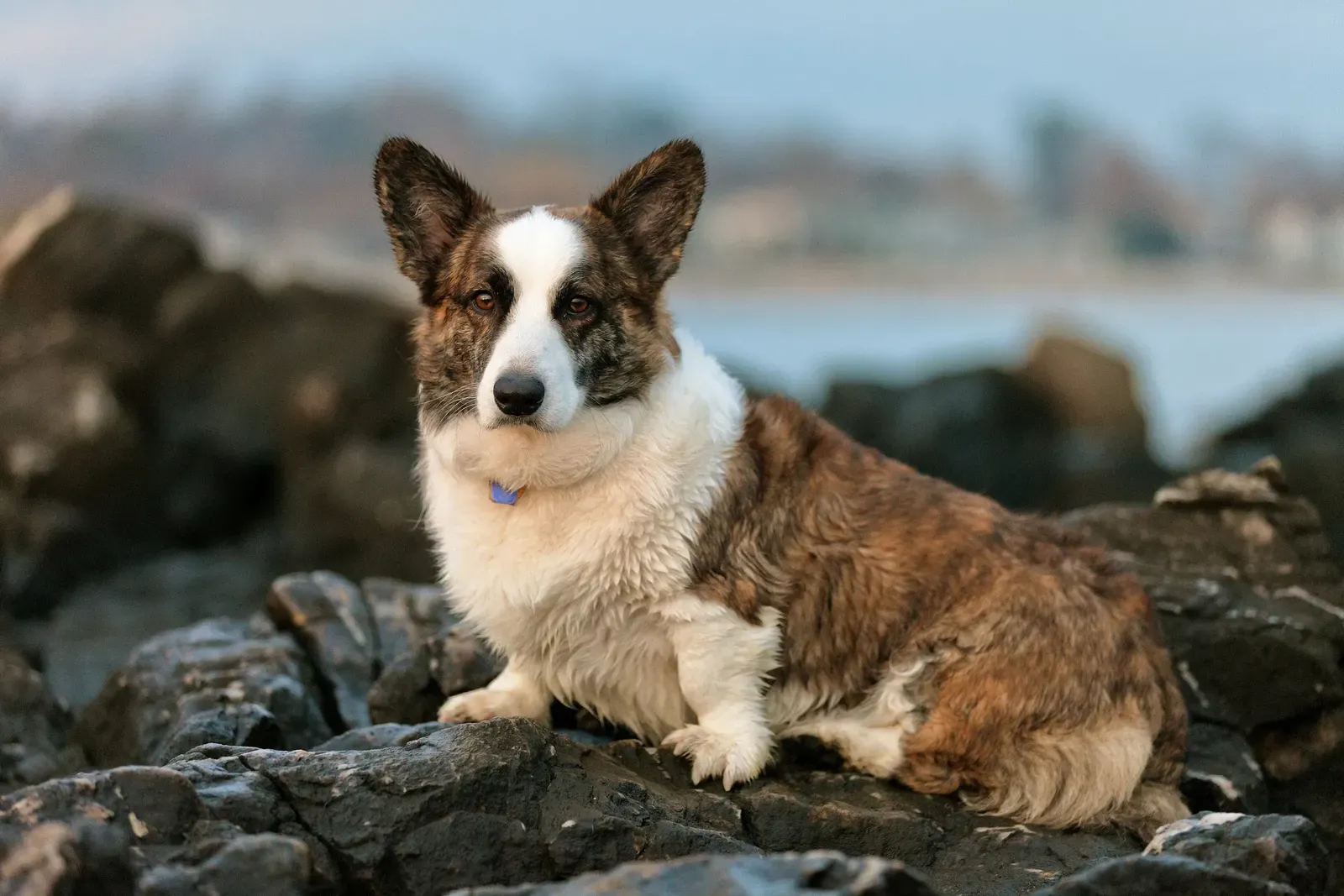
It stands about 30 cm tall, weighs roughly 11 to 17 kg and typically lives 12 to 15 years. Its best-known features are a long fox-like tail, big upright ears and, in some dogs, blue merle colouring. It was shown as one breed with the Pembroke Welsh Corgi until 1934. The Cardigan suits active owners who want a sturdy, thinking farm dog in a small body, and who will protect its back.
Cardigan Welsh Corgi quick facts
 Related breedAustralian Kelpie1870 to 1902 · AustraliaVictorian Breed Boom
- Closest DNA relatives
- Pembroke Welsh Corgi, Rough Collie, Shetland Sheepdog
- Country of origin
- United Kingdom (Cardiganshire, Wales, Great Britain)
- Period of development
- About 1200 to 1934 (atlas data, medium confidence); recognised as a separate breed in 1934
- Group
- Group 1 (Sheepdogs and Cattledogs), standard no. 38; AKC Herding Group; UK Kennel Club Pastoral Group
- Height
- Kennel Club: ideal 30 cm at the shoulder. AKC: 10.5 to 12.5 inches (about 27 to 32 cm)
- Weight
- AKC page: dogs 30 to 38 pounds (about 14 to 17 kg), bitches 25 to 34 pounds (about 11 to 15 kg). The Kennel Club gives no figure
- Coat
- Short or medium, hard, weatherproof, with a good undercoat
- Colours
- Blue merle, brindle, red, , tricolour with brindle points, tricolour with red points (Kennel Club)
- Tail
- Long, fox-like brush, never docked in the standard
- Life span
- Atlas data and AKC: 12 to 15 years
- Other names
- Cardigan, Cardi, Welsh Corgi (Cardigan)
- DNA family
- UK Rural (Parker et al. 2017)
- Descendant breed
- Lancashire Heeler (atlas data)
Drawn to scale in real centimetres. Its back reaches about 30 cm, your shin; its head about 37 cm, just below your knee.
Where it sits in the tree
Late Middle Ages · 1200 to 1499
Name and origin
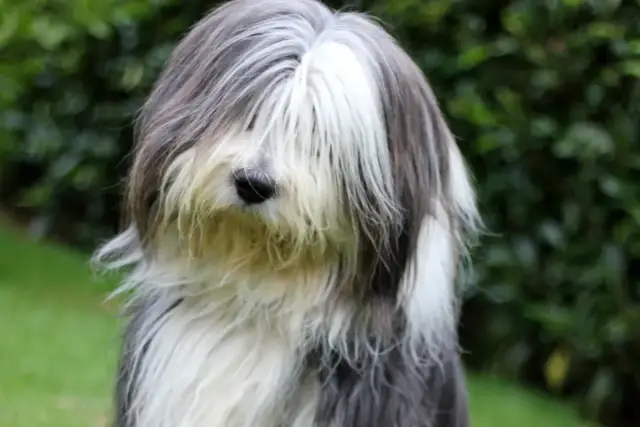 Related breedBearded Collie1500 to 1944 · United KingdomAge of Exploration
"Cardigan" is the Welsh county of Cardiganshire (today Ceredigion), where the breed was kept. "Corgi" is Welsh, from cor, "dwarf", and ci, "dog". The official FCI name is Welsh Corgi (Cardigan), and in Spanish and German it is Corgi Cardigan and Welsh Corgi Cardigan.
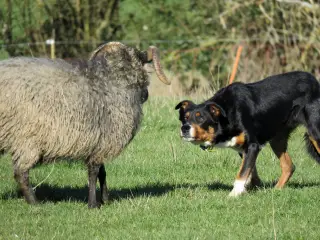
Short, low dogs have worked cattle in Wales for centuries. They moved cows along lanes and onto common grazing land and nipped at the heels, then dropped out of range of a kick. A dog under 35 cm high passes under a hoof, and a long tail did not matter because nobody was showing the dog. The same farm jobs shaped the Pembroke, and the two breeds are close relatives.
The AKC says the Cardigan came to Cardiganshire with Celtic settlers from Central Europe around 1200 BC, which is where the atlas start date of about 1200 comes from. This is a popular claim, and no independent record backs it. Treat it as legend: the breed is old in Wales, but nobody can name the year.

History
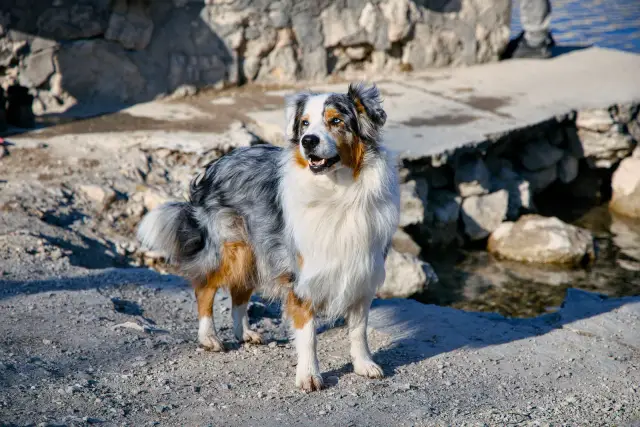 Same eraAustralian Shepherd1840 to 1957 · United StatesIndustrial Revolution
Farm dogs of Cardiganshire
For most of its history the Cardigan was a working cattle dog on small Welsh farms, owned by people who cared about what the dog could do, not what it looked like. There was no studbook, no standard and no show. Because it was rural and little documented, the early history rests on traditional accounts.
One breed becomes two
In the 1920s the corgis of Wales began to be shown. The Welsh Corgi Club was founded in December 1925 in Carmarthen, and Cardigan fans formed their own club a year later. Cardigans and Pembrokes were judged together as "Welsh Corgis" for years, even though breeders already treated them as different. Dogs of both types were interbred, and writers have long suggested that some Pembroke blood entered Cardigan lines in that period. The atlas data does not settle how much.
In 1934 the UK Kennel Club recognised each as its own breed. The first registers listed about 240 Pembrokes and 59 Cardigans, a figure from secondary histories. That small start explains why the Cardigan stayed the rarer corgi.
Recognition in the United States
The first pair of Cardigans reached the United States in 1931, imported by Mrs. B. P. Bole. The AKC recognised the Cardigan in 1935. Sources differ on whether the national breed club was founded the same year or got AKC member status that year, so the exact club date is not settled. The AKC places the Cardigan in the Herding Group, and its breed page currently ranks it 60th of 210 breeds in popularity.
The rarer corgi in Britain
The Pembroke made the headlines because it was the royal family's dog. The Cardigan stayed in the background, and it has appeared among the Kennel Club's Vulnerable Native Breeds, the list of breeds with 300 or fewer UK puppy registrations a year.
Cardigan vs Pembroke: how the two corgis differ
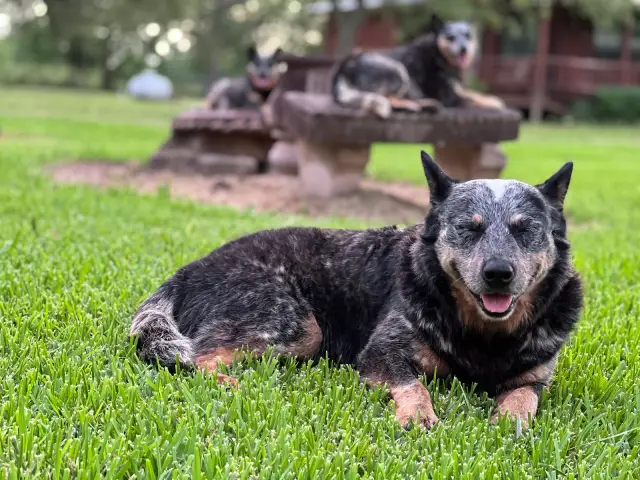 Related breedAustralian Cattle Dog1840 to 1903 · AustraliaIndustrial Revolution
The two corgis are often mixed up. The Pembroke Welsh Corgi page covers the Pembroke in detail. The main differences are these.
| Trait | Cardigan | Pembroke |
|---|---|---|
| Tail | Long, fox-like brush, carried low | Naturally short or docked in some countries |
| Size | Bigger and heavier; ideal 30 cm | 25 to 30 cm |
| Ears | Large, rounded tips, set wide | Smaller, more pointed |
| Bone and body | Heavier bone, longer in the body | Lighter, foxier |
| Colours | Blue merle, brindle and others | Red, sable, fawn, black and tan |
| Rarity | Rarer | More common worldwide |
| Origin | Cardiganshire | Pembrokeshire |
Both are tough, quick herders with a strong voice. Many owners say the Cardigan is calmer and a little more reserved, but temperament varies by line, and any such difference is anecdotal.
Relatives and DNA
 Same familyBorzoi1200 to 1650 · RussiaLate Middle Ages
In the 2017 Parker study (Cell Reports), which analysed 1,346 dogs from 161 breeds and sorted them into 23 supported clades, the Cardigan falls in the UK Rural family with strong support. That family holds British herding breeds, collie types and sighthounds. The study measured shared : long stretches of identical DNA from common ancestors. The more () two breeds share, the stronger the sign of crossing or shared founders. It cannot say which way genes flowed.
Source: Parker et al. 2017, as recorded in this site's breed database.
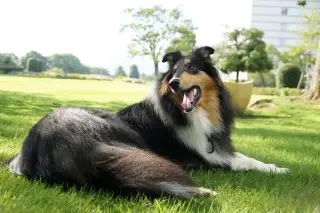
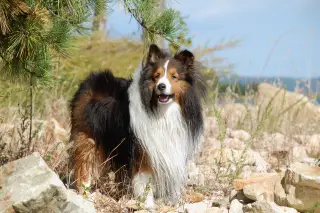
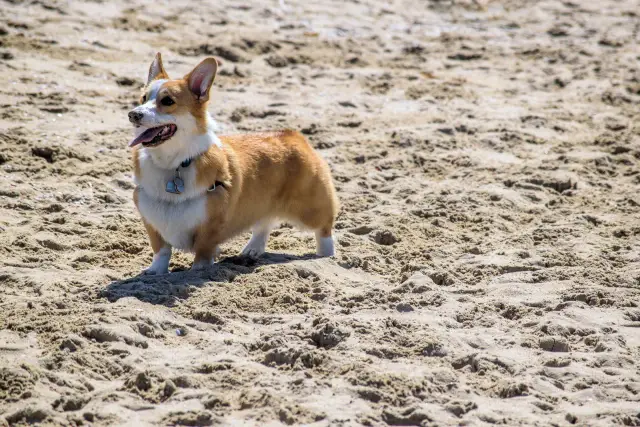
The Pembroke comes first by a wide margin, which matches the shared history and the years of being shown together. The collie breeds that follow show that corgi blood and collie blood overlap, which fits the British herding stock. The atlas data lists the Lancashire Heeler as a descendant and the Pembroke as a sister breed. For the wider picture, see the dog family tree.
Sister breeds · 1
- Pembroke Welsh Corgi1100 to 1934
Descend from it · 1
- Lancashire HeelerUnited Kingdom
- Pembroke Welsh Corgi73.9 Mb 3.1%
- Rough Collie40.3 Mb 1.7%
- Shetland Sheepdog29.5 Mb 1.2%
- Border Collie23.8 Mb 1.0%
- Australian Kelpie23.0 Mb 1.0%
- Bearded Collie22.6 Mb 0.9%
- Australian Shepherd14.7 Mb 0.6%
Source: Parker et al. 2017. Percent of the whole genome.
| Breedwith Cardigan Welsh Corgi | with Cardigan Welsh Corgi (Mb)Shared DNA (Mb) |
|---|---|
| Pembroke Welsh Corgi | 73.9 |
| Rough Collie | 40.3 |
| Shetland Sheepdog | 29.5 |
| Border Collie | 23.8 |
| Australian Kelpie | 23.0 |
| Bearded Collie | 22.6 |
| Australian Shepherd | 14.7 |
Source: Parker et al. 2017, Cell Reports, shared haplotypes between 161 breeds (1,346 dogs).
The breed standard
 Looks relatedGreyhound800 CE to 1850 · United KingdomEarly Middle Ages
A is the written ideal that judges compare each dog against. The Kennel Club says its size figures are a guide, and that a dog may be larger or smaller than they state.
| Trait | What the standards say |
|---|---|
| General look | Kennel Club: "Sturdy, tough, mobile, capable of endurance", long in proportion to height, ending in a fox-like brush |
| Height | Kennel Club: ideal 30 cm at the shoulder. AKC: 10.5 to 12.5 inches |
| Weight | Kennel Club: in proportion to size, overall balance the prime consideration. AKC page: 30 to 38 pounds for dogs, 25 to 34 pounds for bitches |
| Head | Kennel Club: foxy in shape; skull wide and flat between the ears, moderate stop, black nose |
| Eyes | Kennel Club: medium, clear, kindly but watchful, preferably dark. One or both eyes pale blue or blue-flecked are allowed only in blue merles |
| Ears | Kennel Club: erect, proportionately rather large, tips slightly rounded |
| Body | Kennel Club: fairly long and strong, deep brisket, clear waist, level ; legs short, forearms slightly bowed around the chest |
| Tail | Kennel Club: like a fox's brush, in line with the body, moderately long (touching or nearly touching the ground), carried low |
| Coat | Kennel Club: short or medium, hard, weatherproof, good undercoat |
| Colour | Kennel Club: blue merle, brindle, red, sable, tricolour with brindle points, tricolour with red points |
Merle. The merle pattern comes from an insertion in the SILV gene (Clark et al. 2006). A dog with two copies, called a double merle, can have eye malformations and deafness. For that reason the Kennel Club prohibits merle-to-merle matings for litters registered after 1 January 2013. A blue merle Cardigan should come from a merle to a non-merle mating.
Cardigan Welsh Corgi temperament
 Related breedIrish Wolfhound100 BCE to 1885 · IrelandAncient World
The Kennel Club asks for a dog that is "alert, intelligent, steady, not shy or aggressive". In daily life that means a dog with plenty of bark, a watchful eye on the front door and a steady nature with its own people. Many Cardigans are reserved with strangers, and early meetings with different people and dogs keep that reserve from turning into suspicion. Socializing your dog covers how.
Its job was to run low and nip at heels to move cattle. At home that can show up as heel-nipping at children, joggers or visitors, and as chasing moving things. Herding trials, agility, obedience, tracking and scent work give the dog a legal outlet, and Cardigans are known as quick students. See dog training basics to start, and the smartest dog breeds for how herders compare.
The breed barks easily. A small garden and a close neighbour call for early work on a quiet cue.
Cardigan Welsh Corgi health
 Related breedItalian Greyhound500 BCE to 1900 · ItalyAncient World
Most Cardigans are sturdy and long-lived for a medium-sized dog, but a long body on short legs puts load on the back. Information here is general, so talk to a vet about your own dog.
How long do Cardigans live? The AKC and the atlas data give 12 to 15 years. No published breed median is available, so treat the range as a guide.
Progressive retinal atrophy (rcd3). This inherited form of PRA is caused by a single-base deletion in the PDE6A gene. It is , so a dog needs two copies. Affected puppies show night blindness by about 3 months and are usually blind by about a year. Petersen-Jones and Zhu (American Journal of Veterinary Research, 2000) built a DNA test and screened 500 Cardigans: 457 were clear, 43 were (about 1 in 12) and none was affected. Testing has been available for over two decades, so careful breeders can avoid carrier-to-carrier matings.
| Condition | What it is | How common | What to do |
|---|---|---|---|
| Progressive retinal atrophy (rcd3) | Recessive eye disease that ends in blindness | 43 of 500 tested dogs were carriers (2000 study); none affected | DNA test of both parents; never mate two carriers |
| Intervertebral disc disease (IVDD) | The cushions between back bones bulge or burst and press on the spinal cord, causing pain or weak legs. Short-legged, long-backed breeds are more prone (Cornell) | No published Cardigan figure | Lean weight, no jumping off furniture, steps or ramps; see a vet fast for back pain or wobbling |
| (DM) | Slow nerve wear in the spinal cord that weakens the back legs in older dogs; linked to the SOD1 gene. Best documented in Pembrokes | Zeng and colleagues surveyed 33,700 dogs in 222 breeds in 2014; no Cardigan figure is published | DNA test of breeding dogs; the University of Glasgow is recruiting Pembrokes and Cardigans for a DM study |
| A loose or misshapen hip joint that can lead to arthritis | No published Cardigan figure | Hip scoring of breeding dogs; lean weight | |
| Obesity | Extra fat that strains the back and joints | No published Cardigan figure; corgis have a hearty appetite | Weigh food, count treats, check weight at the vet |
| Double merle problems | Eye defects and deafness from two merle genes | Preventable | Never breed merle to merle |
A healthy-looking dog can still carry a recessive gene, which is why both parents need to be tested. Before you buy, ask for the rcd3 result for both parents, hip scores, an eye exam and, if offered, a DM result.
 Ticks and fleasTicks and fleas on dogs: how to check, remove and prevent themTicks and fleas on dogs: how to tell them apart, check your dog, remove a tick safely, break the flea life cycle and prevent both.
 GuidesPractical guidesBehaviour, training, health and adoptionRelated breedItalian Greyhound500 BCE to 1900 · ItalyAncient World
Living with a Cardigan Welsh Corgi
 Related breedMiniature American Shepherd1968 to 2015 · United StatesModern Era
| Daily reality | Rating | Why |
|---|---|---|
| Exercise | Moderate to high | Daily walks plus a job or game; bred for a working day |
| Training needs | Medium to high | Bright, quick, a bit stubborn; needs steady guidance |
| Grooming | Medium | Short or medium double coat; brush weekly, more in shedding season |
| Shedding | High | Undercoat sheds heavily, twice a year |
| Barking | High | Alert herding dog with a loud voice |
| Time alone | Fair | Attached to its people; boredom brings barking and nipping |
| Children | Fair | Can nip at heels; needs supervision |
| Other dogs and pets | Fair | Can herd or chase; socialise early |
| Flat living | Fair | Size fits, barking and exercise need work |
| Stairs and jumping | Poor | Long back; avoid repeated jumps |
| First-time owner | Fair | Doable with training classes |
A good fit if you...
- want a sturdy small herding dog that enjoys training and outdoor days;
- can keep up daily exercise and mental work;
- can manage a back-friendly home with steps or ramps;
- do not mind a dog that sheds and barks.
Think twice if you...
- are out all day;
- want a quiet dog;
- have small children who run and scream, which can trigger herding nips;
- cannot keep the dog lean.
Similar breeds to consider
- Pembroke Welsh Corgi: the other corgi, lighter and more widely available.
- Shetland Sheepdog: a small collie, eager to train, with a long coat.
- Border Collie: a leaner, more intense herder.

Cardigan Welsh Corgi fun facts
 Related breedOld English Sheepdog1700 to 1888 · United KingdomEarly Modern Era
- The Cardigan and Pembroke were shown as one breed, the Welsh Corgi, until 1934.
- The Cardigan is the corgi with the long tail. The AKC calls the tail a defining feature.
- Blue eyes are permitted in the standard, but only in blue merles.
- The Cardigan shares more DNA with the Pembroke (73.9 Mb) than any other breed in the 2017 Parker study.
- The Cardigan is the older of the two corgi breeds according to the AKC, though the date is legend.
Frequently asked questions
What is the difference between a Cardigan and a Pembroke corgi?
The Cardigan has a long tail, is bigger and heavier, and can be blue . The Pembroke is lighter and has a short or docked tail.
How big do Cardigan Welsh Corgis get?
The Kennel Club ideal is 30 cm. The lists 30 to 38 pounds for males and 25 to 34 pounds for females.
How long do Cardigan Welsh Corgis live?
The AKC and the atlas data give 12 to 15 years.
Do Cardigan Welsh Corgis shed?
Yes, heavily, with a double coat that blows twice a year.
Are Cardigan Welsh Corgis good with children?
With supervision and training, yes. They may try to herd children by nipping heels.
Are Cardigan Welsh Corgis good for first-time owners?
They can be, with training classes and a plan for exercise, barking and back care.
Which health tests matter?
The rcd3 DNA test for both parents, hip scores and eye exams, and care with weight and jumping.
Read next
 Closest DNAPembroke Welsh Corgi73.9 Mb shared
 FamilyUK RuralThe whole family
 Adopt a dogDog Shelters in EuropeFind dog shelters in Europe, learn how shelters differ from country to country and why adopting a dog is a good option.
Sources (11)
- American Kennel Club, Cardigan Welsh Corgi breed page; and Facts About the Cardigan Welsh Corgi That You May Not Know.
- The Kennel Club (UK), Vulnerable native breeds.
- Clark L.A. et al., "Retrotransposon insertion in SILV is responsible for merle patterning of the domestic dog", Proceedings of the National Academy of Sciences, 2006.
- Cornell University, Riney Canine Health Center, "Chondrodystrophy and intervertebral disc disease (CDDY/IVDD)".
- Fédération Cynologique Internationale, Welsh Corgi (Cardigan), standard no. 38.
- Parker H.G. et al., "Genomic analyses reveal the influence of geographic origin, migration, and hybridization on modern dog breed development", Cell Reports, 2017.
- Petersen-Jones S.M., Zhu F.X., "Development and use of a polymerase chain reaction-based diagnostic test for the causal mutation of progressive retinal atrophy in Cardigan Welsh Corgis", American Journal of Veterinary Research, 2000.
- The Kennel Club (UK), Welsh Corgi (Cardigan) breed standard and breed information page.
- University of Glasgow, research call to corgi owners on a degenerative spinal condition, 2026.
- Wikipedia, "Cardigan Welsh Corgi".
- Zeng R. et al., "Breed distribution of SOD1 alleles previously associated with canine degenerative myelopathy", Journal of Veterinary Internal Medicine, 2014.