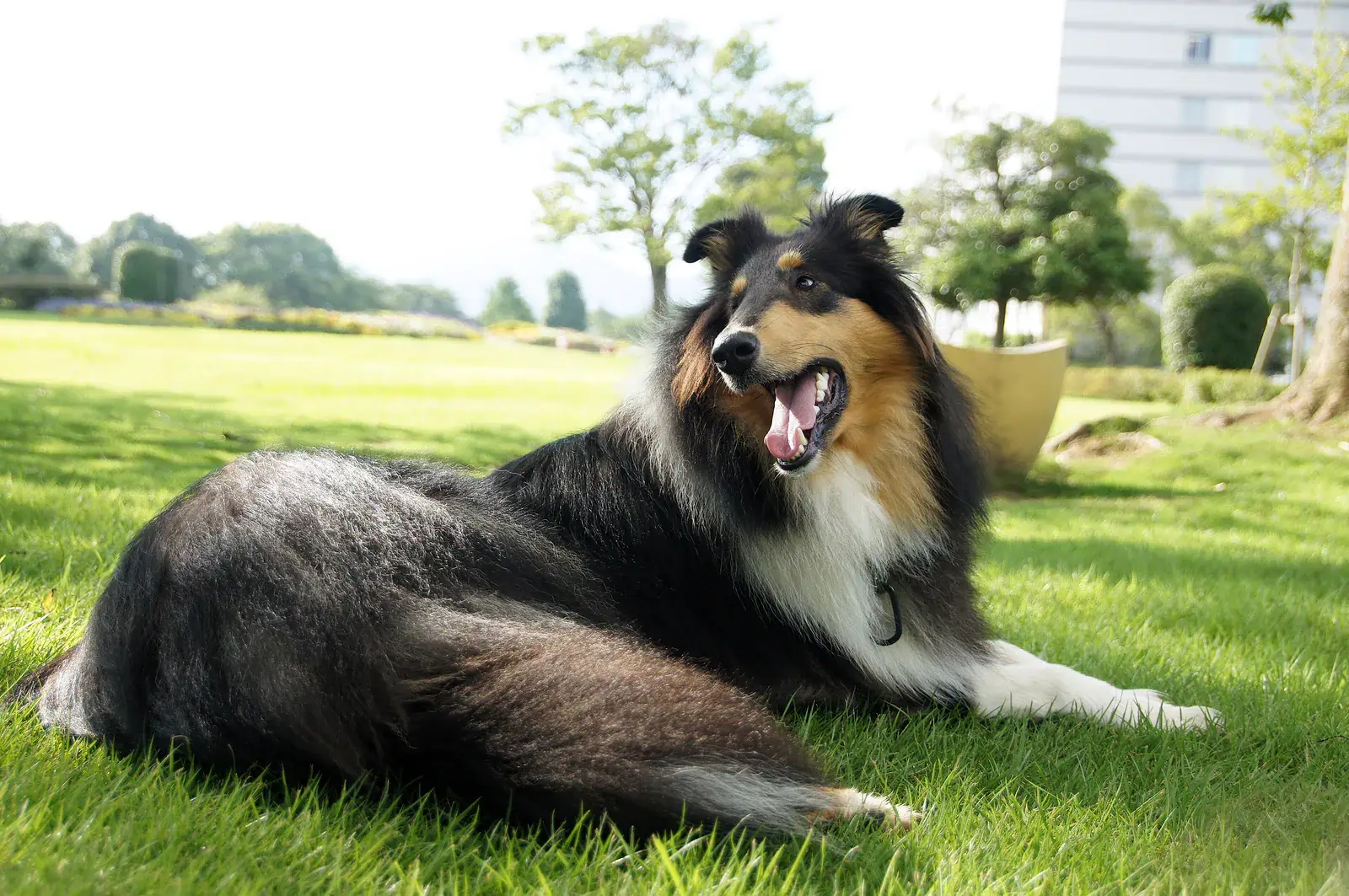
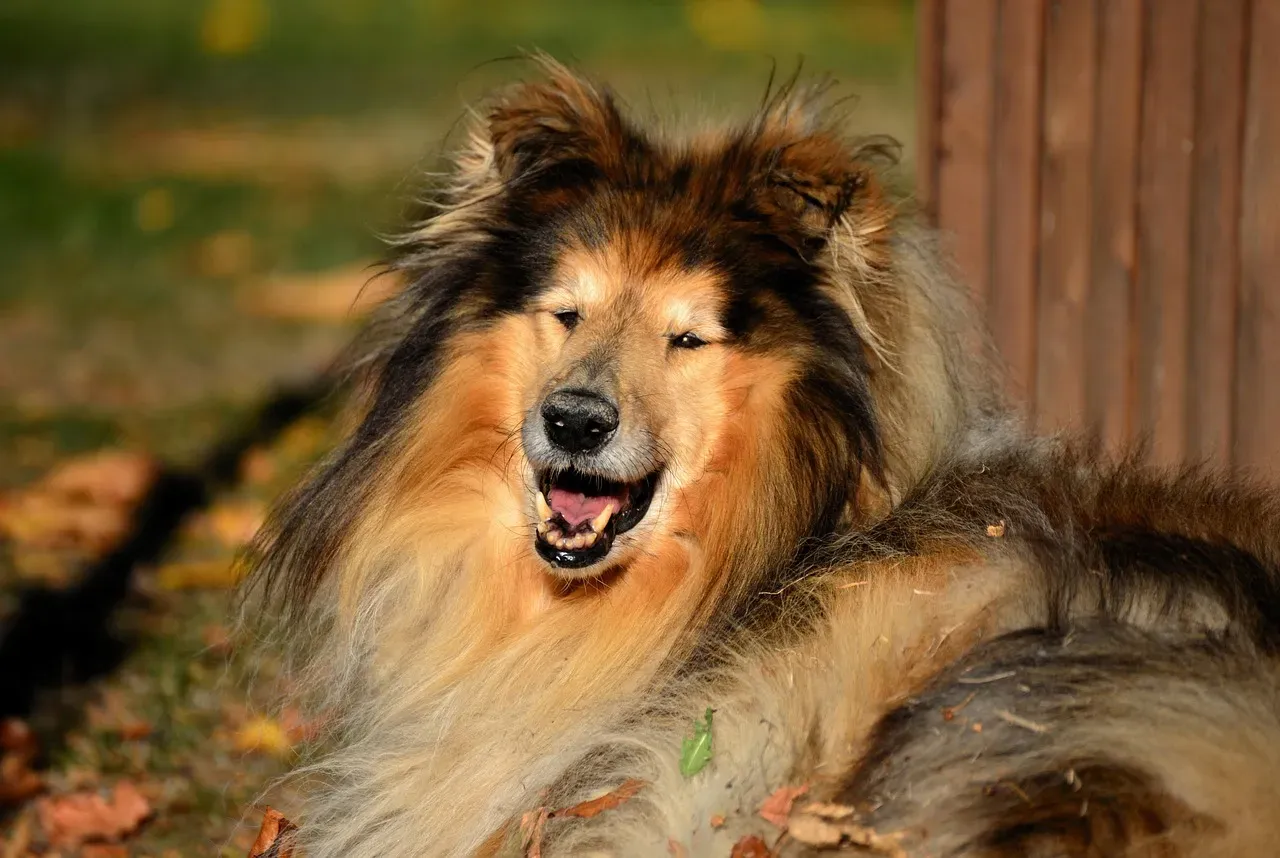
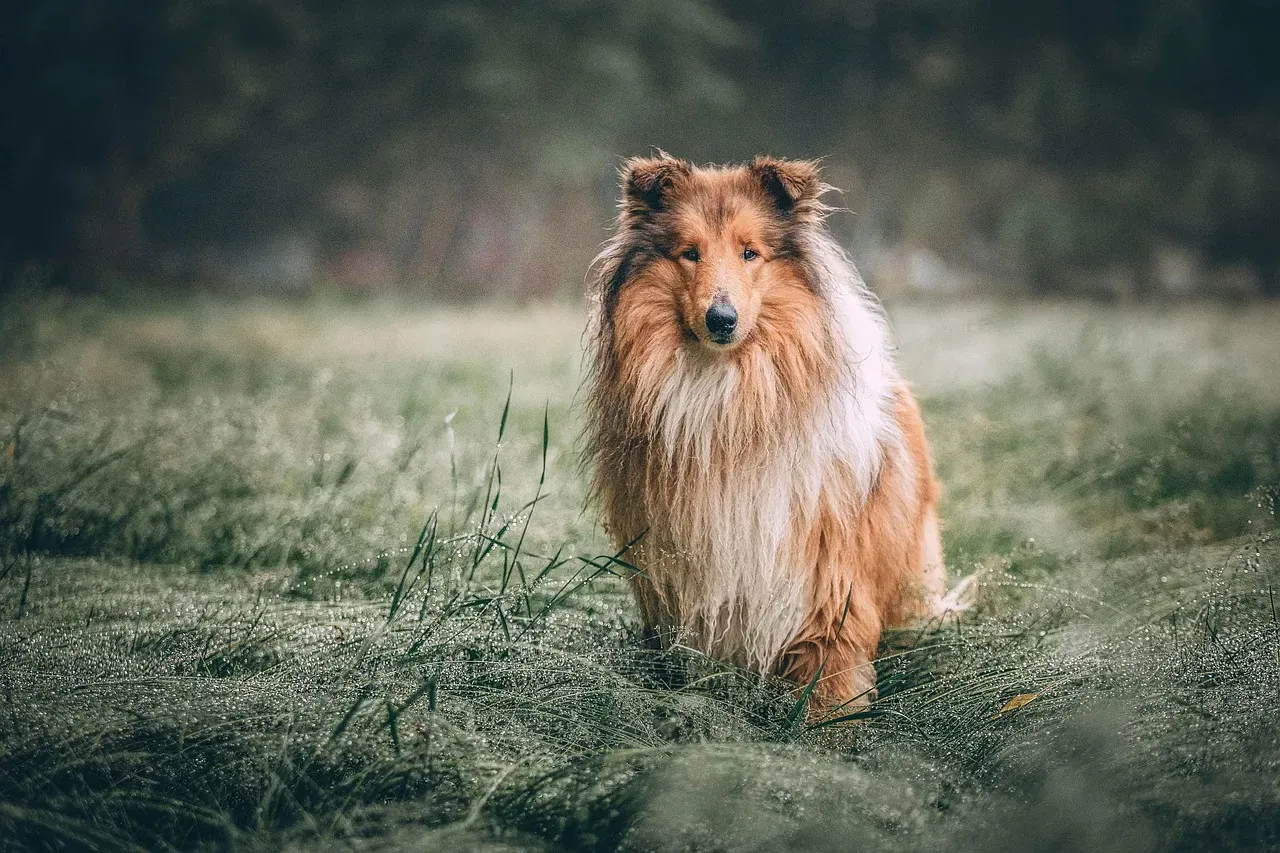
It began as a sheepdog of the Scottish Highlands, was taken up by Victorian dog fanciers in the 1800s, and became a worldwide household name through Lassie. Today it is a gentle, loyal and sensitive family dog that bonds closely with its people and learns fast. It needs regular brushing of a thick double coat and a calm, kind approach to training. Many Collies also carry a gene that makes some common drugs dangerous, so a simple DNA test matters. The atlas data gives a life span of 12 to 14 years.
Rough Collie quick facts
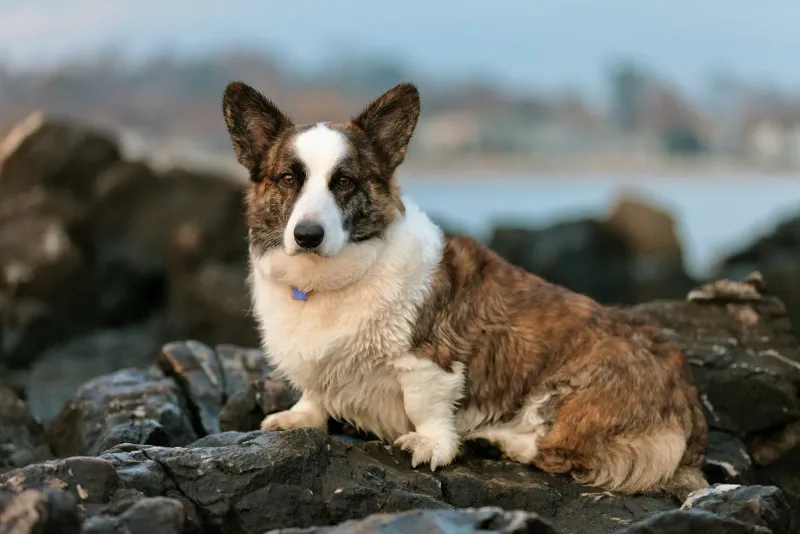 Related breedCardigan Welsh Corgi1200 to 1934 · United KingdomLate Middle Ages
- Country of origin
- Scotland, United Kingdom
- Period of development
- About 1800 to 1886 (atlas data, medium confidence)
- Original job
- Herding sheep in the Highlands; later a show dog and family companion
- Type
- Herding dog (FCI Group 1, standard no. 156; AKC Herding Group; UK Kennel Club Pastoral Group)
- Height
- UK Kennel Club and FCI: dogs 56 to 61 cm, bitches 51 to 56 cm; AKC: dogs 24 to 26 in, bitches 22 to 24 in
- Weight
- AKC: dogs about 60 to 75 lb (27 to 34 kg), bitches about 50 to 65 lb (23 to 29.5 kg)
- Coat
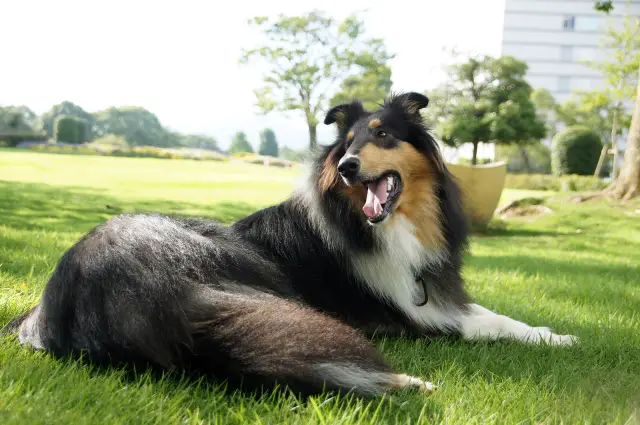
- Long, straight, harsh outer coat over a soft, dense undercoat, with a full mane and frill
- Colour
- and white, tricolour, blue (AKC also lists white)
- Life span
- 12 to 14 years (atlas data)
- Other names
- Long-haired Collie, Scotch Collie, Collie
- DNA family
- UK Rural family (Parker et al. 2017, strong support)
- Closest DNA relative
- Shetland Sheepdog (252.3 shared)
- Related breeds
- Smooth Collie, Shetland Sheepdog, Border Collie, Bearded Collie
Drawn to scale in real centimetres. Its back reaches about 59 cm, just above your knee; its head about 74 cm, mid-thigh.
Where it sits in the tree
Industrial Revolution · 1800 to 1849
Name and origin
 Related breedNova Scotia Duck Tolling Retriever1860 to 1945 · CanadaVictorian Breed Boom
The name Collie is Scots. The atlas data gives the likely source as colley, from the coal-black sheep these dogs herded, with a second suggestion that it comes from the Gaelic cuilean, meaning a puppy. Neither explanation is proven. Older names such as Scotch Collie and Long-haired Collie show how the breed was described before the clubs fixed a name. The FCI lists the breed as the Collie Rough, with Great Britain as its country of origin.
In the atlas data the Rough Collie sits in the UK Rural family, a group of herding and farm dogs from the British Isles. It shares a coat-length twin in the Smooth Collie, which is the same dog with a short coat, and it is cousin to the Border Collie, which came from related Highland and Border working stock but was bred for work rather than for show.
 Save

History
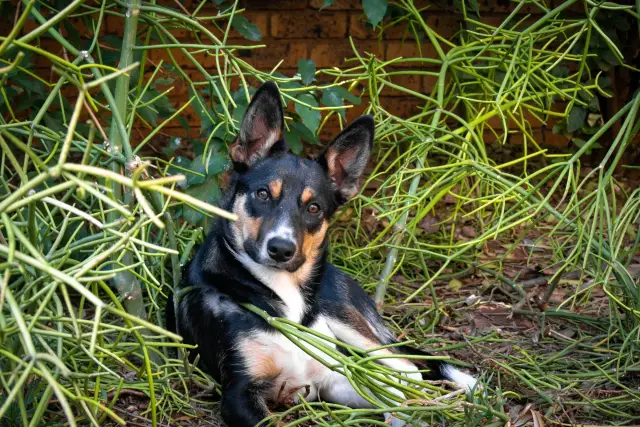 Same eraAustralian Kelpie1870 to 1902 · AustraliaVictorian Breed Boom
Highland sheepdogs
Long before the show ring, shepherds in Scotland kept collies that drove and gathered sheep on the hills. These were working dogs of mixed appearance, chosen for brains, stamina and obedience, not for looks. The atlas data dates the development of today's breed from about 1800 to 1886, with medium confidence, reflecting how the working collie slowly turned into a recognisable show breed over the 19th century.
Queen Victoria and the Victorian boom
The breed's rise in popularity is tied to Queen Victoria. Accounts place her first meeting with Highland collies at Balmoral in the 1860s, and her interest in the dogs, together with the new dog shows of the period, made collies fashionable. Sources disagree on how many of the queen's own dogs were smooth or rough, and she appears to have kept both types. What is clear is that the breed moved quickly from the hills to the drawing room, and breeders began selecting for a longer, more refined head, a richer coat and a more striking colour.
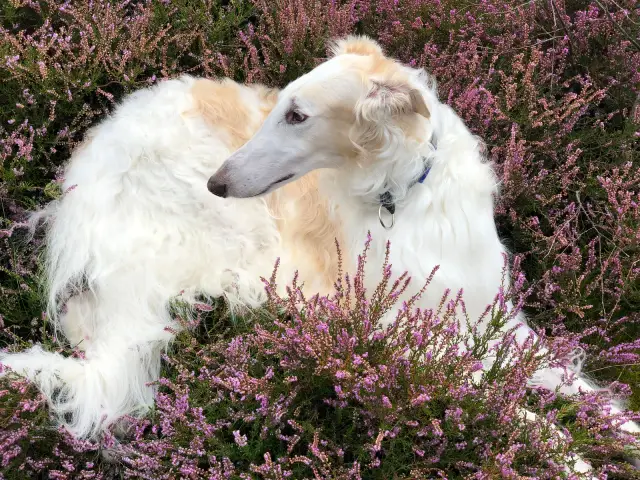
A belief repeated in many breed histories is that some breeders crossed collies with the Borzoi to lengthen the head and add coat. The atlas data records this as a possible link of low confidence, noting that it is not conclusively known. The long, narrow head of the show Collie is often used as an argument for it, but the cross is not documented.
Collies abroad and the Lassie effect
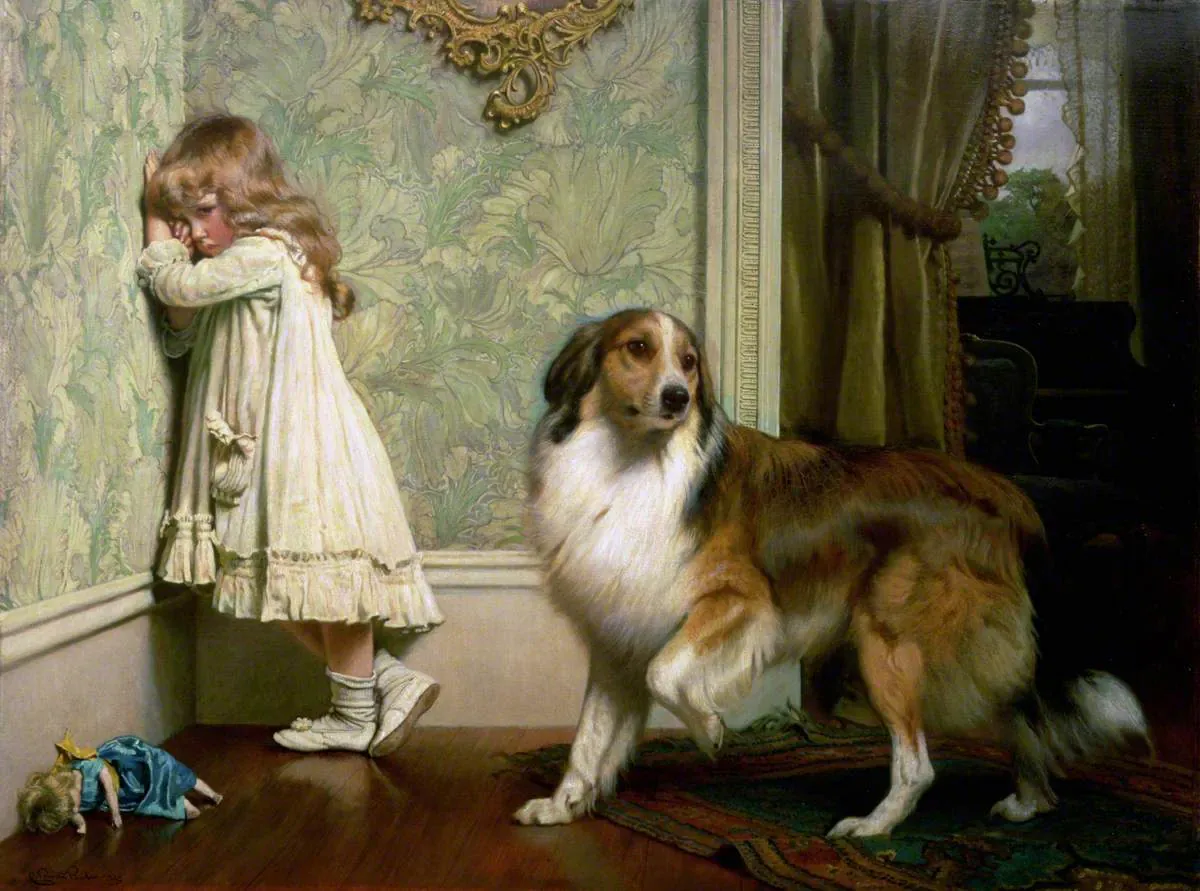
Collies were exported to North America and across the world in the late 1800s. The American Kennel Club classes the breed in the Herding Group today. In 1938 the writer Eric Knight published a short story about a loyal Rough Collie, and the novel Lassie Come-Home followed in 1940. The 1943 film adaptation made the sable and white Collie one of the most recognisable dogs on screen, and Lassie became a global image of canine loyalty. The popularity brought demand, and in some countries it also brought careless breeding, which is one reason breed clubs now stress health testing.
Recognition
The FCI lists the breed as no. 156 in Group 1, the herding group. The AKC places it in the Herding Group, and the UK Kennel Club puts it in the Pastoral Group. The Smooth Collie has its own standard in each body but is the same dog with a different coat.
 Save
Relatives and DNA
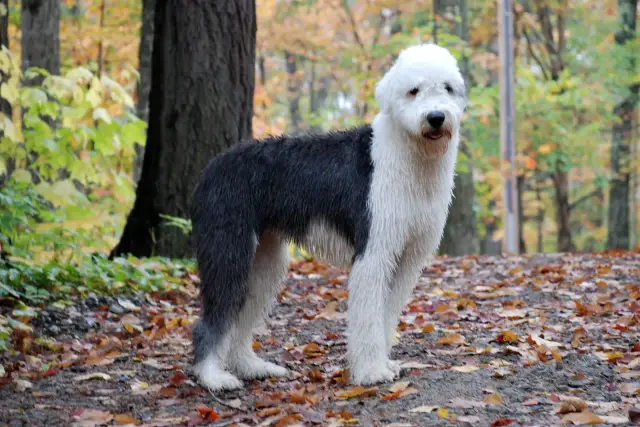 Same familyOld English Sheepdog1700 to 1888 · United KingdomEarly Modern Era
The Parker 2017 DNA study grouped 161 breeds into 23 clades by shared stretches of DNA. The Rough Collie falls in the UK Rural with strong support, which means its DNA clearly belongs with the herding dogs of Britain. The atlas data names the Borzoi and the Saluki as early ancestors and lists four breeds as descendants of the Rough Collie.
Descendant breeds (atlas data)
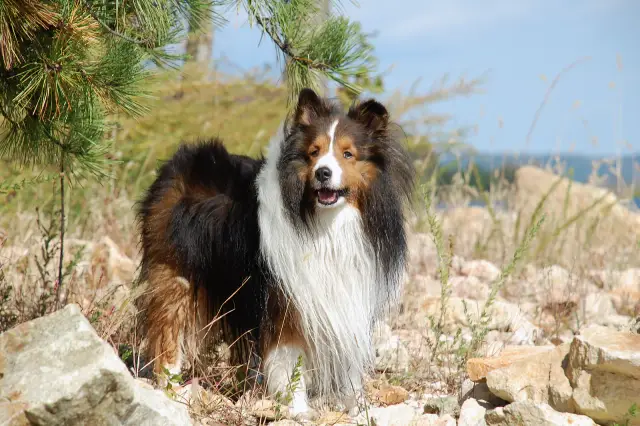
- Shetland Sheepdog. A small, collie-like herder from the Shetland Islands. Its look comes from Rough Collie blood added in the late 1800s.
- Chinook. An American sled dog whose development drew on collie stock.
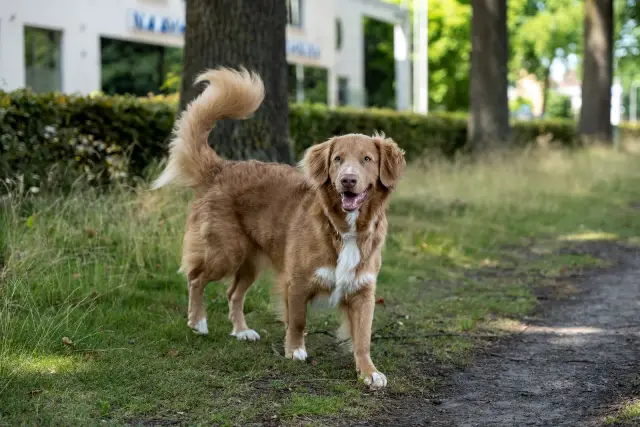
- Nova Scotia Duck Tolling Retriever. A Canadian retriever whose early lines are said to include collie blood.
- Gaucho Sheepdog. A herding dog of South America with collie ancestry.
Sibling breeds (atlas data)
- Smooth Collie. The short-coated variety of the same breed.
- Border Collie. Came from the same working stock but was kept for ability, not for the show ring.
- English Shepherd. A farm dog of North America linked through collies brought by early settlers.
What does DNA say?
Shared show which breeds share long stretches of identical DNA through common ancestors or crossing. A higher number of shared (Mb) means a more recent link. The study cannot say which breed gave genes to which.
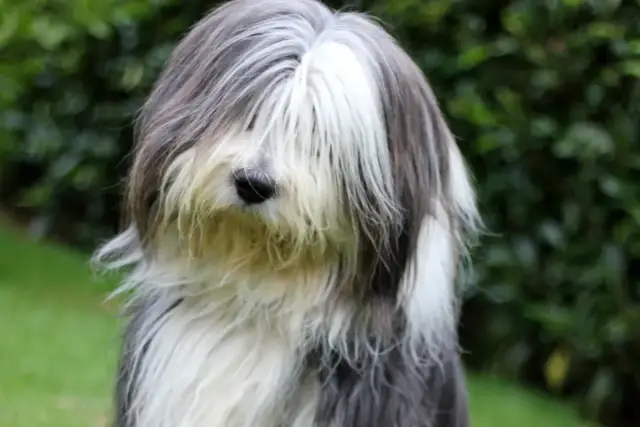
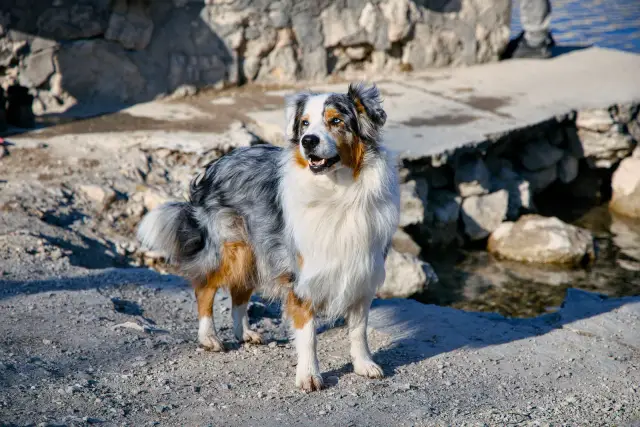
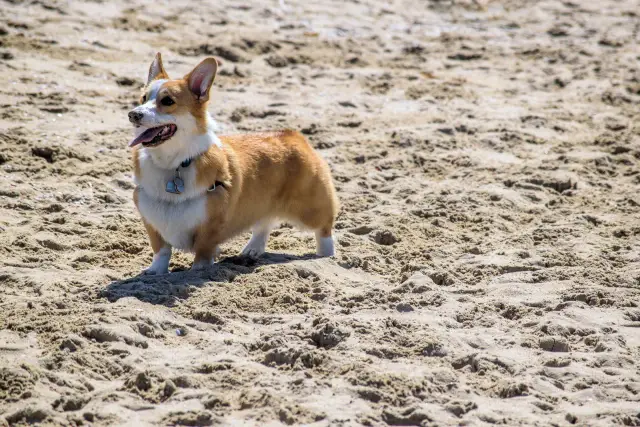
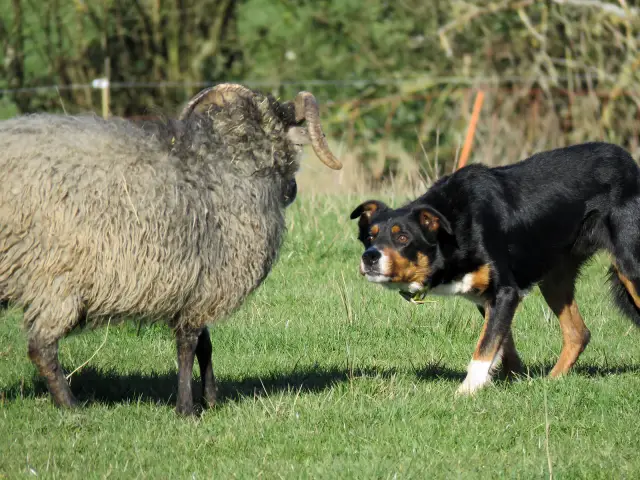
- Rough Collie and Shetland Sheepdog
- Rough Collie and Bearded Collie
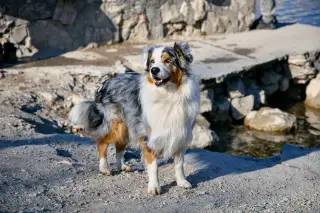
- Rough Collie and Australian Shepherd
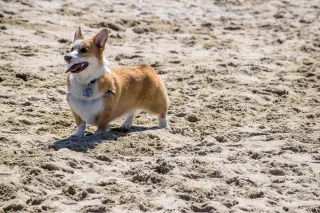
- Rough Collie and Pembroke Welsh Corgi
- Rough Collie and Border Collie
The Shetland Sheepdog value is the highest in the atlas data for the Collie and is about four times larger than the next one, which fits the history of Rough Collie blood in the Sheltie. The Bearded Collie, the Australian Shepherd, the Pembroke Welsh Corgi and the Border Collie share smaller amounts, which fits a wider family of British herding dogs. The Border Collie shares the least of the five, even though the names are alike.
Sister breeds · 3
- English Shepherd1700 to 1927
- Border Collie1800 to 1915
- Smooth Collie1800 to 1885
Descend from it · 4
- Shetland SheepdogUnited Kingdom
- Gaucho SheepdogBrazil
- Nova Scotia Duck Tolling RetrieverCanada
- ChinookUnited States
- Shetland Sheepdog252.3 Mb 10.5%
- Bearded Collie63.1 Mb 2.6%
- Australian Shepherd61.8 Mb 2.6%
- Pembroke Welsh Corgi44.1 Mb 1.8%
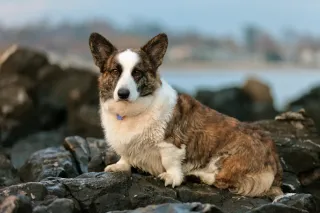
- Cardigan Welsh Corgi40.3 Mb 1.7%
- Border Collie36.2 Mb 1.5%
- Chinook30.4 Mb 1.3%
- Nova Scotia Duck Tolling Retriever28.7 Mb 1.2%
- Australian Kelpie17.9 Mb 0.7%
- Old English Sheepdog16.5 Mb 0.7%
- Australian Cattle Dog14.3 Mb 0.6%
- Xoloitzcuintle10.1 Mb 0.4%
Source: Parker et al. 2017. Percent of the whole genome.
The breed standard
 Looks relatedAustralian Cattle Dog1840 to 1903 · AustraliaIndustrial Revolution
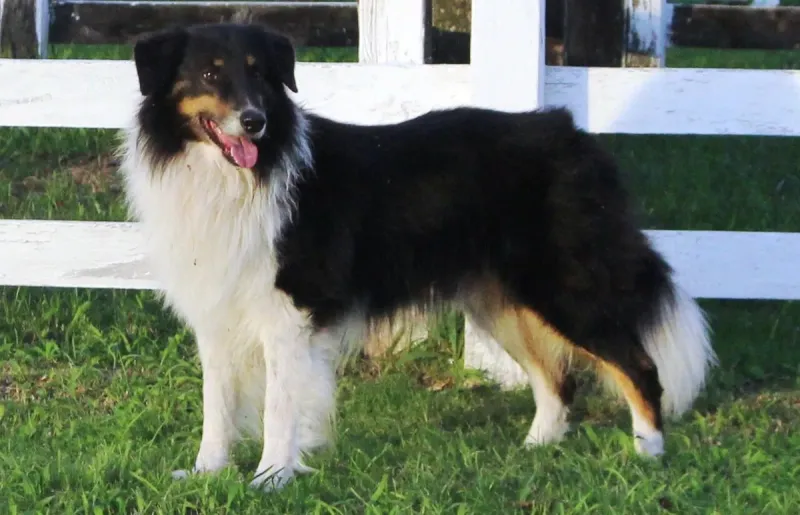
A is the written ideal for a breed that kennel clubs judge dogs against. The FCI, the UK Kennel Club and the AKC describe the same dog: a lithe, graceful, long-coated collie with a smooth, wedge-shaped head and a gentle expression. They differ mostly in size, where the American standard describes a slightly larger dog.
| Trait | What the standards say |
|---|---|
| Height | UK Kennel Club: dogs about 56 to 61 cm, bitches about 51 to 56 cm. FCI: same range. AKC: dogs 24 to 26 in (61 to 66 cm), bitches 22 to 24 in (56 to 61 cm) |
| Weight | AKC: dogs 60 to 75 lb (27 to 34 kg), bitches 50 to 65 lb (23 to 29.5 kg). Canadian Kennel Club: the same ranges |
| Coat | All clubs: straight, harsh outer coat, soft dense undercoat, profuse mane and frill, feathered legs and a full tail |
| Colour | FCI and UK Kennel Club: sable and white, tricolour, blue merle. AKC: also white, with white allowed as a base colour |
| Head | All clubs: long, clean wedge seen from above and from the side, with a slight stop and a flat skull |
| Ears | All clubs: small, semi-erect, tipping forward when alert |
| Eyes | All clubs: medium, almond-shaped, dark brown; blue or blue-flecked eyes are allowed in blue merles |
| Tail | All clubs: long, carried low with an upward swirl at the tip when moving |
The Kennel Club notes that its figures describe the ideal and that an individual dog may be a little larger or smaller. The AKC and Canadian standards describe a taller, heavier dog than the UK and FCI standards, which is why Collies from American and British show lines can look different in size.
Colours. Sable ranges from light gold to deep mahogany and is always combined with white markings. Tricolour is black with white and tan points. Blue merle is a mottled silver blue with black marbling. The white collar, blaze and feet are part of the classic pattern. Merle-to-merle breeding is avoided because double merles can have deafness and eye problems, and responsible breeders do not do it.
Coat care. The coat is the main grooming task of the breed. A weekly brush to the skin, with extra work behind the ears, in the armpits and on the trousers, keeps it free of mats. Shedding is heavy twice a year.
 Save
Temperament
 Related breedXoloitzcuintle1000 BCE to 1956 · MexicoAncient World
Collie clubs describe the Rough Collie as gentle, devoted, intelligent and sensitive. It is quiet in the house, bonds deeply with its family and is often wary or reserved, rather than loud, with strangers. It is a herder by background, so it may circle, nudge or bark at running children or visitors. Most are not aggressive, and breeders look for a stable, kind temperament.
Training and exercise
Collies learn quickly and respond well to praise and food rewards. Harsh correction does not suit a sensitive dog and can make it shut down. Start socialisation early, with new people, places and sounds, and teach a reliable recall. Many Collies are vocal and will bark to alert, which can become a habit without clear rules.
Exercise needs are moderate to high. A long daily walk and some play or training suit most adults. Collies enjoy herding trials, obedience, agility and tracking, and they like having a task. They are less driven than a Border Collie and less likely to become frustrated in a pet home.
With children and other pets
The breed has a long reputation as a gentle family dog. Herding instincts can lead to nipping at heels when children run, so teach children to be calm and teach the dog an alternative. Most Collies live well with other dogs and with cats, especially when raised together.
Alone time
A Collie that is left alone for long periods can become anxious, bored or noisy. It is a companion dog and needs company. Gradual practice and mental stimulation help.
Health
 Related breedBorzoi1200 to 1650 · RussiaLate Middle Ages
Most Rough Collies live healthy lives, and the atlas data gives 12 to 14 years. This section lists what breeders screen for and what owners can watch for. Figures are given only where a named study supplies one. Information here is general. Talk to a vet about your own dog.
MDR1 drug sensitivity. The most important health fact for owners is the MDR1 gene, also called ABCB1. A mutation in this gene, found in Collies in the 2004 PNAS study by Neff and colleagues, stops the body from clearing some drugs from the brain. Dogs with two copies can have serious reactions to certain common drugs, including some used for parasites, diarrhoea and cancer. In that study, which tested 263 Collies (rough and smooth were not separated), about 3 in 10 had two copies, about 4 to 5 in 10 had one copy and about 2 in 10 had none, so roughly 4 in 5 Collies carried the mutation. A simple DNA test, offered by Washington State University and by commercial laboratories, shows the result. Tell the vet the result before any treatment.
| Condition | What it is | How common | What helps |
|---|---|---|---|
| MDR1 drug sensitivity | A gene change that makes some drugs build up in the brain | About 4 in 5 Collies carried at least one copy in the 2004 study of 263 Collies (rough and smooth combined) | DNA test for every dog; tell the vet; avoid risk drugs for dogs with two copies |
| Collie eye anomaly | A development difference in the back of the eye that can range from mild to a cause of sight loss | Common in the breed historically; no published figure for Rough Collies | DNA test and eye exam of puppies at 6 to 8 weeks; breeding plans that reduce affected dogs |
| Progressive retinal atrophy | Gradual loss of the retina | Seen in the breed; no published figure | Yearly eye exam of breeding dogs; DNA test where available |
| Dermatomyositis | An immune-linked disease of skin and muscle, seen in young Collies | Associated with Collies and Shetland Sheepdogs; no published figure | DNA marker panel, vet care and avoiding breeding affected dogs |
| Gastric dilatation and volvulus (bloat) | Gas and twisting of the stomach in deep-chested dogs | Possible in deep-chested breeds; no published figure for Collies | Smaller meals, no hard exercise around meals, quick vet care for signs |
| Overweight | Extra body fat that loads joints | Common in many breeds; no published figure | Measured meals, regular walks, body condition checks |
Collie eye anomaly. This is an inherited difference in the development of the eye layers. It is picked up by a vet eye exam in young puppies, and in many dogs it causes little or no vision loss. A DNA test is available from veterinary genetics laboratories such as the University of California, Davis, which also offers a Collie health panel that includes MDR1 and related tests.
Dermatomyositis. The UC Davis Veterinary Genetics Laboratory describes it as an immune-mediated condition of the blood vessels of the skin and muscle, with both genetic and environmental causes. It is most often noticed in puppies as hair loss and crusts on the face, ears, legs and tail tip. Ask the breeder about the lines.
Merle and hearing. Dogs carrying two copies of the merle gene may be deaf or have eye defects. A merle-to-merle mating is the cause, so check that the parents are not both merle.
 Ticks and fleasTicks and fleas on dogs: how to check, remove and prevent themTicks and fleas on dogs: how to tell them apart, check your dog, remove a tick safely, break the flea life cycle and prevent both.
 GuidesPractical guidesBehaviour, training, health and adoptionRelated breedBorzoi1200 to 1650 · RussiaLate Middle Ages
Living with a Rough Collie
 Related breedGreyhound800 CE to 1850 · United KingdomEarly Middle Ages
| Daily reality | Rating | Why |
|---|---|---|
| Exercise per day | Medium | A long walk and some play or training; less driven than a working collie |
| Training needs | Medium | Learns fast but is sensitive; needs a kind, consistent trainer |
| Grooming | High | Weekly brushing to the skin, more in the shedding seasons |
| Shedding | High | Heavy double coat; large coat blow twice a year |
| Barking | High | Herding breed; often vocal when alerting |
| Time alone | Fair | Bonds closely; may become anxious or noisy when left for long hours |
| Children | Good | Gentle by reputation; may herd running children |
| Other dogs | Good | Usually sociable |
| Cats and small pets | Good | Usually fine when raised together |
| Flat living | Fair | Quiet indoors but large and vocal |
| Heat tolerance | Poor | Thick coat; avoid hard exercise in the heat |
| Cold tolerance | Good | Weatherproof double coat |
| First-time owner fit | Fair | Kind and trainable; coat care and sensitivity need planning |
A great fit if
- You want a gentle, loyal family dog that bonds closely and is calm in the house.
- You enjoy walks and light dog sports and have a garden or nearby parks.
- You are happy to brush a thick coat weekly and to vacuum often.
- You will train with praise and patience, not with harsh corrections.
Think twice if
- You are away from home most of the day with no company for the dog.
- You dislike dog hair on clothes and furniture.
- You live in a hot climate with no air conditioning.
- You want a quiet dog in a flat with thin walls, since many Collies bark.
Before you get one
Ask the breeder for the MDR1 result of both parents, an eye exam certificate and the Collie eye anomaly status, and ask about dermatomyositis in the lines. Check that the parents are not both merle. Breed rescues place adult Collies, often calm and house-trained. The first year brings coat changes, socialisation and adolescent excitement, and the adult coat comes in at around two years.
Similar breeds to consider
- Smooth Collie. The same dog with a short coat and far less grooming.
- Shetland Sheepdog. A smaller, collie-like herder, more alert and more vocal.
- Border Collie. A working collie with much higher energy and training needs.
- Bearded Collie. A shaggy, bouncy Scottish herder with a lighter, more playful manner.

Rough Collie fun facts
 Related breedIrish Wolfhound100 BCE to 1885 · IrelandAncient World
- The Rough Collie became famous through Eric Knight's 1940 novel Lassie Come-Home and the 1943 film.
- The Shetland Sheepdog shares 252.3 Mb of DNA with the Rough Collie in the Parker 2017 study, the highest value in the atlas data for the breed.
- The word Collie may come from the Scots word for a coal-black sheep, though this is not certain.
- Roughly 4 in 5 Collies in the 2004 PNAS study carried the MDR1 mutation, so the DNA test is part of standard Collie care.
Frequently asked questions
Are Rough Collies good family dogs?
Yes, they are gentle and loyal. They suit homes that can offer company, calm training and regular grooming.
How big is a Rough Collie?
The UK Kennel Club and give about 56 to 61 cm for dogs and 51 to 56 cm for bitches. The standard is taller, at 24 to 26 inches for dogs.
How long do Rough Collies live?
The atlas data gives 12 to 14 years.
Do Rough Collies shed a lot?
Yes. The thick double coat sheds all year and heavily twice a year, and weekly brushing helps.
What is MDR1 in Collies?
A gene change that makes some drugs unsafe. A DNA test shows whether a dog is clear, a carrier or affected, and the vet should know the result.
What is the difference between a Rough Collie and a Border Collie?
The Rough Collie is larger, long-coated and calmer, bred for the show ring as well as for work. The Border Collie is a leaner, short-to-medium coated working dog with far higher energy.
Read next
Closest DNAShetland Sheepdog252.3 Mb sharedSister breedBorder Collie1800 to 1915 Adopt a dogDog Shelters in EuropeFind dog shelters in Europe, learn how shelters differ from country to country and why adopting a dog is a good option.
Sources (12)
- American Kennel Club, Collie (Rough) breed standard.
- Canadian Kennel Club, Collie (Rough and Smooth) breed standard.
- Fédération Cynologique Internationale, Collie Rough, standard no. 156.
- Fogle B., The Encyclopedia of the Dog, 2009.
- Knight E., Lassie Come-Home, 1940.
- Neff M.W. et al., "Breed distribution and history of canine mdr1-1Δ, a pharmacogenetic mutation that marks the emergence of breeds from the collie lineage", Proceedings of the National Academy of Sciences, 2004.
- Parker H.G. et al., "Genomic analyses reveal the influence of geographic origin, migration, and hybridization on modern dog breed development", Cell Reports, 2017.
- The Kennel Club (UK), Collie (Rough) breed standard.
- United Kennel Club, Collie breed standard.
- University of California, Davis, Veterinary Genetics Laboratory, Collie health panel and dermatomyositis test.
- Washington State University College of Veterinary Medicine, MDR1 testing and drug sensitivity information.
- Dogs Atlas breed records and Parker 2017 shared-haplotype table (this site).