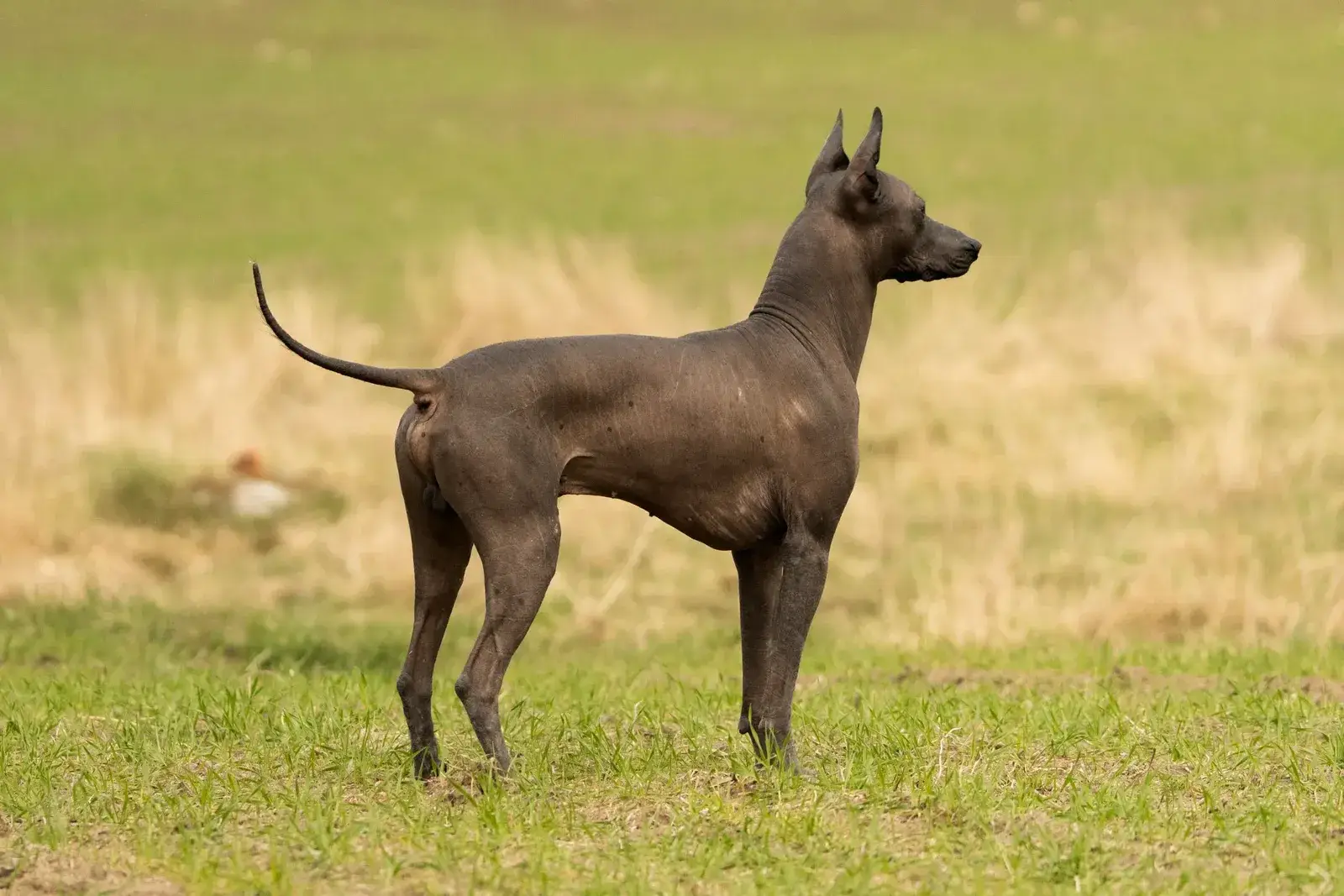
It comes in three sizes, and each size can be hairless or coated. The breed is tied to the cultures of ancient Mexico, and its name joins the Nahuatl words for the god Xolotl and for dog. Modern Xolos are calm, alert, loyal dogs that are often reserved with strangers. The hairless trait comes from a single gene, FOXI3, which also affects teeth. The breed suits owners who want a clean, quiet, long-lived companion and will look after skin and teeth. Breed sources give a life span of 13 to 18 years.
Xoloitzcuintle quick facts
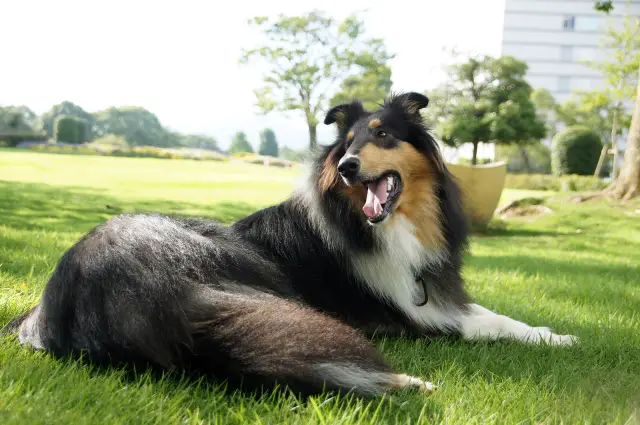 Related breedRough Collie1800 to 1886 · United KingdomIndustrial Revolution
- Closest DNA relatives
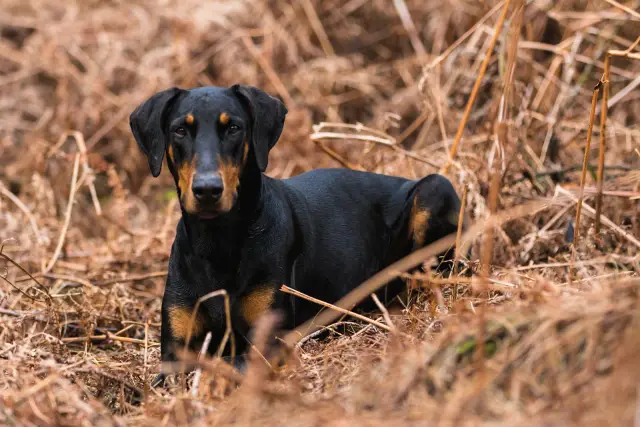
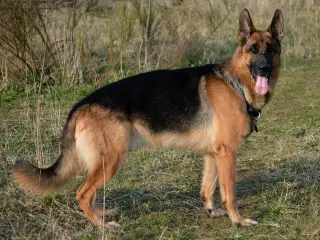
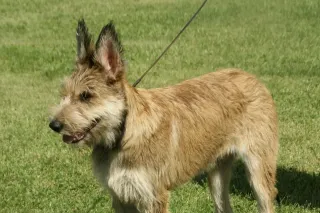
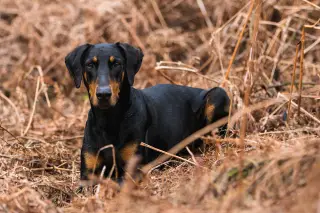
- German Shepherd (64.2 shared), Berger Picard, Dobermann (Parker 2017 data)
- Country of origin
- Mexico
- Period of development
- Pre-Hispanic roots (low-confidence date from about 1000 BCE); modern breed rescued and standardised from the 1950s
- Original job
- Companion, guard, hearth dog; ritual and spiritual roles in Mesoamerican belief
- Type
- Primitive type, FCI Group 5 (Spitz and primitive types), standard no. 234; AKC Non-Sporting Group (since 2011); UK Kennel Club lists the three sizes
- Sizes
- Toy or miniature, intermediate and standard (names vary by club)
- Height
- FCI (via Australian national body): miniature 25 to 35 cm, intermediate 36 to 45 cm, standard 46 to 60 cm. AKC: toy 10 to 14 in, miniature 14 to 18 in, standard 18 to 23 in
- Coat
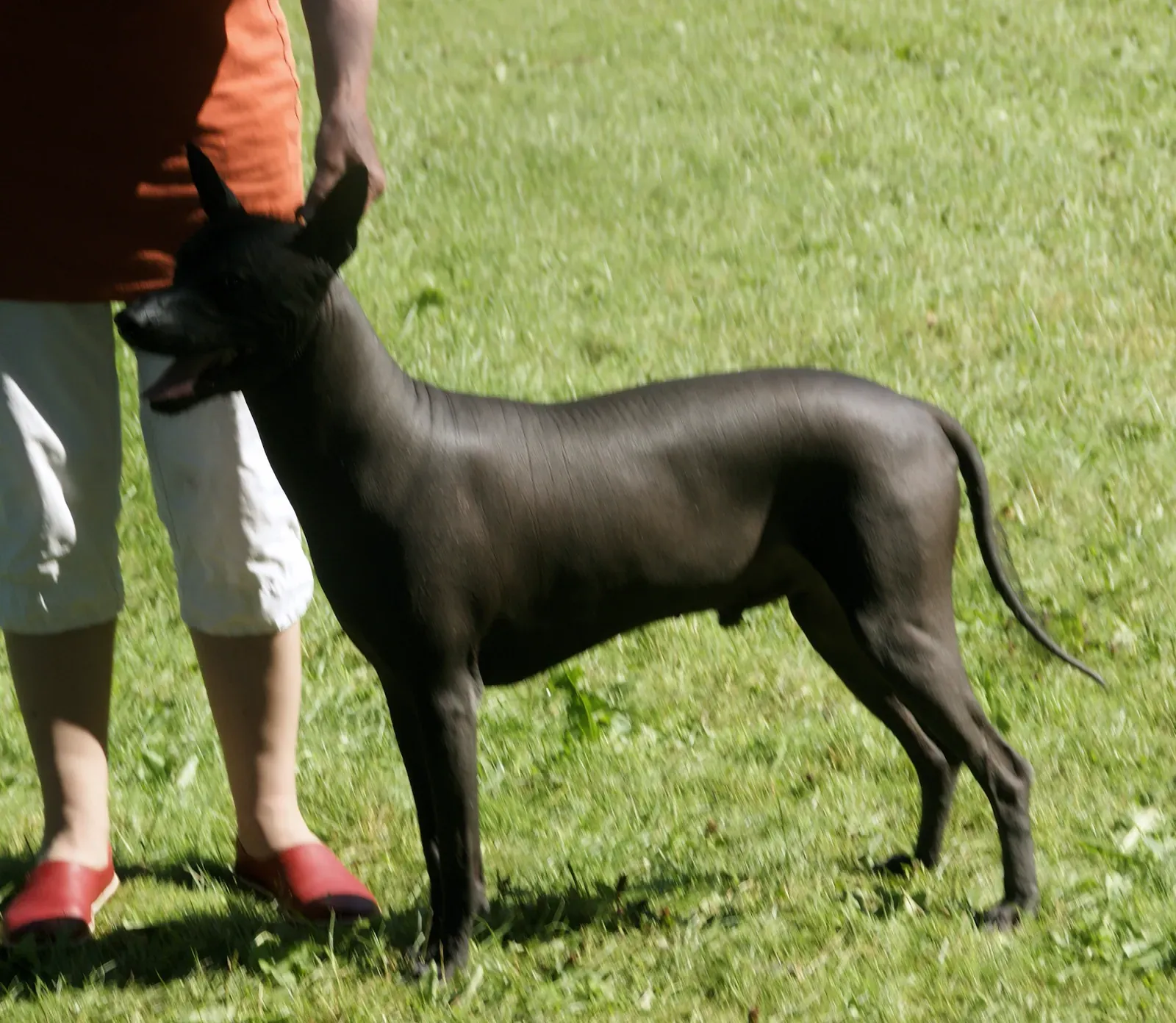
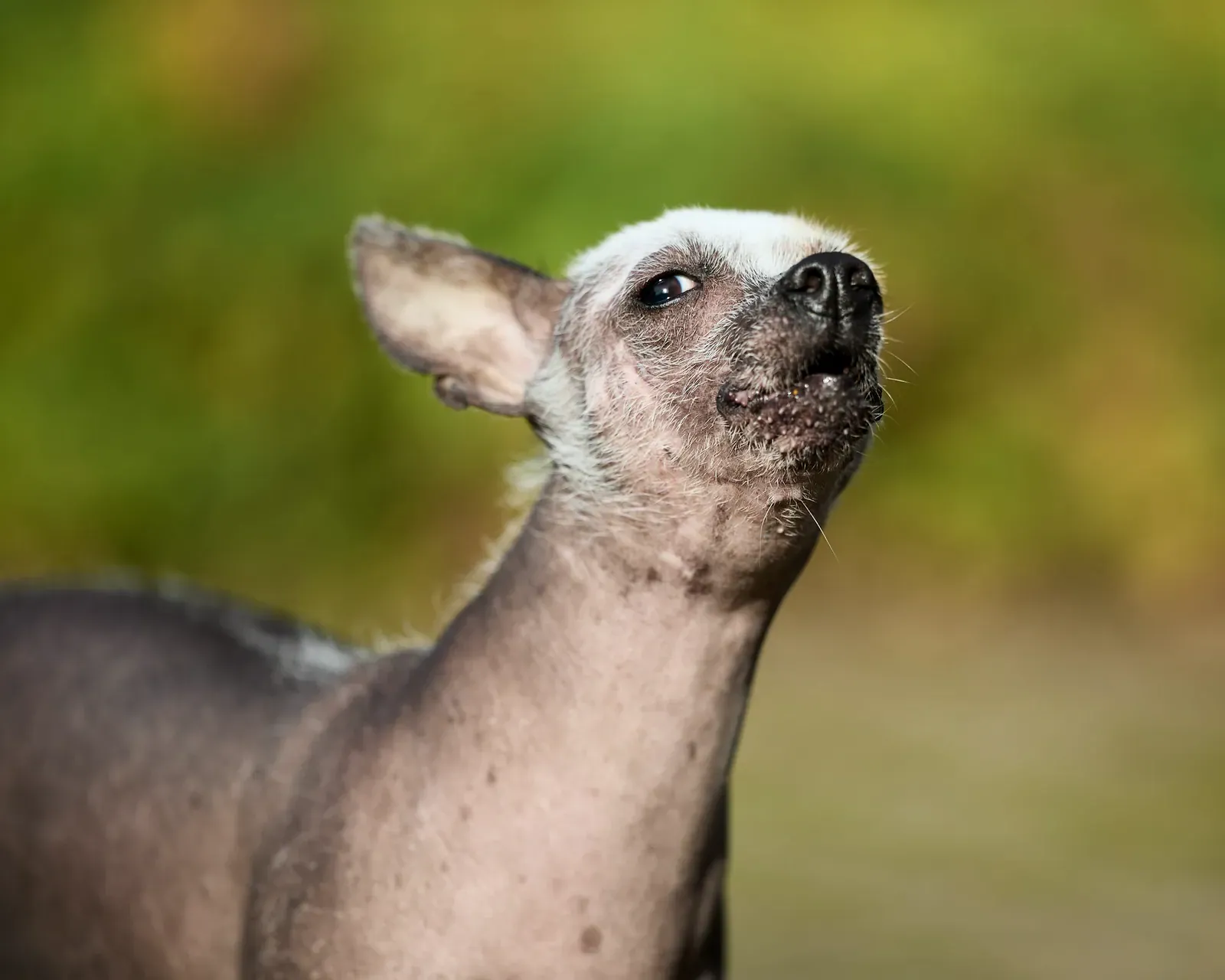
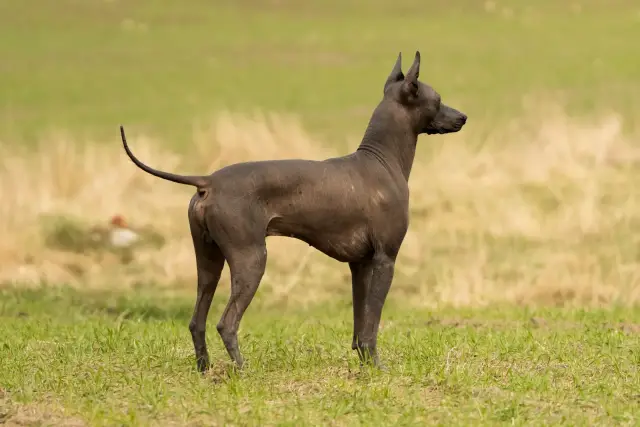
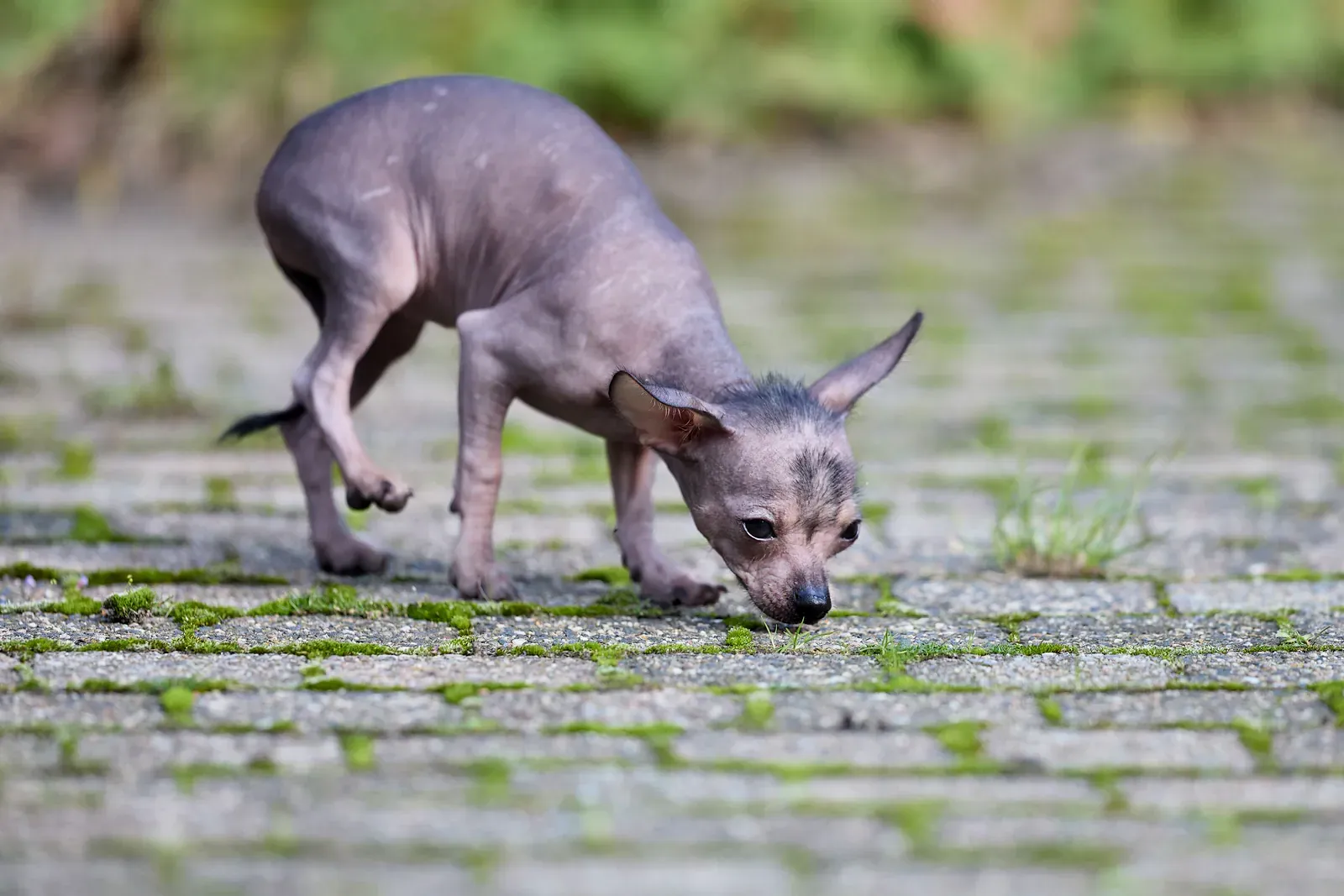
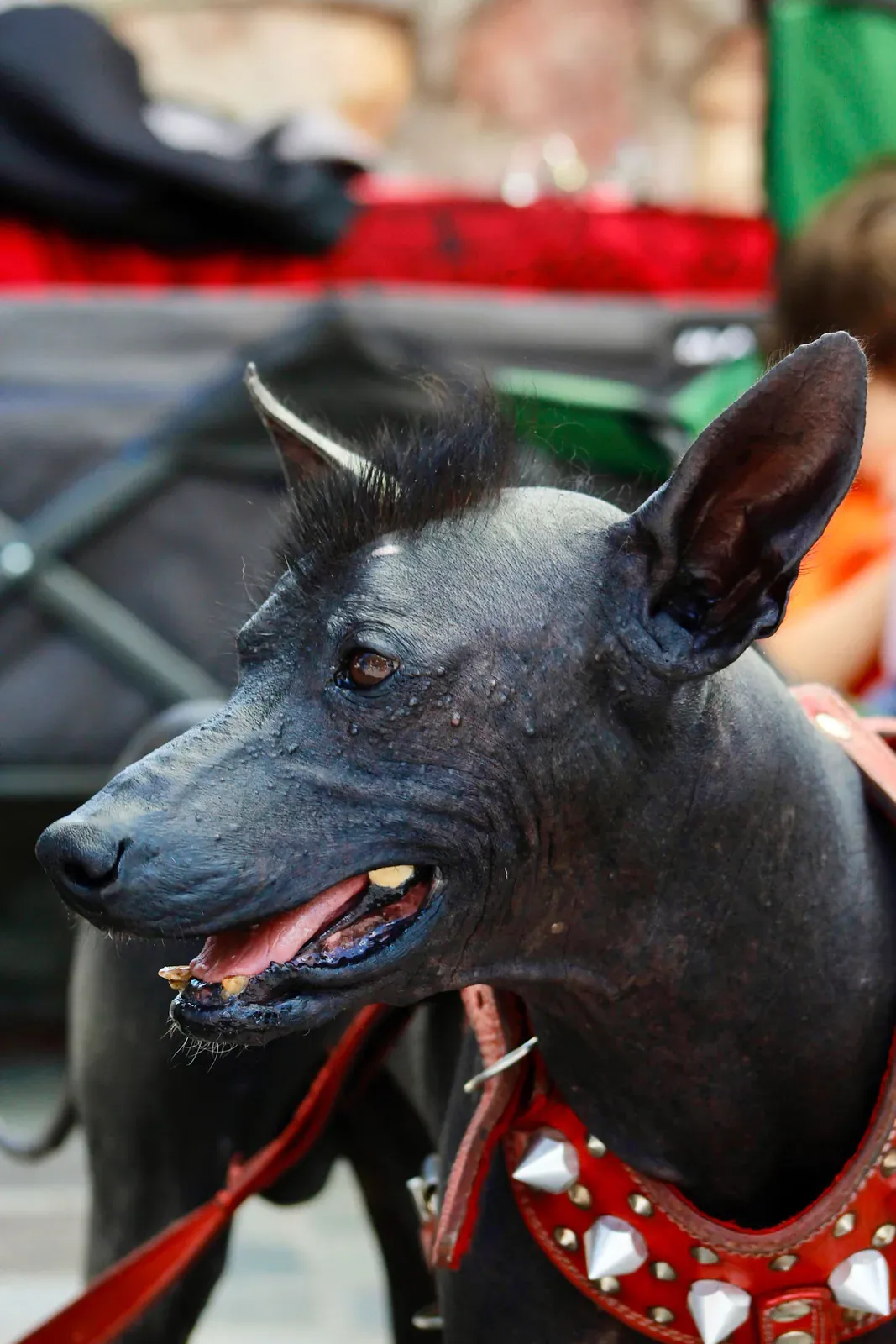
- Hairless (smooth skin, a little hair allowed on head, feet and tail) or coated (short, flat)
- Life span
- Breed sources: 13 to 18 years
- DNA family
- New World family (Parker et al. 2017), weak support
- Related hairless breeds
- Chinese Crested Dog, Peruvian Hairless Dog (same hairless gene)
Drawn to scale in real centimetres. Its back reaches about 43 cm, just below your knee; its head about 54 cm, just above your knee.
Where it sits in the tree
Ancient World · 3,000 BCE to 499
Name and origin
 Related breedBelgian Malinois1891 to 1901 · BelgiumVictorian Breed Boom
The name Xoloitzcuintle comes from Nahuatl, the language of the Aztecs: Xolotl, the name of a god, plus itzcuintli, "dog". It is often shortened to Xolo ("show-low"). Other names in use are Mexican hairless dog, Xoloitzcuintli (the spelling the AKC uses).
The breed's country of origin is Mexico, and the FCI lists it as such. The dog is generally linked with the Mesoamerican peoples who lived in what is now Mexico before the arrival of the Spanish in the 1500s, including the Aztecs (Mexica). How much of the modern Xolo comes from those dogs is a real question, and it is covered in the DNA section below.
 Save

History
 Same eraBasenji3000 BCE to 1937 · Democratic Republic of the CongoAncient World
Xolotl and the dogs of the dead
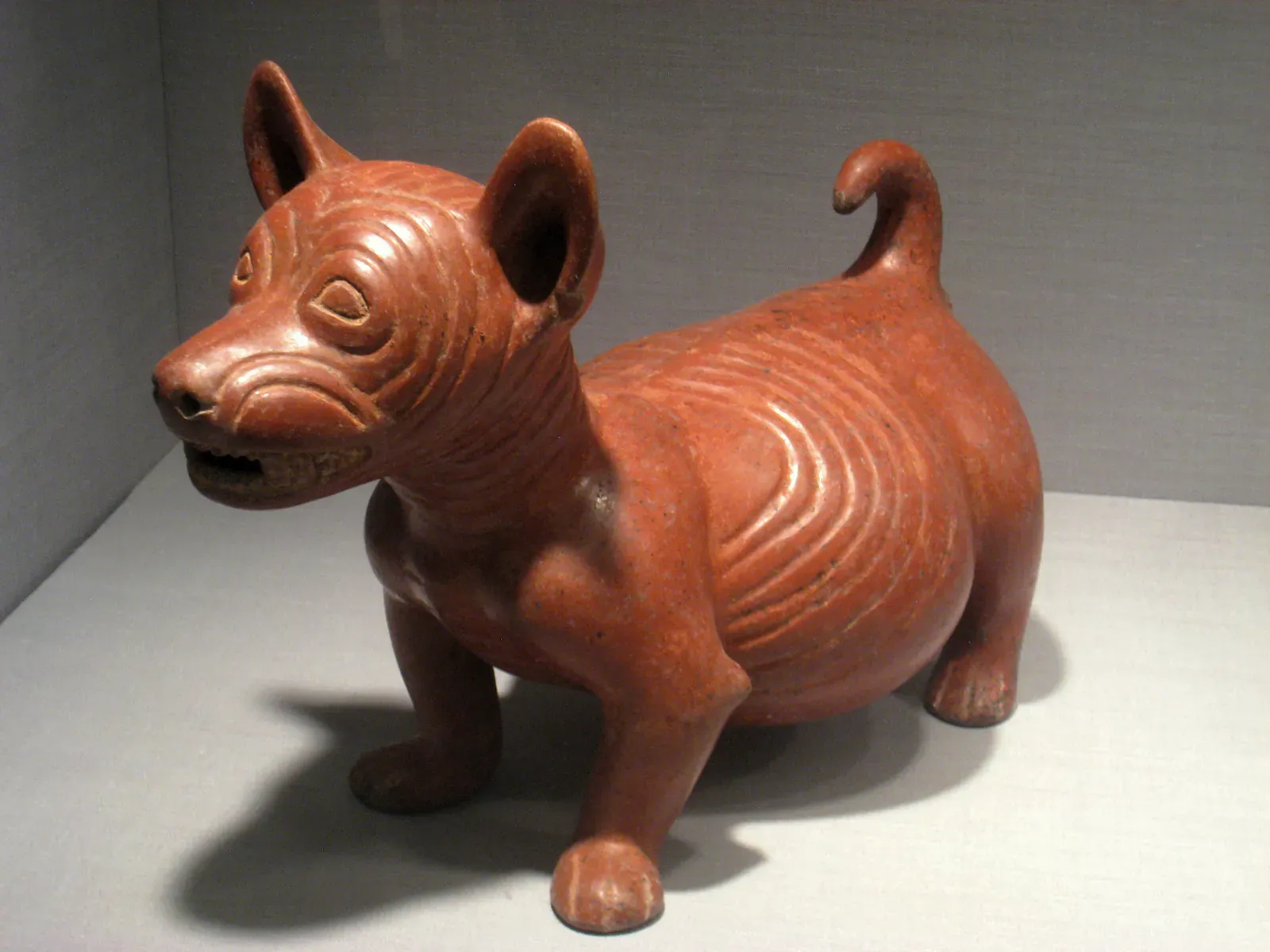
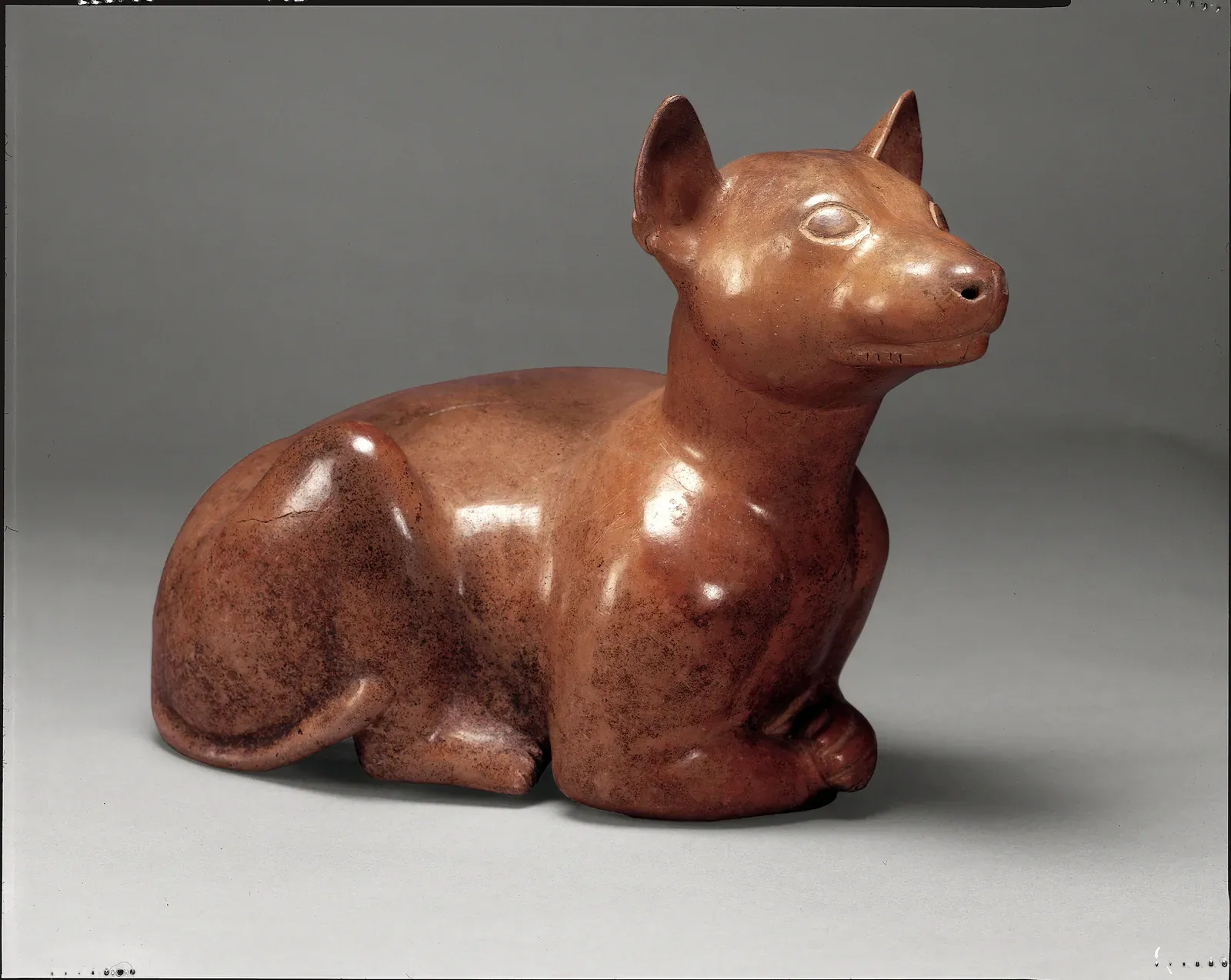
In Aztec belief, as described in many accounts, the god Xolotl was a dog-headed deity linked with fire, lightning and the evening star, and with guiding souls. A widely repeated tradition holds that a dog helped the dead cross the river to Mictlan, the underworld, and that a dog's companionship in life earned it a place at that crossing. Sources also say that dogs were sometimes buried with their owners, and dog sculptures and remains have been found in burials in Mexico, including at the main temple of Tenochtitlan.
This belief is best taken as a legend and religious tradition, not as history in the modern sense. The written accounts come largely from the 1500s, after the Spanish conquest, and they are secondary and incomplete. Not every dog in the burials was hairless, and the link between the god and the specific hairless dog we call a Xolo is a tradition, not a proven fact. See dogs in myth for other dog legends.
The popular line that Xolos were sacred dogs and were sacrificed to accompany the dead appears in many breed accounts. Some of it is supported by burial finds. The details of who, how often and why are not settled.
 Save
Hairless dogs in the archaeology
Dog remains are common in Mesoamerican sites. The question that matters here is when hairless dogs appear. A 2018 paper on dogs from Tizayuca in the Basin of Mexico (Manin and colleagues) notes that the first written accounts of hairless dogs in Mexico date to the 1500s. Some pre-Hispanic skeletons with missing or oddly shaped teeth have been read as early signs of hairlessness, since the gene that removes hair also affects teeth. The authors say that several questions remain open about when hairlessness began and how it relates to modern hairless breeds. Some breed histories give a date of 3,000 years or more; that figure is popular but not firmly supported by one definitive study.
The Spanish period and near loss
After the conquest in the 1500s, Mexican society changed, and so did its dogs. European dogs arrived. Some Spanish-language popular sources say the native dogs were persecuted, but that claim rests on weak sources. What is better supported is that by the mid 1900s the Xolo had become rare outside remote rural areas.
The 1950s rescue
Xolos began to appear at Mexican dog shows in the late 1940s, according to the breed historian Norman Pelham Wright, author of The Enigma of the Xoloitzcuintli. The FCI is reported to have judged that the breed would die out without action. Wright's expeditions to remote parts of Mexico in the 1950s, reported as the 1954 Xolo expedition, are said to have found about ten surviving dogs that became foundation stock. Dates differ between sources. A Mexican is usually dated to 1956, and the FCI recognised the breed in 1961, but these dates come from secondary accounts.
Clubs and recognition
The FCI lists the Xoloitzcuintle as standard no. 234 in Group 5. The AKC removed the Xolo from its in 1959 because the breed was so scarce, placed it in the Miscellaneous Class in 2009, and gave it full recognition in the Non-Sporting Group from 1 January 2011, as its 170th breed. The UK Kennel Club lists three size pages: miniature, intermediate and standard.
Relatives and DNA
 Same familyCarolina Dog1000 BCE to 1990 · United StatesAncient World
Xolos sit in the "New World" family in the Parker et al. (2017) study of 161 breeds, "Genomic analyses reveal the influence of geographic origin, migration, and hybridization on modern dog breed development" (Cell Reports), though with weak support. In this article "family" means that DNA .
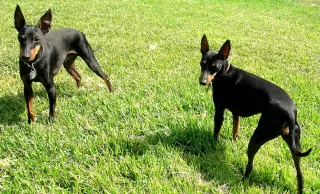
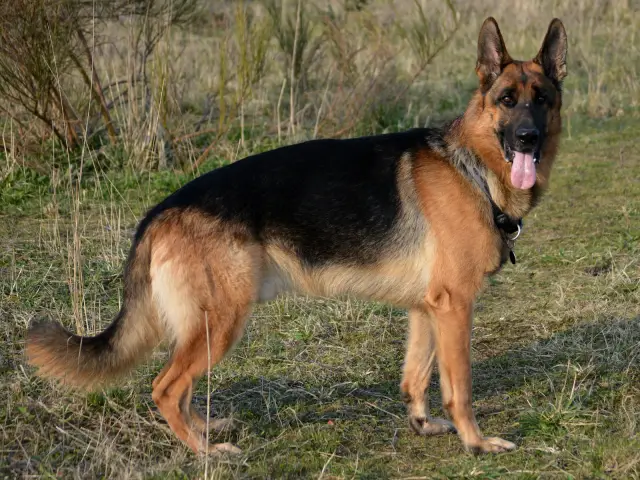
The shared-DNA data from that study is surprising at first sight. The largest shared amount is with the German Shepherd (64.2 Mb), followed by the Berger Picard (20.8), the Dobermann (19.1), the Chinook (18.5), the Toy Manchester Terrier (14.2) and the Chinese Crested Dog (13.1). Overlap with European breeds does not mean the Xolo descends from them. It more likely reflects the dog's mix of ancestry and the way a small, recently re-founded breed shares segments with larger breeds.
Did pre-contact dogs survive in the Xolo?
This is the central DNA question for the breed. Three lines of evidence give a careful answer:
- Ní Leathlobhair and colleagues (2018, Science) sequenced ancient and modern American dogs and found that the dogs that lived in the Americas before European contact descend from dogs that crossed from Siberia with people more than 9,000 years ago. They also found that these pre-contact dogs were largely replaced after European arrival. That study was about the American dog population as a whole and does not single out the Xolo.
- Van Asch and colleagues (2013) studied mitochondrial DNA, which follows the maternal line only. They found a pre-Columbian origin for several native American breeds, including the Chihuahua, the Xoloitzcuintle and the Peruvian Hairless Dog, with limited replacement by European dogs: at most about 30% of the maternal lineages in the American breeds were European. The 30% is an upper limit for the group, not a Xolo figure.
- An Oxford-led mitochondrial study (Manin and colleagues, 2025) of 70 ancient and modern dogs from Mexico to Chile and Argentina found that pre-contact dogs in Central and South America came from one maternal line. It also reported that some modern Chihuahuas still carry maternal DNA from pre-contact Mesoamerican dogs. Whether it reports the same for Xolos is not clear from the summaries available.
The short version: the maternal line of the Xolo most likely goes back to pre-contact Mexico, but whole- ancestry is less clear. Breeds that were re-founded from a handful of dogs in the 1950s may also have taken in other dogs. A statement such as "the Xolo is a living copy of an Aztec dog" is a romantic simplification, not a finding.
 Save
 Save
Sister breeds · 1
- Chinese Crested Dog1500 to 1965
- German Shepherd64.2 Mb 2.7%
- Berger Picard20.8 Mb 0.9%
- Dobermann19.1 Mb 0.8%
- Chinook18.5 Mb 0.8%
- Toy Manchester Terrier14.2 Mb 0.6%
- Chinese Crested Dog13.1 Mb 0.5%
- Cane Paratore12.1 Mb 0.5%
- Pekingese10.4 Mb 0.4%
- Rough Collie10.1 Mb 0.4%
- Belgian Malinois9.8 Mb 0.4%
Source: Parker et al. 2017. Percent of the whole genome.
The hairless gene
 Related breedCaucasian Shepherd Dog500 BCE to 1920 · RussiaAncient World
Hairlessness in the Xolo, the Peruvian Hairless Dog and the Chinese Crested Dog comes from the same change in a gene called FOXI3. Drögemüller and colleagues (2008, Science) mapped it by genome-wide association and found a frameshift mutation in FOXI3, a gene active in developing hair and teeth. Secondary sources describe it as a 7-base-pair duplication in the first exon. The authors named the condition canine ectodermal dysplasia and described it as semi-dominant.
What that means in practice:
- A dog with one copy of the changed gene is hairless, and usually has fewer teeth.
- A dog with two copies is not born alive, so a hairless dog always has one hairless parent and one normal copy.
- A dog with no copies has a coat. Coated Xolos are not a different breed; they are born in the same litters as hairless ones.
- Breeders do not mate two hairless dogs without accepting that a part of the litter will not survive, so many mate a hairless dog to a coated one.
A commercial FOXI3 test for the three hairless breeds exists, and its maker notes that a normal result does not rule out other changes in the gene. A secondary lab page suggests that the mutation arose around 4,000 years ago in Mexican hairless dogs, but the paper's abstract does not give this date.
The gene also explains the teeth. A 2017 study of skulls in Scientific Reports (Kupczik and colleagues, "The dental phenotype of hairless dogs with FOXI3 haploinsufficiency") found that hairless dogs tend to lose permanent canines, premolars and sometimes incisors, whereas coated dogs do not. In the Xolo, missing teeth are part of being hairless, not a sign of poor care.
The breed standard
 Looks relatedCentral Asian Shepherd Dog2000 BCE to 1990 · Turkmenistan, Uzbekistan, KazakhstanAncient World
A breed standard is the written ideal for a breed that kennel clubs judge dogs against. The Xolo standard is unusual because it covers three sizes and two coats.
| Trait | What the standards say |
|---|---|
| Sizes, FCI | Miniature 25 to 35 cm, intermediate 36 to 45 cm, standard 46 to 60 cm (FCI figures) |
| Sizes, AKC | Toy 10 to 14 in, miniature 14 to 18 in, standard 18 to 23 in; dogs under 10 in or over 24 in are disqualified (summary of the AKC standard) |
| Sizes, Canadian Kennel Club | Toy up to 34.9 cm, miniature over 34.9 to 45.7 cm, standard over 45.7 to 57.8 cm |
| Hairless coat | No hair on the body; short coarse hair allowed on the forehead, back of neck, feet and tail tip (FCI, AKC) |
| Coated coat | Short, flat hair over the whole body (FCI, AKC) |
| Colour | Hairless: dark skin tones from black and slate to bronze, red and liver, sometimes blotched (AKC; as reported); coated: as the skin colours |
| Build | Slim, elegant, strong, with a long neck and a clean outline |
| Ears | Large, upright, bat-like |
| Use | FCI: standard and intermediate as guard dogs, miniature as a companion dog |
The UK Kennel Club has separate standard pages for the miniature, intermediate and standard Xolo; its figures are left out here because they could not be verified. The Kennel Club notes that its size descriptions do not mean a dog will match the measurements exactly.
Varieties in the standard. The AKC says all three sizes and both coat types compete together. When the breed joined the Non-Sporting Group, its parent club chose not to split the varieties into separate breeds.
Temperament
 Related breedChow Chow200 BCE to 1895 · ChinaAncient World
Breed descriptions agree on the main picture: a calm, quiet, alert and loyal dog that bonds closely with its family. Xolos are often reserved with strangers and can act as watchful, protective guards, which fits the FCI's use description for the larger sizes. They are clever and can be independent, so training works best when it is positive and consistent.
Puppies are usually active and playful, and many Xolos stay lively into adulthood. Adults tend to be calm indoors and enjoy warmth and closeness, which can mean sitting on laps or in beds. Many owners say they are "velcro" dogs.
Early socialisation matters because reserve can turn into wariness. A dog that meets many people, places and sounds as a puppy is more relaxed later. This advice is general to the breed type and comes from breed descriptions, not from a behaviour study; no research was found that compares Xolo temperament with that of other breeds.

Care: skin, sun and teeth
 Related breedDingo3000 BCE to 1500 BCE · AustraliaAncient World
Skin. The hairless Xolo has exposed skin. Care guides advise sun protection and moisture: a thin coat or a pet-safe sun protection on sunny days, and regular bathing with a gentle shampoo to prevent clogged pores. Some Xolos get blackheads or acne-like spots. Ask a vet before using any product on the skin. The coated variety needs far less skin care and only brushing.
Teeth. Missing teeth are expected in hairless dogs, because of the FOXI3 change (Kupczik et al. 2017). The teeth that remain still need regular brushing and vet dental checks.
Warmth. With no coat, hairless Xolos feel cold more than most dogs. A jumper or coat helps in winter. They also warm up quickly in the sun, so shade matters.
Health
 Related breedIrish Wolfhound100 BCE to 1885 · IrelandAncient World
Most Xolos live healthy, long lives. The breed is generally seen as sturdy and healthy, and Breed sources give a life span of 13 to 18 years. This section is short because no study with named prevalence figures for the Xolo was found, so no "1 in N" numbers are given. The points below are about the breed's biology, not about frequency.
| Condition | What it is | How common | What helps |
|---|---|---|---|
| Missing teeth | Fewer permanent teeth in hairless dogs, caused by the FOXI3 change | Expected in hairless dogs (Kupczik 2017) | Regular tooth brushing and vet dental checks |
| Skin problems | Sunburn, dryness and clogged pores on bare skin | No study figure found | Sun cover, gentle bathing, vet advice |
| Cold sensitivity | Less insulation without a coat | Part of the hairless trait | Coats in cold weather, warm bed |
| Hip and joint problems | Joint disease in some dogs | No figure found for the breed | Ask breeders about hip scores in breeding dogs; keep a lean weight |
Skin and teeth are the two things to plan for, and both can be managed. A DNA test for the hairless gene tells a breeder whether a dog carries it, but it does not screen for disease. Ask breeders what health checks they do and which results they can show you.

Mexico and the Xolo today
 Related breedItalian Greyhound500 BCE to 1900 · ItalyAncient World
The Xolo is widely treated as a cultural symbol of Mexico. In 2016 the government of Mexico City, led by Miguel Angel Mancera, declared the breed a cultural heritage symbol of the city, as reported in the Mexican press. No source found formally names it Mexico's national dog. Lawmakers in the federal Chamber of Deputies have worked on a national Xoloitzcuintle day, and in April 2026 the Chamber was reported to have approved one for 27 October, near Day of the Dead, with the proposal then going to the Senate. Check the current status if it matters to you.
The dog also appears in modern popular culture around the Day of the Dead, which is one reason it is better known than its small numbers suggest.
 Save
Living with a Xoloitzcuintle
 Related breedMaltese500 BCE to 1888 · MaltaAncient World
| Daily reality | Rating | Why |
|---|---|---|
| Exercise per day | Medium | Active but calm; daily walks and play; varies with size |
| Training needs | Medium | Clever and independent; positive training; early socialisation |
| Grooming | Low | Coated: brushing; hairless: skin care and bathing every few weeks |
| Shedding | Low | Hairless dogs shed little; coated dogs shed lightly |
| Barking | Varies | Alert watchdogs; depends on the dog |
| Time alone | Poor | Closely bonded; do not leave alone for long hours |
| Children | Varies | Calm, but reserve and small sizes mean supervision; evidence is thin |
| Other dogs | Varies | Depends on socialisation; evidence is thin |
| Cats and small pets | Varies | Evidence is thin |
| Flat living | Good | Calm indoors; smaller sizes fit easily; needs outings |
| Heat tolerance | Fair | Bare skin burns in the sun; shade and sun cover |
| Cold tolerance | Poor | Hairless dogs need coats in cold weather |
| First-time owner fit | Fair | Easy to live with, but needs skin and dental care and early socialisation |
A great fit if
- You want a calm, close companion that is quiet indoors.
- You are happy to do skin care and tooth care as a routine.
- You can offer warmth in winter and shade in summer.
- You are home for much of the day.
Think twice if
- You want a dog that greets everyone with enthusiasm.
- You are away for long hours.
- You live in a cold place and will not use a coat.
- You mind unusual looks, or the need for regular skin care.
Before you get one
- Health and genetics. Ask breeders what screening they do, which size and coat type the parents are and whether the pairing is hairless to coated. Ask to see original certificates.
- Puppy or adult rescue. Xolos are uncommon outside Mexico, so waiting lists are likely. Rescue organisations sometimes place adults, whose coat, size and temperament are already known.
- First year. Plan for socialisation, tooth care from puppyhood, and a routine for sun and warmth.
Similar breeds to consider
- Chinese Crested Dog. Shares the same hairless gene and the sensitive skin, but is a smaller toy dog with a different history.
- Peruvian Hairless Dog. The closest hairless relative in type, from Peru, with similar care needs.
- American Hairless Terrier. Hairless through a different gene, and more energetic.
- Chihuahua. Another Mexican breed with pre-contact maternal lines, much smaller.

Xoloitzcuintle fun facts
 Related breedPug400 BCE to 1885 · ChinaAncient World
- Xolo puppies from the same litter can be hairless or coated, because hairlessness comes from one gene.
- The hairless gene FOXI3 was described in a 2008 paper in Science by Drögemüller and colleagues.
- The AKC took the Xolo out of its stud book in 1959 and welcomed it back as its 170th breed in 2011.
- The Xolo's largest with another breed is with the German Shepherd (64.2 Mb), which says more about breed history than about looks.
Frequently asked questions
What is a Xoloitzcuintle?
The Mexican hairless dog, a breed from Mexico with three sizes and two coat types, hairless and coated.
Are Xolos really hairless?
The hairless variety has bare skin, with a little hair allowed on the head, feet and tail. The coated variety has a short coat all over. Both are born in the same litters.
How big is a Xolo?
It depends on the size. In the system miniature is 25 to 35 cm, intermediate 36 to 45 cm and standard 46 to 60 cm. The gives toy 10 to 14 in, miniature 14 to 18 in and standard 18 to 23 in.
How long do Xolos live?
Breed sources give 13 to 18 years. No study with a median was found.
Is the Xolo Mexico's national dog?
It is widely called a national symbol, and Mexico City declared it a cultural heritage symbol in 2016. A formal national dog title was not found; a national day has been moving through Congress.
Why do hairless Xolos have missing teeth?
The same gene change that removes the hair affects tooth development (Drögemüller 2008; Kupczik 2017).
Read next
 Closest DNAGerman Shepherd64.2 Mb shared
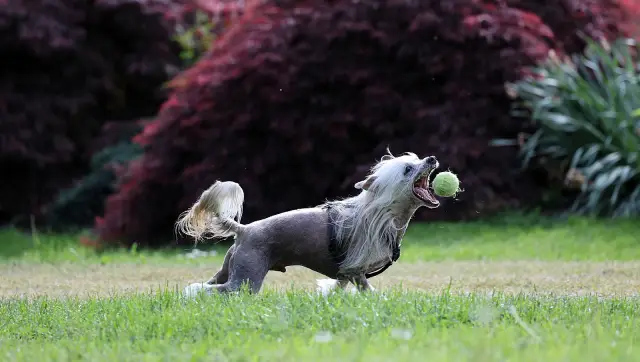 Sister breedChinese Crested Dog1500 to 1965
 Adopt a dogDog Shelters in EuropeFind dog shelters in Europe, learn how shelters differ from country to country and why adopting a dog is a good option.
Sources (14)
- Fédération Cynologique Internationale, Xoloitzcuintle, standard no. 234.
- American Kennel Club, Xoloitzcuintli breed standard, history and varieties pages.
- The Kennel Club (UK), Xoloitzcuintle (Mex Hairless) miniature, intermediate and standard breed standard pages.
- Canadian Kennel Club, Xoloitzcuintli (Toy) breed standard.
- Dogs Victoria (Australia), Xoloitzcuintle breed page (FCI size figures).
- Drögemüller C. et al., "A mutation in hairless dogs implicates FOXI3 in ectodermal development", Science, 2008.
- Kupczik K. et al., "The dental phenotype of hairless dogs with FOXI3 haploinsufficiency", Scientific Reports, 2017.
- Parker H.G. et al., "Genomic analyses reveal the influence of geographic origin, migration, and hybridization on modern dog breed development", Cell Reports, 2017.
- Ní Leathlobhair M. et al., "The evolutionary history of dogs in the Americas", Science, 2018.
- Van Asch B. et al., "Pre-Columbian origins of Native American dog breeds, with only limited replacement by European dogs, confirmed by mtDNA analysis", Proceedings of the Royal Society B, 2013.
- Manin A. et al., study of dogs from Tizayuca, Basin of Mexico, on hairless dogs and dental traits, 2018.
- Manin A. et al., mitochondrial genomes of pre-contact dogs of the Americas, University of Oxford, 2025.
- Wright N.P., The Enigma of the Xoloitzcuintli (breed history, as cited in secondary accounts).
- Excelsior (Mexico), report on the 2016 Mexico City declaration; Mexican Chamber of Deputies communications on a national Xoloitzcuintle day.