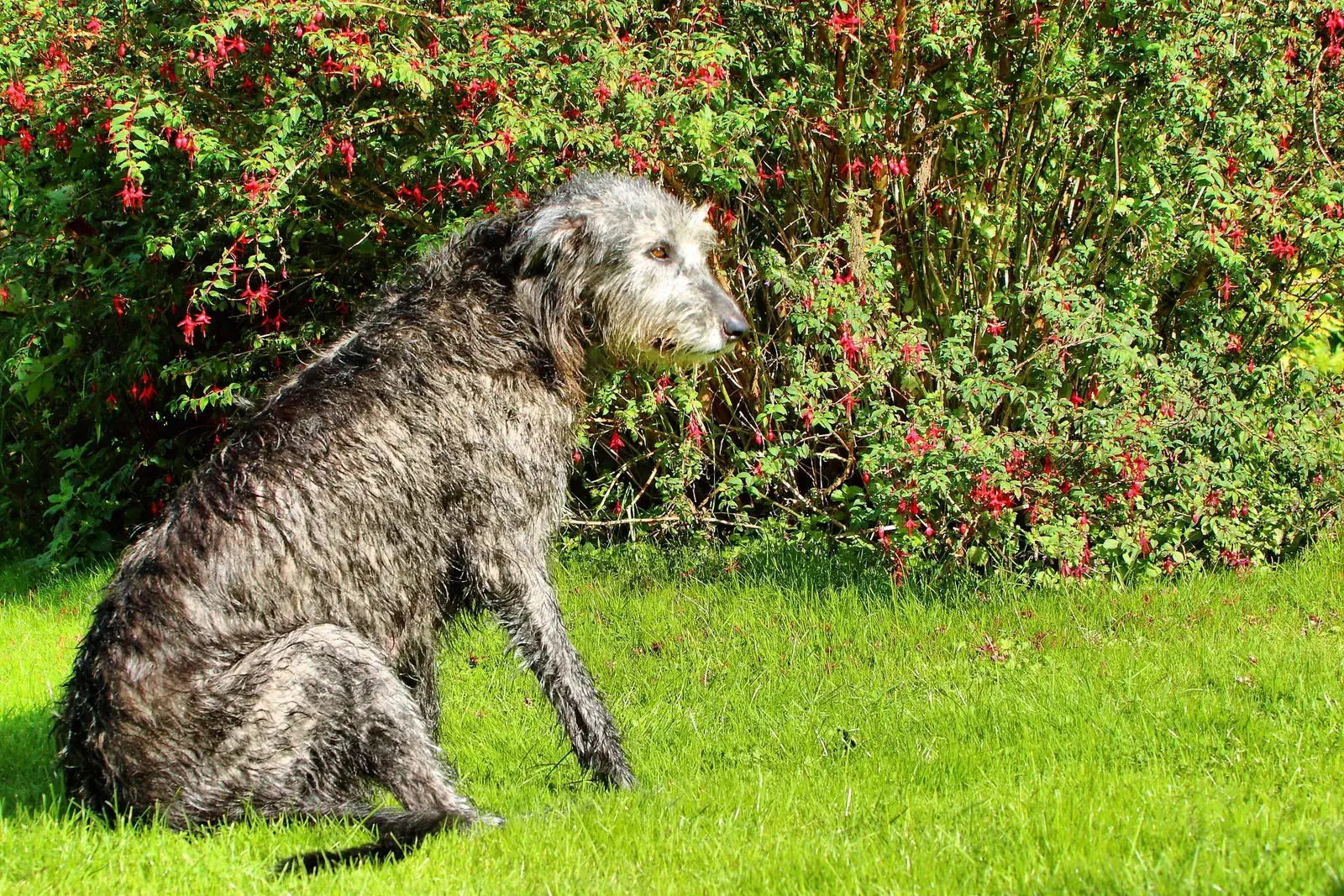
It is a rough-coated hound from Ireland, famous for stories of wolf hunting, Celtic heroes and Roman arena games. The modern breed was rebuilt in the 1860s and after by a British army officer, Captain George Augustus Graham, who crossed the few surviving Irish dogs with other large hounds. Wolfhounds are gentle, quiet and calm indoors, but they need space, and their short life span is the hardest part of living with one. Studies in several countries put the typical life span at about 6 to 8 years.
Quick facts
 Related breedAustralian Kelpie1870 to 1902 · AustraliaVictorian Breed Boom
- Descendant breeds
- Dogo Argentino (atlas data)
- Country of origin
- Ireland
- Period of development
- Ancient Irish hounds (legend and early records, atlas data from about 100 BCE); modern breed rebuilt from the 1860s, club founded 1885
- Original job
- Hunting wolves, deer and boar; war and status dog of Irish chiefs (tradition)
- Type
- Sighthound (FCI Group 10, Sighthounds, standard no. 160; AKC Hound Group; UK Kennel Club Hound Group)
- Height
- FCI and Kennel Club: dogs average 81 to 86 cm. AKC and IWCA: dogs at least 81 cm, bitches at least 76 cm
- Weight
- Dogs at least 54.5 kg; bitches at least 40.5 kg (FCI) or 40.9 kg (UK Kennel Club) or 47.6 kg (AKC)
- Coat
- Rough, hard and wiry, longer over the eyes and under the jaw
- Colour
- Grey, brindle, red, black, pure white or fawn (as the standards list them)
- Life span
- Atlas data: 6 to 10 years. Studies report means from about 5 to 8.75 years
- Exercise
- Moderate; daily walks and room to run, but not a high-energy breed indoors
- DNA family
- UK Rural family (Parker et al. 2017)
Drawn to scale in real centimetres. Its back reaches about 79 cm, your hip; its head about 100 cm, your waist.
Where it sits in the tree
Ancient World · 3,000 BCE to 499
Name and origin
 Related breedAustralian Shepherd1840 to 1957 · United StatesIndustrial Revolution
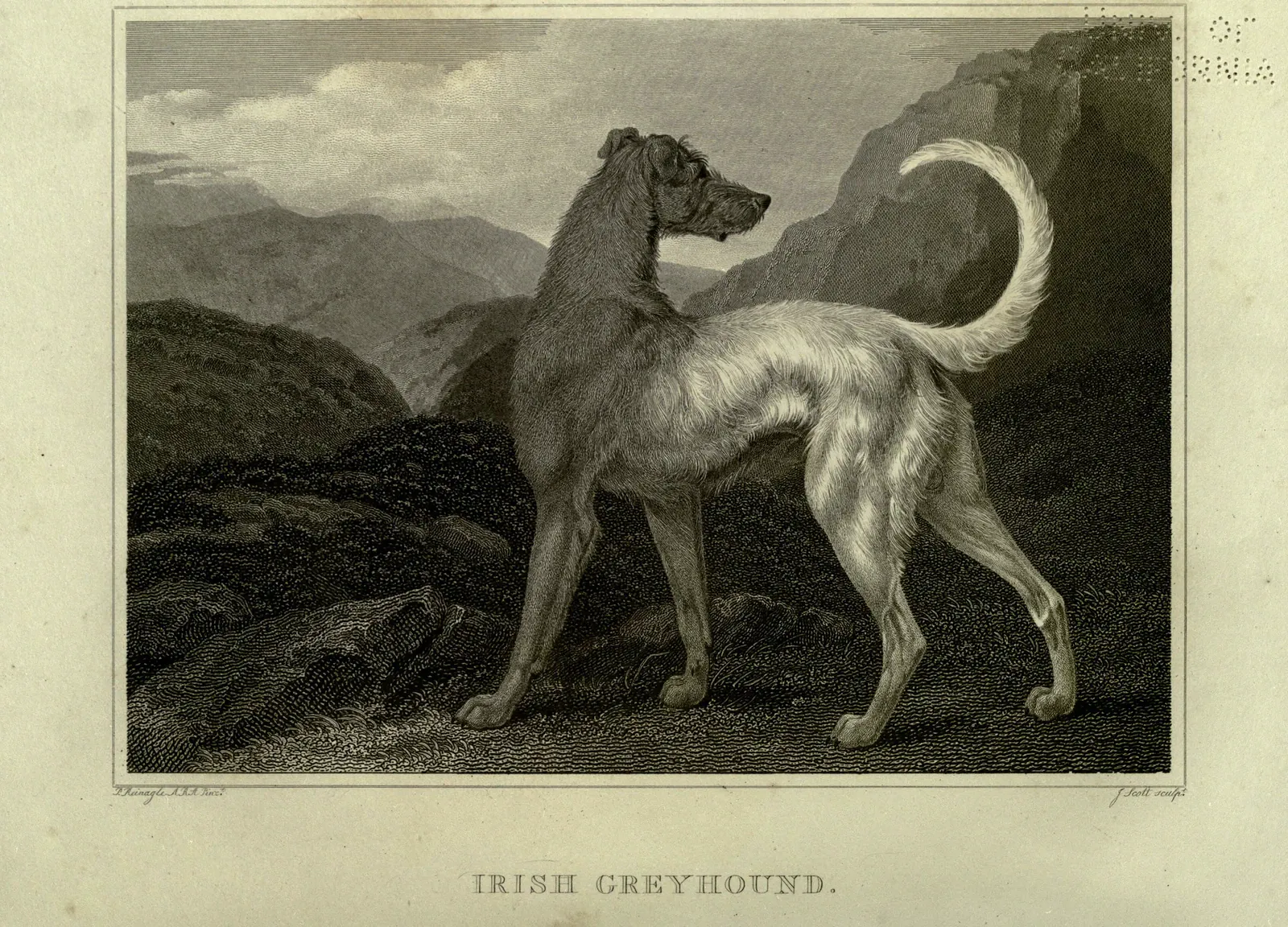
"Wolfhound" says what the dog was for. The Irish name is Cú Faoil, from cú (hound) and faoil (wolf). In early Irish law and literature, cú can mean any hound, so the old texts do not always tell us which kind of dog they mean. A big hunting hound that went after wolves, deer and boar was part of Irish life for a very long time, but the line from those dogs to today's breed is not a straight one.
Three points help sort fact from tradition.
- Old records. Irish laws from about the 6th century mention hounds and the owners' duties and rights. Retellings often say only kings, chiefs and nobles could own the great hounds. This comes from later summaries of the Brehon laws, so read it as general tradition.
- A Roman letter. The oldest widely quoted record is a letter from the Roman senator Quintus Aurelius Symmachus, dated 391 CE. He thanked his brother for a gift of seven Irish dogs for the games in Rome and said the crowds watched them in wonder. The letter does not say the dogs were wolfhounds as we know them. It shows that large Irish hounds were prized abroad.
- How the modern breed formed. Historians still argue whether Captain Graham revived a fading breed or built a new one that looks like the old one. Many accounts say he kept the old appearance but not the old bloodlines.
The atlas data gives the first appearance as about 100 BCE (a medium-confidence date) and the established modern breed as 1885.
 Save

History
 Same eraBearded Collie1500 to 1944 · United KingdomAge of Exploration
Legends of the great Irish hound
Irish stories are full of hounds, and they are the oldest "history" of the breed. All of these are legends, written down in medieval manuscripts, and none proves what the dogs looked like.
- Cú Chulainn. As a boy named Setanta, he killed the fierce guard dog of the smith Culann and offered to guard Culann's herds until a new dog could be raised. He took the name Cú Chulainn, "the hound of Culann". Retellings differ on how he killed the dog. The story does not say the dog was a wolfhound, though modern breed histories often claim it was.
- Fionn mac Cumhaill. The warrior-hero Fionn is said to have owned the hounds Bran and Sceolan, and later tales give him huge packs. These are heroic tales, not records.
- Hounds as gifts. Stories and later popular accounts describe wolfhounds as royal gifts to foreign courts. The Symmachus letter is the one early document that fits this idea.
You can read more about dogs in these old stories in the atlas guide to dogs in myth.
Wolves, hunting and decline
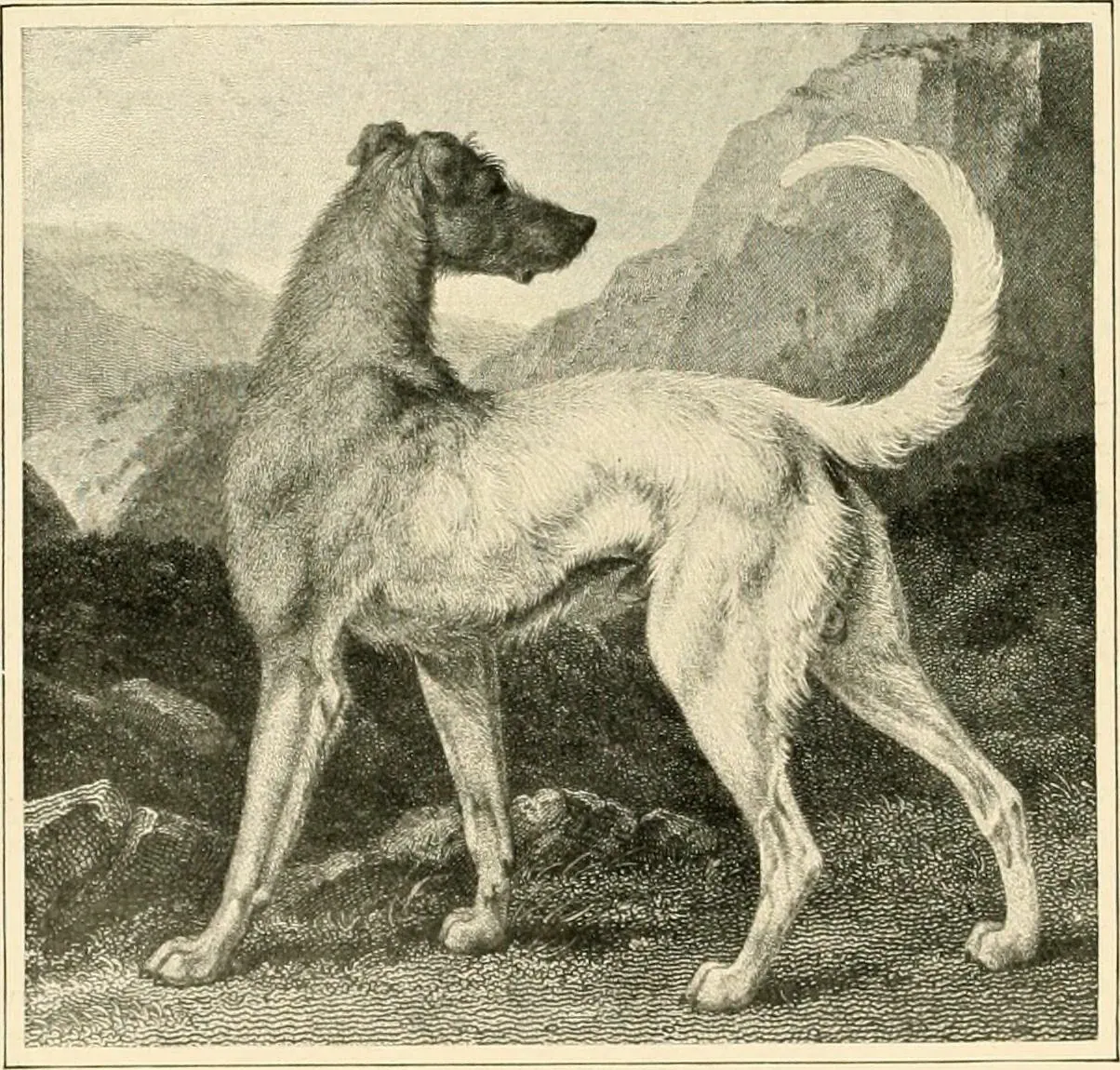
Wolves lived in Ireland for a long time, and they were a threat to livestock. In the 1650s the English government of Ireland set money rewards for killing them. Sources give 1652 or 1653 for the rewards, so the exact year is uncertain. Forest clearing also took away wolf habitat.
In April 1652 the same government is reported to have banned the export of "wolfe dogges" from Ireland, because the dogs were being sent abroad as gifts and in trade. Popular accounts say this ban "saved" the breed. That is too simple: the ban slowed the loss, but with the wolves disappearing and demand abroad continuing, numbers kept falling.
By tradition the last Irish wolf was killed in County Carlow in 1786, though accounts disagree on the place and the date. Most sources agree that wolves were gone by about the end of the 18th century. Without wolves to hunt, the great hounds lost their job. A list of animals that had disappeared from Ireland, published in 1836, is cited in breed histories as already counting the wolfhound among the lost. A few dogs survived in the hands of some Irish families, and those few were the base for the revival.
 Save
Captain Graham and the revival
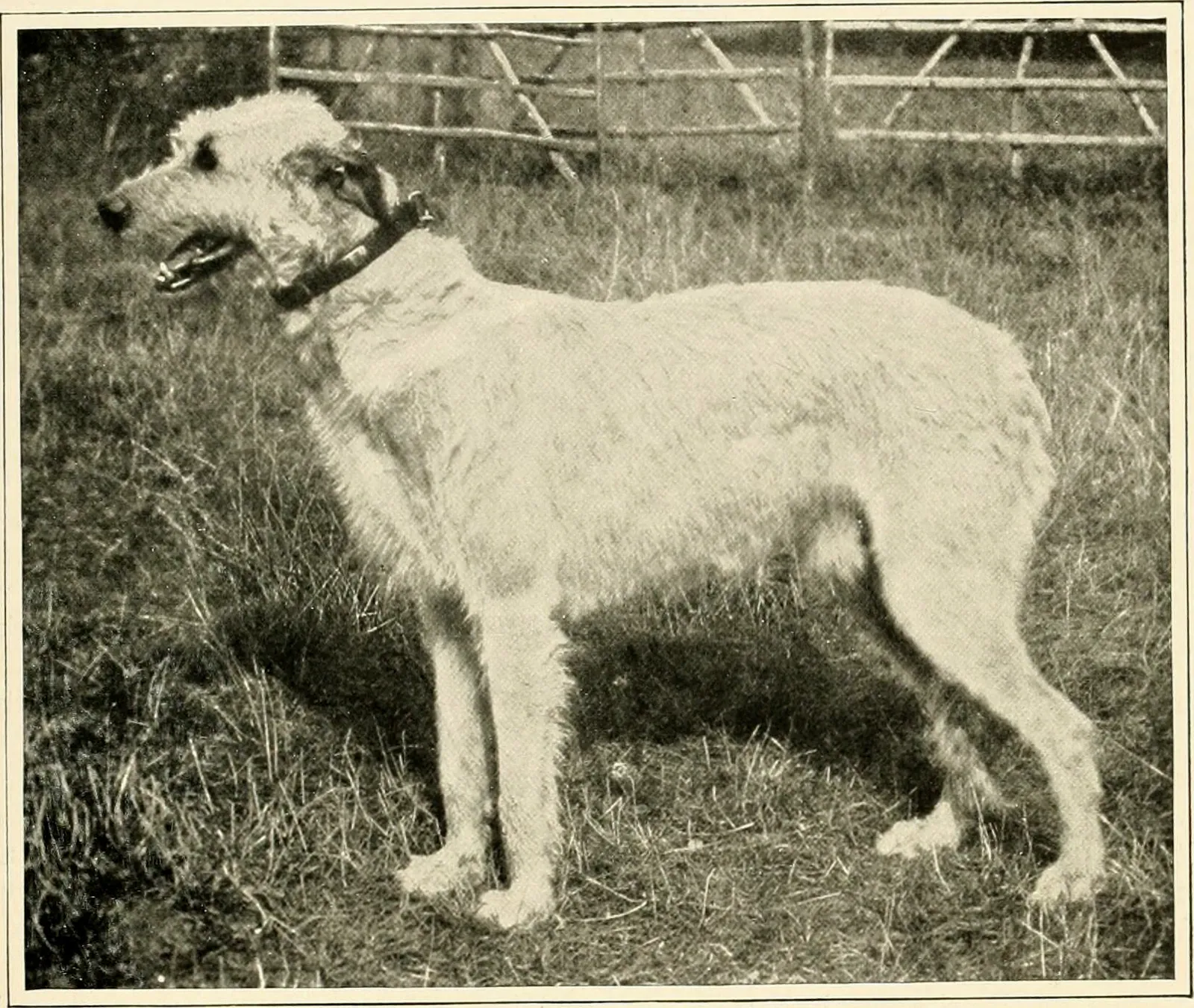
Captain George Augustus Graham, an army officer living at Dursley in Gloucestershire, England, is credited with saving the breed. Sources give different starting years: 1862, 1863 and, in one source, 1869. He collected the best of the remaining Irish dogs, including stock from the Kilfane and Ballytobin lines, which came to him through earlier Irish breeders such as Sir John Power and H. D. Richardson.
Graham himself doubted that the surviving dogs were pure. To restore the size and the look of the old hound he used outcrosses:
- Scottish Deerhound. The main outcross, and the biggest contributor.
- Great Dane. Used repeatedly. The Parker 2017 study found DNA sharing between the two breeds, and the atlas data records the cross.
- Borzoi. Used on a small scale. The AKC history names a dog called Korotai, owned by the Duchess of Newcastle.
- A Tibetan dog. The AKC says one cross to a Tibetan Mastiff named Wolf (some believe it was a rare Kyi Apso). Wikipedia is more cautious and says only that a "Tibetan wolfdog" may have been used.
Graham and other fanciers founded the Irish Wolfhound Club in 1885. The AKC says the followed in 1886, while another source credits the Irish Kennel Club with the first standard in 1885, so the standard's date is given here as 1885 or 1886. The breed has been bred as a pure breed ever since.
 Save
Clubs and recognition
The FCI lists the breed as Group 10, Sighthounds, with Ireland as the country of origin (standard no. 160). The AKC places it in the Hound Group, and the UK Kennel Club in the Hound Group. Breed clubs exist in Ireland, Britain, the United States and many other countries. They run health surveys and keep pedigree databases that researchers use (see Health).
Relatives and DNA
 Same familyBorder Collie1800 to 1915 · United KingdomIndustrial Revolution
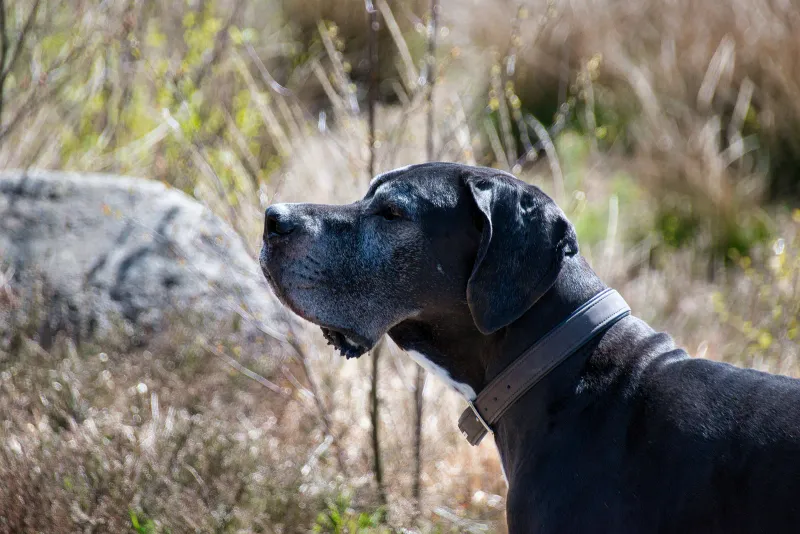
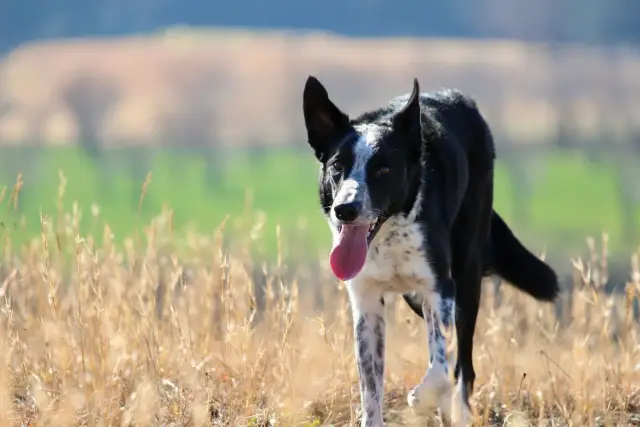
The Parker et al. 2017 study (Cell Reports) placed the Irish Wolfhound in the UK Rural family, a group of British and Irish hunting and herding breeds. Its closest breed in the shared-DNA numbers was the Scottish Deerhound (122 shared), then the Great Dane (38.4 Mb), the Greyhound (19.3 Mb) and the Whippet (9.8 Mb). That fits Graham's crosses and the sighthound base of the breed.
The whole family is on the UK Rural family page.
Descend from it · 1
- Dogo ArgentinoArgentina
- Scottish Deerhound122.0 Mb 5.1%
- Great Dane38.4 Mb 1.6%
- Greyhound19.3 Mb 0.8%
- Whippet9.8 Mb 0.4%
Source: Parker et al. 2017. Percent of the whole genome.
| Relation | Breeds | Source |
|---|---|---|
| Crossed in the revival | Scottish Deerhound, Great Dane | Atlas data, AKC and club histories |
| Used in small numbers | Borzoi | AKC history |
| Close DNA relatives | Scottish Deerhound, Great Dane, Greyhound, Whippet | Parker et al. 2017 |
| Descendant | Dogo Argentino | Atlas data |
The breed standard
 Looks relatedBorzoi1200 to 1650 · RussiaLate Middle Ages
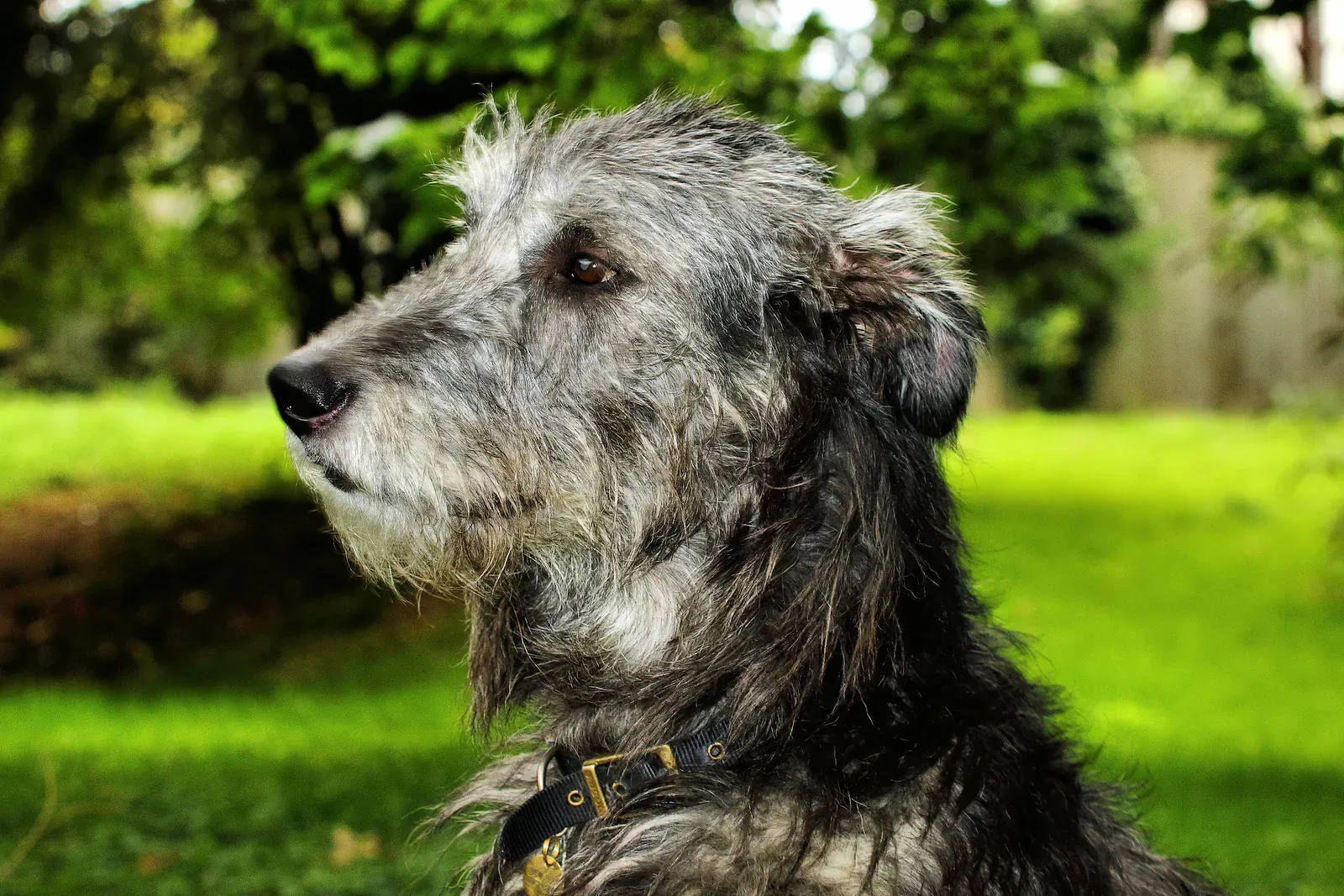
A breed standard is the written ideal a kennel club judges dogs against. The Irish Wolfhound standards agree on the type: a very large, powerful but graceful hound, rough-coated, with a long head, small rose ears and a long, slightly curved tail. They differ on how they state size.
| Trait | What the standards say |
|---|---|
| Height, dogs | FCI: average 81 to 86 cm, with a minimum of 79 cm (2016 text). UK Kennel Club: average 81 to 86 cm. AKC and Irish Wolfhound Club of America: at least 81 cm (32 in) |
| Height, bitches | FCI: minimum 71 cm (2016 text). AKC and IWCA: at least 76 cm (30 in). UK Kennel Club: height for bitches not listed |
| Weight, dogs | FCI: 54.5 kg. UK Kennel Club: at least 54.5 kg. AKC and IWCA: at least 54.5 kg (120 lb) |
| Weight, bitches | FCI: 40.5 kg. UK Kennel Club: at least 40.9 kg (90 lb). AKC and IWCA: at least 47.6 kg (105 lb) |
| Coat | Rough, hard and wiry on body, legs and head; especially wiry over the eyes and under the jaw |
| Colour | Grey, brindle, red, black, pure white, fawn or any other colour found in the Deerhound |
| Head and ears | Long head, carried high; small ears, rose shaped |
| Build | Great size and commanding look; muscular, strong and fast, with a deep chest and a long, curved tail |
The standards call the Irish Wolfhound the tallest of the breeds, and the FCI text describes it as the largest and tallest of the sighthounds. The AKC and club figures apply to hounds over 18 months. The FCI text above is the 2016 version; a revision dated 2026 exists.
Tallest breed? The Irish Wolfhound and the Great Dane both compete for this title. The Great Dane is usually heavier and holds most records for individual dogs; the Wolfhound is the tallest of the sighthounds and a leading contender for the tallest breed on average standards.
Temperament
 Related breedCardigan Welsh Corgi1200 to 1934 · United KingdomLate Middle Ages
The Irish Wolfhound is known for being gentle, quiet and dignified indoors. The old saying is "gentle when stroked, fierce when provoked", which owners and clubs often repeat, but a calm and friendly nature is what the breed standard and breed clubs actually describe. The FCI and UK standards describe a dog that is kind, patient, thoughtful and generous, and not suspicious or aggressive.
- With people. Usually friendly and quiet with family and visitors. It is a poor guard dog, because it is rarely protective or noisy. Its size is what people notice first.
- With children. Gentle with respect. A fully grown wolfhound can knock over a toddler without meaning to, so size and supervision matter more than temper.
- With other dogs. Usually good with dogs it knows. Sighthound chase instinct can show up around fast-moving small animals.
- Intelligence and training. Clubs describe it as sensitive and quick to learn but not eager to repeat. Gentle, short sessions work better than force.
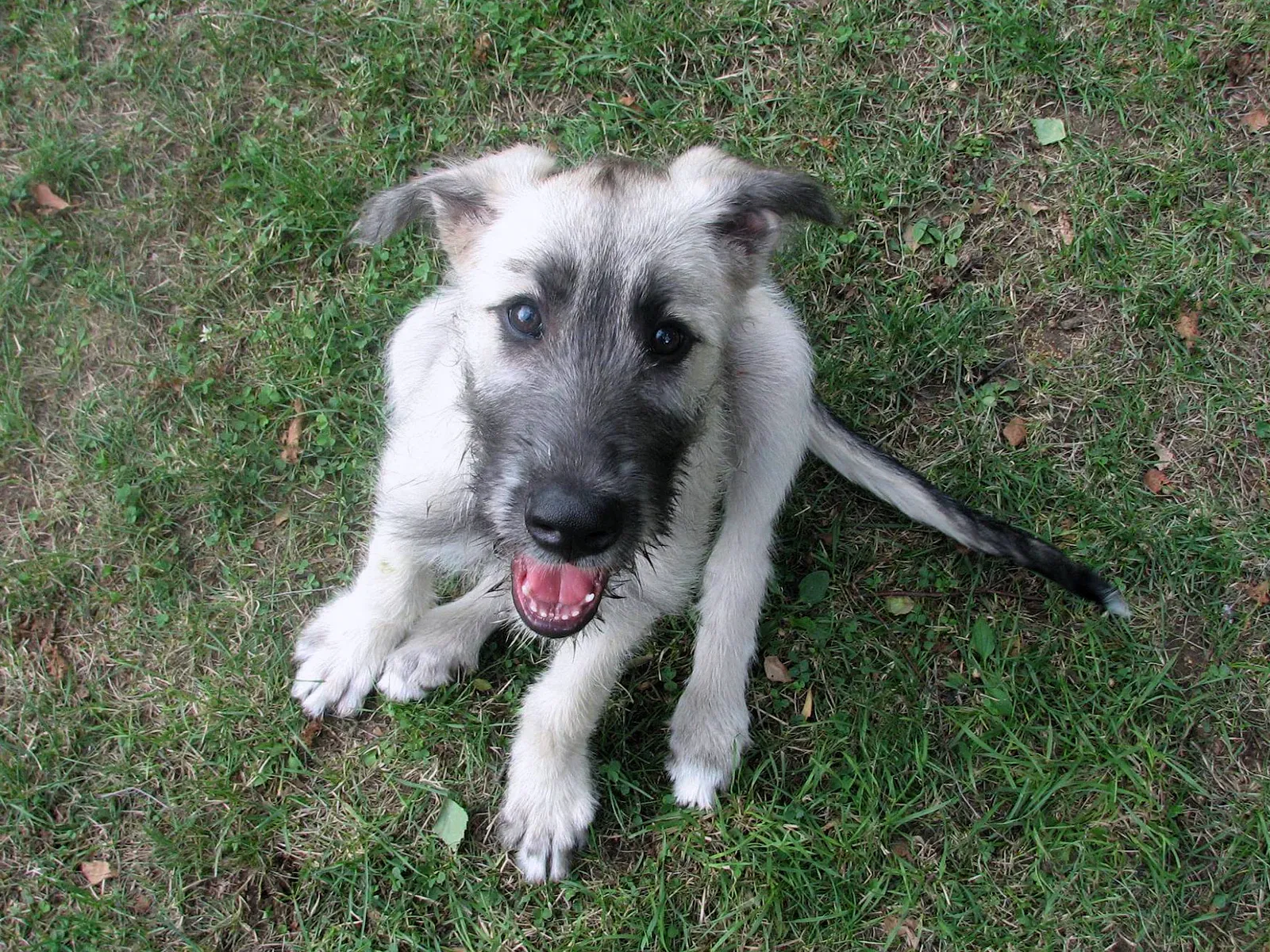
The temperament varies between dogs, and early training and socialisation help. A giant puppy grows fast, so calm manners (no jumping, walking on a loose lead) are worth teaching before it is large.
Hunting instincts and training
 Related breedMiniature American Shepherd1968 to 2015 · United StatesModern Era
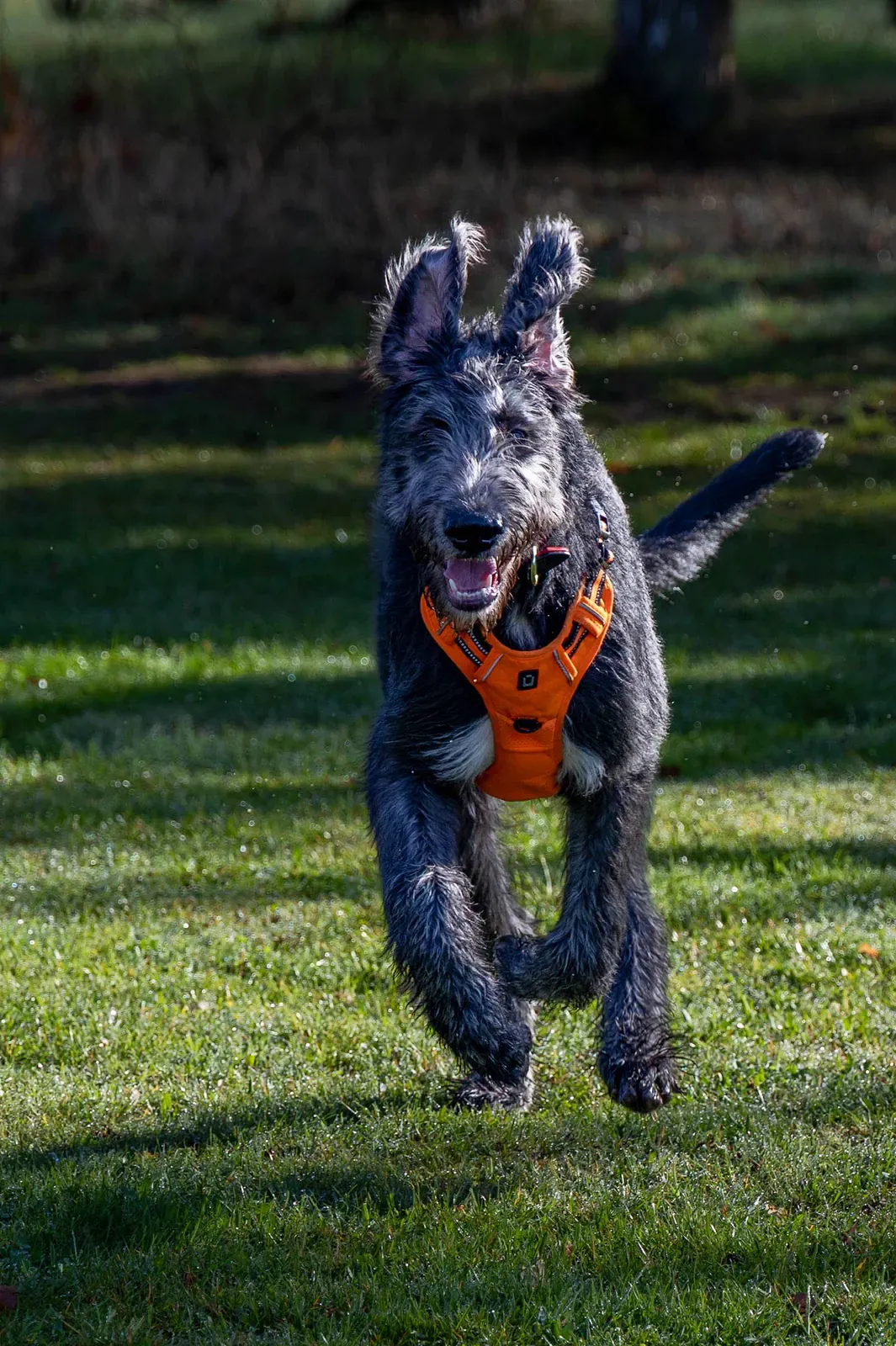
Wolfhounds hunt by sight and chase. They are not as fast as a Greyhound, but they are fast, big and powerful for a dog their size. Even a calm adult may chase a cat, rabbit or small dog that bolts. Recall is unreliable around moving prey, so walk off lead only in fenced or very safe places.
- Exercise. Enough for a big hound: daily walks, with space to run. Puppies should not do hard or repeated exercise, jumping or long runs while their bones are growing.
- Training. Positive methods suit a sensitive hound. Teach lead walking and calm greetings early.
- Home setup. A dog this big needs a bed it can stretch on, a car it can fit in and food and vet costs that scale with size.
 Save
Health
 Related breedOld English Sheepdog1700 to 1888 · United KingdomEarly Modern Era
Most Irish Wolfhounds live happy, active lives in their short span. This section lists what breeders screen for and what owners can watch for, with figures from named studies. It is general information; your vet knows your dog. Studies of the breed's health are among the most detailed for any giant breed, thanks to breed club databases.
Life span. Wolfhounds do not live long. A review by Urfer and colleagues (2007) found published mean life spans ranging from about 4.95 to 8.75 years and warned that many figures are biased by dogs still alive when the studies ended. A Swedish questionnaire study (Acta Veterinaria Scandinavica, 2017) reported a median life span of 2,720 days, about 7.4 years, with 101 responses. An older US club study of 1966 to 1986 found a mean age at death of 6.47 years, with bone cancer the most common cause. The atlas data gives 6 to 10 years. A Norwegian university thesis using the Irish Wolfhound database (118,095 dogs, 10,122 with a known life span) found life span moderately heritable (0.27), so breeding choices can shift it over time.
| Condition | What it is | How common | What helps |
|---|---|---|---|
| Dilated cardiomyopathy (DCM) | The heart muscle weakens and the chambers stretch, so the heart pumps less well | Screening of 1,038 wolfhounds in 1990 to 2004 found about 29 percent affected, about 1 in 3 (cited in a review by Vollmar and Fox, 2016; original study not identified). A North American screening study (Tyrrell et al., 2020) found a lower rate, 1.8 percent, about 1 in 56, using a strict definition | Yearly heart checks with an ultrasound (echocardiogram) and ECG by a cardiologist from young adulthood; ask breeders for results |
| Atrial fibrillation (AF) | An irregular heartbeat from the upper heart chambers, often an early sign before DCM | 8.9 percent in the Tyrrell 2020 North American study, about 1 in 11. Reported in up to 21 percent of screened dogs in some selected populations (Vollmar and Fox, 2016) | Same screening; AF with male sex predicted later DCM in the Tyrrell study |
| Osteosarcoma (bone cancer) | A tumour of the bone, usually a leg bone | The breed has one of the highest rates and an early age of onset (Momen et al., 2021). Heritability was estimated at 0.65 in 5,110 dogs, so genes matter a lot. No published prevalence figure | Report limb lameness lasting more than a few days to a vet; no screening test; the 2007 review advises against routine male neutering because of a link with higher risk |
| Gastric dilatation and volvulus (bloat) | The stomach fills with gas and may twist | Listed as one of the most commonly reported conditions in the 2007 review; no published prevalence figure | Feed measured meals; avoid hard exercise around meals; ask a vet about preventive stomach surgery |
| Osteochondrosis and other bone growth issues | Cartilage forms abnormally in growing joints | Reported among common diseases in the 2007 review; no figure used | Steady puppy growth, a balanced diet for giant breeds, and no hard jumping |
What the heart studies show
Vollmar and colleagues have followed wolfhounds with heart disease for years. In a 2019 study, 52 wolfhounds with atrial fibrillation but no sign of DCM were compared with 52 healthy controls. Of the 52, 26 went on to develop DCM, and 49 had died by the end of the study. The authors concluded that wolfhounds with early AF commonly develop DCM, but that other conditions also shorten life in the breed. A 2018 study of 151 dogs on long-term therapy found median survival of 29.1 months for preclinical DCM with a normal heart rhythm, 21.9 months with AF, and 7.3 months once heart failure appeared. These findings are why breed clubs recommend regular heart screening and why finding AF early matters.
 Ticks and fleasTicks and fleas on dogs: how to check, remove and prevent themTicks and fleas on dogs: how to tell them apart, check your dog, remove a tick safely, break the flea life cycle and prevent both.
 GuidesPractical guidesBehaviour, training, health and adoptionRelated breedOld English Sheepdog1700 to 1888 · United KingdomEarly Modern Era
Living with an Irish Wolfhound
 Related breedPembroke Welsh Corgi1100 to 1934 · United KingdomEarly Middle Ages
| Daily reality | Rating | Why |
|---|---|---|
| Exercise per day | Medium | Daily walks and some safe running; calm indoors |
| Training needs | Medium | Sensitive, quick to learn; manners matter because of size |
| Grooming | Medium | Weekly brushing and hand stripping or trimming of the wiry coat (breed clubs) |
| Shedding | Medium | Rough coat; seasonal shed |
| Barking | Low | Usually quiet; a poor watchdog |
| Time alone | Fair | Social dog; separation problems are possible, but evidence is thin |
| Children | Good | Gentle, but size means supervision with toddlers |
| Other dogs | Good | Usually good with dogs it knows |
| Cats and small pets | Poor | Strong chase instinct as a sighthound; varies by dog and early exposure |
| Flat living | Poor | Very large dog needing room to stretch and a lift or ground floor |
| Heat tolerance | Fair | Large dog with a rough coat; no source rates it |
| Cold tolerance | Good | Rough, hard coat |
| First-time owner fit | Fair | Gentle, but its size, costs and health needs are a lot to learn |
A great fit if
- You have a large house, a secure garden and a car that fits a giant dog.
- You want a quiet, gentle dog that is calm at home and goes for good walks.
- You can plan for a short life and heart and bone health checks from the start.
- You can pay for giant-breed food, vet fees and insurance.
Think twice if
- You live in a small flat or on high floors without easy access.
- You have cats, rabbits or small pets you cannot keep separate.
- You want a guard dog or a dog that lives into its teens.
- You cannot lift or manage a dog of 55 kg or more.
Before you get one
- Health tests. Ask the breeder for heart screening results (an ultrasound by a cardiologist and an ECG) for both parents, and for their health history, including any bone cancer in close relatives. Ask for the originals. Breeders can also check the breed database for life span and cause of death in a puppy's family.
- Puppy or adult rescue. Breed rescues exist, and adults come with a known size and temperament. An adult can suit someone who does not want to raise a giant puppy.
- First year. Wolfhound puppies grow very fast. Ask a vet about feeding and gentle exercise, keep the puppy lean and avoid hard jumping and long runs.
Similar breeds to consider
- Scottish Deerhound. A smaller, closely related hound with a similar gentle nature and chase instinct.
- Great Dane. Equally giant, with a smooth coat and its own heart and stomach risks.
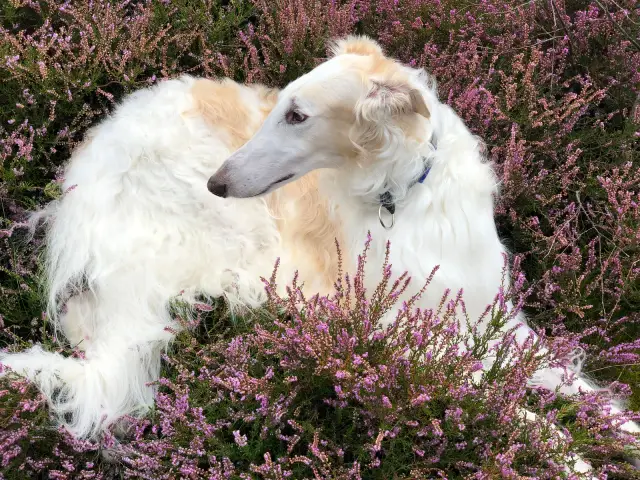
- Borzoi. An elegant Russian sighthound, lighter and with a silky coat.
- Greyhound. A smaller, short-coated sighthound that is much faster and more compact.

Irish Wolfhound fun facts
 Related breedRough Collie1800 to 1886 · United KingdomIndustrial Revolution
- The Irish name Cú Faoil means "wolf hound", and the Roman senator Symmachus wrote about seven Irish hounds in 391 CE.
- The 1652 export ban on "wolfe dogges" is a favourite fact in breed histories, but it did not by itself save the breed.
- The Irish Wolfhound shares more DNA with the Scottish Deerhound (122 Mb) than any other breed in the Parker 2017 study.
- The Dogo Argentino, a hunting dog bred in Argentina, lists the Irish Wolfhound among its ancestors in the atlas data.
Frequently asked questions
How tall is an Irish Wolfhound?
Dogs average 81 to 86 cm ( and UK Kennel Club) and the and club standard sets a minimum of 81 cm; bitches at least 76 cm (AKC) or 71 cm (FCI 2016 text).
How long do Irish Wolfhounds live?
Studies report averages of about 5 to 8.75 years, with a Swedish median of about 7.4 years. Many die of bone cancer or heart disease.
What do Irish Wolfhounds die of?
Bone cancer (osteosarcoma) and heart disease, including DCM and atrial fibrillation, are the best-documented causes in the studies above.
Are Irish Wolfhounds good family dogs?
Often yes. They are gentle and quiet. They need space, supervision with small children and an owner prepared for a giant dog's costs.
Are Irish Wolfhounds good guard dogs?
Not usually. They are friendly and rarely protective, though their size alone puts some people off.
Where did the Irish Wolfhound come from?
From Ireland, where large hunting hounds have a very long history. The modern breed was rebuilt by Captain George Augustus Graham from the 1860s using Scottish Deerhound, Great Dane and other outcrosses.
Read next
 Closest DNAGreat Dane38.4 Mb shared
 FamilyUK RuralThe whole family
 Adopt a dogDog Shelters in EuropeFind dog shelters in Europe, learn how shelters differ from country to country and why adopting a dog is a good option.
Sources (14)
- Fédération Cynologique Internationale, Irish Wolfhound, standard no. 160 (2016 text consulted).
- American Kennel Club, Irish Wolfhound breed history and breed standard pages.
- Irish Wolfhound Club of America, breed standard, early history and revival pages, and "Longevity and Morbidity in the Irish Wolfhound in the United States, 1966 to 1986".
- The Kennel Club (UK), Irish Wolfhound breed standard.
- Parker H.G. et al., "Genomic analyses reveal the influence of geographic origin, migration, and hybridization on modern dog breed development", Cell Reports, 2017.
- Urfer S.R. et al., "Lifespan and disease predispositions in the Irish Wolfhound: a review", 2007.
- Vollmar C. et al., studies of atrial fibrillation and dilated cardiomyopathy in Irish Wolfhounds, Free University of Berlin and Munich (2018 survival study; 2019 subclinical AF study).
- Vollmar A.C. and Fox P.R., "Long-term outcome of Irish wolfhound dogs with preclinical cardiomyopathy, atrial fibrillation, or both treated with pimobendan, methyldigoxin, or benazepril monotherapy", 2016.
- Tyrrell W.D. et al., echocardiographic and electrocardiographic evaluation of North American Irish Wolfhounds, 2020.
- Momen M. et al., "Heritability and genetic variance estimation of osteosarcoma (OSA) in Irish Wolfhound, using deep pedigree information", Canine Medicine and Genetics, 2021.
- Swedish questionnaire study of life span in Irish Wolfhounds, Acta Veterinaria Scandinavica, 2017.
- Norwegian University of Life Sciences (NMBU), thesis "Genetic analysis of lifespan in Irish wolfhounds", using the Irish Wolfhound database.
- Joyce P.W., "A Social History of Ancient Ireland" (hunting and hounds in ancient Ireland).
- Wild Ireland and Irish popular history sources on the Irish wolf and the 1652 export ban (accounts differ on dates).