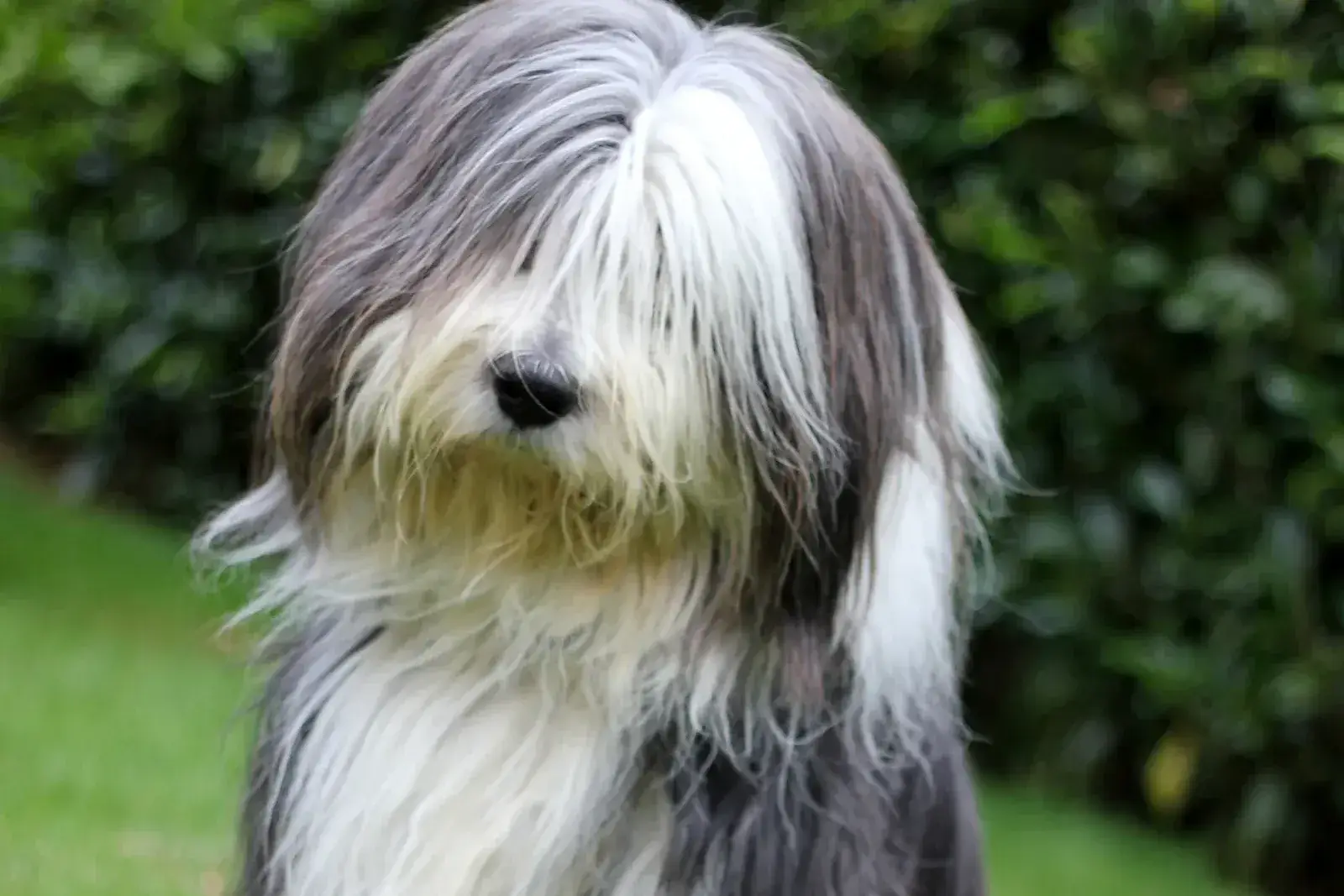
It was bred to gather sheep and cattle on hill farms, and it was close to disappearing in the 1940s before a handful of dogs rebuilt the breed in Britain. It suits active households that enjoy outdoor exercise and will brush a long coat most days. It tends to struggle with owners who want a quiet, low-grooming dog or who are away for long hours.
Bearded Collie quick facts
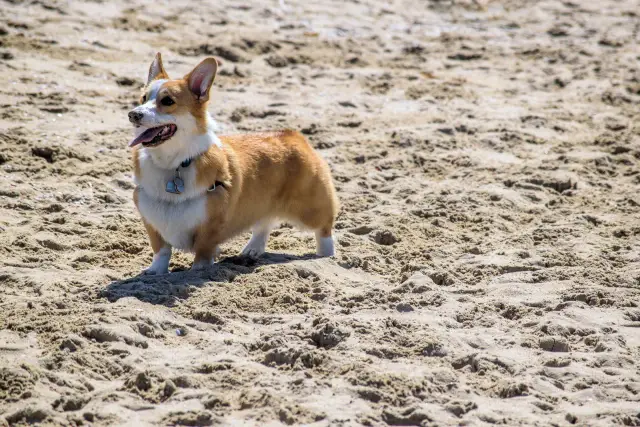 Related breedPembroke Welsh Corgi1100 to 1934 · United KingdomEarly Middle Ages
- Closest DNA relatives
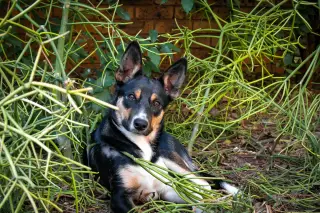
- Border Collie, Rough Collie, Australian Kelpie
- Other names
- Beardie, Highland Collie
- Country of origin
- United Kingdom (Scotland, Great Britain)
- Period of development
- About 1500 to 1944 (atlas data, medium confidence)
- Type
- Herding dog ( Group 1, standard no. 271; Herding Group; UK Kennel Club Pastoral Group)
- Height
- Kennel Club and FCI standards: dogs 53 to 56 cm, bitches 51 to 53 cm. AKC: 21 to 22 in (53 to 56 cm) dogs, 20 to 21 in (51 to 53 cm) bitches
- Weight
- Breed standards give no weight
- Coat
- Double coat: soft, furry undercoat under a flat, harsh, shaggy outer coat
- Colours
- Slate grey, reddish fawn, black, blue, brown and sandy shades, with or without white markings
- Life span
- Atlas data: 12 to 14 years. Kennel Club: over 12 years
- Exercise
- Kennel Club: up to 1 hour a day. PDSA: 1 to 2 hours a day
- DNA group
- "UK Rural" (Parker et al. 2017)
- Descendant breeds in atlas data
- Old English Sheepdog, Hall's Heeler (and through it the Australian Cattle Dog)
Drawn to scale in real centimetres. Its back reaches about 54 cm, just above your knee; its head about 68 cm, mid-thigh.
Where it sits in the tree
Age of Exploration · 1500 to 1599
Name and origin
 Related breedCardigan Welsh Corgi1200 to 1934 · United KingdomLate Middle Ages
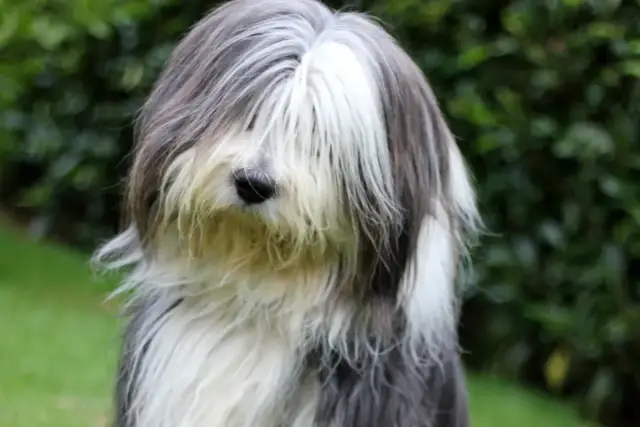
The "Bearded" part is plain: the long hair on the muzzle and chin falls into a beard. "Collie" is older and its origin is uncertain. It may come from the Scots word coll, meaning coal or black, or from "colley", a name for a black-faced sheep. The breed has also been called the Highland Collie, a name that points to the Scottish hill farms where it worked.

History
 Same eraOld English Sheepdog1700 to 1888 · United KingdomEarly Modern Era
The 1514 legend
One popular story says the Beardie came to Scotland in 1514, when a Polish grain trader named Kazimierz Grabski sailed to Scotland and swapped his Polish Lowland Sheepdogs for Scottish sheep. Scottish shepherds then crossed those dogs with local collies. The story is repeated in many breed histories, but it is a legend: no document of the time survives to support it. What can be said is that shaggy herding dogs of this kind were working in Scotland for centuries before anyone registered them.
Before the show ring
Early writers described rough-coated, bearded sheepdogs in the Scottish uplands and borders. The first detailed book portrait comes from The Dogs of Scotland (1891) by D. J. Thompson Gray, who described the breed and offered an early standard. The dogs were working animals first. Farmers valued a dog that could gather and move stock on open hill ground and work some distance from the shepherd. Looks came second.
One pup, and the 1940s revival
By the early 1940s the breed was rare outside a few farms. The usual account says Mrs G. Olive Willison asked a Scottish farmer for a working Shetland Sheepdog and was sent a Bearded Collie pup instead, which she named Jeannie (dates around 1944 are common). Willison then looked for a male. On a beach in Brighton she met a Bearded Collie whose owner was about to emigrate, took the dog, and registered him as Bailie of Bothkennar. The prefix "Bothkennar" became the name of her kennel. Accounts of when the first litter arrived differ: one gives April 1950, another says about five years after Jeannie came.
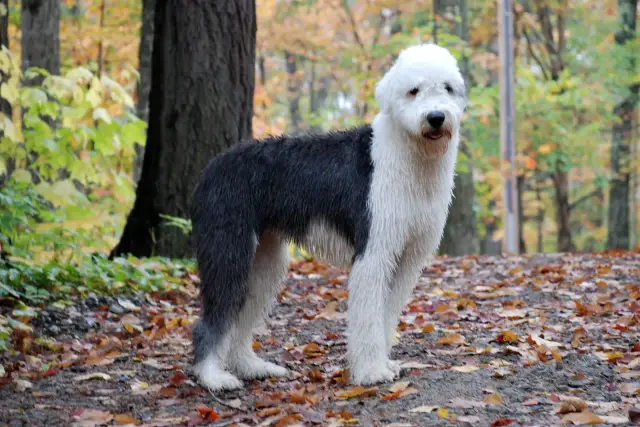
Sources agree that these two dogs are the foundation of the modern breed. Some histories add that Willison used a little Old English Sheepdog blood while rebuilding the stock, though the DNA link between the two breeds is modest (see below). The atlas data puts the end of the breed's development period at 1944, the year the revival began.
Recognition and show breeds
The Kennel Club (UK) puts the Bearded Collie in the Pastoral Group, the FCI lists it as standard no. 271 (definitive, country of origin Great Britain), and the AKC places it in the Herding Group. A Kennel Club statement notes that no points of concern specific to the breed have been identified for judges beyond what the standard already covers.
Relatives and DNA
 Same familyAustralian Shepherd1840 to 1957 · United StatesIndustrial Revolution
The atlas data lists no fixed parent breeds for the Bearded Collie. It records two child breeds: the Old English Sheepdog and Hall's Heeler. The Hall's Heeler is the 19th-century Australian cattle dog line that later fed into the Australian Cattle Dog, so the atlas data also lists that breed, and the Australian Stumpy Tail Cattle Dog, as descendants. Where breed histories disagree on how much collie blood went into these breeds, treat the atlas link as a family connection, not as a precise recipe.
What does DNA say?
A 2017 study by Parker and colleagues (Cell Reports) analysed 1,346 dogs from 161 breeds and sorted them into 23 supported clades. The Bearded Collie falls in the "UK Rural" clade with other British herding breeds and several sighthounds, and the atlas data records the support for this placement as strong. The study also measured shared , long stretches of identical DNA inherited from common ancestors. The more () two breeds share, the stronger the sign of shared founders or crossing. The method cannot say which way the genes flowed. See the UK Rural family for the wider group.
Source: Parker et al. 2017, as recorded in this site's breed database.
The Border Collie is the closest match by a wide margin. That sits well with the story of Scottish and northern English collie stock moving freely between farms. The Rough Collie is second, and the Australian Kelpie third, a pattern that fits Scottish collies travelling to Australia with shepherds. The Old English Sheepdog shares 20.8 Mb, far below the Border Collie, so the "Old English blood" in Willison's revival and the "child" link in the atlas should be read as modest contributions, not as a close pairing.
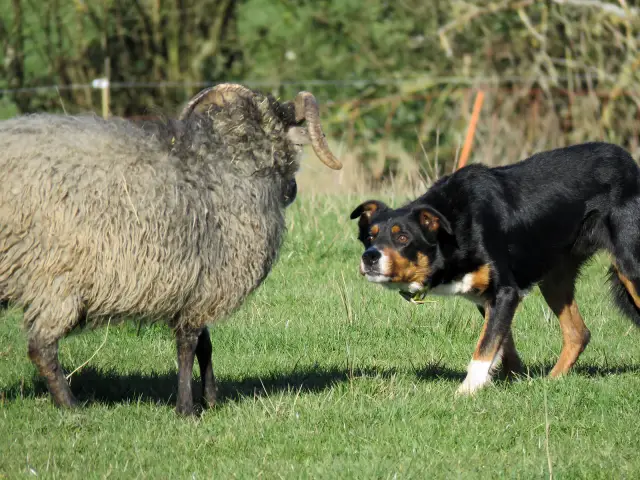
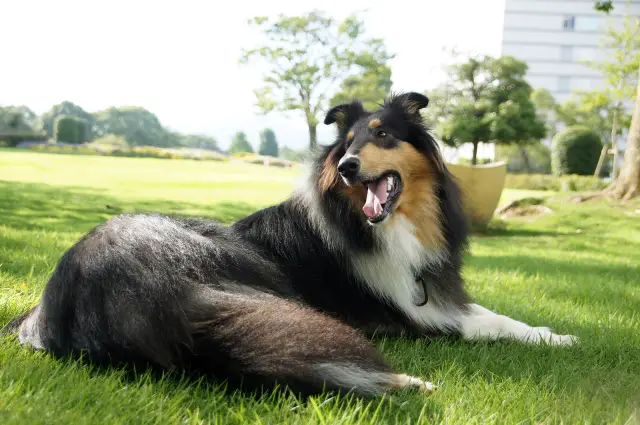
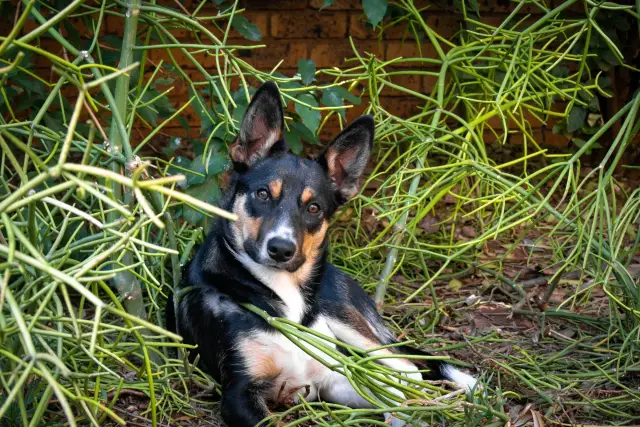
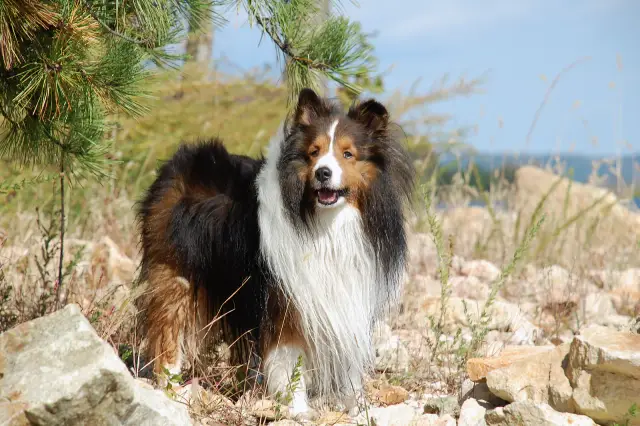
- Bearded Collie and Border Collie
- Bearded Collie and Rough Collie
- Bearded Collie and Australian Kelpie
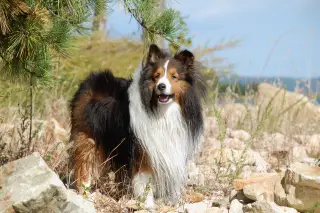
- Bearded Collie and Shetland Sheepdog
- Bearded Collie and Old English Sheepdog
Descend from it · 2
- Old English SheepdogUnited Kingdom
- Halls HeelerAustralia
- Border Collie77.8 Mb 3.2%
- Rough Collie63.1 Mb 2.6%
- Australian Kelpie41.8 Mb 1.7%
- Shetland Sheepdog30.6 Mb 1.3%
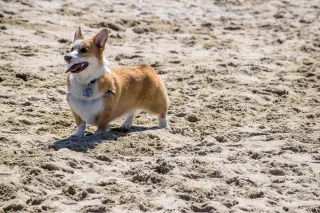
- Pembroke Welsh Corgi23.3 Mb 1.0%
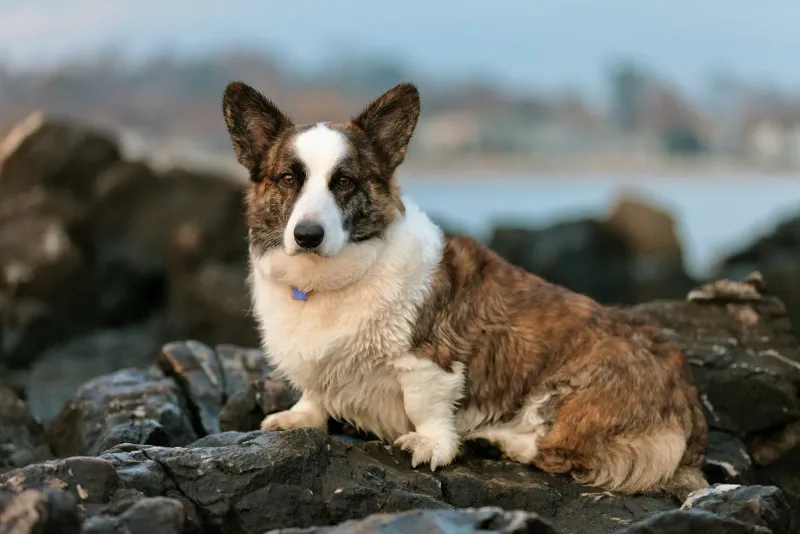
- Cardigan Welsh Corgi22.6 Mb 0.9%
- Old English Sheepdog20.8 Mb 0.9%
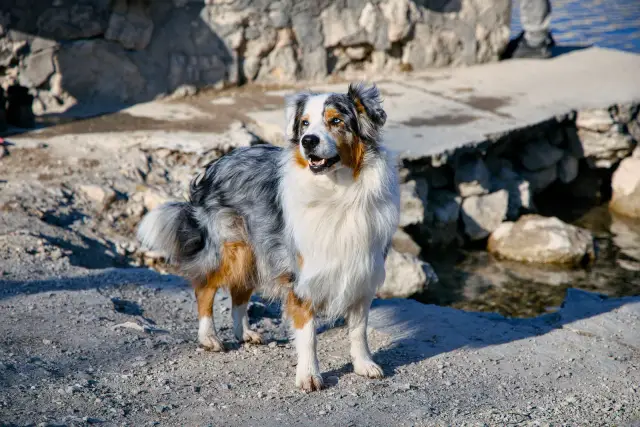
- Australian Shepherd19.1 Mb 0.8%
- Australian Cattle Dog16.2 Mb 0.7%
- Chinook10.7 Mb 0.4%
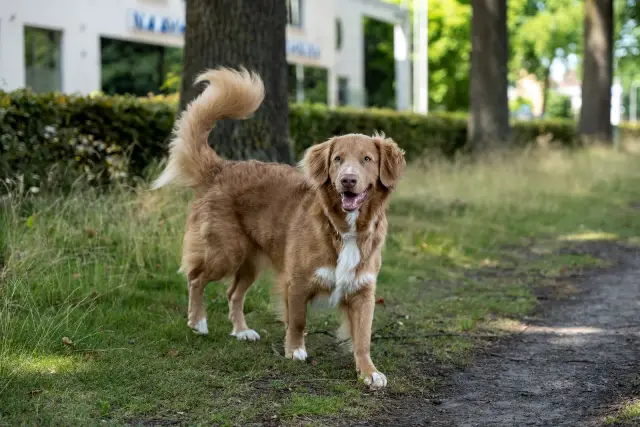
- Nova Scotia Duck Tolling Retriever10.5 Mb 0.4%
Source: Parker et al. 2017. Percent of the whole genome.
| Breedwith Bearded Collie | with Bearded Collie (Mb)Shared DNA (Mb) |
|---|---|
| Border Collie | 77.8 |
| Rough Collie | 63.1 |
| Australian Kelpie | 41.8 |
| Shetland Sheepdog | 30.6 |
| Pembroke Welsh Corgi | 23.3 |
| Cardigan Welsh Corgi | 22.6 |
| Old English Sheepdog | 20.8 |
| Australian Shepherd | 19.1 |
| Australian Cattle Dog | 16.2 |
Source: Parker et al. 2017, Cell Reports, shared haplotypes between 161 breeds (1,346 dogs).
The Bearded Collie breed standard
 Looks relatedAustralian Cattle Dog1840 to 1903 · AustraliaIndustrial Revolution
A is the written ideal that judges compare each dog against. The Kennel Club standard describes a lean, active dog, longer than tall, with a strong, deep chest and a long, low-set tail carried low with an upward curve at the tip when the dog moves. The Kennel Club notes that its sizes are a guide and that individual dogs may be larger or smaller.
| Trait | What the standards say |
|---|---|
| Height | Kennel Club and FCI: dogs 53 to 56 cm, bitches 51 to 53 cm. AKC: 21 to 22 in for dogs, 20 to 21 in for bitches |
| Weight | None given in the standards |
| Head | Broad, flat skull, in proportion to the body, with a strong, fairly square muzzle |
| Eyes | Large, wide apart; colour in harmony with the coat |
| Ears | Medium size, drooping, set level with the eyes |
| Coat | Double. Soft, furry undercoat; flat, harsh, strong, shaggy outer coat that parts along the spine; hair on the muzzle forms the beard |
| Colours | Slate grey, reddish fawn, black, blue, all shades of grey, brown and sandy, with or without white markings |
| Movement | Supple, smooth and long-reaching, covering ground easily (Kennel Club) |
The hair does more than look pretty. The harsh outer coat sheds rain and the soft undercoat keeps the dog warm on a wet Scottish hillside. Puppies are usually born darker and many lighten as they grow, which surprises first-time owners of a black or brown pup.
Bearded Collie temperament
 Related breedNova Scotia Duck Tolling Retriever1860 to 1945 · CanadaVictorian Breed Boom
The Kennel Club standard describes a steady, intelligent working dog that should be stable, self-confident and active, with no sign of nervousness or aggression. In daily life that translates to a cheerful, outgoing, people-focused dog. Owners often describe the "Beardie bounce": an exuberant, springing style of greeting and play that can last well into adulthood. Most Bearded Collies are friendly with strangers and other dogs, though early socialisation matters. See socialising your dog for a practical starting plan.
Compared with its close relative the Border Collie, the Beardie is usually described as less intense and less eye-driven, with a goofier, more independent streak. It is a herding dog, so many will try to round up children, other pets or joggers by circling, barking or nudging. A Beardie that has little to do can also become noisy and destructive. For a general guide to teaching manners, see dog training basics.
Training works best with short, upbeat sessions and plenty of praise. Bearded Collies are clever and often slow to mature, so a young adult can behave like a puppy for two or three years. Harsh handling tends to switch them off. Many enjoy agility, obedience, rally, herding trials and long hill walks.

Bearded Collie health
 Related breedBorzoi1200 to 1650 · RussiaLate Middle Ages
Bearded Collies are generally sturdy dogs, but the breed has an unusually high rate of autoimmune disease, which is the main health theme to understand before buying a puppy. For lifespan, atlas data gives 12 to 14 years and the Kennel Club gives over 12. For comparison, O'Neill and colleagues (The Veterinary Journal, 2013) found a median age at death of 12.0 years across all breeds in English vet records, and Lewis and colleagues (Canine Genetics and Epidemiology, 2018) found a median of 10.33 years across breeds in a Kennel Club survey.
The best-studied problem is Addison's disease (hypoadrenocorticism), where the adrenal glands stop making enough cortisol and other hormones. A 2019 study by Gershony and colleagues describes a relatively high prevalence of autoimmune disease in the breed, particularly Addison's disease and symmetrical lupoid onychodystrophy, and links one DLA gene haplotype to higher Addison's risk. No breed rate is published here. A 2020 -wide study in 140 Bearded Collies (55 affected, 85 unaffected) found a region on chromosome 18 linked with the disease and described it as polygenic: many genes contribute, so no single DNA test predicts it.
Information here is general. A vet should look at any individual dog. For breeders, the Kennel Club recommends using the health schemes that apply to the breed, including hip scoring in the BVA/Kennel Club scheme.
| Condition | What it is | How common | What helps |
|---|---|---|---|
| Addison's disease | Immune attack on the adrenal glands; weakness, vomiting, collapse | No published figure; described as relatively high for the breed | Blood tests; lifelong hormone replacement; avoid breeding from affected lines |
| Other autoimmune disease | Includes hypothyroidism and immune-mediated blood disorders | No published figure | Early vet checks for tiredness, weight change or pale gums |
| Symmetrical lupoid onychomadesis | Immune-mediated loss of claws; Steimer and colleagues described it in Bearded Collies (Veterinary Dermatology, 2019) | No published figure | Vet diagnosis and vet-led treatment |
| Hip dysplasia | Loose or malformed hip joint; named by PDSA and the Kennel Club among breed concerns | No published breed rate in the sources used | BVA/Kennel Club hip scoring of breeding dogs; healthy weight |
| Skin allergies | Itchy skin and ears; listed by PDSA | No published figure | Vet diagnosis; regular coat and ear checks |
Because the long coat hides skin, check weekly under the beard, between the toes and behind the ears. Ticks and fleas hide easily in this coat.
 Ticks and fleasTicks and fleas on dogs: how to check, remove and prevent themTicks and fleas on dogs: how to tell them apart, check your dog, remove a tick safely, break the flea life cycle and prevent both.
 GuidesPractical guidesBehaviour, training, health and adoptionRelated breedBorzoi1200 to 1650 · RussiaLate Middle Ages
Living with a Bearded Collie
 Related breedGreyhound800 CE to 1850 · United KingdomEarly Middle Ages
| Daily reality | Rating | Why |
|---|---|---|
| Exercise | High | Kennel Club: up to 1 hour; PDSA: 1 to 2 hours, with off-lead running |
| Training needs | Medium to high | Bright but slow to mature; needs patient, positive training |
| Grooming | High | Daily brushing (Kennel Club, PDSA); see dog grooming |
| Shedding | Medium | Moderate, mostly through the brush |
| Barking | Varies | Herding dogs can be vocal when bored or excited |
| Time alone | Poor | A bored Beardie may bark or dig |
| Children | Good with supervision | Bouncy; may try to herd small children |
| Other dogs | Good | Usually sociable with early socialisation |
| Cats and small pets | Fair | Herding chase; introduce with care |
| Flat living | Poor | Large energy needs and a long coat suit a house and garden |
| Heat tolerance | Fair | Thick double coat; avoid hard exercise in hot weather |
| Cold tolerance | Good | Weatherproof coat bred for the Scottish hills |
| First-time owner | Fair | Friendly, but demands grooming time and exercise |
A great fit if you...
- enjoy daily walks in all weather;
- like grooming and have 15 to 30 minutes most days;
- want a cheerful, people-loving dog;
- are home for much of the day.
Think twice if you...
- want a tidy, low-maintenance dog;
- live in a small flat;
- are away for long working days;
- would find a muddy, bearded face and a wet coat irritating.
Before you get one. Ask the breeder for hip scores and for the health history of both parents, including Addison's disease and other autoimmune conditions in close relatives. Ask how many litters the dam has had and what the pups' temperaments are like. Breed rescue exists, and an adult's character is already visible.
Similar breeds to consider
- Border Collie: closest DNA relative, more intense and sharper-focused.
- Rough Collie: long-coated Scottish collie, more reserved.
- Old English Sheepdog: bigger, shaggier, slower-moving relative.
- Shetland Sheepdog: smaller long-coated herder.
- Australian Shepherd: athletic herder with a shorter coat.

Bearded Collie fun facts
 Related breedIrish Wolfhound100 BCE to 1885 · IrelandAncient World
- Nearly every modern Bearded Collie traces to the revival started by Mrs Willison's Jeannie and Bailie of Bothkennar.
- A Beardie born black or brown often fades to grey or fawn as it grows.
- The Kennel Club grooming guide for the breed is simple: every day.
- Some Beardies keep their bounce into old age.
Frequently asked questions
Are Bearded Collies good family dogs?
Often yes, with active families who can supervise play with young children and meet the dog's need for exercise and grooming.
How much exercise does a Bearded Collie need?
The Kennel Club lists up to 1 hour daily, and PDSA says 1 to 2 hours. A garden helps but does not replace walks.
How long do Bearded Collies live?
The atlas data gives 12 to 14 years, and the Kennel Club says over 12.
Do Bearded Collies shed?
Moderately, but the hair stays in the coat and needs brushing out. Daily brushing prevents mats.
What health problems do Bearded Collies have?
Autoimmune conditions, especially Addison's disease, stand out in the research. and allergies also appear in breed advice.
What is the difference between a Bearded Collie and a Border Collie?
Both are British herding dogs, and the Border Collie is its closest DNA match. The Beardie has a long shaggy coat, a bouncier style and a softer, less intense working manner. The Border Collie is leaner, shorter-coated and more driven.
Read next
Closest DNABorder Collie77.8 Mb shared FamilyUK RuralThe whole family
 Adopt a dogDog Shelters in EuropeFind dog shelters in Europe, learn how shelters differ from country to country and why adopting a dog is a good option.
Sources (14)
- AKC, Bearded Collie breed information.
- FCI, Standard no. 271, Bearded Collie.
- Gershony L.C. et al., "DLA class II risk haplotypes for autoimmune diseases in the bearded collie offer insight to autoimmunity signatures across dog breeds", Canine Genetics and Epidemiology, 2019.
- Gershony L.C. et al., "Genetic characterization of Addison's disease in Bearded Collies", BMC Genomics, 2020.
- Lewis T.W. et al., "Longevity and mortality in Kennel Club registered dog breeds in the UK in 2014", Canine Genetics and Epidemiology, 2018.
- O'Neill D.G. et al., "Longevity and mortality of owned dogs in England", The Veterinary Journal, 2013.
- Parker H.G. et al., "Genomic analyses reveal the influence of geographic origin, migration, and hybridization on modern dog breed development", Cell Reports, 2017.
- PDSA, Bearded Collie breed information.
- Steimer C. et al., "Canine symmetrical lupoid onychomadesis in bearded collies", Veterinary Dermatology, 2019.
- The Kennel Club (UK), Bearded Collie breed standard and breed information pages.
- Thompson Gray D.J., The Dogs of Scotland, 1891.
- Wikipedia, "Bearded Collie".
- Fogle B., The New Encyclopedia of the Dog, 2009.
- Atlas data, breed records and Parker 2017 shared-haplotype table (this site).