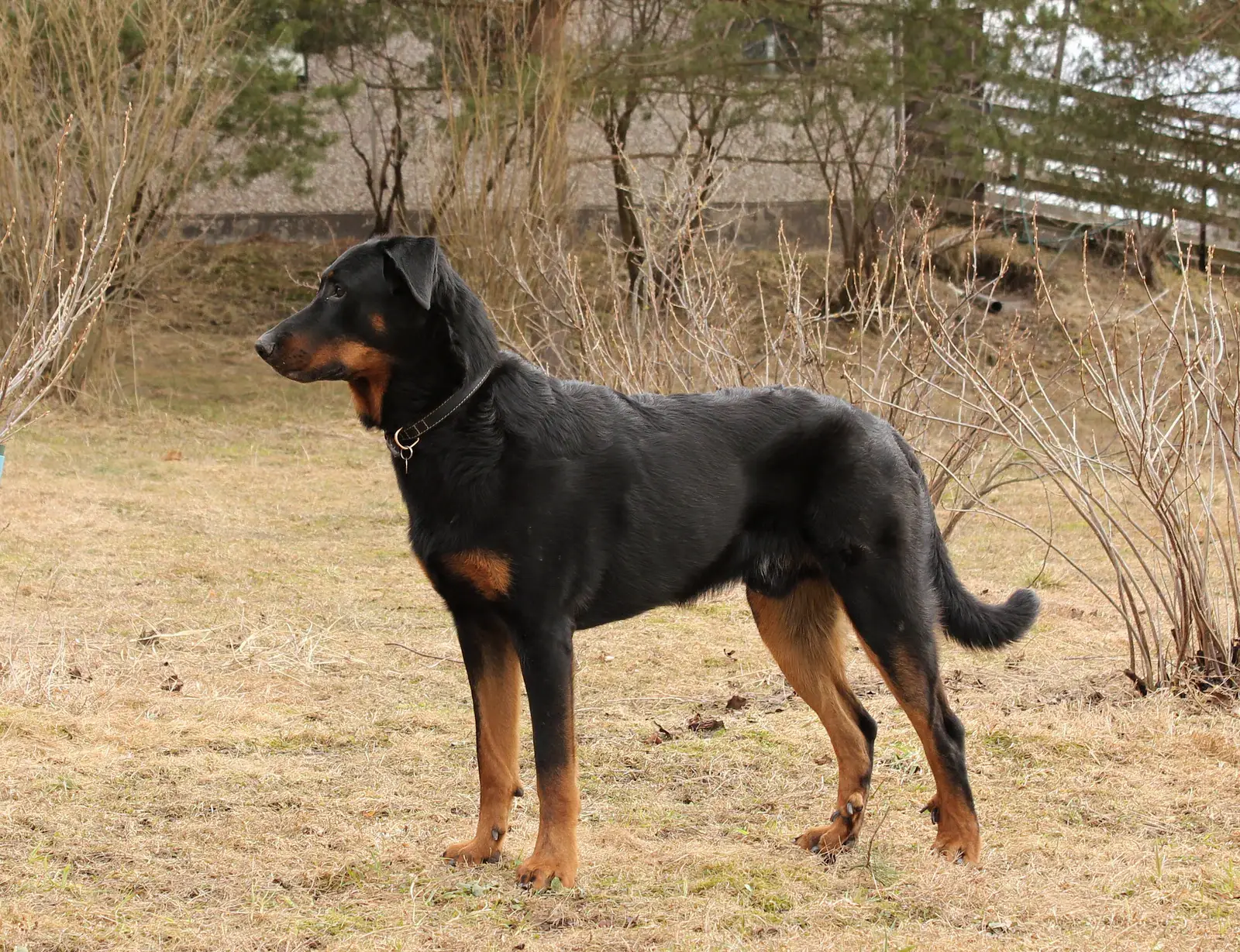
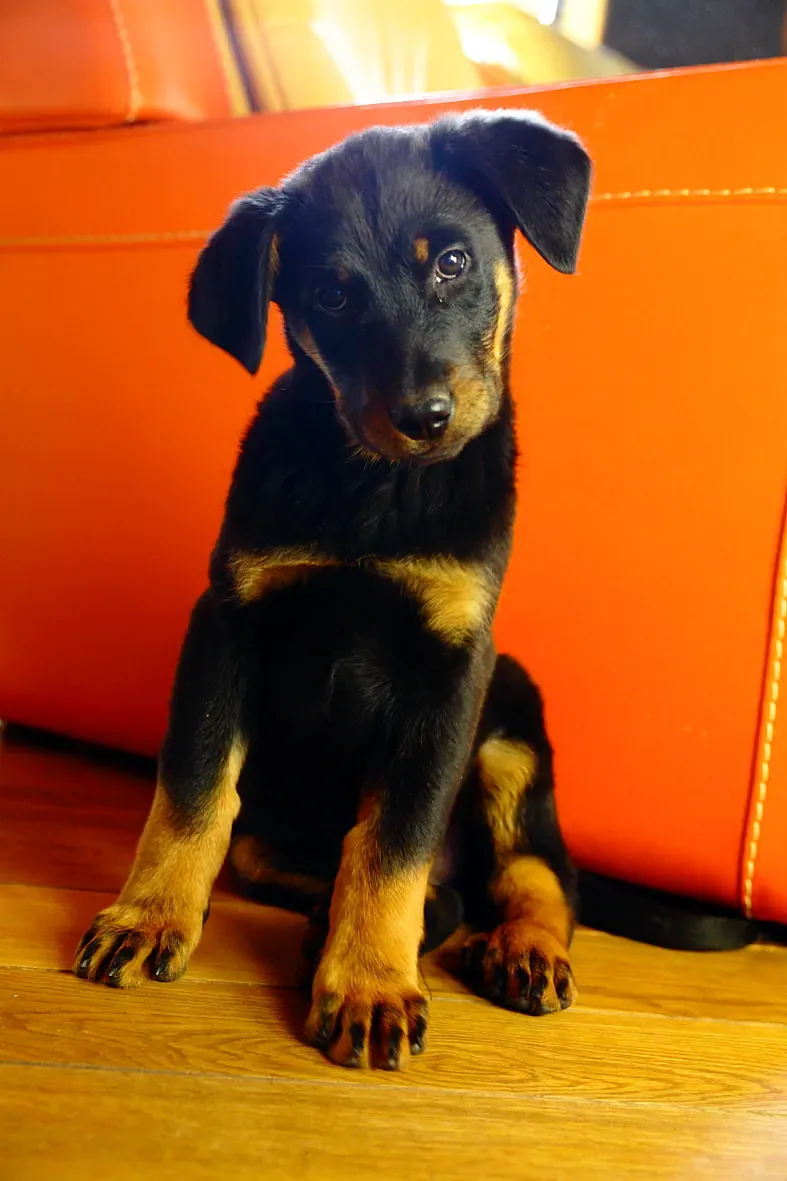
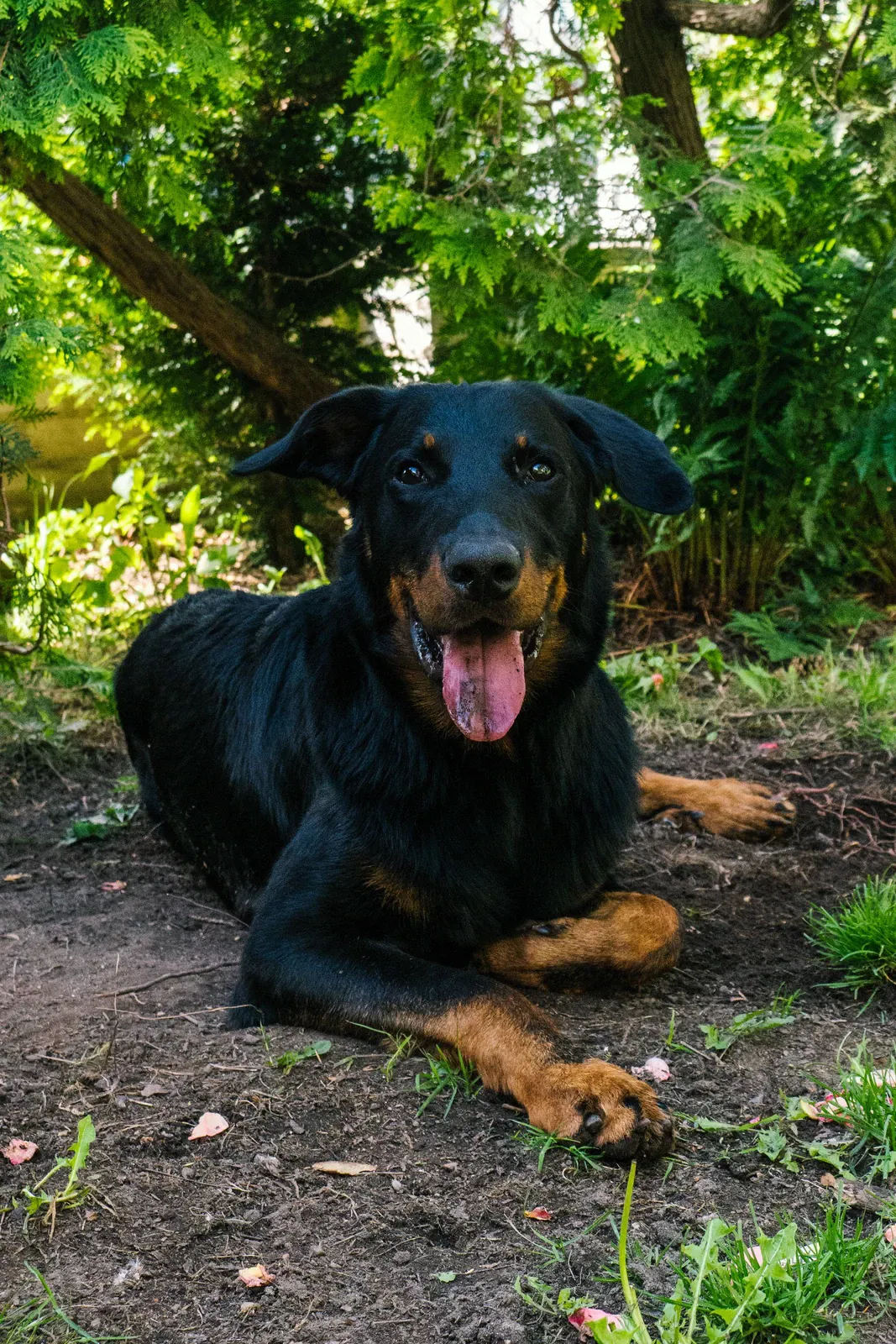
It is nicknamed "Bas Rouge", which means red stockings, for the tan on its lower legs. Its most unusual feature is the double dewclaw on each hind leg, which the requires. Beaucerons served with the French army as messenger, sentry and mine-detection dogs in both world wars. Today the breed is a powerful, serious and loyal working companion, tall at 61 to 70 cm, that needs a confident owner, steady training and a lot of daily activity.
Beauceron quick facts
 Related breedCairn Terrier1500 to 1910 · United KingdomAge of Exploration
- Country of origin
- France; the plains of the Beauce region south-west of Paris (FCI)
- Period of development
- About 1500 to 1896 (atlas data, medium confidence); standard and first registration in the 1890s
- Original job
- Herding sheep and guarding flocks and farms
- Type
- Large herding dog. FCI: Group 1, Sheepdogs and Cattledogs, standard no. 44. : Herding Group. UK Kennel Club: recognised
- Family (Parker 2017)
- Continental Herder
- Other names
- Berger de Beauce, Beauce Sheepdog, Bas Rouge
- Height
- FCI: 65 to 70 cm for males, 61 to 68 cm for females
- Life span
- Atlas data: 10 to 12 years. No named survey figure exists for the breed
- Colours
- Black and tan, or harlequin (FCI)
- Signature feature
- Double dewclaws on both hind legs
Drawn to scale in real centimetres. Its back reaches about 66 cm, mid-thigh; its head about 83 cm, your hip.
Where it sits in the tree
Age of Exploration · 1500 to 1599
Name and origin
 Related breedChinese Crested Dog1500 to 1965 · ChinaAge of Exploration
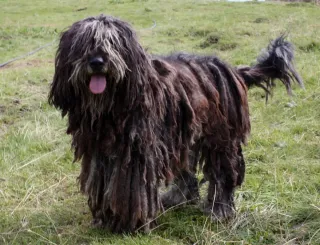
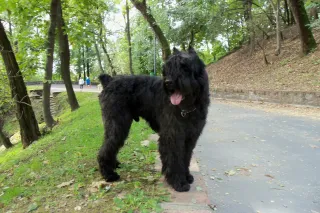
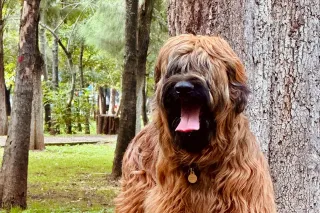
The name is a place name. The Beauce is a flat, open farming region south-west of Paris, and "Berger de Beauce" means shepherd of the Beauce. The atlas data gives the same etymology. The English form "Beauceron" is the French name for a person or thing of the Beauce. The nickname "Bas Rouge" is French for red stockings and refers to the tan markings on the lower legs. Hill's and other breed profiles explain the name this way.
The geography behind the name is looser than it sounds. Breed writers note that the short-coated shepherds of northern France were found far beyond the Beauce, and that the long-coated Briard likewise did not come only from the Brie. The two names became regional labels for two coat types of the same working shepherd stock.
Several things about the name are commonly repeated and deserve care:
- The 1578 manuscript. A date of 1578 for the first written mention of the breed turns up in some breed material. No source supports that exact year. Breed clubs give other early markers: the UK Beauceron Club says the breed can be traced back to about 1560, and Beauce.org (the American breed club site) says the earliest specific description is a manuscript dated 1587. Treat all of these as claims that are not documented in the original manuscripts, and read 1578 as a claim, not an established fact.
- The 1863 Paris show. The UK Beauceron Club says Beaucerons were included in the first French dog show, held in Paris in 1863 by the Imperial Society of Acclimation. One account of the Briard says that it was the Berger de Brie that was shown there. The sources disagree, so I cannot say which short-coated or long-coated dogs were present.
- Pierre Mégnin and the name. Sources agree that the veterinarian and cynologist Pierre Mégnin separated the short-coated Beauce dog from the long-coated Brie dog on paper, but they disagree on the date. One source says he first used the name Beauceron in his 1888 book on war dogs. Others place the clear distinction in the 1890s, and one writes that in 1895 he separated the short-haired Chien de Beauce from the long-haired Chien de Brie. A single source gives 1863 for Mégnin's role, and no other source supports it.

History
 Same eraEnglish Setter1500 to 1850 · United KingdomAge of Exploration
Shepherds of the Beauce plains
For centuries the open farmland around Paris needed dogs that could keep sheep off crops, hold a flock together on the road to market, and warn of strangers at night. The Beauceron grew out of that work. It is a short-coated, big, rangy dog, quicker and lighter than a mastiff and heavier than most herding dogs. The French breed clubs describe a dog bred for hard use, which the breed standard still reflects.
Rozier and the two coats
The first writer usually credited with separating the types is the agronomist Abbé Rozier. According to Beauce.org, in 1809 he described the differences between the long-coated and short-coated shepherds of the region and used the terms Berger de la Brie and Berger de la Beauce. David Hancock, a historian of working dogs, adds a caution that the old claim that the Briard came from a cross of the Beauceron and the Barbet is a fallacy. The two coat types are better read as two forms of one shepherd stock.
The 1890s standard and registration
The standard and first registration come in the 1890s. Several sources say the Société Centrale Canine registered the first Berger de Beauce in 1893. One weaker source dates registration to 1911 instead. Later records mention the Club des Amis du Beauceron, formed in 1922 under Mégnin's guidance according to Beauce.org, which is the club's own account. The UK Beauceron Club notes a separate breed club in 1911 as the point when the Beauceron and Briard were split into separate clubs.
The two world wars
The strongest, best-supported part of the story is the breed's military service. The AKC says Beaucerons served bravely in both world wars as messenger and mine-detection dogs. Beauce.org says the French army used the dogs for messages between trenches in the First World War, and for sentry work and mine detection in the Second. The breed's popularity rose after the Second World War, according to the AKC. No figures exist on how many dogs served.
Recognition
The FCI lists the breed as definitive, standard no. 44, under Group 1. VCA Hospitals, citing AKC records, says the AKC admitted the breed to its Miscellaneous class in 2001, to the Herding class in March 2007, and to shows in June 2007. The UK Kennel Club also recognises the breed.
Relatives and DNA
 Same familyKooikerhondje1500 to 1966 · NetherlandsAge of Exploration
The Beauceron is in the Continental Herder family in the DNA study by Parker and colleagues (2017, Cell Reports). The atlas data holds no pairwise DNA figures for the Beauceron, so there is no DNA chart here.
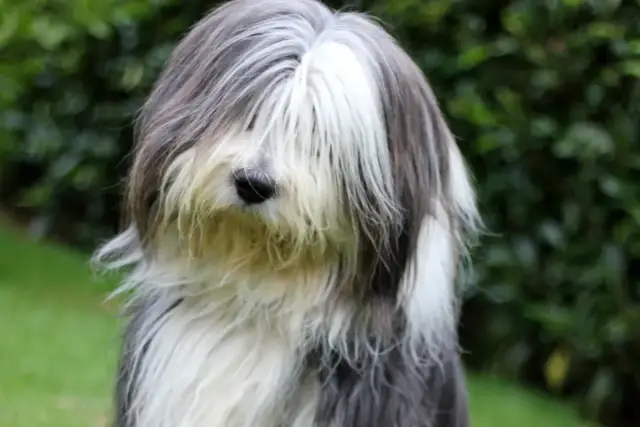
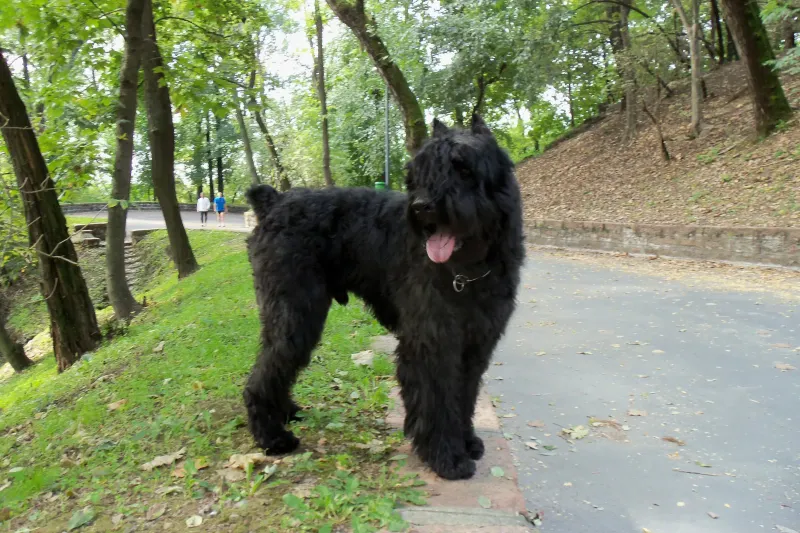
The most obvious relative is the Briard, the long-coated Berger de Brie. Both breeds are old French shepherds, and both carry double dewclaws on the hind legs. A breed-club account says that, though they look very different, they come from similar ancestral stock. The Berger Picard is another French shepherd of the northern plains.
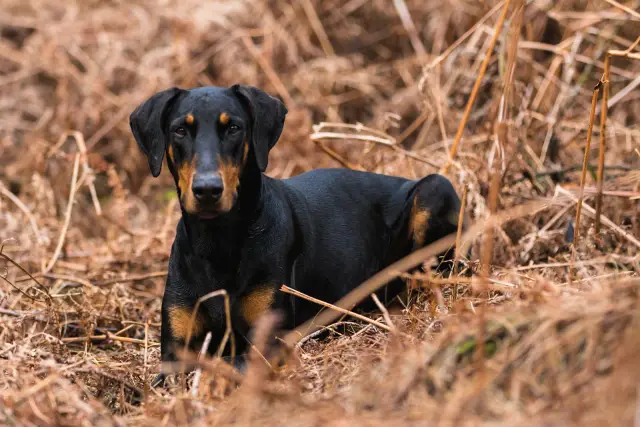
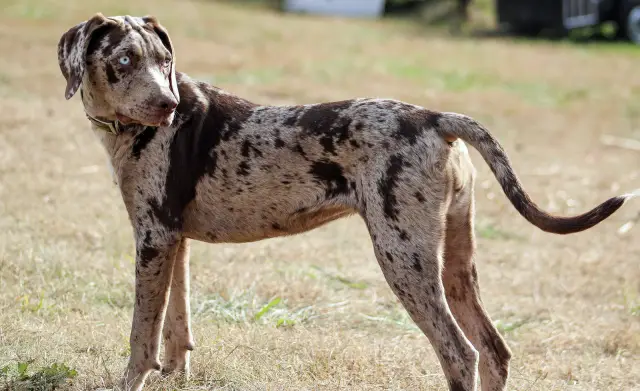
The atlas data lists two descendants of the Beauceron. One is the Dobermann, which is described in breed histories as a mix of several breeds, not of the Beauceron alone. The other is the Catahoula Leopard Dog. The Beauceron theory for the Catahoula says French settlers in Louisiana crossed their Beaucerons with local dogs in the 1800s. The best-known alternative story says Catahoulas descend from the dogs of Hernando de Soto's 1540s expedition. A Louisiana source calls the origin of the breed speculative, and another says factual claims lack credible documentation. So the Beauceron link to the Catahoula is a theory, not a proven descent.
Beauceron or Briard
Descend from it · 2
- Catahoula Leopard DogUnited States
- DobermannGermany
| Question | Beauceron | Briard |
|---|---|---|
| Coat | Short and dense | Long, slightly wavy |
| Region on the name | Beauce | Brie |
| Hind dewclaws | Double, required | Double, a shared trait |
| Early description | Abbé Rozier, 1809 (Beauce.org) | Same, as the Berger de Brie |
The breed standard
 Looks relatedLagotto Romagnolo1500 to 1991 · ItalyAge of Exploration
A breed standard is the written ideal that a kennel club judges dogs against. The FCI standard no. 44 and the French club's translation give the main points below. No verified weight is available from the standard text, so none is given for the FCI. A general range of about 30 to 45 kg is often quoted, which is not from the standard.
| Trait | What the standards say |
|---|---|
| Height (FCI) | Males 65 to 70 cm; females 61 to 68 cm |
| Colours (FCI) | Black and tan, or harlequin. Tawny and grey were once allowed and are no longer |
| Black and tan (FCI) | Black coat with tan over the eyes, on the sides of the muzzle, chest, throat, under the tail and on the legs |
| Harlequin (FCI) | Grey and black patches, with more black than grey in many accounts, and tan in the same places as the bicolour |
| Dewclaws (FCI) | Double dewclaws on both hind legs, forming two separate "thumbs" with nails, set rather close to the foot |
| Coat (FCI) | Short, dense, with an undercoat |
The double dewclaw is the point judges check first. The older 1994 standard disqualified a single dewclaw or none at all. That version appears to have been replaced by the 2006 text, so it is treated as historical. In the working tradition shepherds valued dogs that kept their double dewclaws, which the standard still reflects.
Temperament
 Related breedPapillon1500 to 1935 · France, BelgiumAge of Exploration
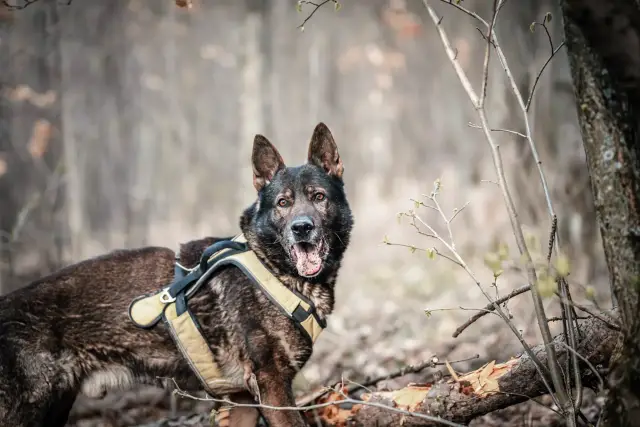
The Beauceron is a serious, bold, sometimes aloof dog, and breed accounts return to the same words. VCA Hospitals calls it alert, courageous and loyal, and Vetstreet describes it as confident, smart and strong-willed. The breed was made for herding and guard work, so it tends to watch strangers and take initiative.
Breed clubs, including the American club Beauce.org, stress early and calm socialisation, because the breed matures slowly and can be wary and territorial if left unsocialised. That is general club guidance and no behaviour study of the breed itself exists.
 Save
Training and activity
 Related breedPresa Canario1500 to 1990 · SpainAge of Exploration
A herding dog of this size needs real daily work. Breed-club pages describe a dog suited to obedience, herding and protection-style sports. It responds to firm, fair, consistent training and gets bored with drills. A bored Beauceron can invent its own jobs, such as patrolling, herding children or barking at the gate.
Coat and grooming
 Related breedSpanish Water Dog1500 to 1980 · SpainAge of Exploration
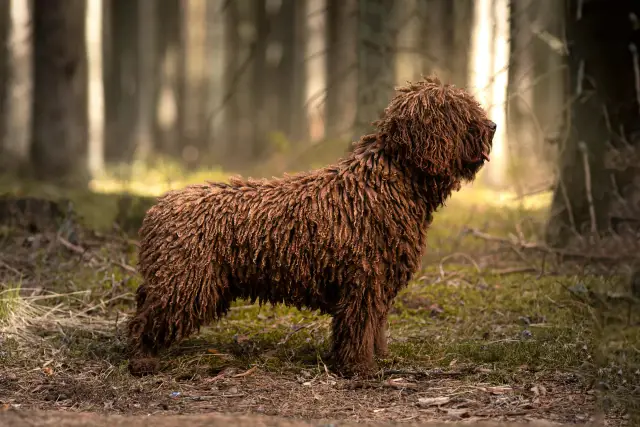
The coat is short and dense and needs little grooming: a weekly brush in most weeks and more in the twice-yearly shed. The nails and the double dewclaws need regular checks, because dewclaws that are not worn down can catch and tear.
Health
Most Beaucerons live healthy lives. This section lists the conditions that breed clubs and vets discuss. No Beauceron-specific prevalence study exists, so the table gives no numbers and does not borrow figures from other breeds.
| Condition | What it is | How common | What helps |
|---|---|---|---|
| Bloat (gastric dilatation volvulus) | The stomach fills with gas and can twist, which needs emergency vet care | Deep-chested large breeds are at higher risk in general; PetMD and Purina UK list it for the breed; no breed figure found | Several small meals, no hard exercise around meals, know the signs and go to a vet fast |
| Hip dysplasia | The hip joint forms loosely and wears over time | Listed for the breed by several sources; no figure found | Hip scoring or X-rays before breeding, healthy weight, avoid over-exercise in puppies |
| Heart disease | Some large breeds develop heart muscle problems | Breed-oriented sources suggest cardiac screening; no figure found | Heart checks by a vet and ask the breeder about screening |
| Eye conditions | Some sources suggest eye screening in the breed | No figure found | Annual eye exam for breeding dogs |
Life span. The atlas data gives 10 to 12 years, and most breed profiles give a similar range. One outlier gives 8 to 10 years without a source. I do not rely on any of these as a measured median.
Screening. Ask the breeder for hip scores or X-ray results, a heart check and an eye exam for both parents. Because the breed is uncommon, a breed club is the best place to find out what the parents were tested for.


Living with a Beauceron
 Save
| Daily reality | Rating | Why |
|---|---|---|
| Exercise per day | High | A large working herder; breed clubs describe an active, driven dog |
| Training needs | High | Strong-willed and intelligent; needs consistent, calm handling and early socialisation |
| Grooming | Low | Short, dense coat |
| Shedding | Medium | A short coat with an undercoat that sheds, most in the seasonal moult |
| Barking | Medium | A guarding breed that alerts to strangers |
| Time alone | Poor | Bred to work close to its people; boredom brings trouble |
| Children | Fair | Loyal, but large; supervision and early socialisation matter |
| Other dogs | Fair | Varies with socialisation |
| Cats and small pets | Varies | Herding instinct; depends on the dog and the early introduction |
| Flat living | Poor | A big, active dog |
| Heat tolerance | Fair | A large dog with an undercoat; keep exercise to cooler hours |
| Cold tolerance | Varies | A farm dog from northern France with an undercoat; no study found |
| First-time owner fit | Poor | Needs an experienced, confident owner |
A great fit if
- You have an active life and want a dog that takes part, not just a pet.
- You enjoy training sports such as obedience, herding or scent work.
- You have a fenced garden and room to run.
- You have owned a large guarding or herding dog before and like a serious temperament.
Think twice if
- You are out of the house for long days.
- You want a laid-back dog that greets every stranger.
- You live in a small flat or have little time for daily exercise.
- You are a first-time owner looking for an easy dog.
Before you get one
Ask the breeder for hip results, a heart check and an eye exam for both parents, and for the double dewclaws to be intact and well formed. Beaucerons are uncommon outside France, so expect a wait or travel. Breed clubs run rescue lists for adult dogs, and an adult dog may suit you better than a puppy because its temperament is already visible. Plan for the first two years as a training period, with puppy classes and a lot of calm socialisation.
Similar breeds to consider
- Briard. The long-coated cousin from the same French shepherd stock.
- Dobermann. A sleek guardian breed that the atlas data links to the Beauceron.
- Belgian Malinois. Another driven herding breed for active owners.
- German Shepherd. A large herding dog with a long working record, more widely available.

Beauceron fun facts
- The nickname "Bas Rouge" means red stockings and describes the tan on the lower legs.
- The breed standard requires double dewclaws on each hind leg.
- Beaucerons served as messenger and mine-detection dogs in both world wars.
- The AKC admitted the breed to its Herding Group in 2007.
Frequently asked questions
Where does the Beauceron come from?
The Beauce, a plains region south-west of Paris, in France. The lists France as the country of origin.
Why is the Beauceron called Bas Rouge?
It is French for red stockings, for the tan on the lower legs.
How big is a Beauceron?
The FCI standard says 65 to 70 cm for males and 61 to 68 cm for females.
What is the difference between a Beauceron and a Briard?
The coat first: the Beauceron is short-coated and the Briard long-coated. They share old French shepherd stock and double hind dewclaws.
What health problems do Beaucerons have?
Sources list bloat and , and recommend heart and eye screening. No named prevalence study exists for the breed.
Is a Beauceron a good family dog?
It can be loyal and protective with a family that socialises it early and trains it consistently. It is not an easy first dog.
Read next
 FamilyContinental HerderThe whole family
 Adopt a dogDog Shelters in FranceTen big cities checked, how adoption works, fees in euros
Sources (14)
- Fédération Cynologique Internationale, standard no. 44, Berger de Beauce (Beauce Sheepdog), origin France (height, colours, dewclaws).
- Club des Amis du Beauceron, breed standard translation.
- Beauce.org, American breed club pages: history of the Beauceron, health concerns in Beaucerons, breed standard.
- UK Beauceron Club, history pages (1560, 1863, 1911 claims).
- American Kennel Club, press release on the Beauceron and Swedish Vallhund entering the Herding Group.
- VCA Hospitals, Beauceron breed profile (AKC recognition steps, temperament).
- Hill's Pet, Beauceron breed profile (Bas Rouge name).
- Vetstreet, Beauceron breed profile (temperament; 1893 registration).
- David Hancock, "French Pastoral Breeds" and "The Berger of Beauce", davidhancockondogs archive (Briard and Barbet cross as a fallacy).
- PetMD, Purina UK and WebMD, Beauceron profiles (listed health conditions; secondary).
- Wikipedia, "Beauceron", "Briard" and "Jean Pierre Mégnin" (secondary: size range, 1863 Briard show).
- 64 Parishes, Louisiana Catahoula Leopard Dog entry, and The Advocate, "The origins of the Catahoula" (Catahoula origin theories).
- Parker H.G. et al., "Genomic analyses reveal the influence of geographic origin, migration and hybridization on modern dog breed development", Cell Reports, 2017.
- Atlas data, Beauceron knowledge record (etymology, lineage, life span).