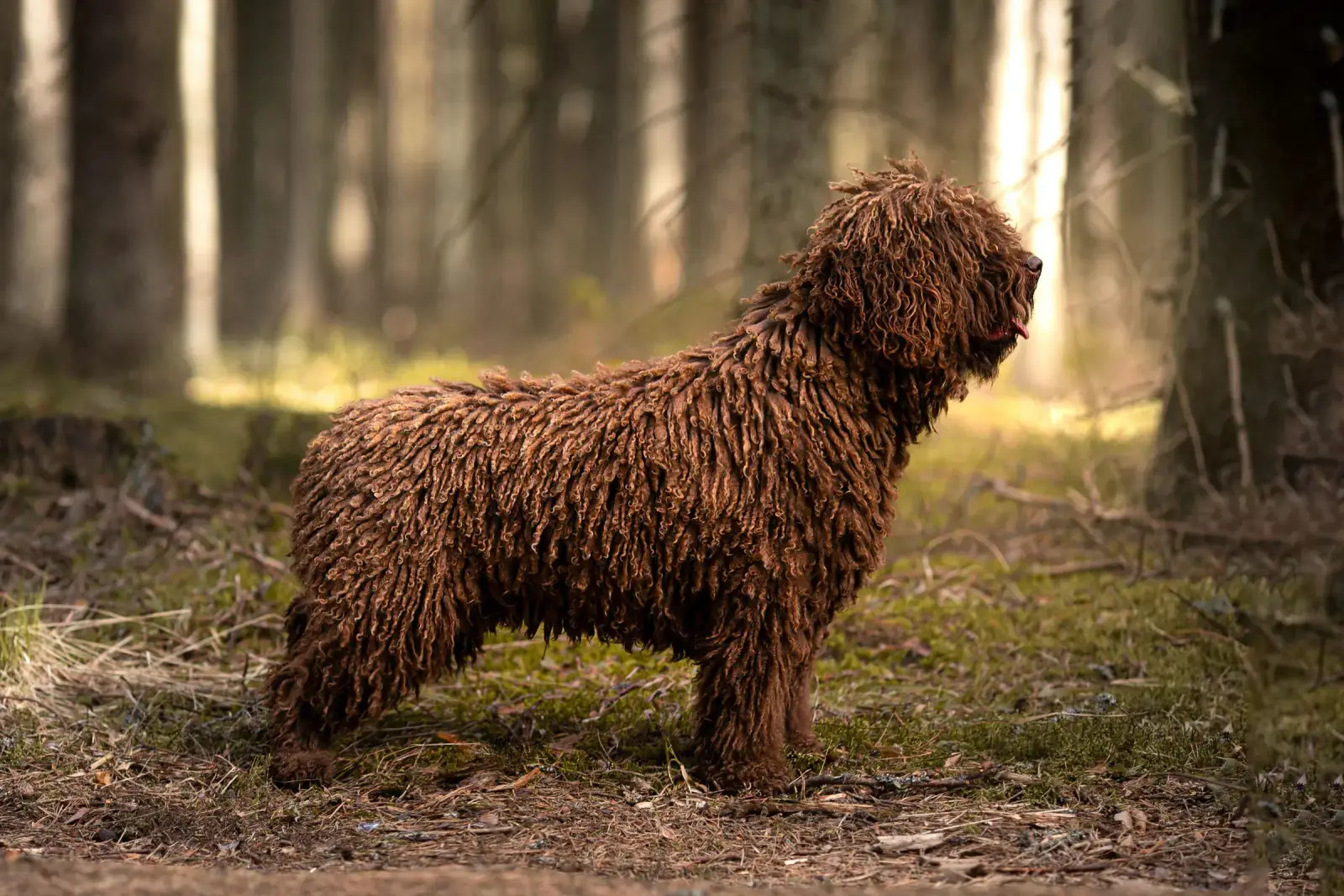
In Andalusia, where the breed is densest, it has long worked as a shepherd's dog, mostly with goats and sheep, and as a hunter's and fisherman's helper. It is intelligent, loyal and energetic. It suits active owners who want a trainable dog and can give it daily exercise and a job, and it tends to struggle in homes that leave it idle.
Spanish Water Dog quick facts
 Related breedMaltese500 BCE to 1888 · MaltaAncient World
- Country of origin
- Spain (Andalusia is the heartland)
- Period of development
- About 1500 to 1980 (atlas data, low confidence); older roots are claimed
- Original job
- Herding goats, sheep and cattle; hunting; helping fishermen
- Type
- Water dog ( Group 8, Retrievers, Flushing dogs, Water dogs; standard no. 336; Herding Group; UK Kennel Club Gundog Group)
- Height
- UK Kennel Club standard: dogs 44 to 50 cm, bitches 40 to 46 cm
- Weight
- UK Kennel Club standard: dogs 18 to 22 kg, bitches 14 to 18 kg
- Coat
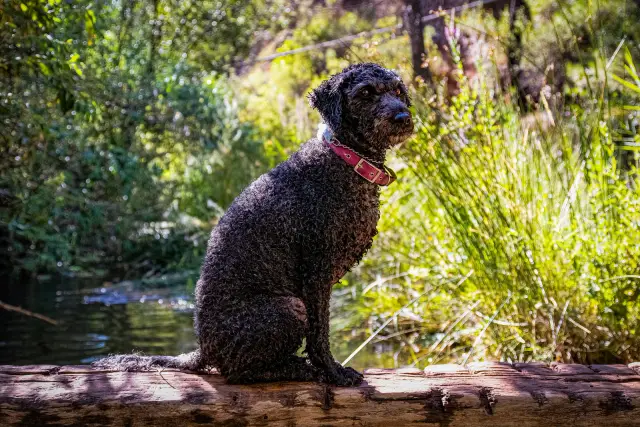
- Always curled, woolly, forming cords when long; may be clipped to one length
- Colours
- Solid black, brown or white; black and white or brown and white; never tricolour
- Life span
- Atlas data: 12 to 14 years
- Family
- Poodle family (atlas data)
- Related breeds
- Portuguese Water Dog, Cantabrian Water Dog
- Other names
- Perro de Agua Español, Turco Andaluz, Perro Turco
Drawn to scale in real centimetres. Its back reaches about 45 cm, just below your knee; its head about 57 cm, just above your knee.
Where it sits in the tree
Age of Exploration · 1500 to 1599
Name and origin
 Related breedPoodle1400 to 1874 · FranceLate Middle Ages
The name says two things. "Spanish" gives the country. "Water dog" is a working type, found across Europe, of curly-coated dogs that fetch, herd and swim. In Spanish the breed is Perro de Agua Español, and the atlas data records it as a plain translation of "Spanish water dog".
It has had many local names. The Spanish Water Dog Club of America quotes the FCI history, which lists Turco Andaluz as the most common, along with laneto, perro de lanas, patero, rizado and cordelero. Turco Andaluz means "Andalusian Turk". Nobody has shown why "Turk" was used. One tradition ties it to Turkish traders and ships, and a Spanish article from 1983 is said to claim that Turkish boats carried the dogs while exporting sheep in the 18th and 19th centuries. These stories are folklore, not records, and no Turkish origin has been proved.
The FCI lists the breed as standard no. 336. The current standard, published on 1 October 2019, gives Spain as the country of origin and describes the use as shepherd dog, hunting dog and assistant to the fisherman. The AKC places it in the Herding Group, and the UK Kennel Club puts it in the Gundog Group.

History
 Same eraPortuguese Water Dog1200 to 1938 · PortugalLate Middle Ages
Origins are uncertain
Nobody knows where the Spanish Water Dog came from. Several theories are repeated in breed histories: that water dogs came from North Africa with the tribes who crossed to Spain, from Turkey, from Hungary, or that they simply developed in Spain itself. The FCI history, as quoted by the Spanish Water Dog Club of America, cites two Spanish authors who note that ancient water dogs were used by tribes in North Africa in watery regions. Some histories say there are clear references to dogs of this type in literature by about the year 1100, but the original passages are not cited.
The atlas data places the start of the breed's development at about 1500 and gives low confidence. That window covers the period when the type spread across the Iberian peninsula. The Portuguese Water Dog and the Cantabrian Water Dog are its nearest cousins, and the atlas data records the link to the Portuguese dog as low confidence: the two are probably related through a common ancestor, but the records are thin.
A working farm dog
For centuries the breed lived on farms, not in kennels. The Club of America's summary calls it a multi-purpose farm dog whose main historic job was herding livestock, including goats, sheep and cattle. Its densest population is in Andalusia, where it was used as a shepherd and as a helper to hunters and fishermen. The FCI history says its coat suits the changes between damp and drought in the marsh regions of the south.
The traditional coat care followed the farm calendar. The dogs were often sheared once a year at the same time as the sheep. That explains why the standard still allows an overall clip but forbids a decorative one: the coat should be the same length all over.
The 1970s revival
The breed was always a minority breed and almost went unnoticed by the dog-show world. In the mid-1970s, according to breed histories, Antonio Garcia Perez and Santiago Montesinos travelled through rural Andalusia to find and buy these dogs. Antonio Garcia, born in Ubrique in the province of Cadiz, is credited as the father of the modern breed and with drafting the first standard.
| Event | Date |
|---|---|
| FCI current standard (no. 336) | Published 1 October 2019 |
| AKC | Accepted into the AKC on 1 December 2014; eligible to compete in the Herding Group from 1 January 2015 |
| UK Kennel Club | in the Gundog Group |
The AKC took the breed into its Herding Group in 2015, after years in its Foundation Stock Service. The Spanish Water Dog Club of America developed herding tests for the dog, and one of the first was a test using goats, which shows the drive, gather and pen skills the breed was kept for.
The split of the Cantabrian dogs
In northern Spain, in Cantabria and Asturias, lighter water dogs of a local type were once counted as Spanish Water Dogs. This group, called the Norteno sub-population, was recognised in Spanish law in 2012 as a separate breed, the Cantabrian Water Dog. The atlas data lists the two as sister breeds.
Relatives and DNA
 Same familyBeauceron1500 to 1896 · FranceAge of Exploration
The atlas data lists no parent or descendant breeds for the Spanish Water Dog. It places the breed in the Poodle family, the group of curly-coated water dogs. The atlas data has no shared-DNA table for the breed, so statements about its closeness to other water dogs rest on shared type and history, not on measured DNA.
Sister breeds
- Portuguese Water Dog. Often compared with the Spanish dog. The atlas data says the two are related and probably share a common ancestor, with low confidence. The Portuguese dog is larger and more strongly built, and is better known worldwide.
- Cantabrian Water Dog. Split from the Spanish Water Dog in Spanish law in 2012. Lighter Cantabrian dogs were previously included in the Spanish Water Dog.
The Poodle link. The atlas data places the Spanish Water Dog in the Poodle family. The Poodle was also a water dog, a retriever of ducks, and the curly coat is shared. For the wider group see the dog family tree.
Sister breeds · 2
- Portuguese Water Dog1200 to 1938
- Cantabrian Water Dog1700 to 2011
The breed standard
 Looks relatedCairn Terrier1500 to 1910 · United KingdomAge of Exploration
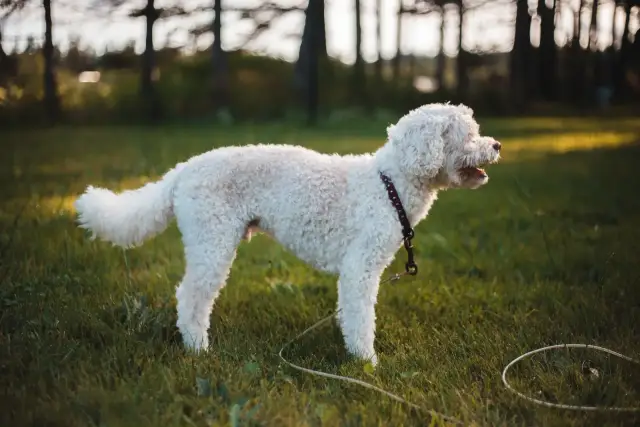
A breed standard is the written ideal that kennel club judges compare each dog against. The UK Kennel Club standard describes a sturdy, medium-sized dog that is well muscled from constant activity, with a distinctive coat. Its character is that of a herding, hunting and fishing dog with well-developed senses of smell, sight and sound, and "great learning capability". Temperament is "faithful, obedient, brave, good tempered and gay".
| Trait | UK Kennel Club standard | |
|---|---|---|
| Height | Dogs 44 to 50 cm, bitches 40 to 46 cm | |
| Weight | Dogs 18 to 22 kg, bitches 14 to 18 kg | |
| Head | Strong and elegant, parallel planes of skull and muzzle, flat skull, slight stop | |
| Eyes | Medium, oval, very expressive, hazel or dark brown to suit coat colour | |
| Ears | Dropped, V-shaped, slightly rounded at the tip, set slightly above eye level | |
| Coat | Always curled, consistently woolly in texture, forming cords when long; may be clipped overall, but no aesthetic clip | UKC disqualifies a smooth or wavy coat |
| Colours | Solid black, brown or white of various shades; black and white or brown and white; never tricolour | |
| Gait | Brisk, sound and athletic, with powerful drive |
The coat. The coat is the dog's trademark. It is curly and woolly, not silky, and left alone it grows into tight cords or mats. Most pet owners clip it to a short, even length. Cords need hand separation, and wet dogs take a long time to dry. Water dogs of this type were bred to be clipped, so do not expect a brush-and-go coat.
Temperament
 Related breedChinese Crested Dog1500 to 1965 · ChinaAge of Exploration
The Kennel Club standard describes the breed as faithful, obedient, brave and good tempered, and says it "adapts to almost all situations". In daily life that means a dog that attaches closely to its family, is quick to learn and is watchful. The breed's herding and farm background gives it a natural alertness. Many dogs of this type are reserved with strangers until they know them.
Because it was bred to work alongside shepherds, hunters and fishermen, it does best when it has a job. Obedience, agility, scent work, tracking, herding trials and water retrieving all suit it. The Spanish Water Dog Club of America runs herding tests with goats for the breed. Without work it can become bored and noisy, and its herding instinct may show as nipping at heels or circling.
It enjoys water, as its name suggests, and many take to swimming and retrieving. Early socialisation to strangers, other dogs and different surfaces is sensible for any herding breed.

Health
 Related breedEnglish Setter1500 to 1850 · United KingdomAge of Exploration
The Spanish Water Dog is a small breed with a limited gene pool, and several inherited conditions have a DNA test. The atlas data gives a life span of 12 to 14 years. No large published longevity study for the breed has been found, so treat that range as a guide.
The UK Kennel Club approved two official DNA testing schemes in 2018, for neuroaxonal dystrophy (NAD) and congenital hypothyroidism with goiter (CHG), after consulting the breed's health co-ordinator for the breed club. The Kennel Club asks breeders, at a minimum, to run these tests before breeding. Information here is general. Talk to a vet about your own dog.
Neuroaxonal dystrophy
Hahn and colleagues (PLOS ONE, 2015) described a juvenile-onset disease in Spanish Water Dogs, linked to a variant in the TECPR2 gene (c.4009C>T). It is , which means a puppy needs two copies, one from each parent. The nerve cells in the brain and spinal cord degenerate, and affected dogs show a growing loss of coordination in the first years of life. The disease is serious and progressive. A DNA test lets breeders avoid carrier-to-carrier matings.
Early-onset progressive retinal atrophy
Winkler and colleagues (Veterinary Ophthalmology, 2020) identified a deletion in the PDE6B gene in Spanish Water Dogs with early-onset progressive retinal atrophy. The study used 18 dogs, and the variant followed the disease in the family. Affected dogs are typically diagnosed before the age of four, with owners often first noticing night blindness around the ages of two to three. A DNA test is available.
Congenital hypothyroidism with goiter
CHG is the second condition with an official UK scheme. It is an inherited thyroid disorder, and the Spanish Water Dog Club of America lists it among the breed's health topics, together with autoimmune thyroiditis (hypothyroidism). Ask a breeder for the CHG test result of both parents.
| Condition | What it is | How common | What to do |
|---|---|---|---|
| Neuroaxonal dystrophy (NAD) | Recessive, juvenile-onset nerve disease; TECPR2 variant (Hahn et al. 2015) | No published carrier rate | DNA test of both parents; official UK Kennel Club scheme |
| Early-onset PRA | Retinal degeneration; PDE6B deletion (Winkler et al. 2020) | No published carrier rate | DNA test of both parents |
| Congenital hypothyroidism with goiter | Inherited thyroid disorder | No published carrier rate | DNA test of both parents; official UK Kennel Club scheme |
| Hip and elbow problems | Joint malformation, a general risk in medium-sized dogs | No published breed figure | Hip and elbow scoring of breeding dogs; lean body weight |
| Ear infections | Dropped ears with curly hair inside can trap water, especially in swimmers | No published breed figure | Dry and check the ears after swimming |
A healthy-looking dog can still carry a recessive gene, which is why testing both parents matters.

Living with a Spanish Water Dog
 Related breedKooikerhondje1500 to 1966 · NetherlandsAge of Exploration
| Daily reality | Rating | Why |
|---|---|---|
| Exercise | High | Daily walks, play and training; a working-farm background |
| Training needs | High | "Great learning capability" (Kennel Club), needs mental work |
| Grooming | High | Curly wool: regular brushing or clipping; cords need care |
| Shedding | Low | A curly, woolly coat holds loose hair rather than dropping it |
| Barking | Medium | Alert; can bark at visitors |
| Time alone | Poor | Attached to its family; bored dogs can become noisy or destructive |
| Children | Fair | Faithful and good tempered; herding nips need guiding |
| Other dogs | Fair | Depends on socialisation |
| Cats and small pets | Varies | A farm dog that learned to live with stock; introduce with care |
| Flat living | Fair | Possible if exercise is met, a garden helps |
| Heat tolerance | Fair | Wool coat; a short clip helps in summer |
| Cold and wet tolerance | Good | Bred for damp marsh country and swimming |
| First-time owner | Fair | Eager to learn, but needs time and consistent training |
A great fit if you...
- are active and enjoy training, swimming or herding sports;
- like a clever dog that works closely with its person;
- are ready to clip and brush a woolly coat;
- are home for much of the day.
Think twice if you...
- are away at work most of the day;
- want a low-grooming dog;
- cannot give regular exercise and mental work;
- want a calm lap dog.
Before you get one. Ask the breeder for DNA results for NAD, CHG and PRA for both parents, plus hip and elbow scores. The breed is rare outside Spain, so expect to wait and possibly travel. Breed clubs run rescue and rehoming programmes, and an adult dog's temperament is already visible.
Similar breeds to consider
- Portuguese Water Dog: bigger and stronger, the closest cousin.
- Poodle: a curly water dog of the same family, in several sizes.
- Australian Shepherd: a herder with similar energy and trainability.
- Border Collie: the benchmark working herder, with more intensity.

Spanish Water Dog fun facts
 Related breedPapillon1500 to 1935 · France, BelgiumAge of Exploration
- In Andalusia the breed has been called the "Turkish dog" for centuries, though nobody has shown any link to Turkey.
- The breed has about ten local names, among them laneto, perro de lanas, patero and cordelero.
- Its coat was traditionally sheared once a year, together with the sheep.
- The Cantabrian Water Dog was split off from it in Spanish law in 2012.
- The AKC gave the breed full recognition from 1 January 2015.
Frequently asked questions
Are Spanish Water Dogs good family dogs?
They can be, in active families who give them exercise, training and company. They are faithful and good tempered, but they may herd children by nipping, so supervision and training matter.
Do Spanish Water Dogs shed?
Very little. The woolly coat holds loose hair, so it needs regular brushing or clipping to avoid matting.
How big is a Spanish Water Dog?
The Kennel Club standard gives 44 to 50 cm and 18 to 22 kg for dogs, and 40 to 46 cm and 14 to 18 kg for bitches.
How long do Spanish Water Dogs live?
Atlas data gives 12 to 14 years.
How much exercise does a Spanish Water Dog need?
A lot. It is a working farm dog and needs daily exercise plus training or a job. No published figure for hours.
What is the difference between a Spanish Water Dog and a Portuguese Water Dog?
They are related water dogs. The Portuguese dog is bigger and heavier, and the Spanish dog is a medium-sized herder with a woolly, cord-forming coat.
Why is it called Turco Andaluz?
It means "Andalusian Turk". The reason is unknown, and the Turkish link is a tradition, not a proven origin.
What genetic tests should a breeder do?
NAD and CHG, which have official UK Kennel Club schemes, plus PRA, and hip and elbow scores.
Read next
Sister breedPortuguese Water Dog1200 to 1938 FamilyPoodleThe whole family
 Adopt a dogDog Shelters in EuropeFind dog shelters in Europe, learn how shelters differ from country to country and why adopting a dog is a good option.
Sources (9)
- American Kennel Club, Meet AKC's four newly recognized breeds and Foundation Stock Service news.
- American Kennel Club, Spanish Water Dog breed page; and "Meet the Spanish Water Dog fancier", AKC news.
- Fédération Cynologique Internationale, Perro de Agua Español (Spanish Water Dog), standard no. 336.
- Hahn K. et al., "TECPR2 associated neuroaxonal dystrophy in Spanish Water Dogs", PLOS ONE, 2015.
- Spanish Water Dog Club of America, herding history and breed information.
- The Kennel Club (UK), Spanish Water Dog breed standard; and "New DNA testing schemes for Spanish Water Dogs", 2018.
- Winkler P.A., Ramsey K.L., Petersen-Jones S.M., "A novel mutation in PDE6B in Spanish Water Dogs with early-onset progressive retinal atrophy", Veterinary Ophthalmology, 2020.
- Wikipedia, "Spanish Water Dog".
- Atlas data, breed records (this site).