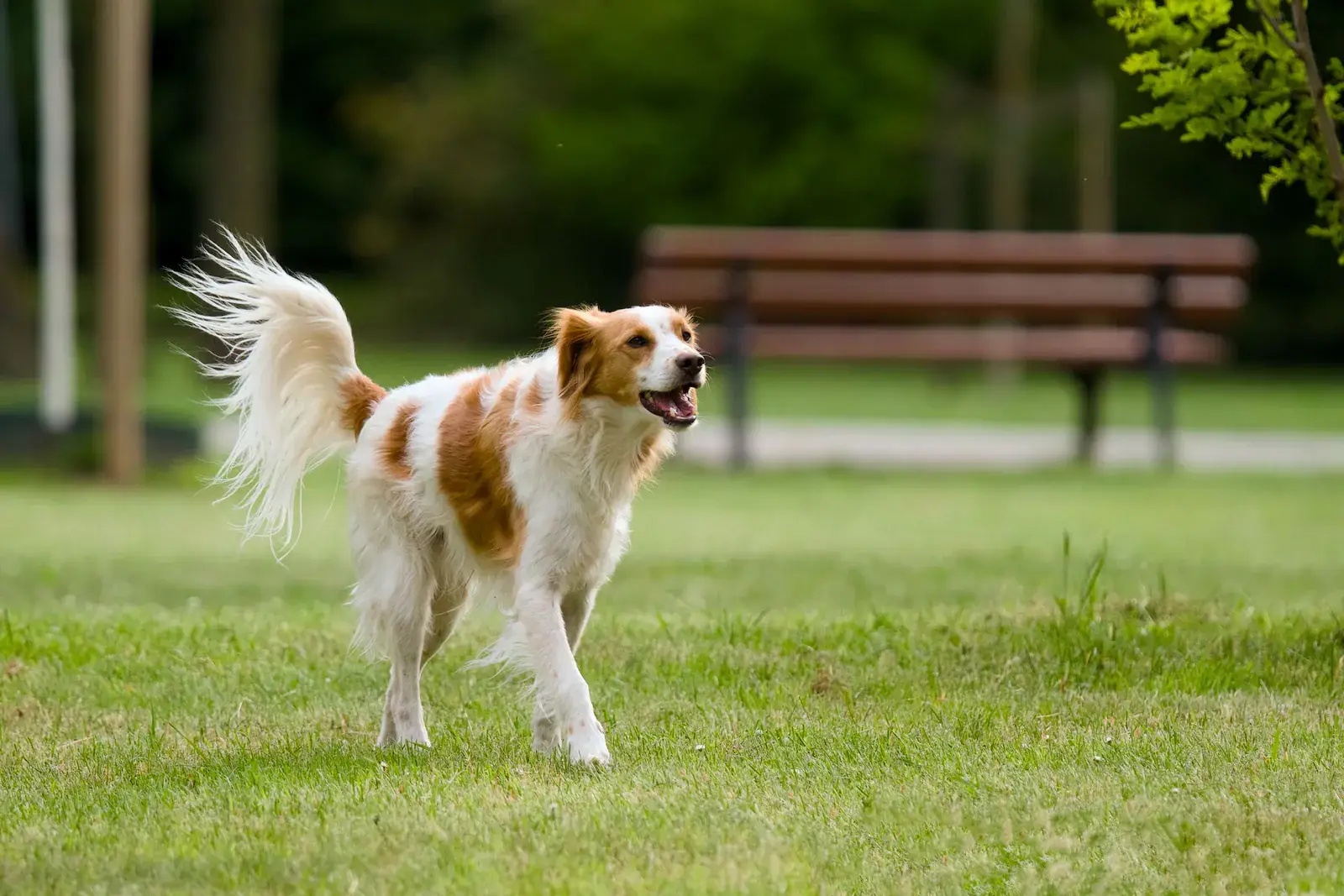
It was bred to work in an eendenkooi, a Dutch duck decoy, where it lured wild ducks into a netted pipe by playing along the water's edge and waving its white-tipped tail. The breed nearly vanished in the 1930s and 1940s and was rebuilt from a few dozen dogs. Today it is a lively, sensitive companion and sporting dog, still rare outside the Netherlands.
Kooikerhondje quick facts
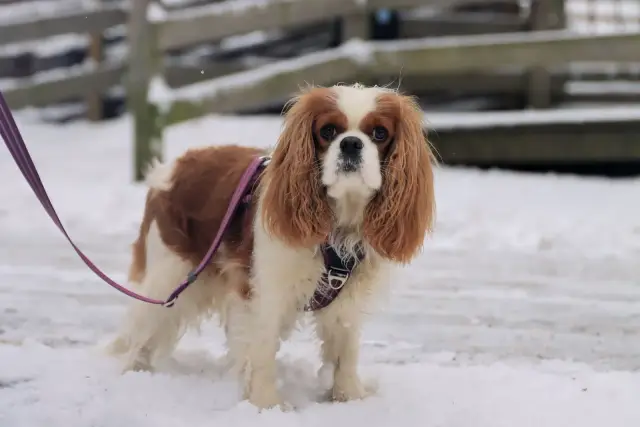
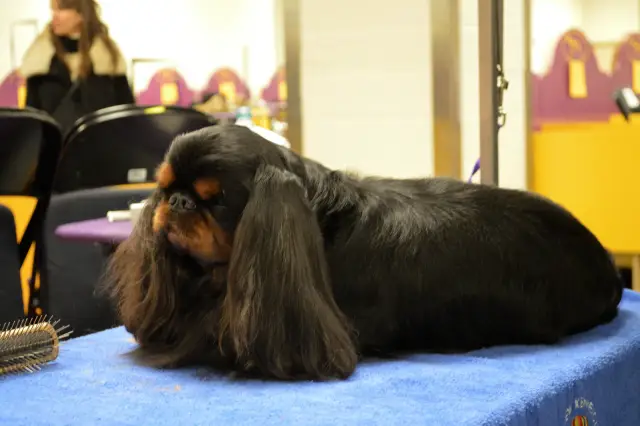 Related breedKing Charles Spaniel1600 to 1903 · United KingdomEarly Modern Era
- Other names
- Nederlandse Kooikerhondje, Dutch Decoy Dog
- Country of origin
- Netherlands
- Family
- Spaniel (atlas data, after Parker 2017)
- Type
- Small flushing spaniel
- Size
- Small; ideal height about 38 to 40 cm (FCI)
- Lifespan
- 12 to 14 years (atlas data)
- Coat
- Medium length, close-lying, slightly wavy or straight
- Colour
- Orange-red patches on white
- Recognised by
- FCI (no. 314, Group 8), AKC (Sporting), UK Kennel Club
- Original job
- Luring ducks into a decoy pipe; later a flushing and retrieving dog
- Today
- Companion, agility, obedience, hunting dog
Drawn to scale in real centimetres. Its back reaches about 39 cm, just below your knee; its head about 50 cm, your knee.
Where it sits in the tree
Age of Exploration · 1500 to 1599
Name and origin
 Related breedBeauceron1500 to 1896 · FranceAge of Exploration
The name is Dutch. A kooiker is the keeper of an eendenkooi, the netted decoy pond where wild ducks were caught for food and for sale. Hondje means "little dog". So a Kooikerhondje is, literally, the decoy keeper's little dog. The full official name is Nederlandse Kooikerhondje, and in English the breed is sometimes called the Dutch Decoy Dog. In the FCI list it carries standard number 314 and country of origin Netherlands.
The atlas data places the breed's appearance at about 1500, with a medium confidence for that date, and its formal establishment in the modern era. The date is an estimate: decoy ponds are documented in the Low Countries from the late Middle Ages, but the dog that worked in them was never a written-down breed until the twentieth century.
How decoy work happened
An eendenkooi is a pond with several curved ditches ("pipes") that narrow and are covered with netting. Wild ducks that rest on the pond are curious about movement along the bank. The kooiker kept out of sight behind screens and sent the dog along the bank, where it appeared and disappeared through gaps in the reed screens. Ducks drawn by the little red-and-white dog followed it toward the mouth of the pipe, and the kooiker then drove them in. The dog's white tail plume was the visible lure.
This is a different job from a gundog's. A Kooikerhondje does not chase or retrieve game during decoy work. It moves quietly, tempts, and stays with its handler's signals. That helps explain the breed's present traits: attentive to the person, sensitive to tone of voice, and driven by curiosity.
A pronunciation note
English speakers shorten the name in many ways: Kooiker, Kooikerhondje, Kooiker dog, Kooikie. In the Netherlands the plural is "kooikerhondjes", and the breed club refers to the dogs as "Kooikers". All are used in this article.

History
 Same eraCairn Terrier1500 to 1910 · United KingdomAge of Exploration
Decoy dogs of the Dutch Golden Age
Small red-and-white spaniel-type dogs appear in Dutch paintings of the seventeenth century, and the work of Jan Steen is often cited as showing a dog of this type. These pictures cannot prove a breed line, but they fit the idea that a recognisable small spaniel was common in Dutch households and decoy ponds by then.
One popular legend ties the breed to William the Silent, Prince of Orange. The story says that in 1572 his small dog woke him with barking and saved him from an assassination attempt. The dog in the legend is often said to be a Kooiker. This is a legend with no document behind it, though it is the reason the breed is sometimes called the dog of the House of Orange.
Near extinction
Decoy ponds gradually lost their economic value. Cheaper ways of buying and selling wildfowl, new hunting laws, and changes in land use all reduced the number of working decoys during the nineteenth and early twentieth centuries. As ponds closed, the dogs lost their jobs, and by the 1930s few pure Kooikers remained. Accounts of the numbers vary: about 25 dogs is given for either 1939 or 1945, depending on the source. Both dates are given in published histories, and the count is best read as "a few dozen at most".
The Baroness and the rebuilding
The breed's survival is credited to Baroness van Hardenbroek van Ammerstol, who started a breeding programme in 1939. By the common account, she searched northern Netherlands for typical dogs. She is said to have sent people out with a photograph of the type she wanted and a scrap of cloth in its colour. Her search led her to a bitch called Tommie from Friesland, who is named as the foundation of the modern line. In other versions she began with one male and two females.
After the Second World War, breeders continued the work under the Baroness's guidance, using the small remaining stock, which explains why the whole present population traces back to so few dogs. Dates in the middle of the century differ between sources. The Dutch Kennel Club (Raad van Beheer) opened a provisional register in 1966, and full recognition followed in 1971. Breeding guidelines are dated to 1961 by one source, and the parent club to 1967 by another.
Recognition abroad
The FCI lists the breed as definitive standard no. 314 in Group 8 (Retrievers, Flushing dogs, Water dogs), section 2, flushing dogs. The current version of the standard is dated 2010. The UK Kennel Club took the breed on in 2014 (some accounts date the announcement to 2013). The American Kennel Club admitted it to the Sporting Group on 1 January 2018, with the Nederlandse Kooikerhondje Club of the USA as the parent club. The year the FCI first accepted the breed is given as 1990 in one account that no second source repeats, so it is left out of the timeline.
Relatives and DNA
 Same familyChinese Crested Dog1500 to 1965 · ChinaAge of Exploration
In the atlas data the Kooikerhondje belongs to the Spaniel family, the group of European dogs that Parker and colleagues (2017) identified by DNA. The Kooikerhondje has no recorded parent breeds in the atlas data, which agrees with the history above: it was never described as a cross between named breeds, but as a local type that was fixed by selection in a tiny population.
Fogle (2009) describes the Kooikerhondje as a small Dutch spaniel-type decoy dog. Nothing is published about how many of DNA it shares with named spaniels, so no figures are given here.
What can be said is about practical relatives. The Netherlands has several other native gundogs, and each has its own working history:
- Drentse Patrijshond: a larger Dutch pointing spaniel type from the province of Drenthe.
- Stabyhoun: a Frisian all-round hunting dog.
- Wetterhoun: a Frisian water dog used for otter and waterfowl.
Outside the Netherlands, the closest in job is the Nova Scotia Duck Tolling Retriever, which also lures ducks by playing at the water's edge, though it was developed in Canada and sits in a different part of the dog family tree.
The breed standard
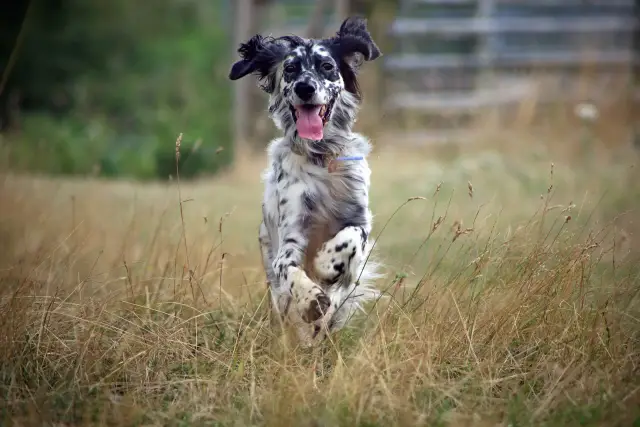 Looks relatedEnglish Setter1500 to 1850 · United KingdomAge of Exploration
A is the written ideal that kennel clubs judge dogs against. The FCI standard (no. 314) is the base text used in most countries. Values below are those the FCI standard gives; where another club is named it is because that club's own description is cited in the text.
| Trait | What the standards say |
|---|---|
| Height | FCI: ideal 40 cm for dogs and 38 cm for bitches; 2 cm above and 3 cm below the ideal is tolerated |
| Weight | FCI: no weight given; the dog is judged on height and proportion |
| Body | FCI: small, almost square (length close to height), well balanced |
| Coat | FCI: medium length, close-lying, slightly wavy or straight; feathering on ears, chest, legs and tail |
| Colour | FCI: orange-red patches on a white ground; the red should be clear, not dull |
| Ears | FCI: carried close to the cheeks, no fold; black tips ("earrings") are strongly desired |
| Tail | FCI: well feathered, carried level or slightly raised |
| Group | FCI: Group 8, section 2 (flushing dogs). AKC: Sporting Group. UK Kennel Club: recognised since 2014 |
| Expression | FCI: alert, friendly, confident; a cheerful dog that is not nervous |
The FCI sets no weight for the breed, so the weights quoted by various breed guides (roughly 9 to 11 kg) are typical values, not standard requirements. Males are slightly taller than females.
The black ear tips are the best-known feature. They are a clearly desired point, but a dog without them is still a Kooikerhondje, and the colour pattern is a matter of show judging, not of health.
 Save
Temperament
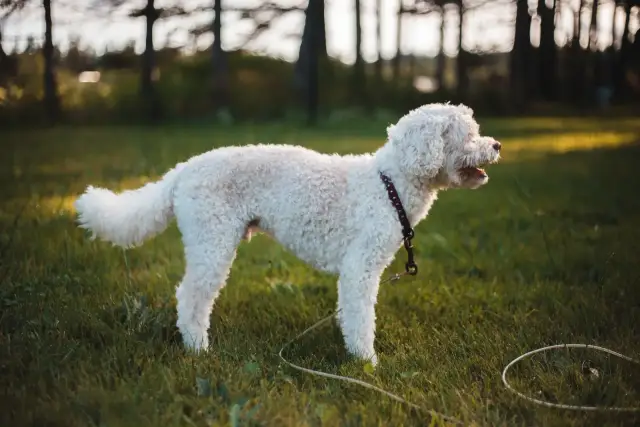 Related breedLagotto Romagnolo1500 to 1991 · ItalyAge of Exploration
The FCI standard describes a cheerful, alert and friendly dog. In practice, breed clubs describe a dog that is affectionate with its own people, more reserved with strangers, and sensitive to a raised voice. That sensitivity comes from the decoy job, in which the dog had to read a handler's small signals rather than act on its own.
Common traits reported by breed clubs:
- Closely bonded. The Kooikerhondje tends to follow its person around the house.
- Alert. It notices visitors and movement and may announce them.
- Playful. It keeps a puppy-like play style into adulthood.
- Sensitive. Harsh correction can make it withdraw.
- Curious. The same curiosity that drew ducks leads the dog to investigate small moving things such as birds and rodents.
There is no large published study of Kooikerhondje behaviour, so these are descriptions from clubs and standards, not measured percentages.
Training and exercise
The breed learns fast and responds well to reward-based training, play and short, varied sessions. It does well in agility, obedience, rally and scent games, and it can work as a flushing and retrieving dog. Most breed clubs describe about an hour or more of activity a day, with something to think about as well as to run after. A bored Kooiker can become noisy or destructive. Recall needs steady work: the prey drive is real, and a dog that spots a duck can be hard to call back.
Early socialisation matters because the breed can be shy or wary. Slowly introducing a puppy to different people, surfaces, sounds and other dogs helps it grow into a confident adult.

Health
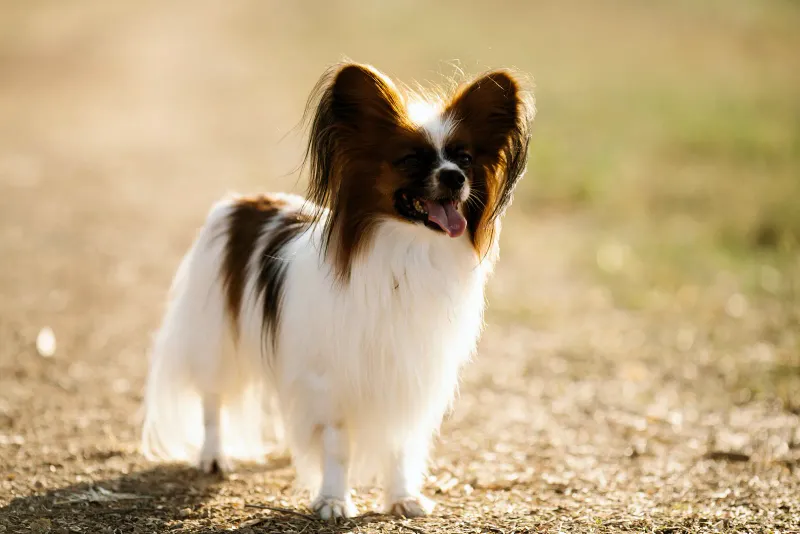 Related breedPapillon1500 to 1935 · France, BelgiumAge of Exploration
Most Kooikerhondjes live healthy lives; the atlas data gives 12 to 14 years as the usual lifespan. The breed is small and founded on very few dogs, so a handful of inherited conditions are known, and the Dutch breed club has screened for them for years. Breeders who test their dogs are the main protection. The table lists what is known, and where no study gives a figure, the table says so.
| Condition | What it is | How common | What helps |
|---|---|---|---|
| Patellar luxation | The kneecap slips out of its groove, often giving an occasional skip in the step | In a Dutch study of 842 dogs screened between 1994 and 2011, 23.6% had it: about 1 in 4. Heritability was about 0.27 (Wangdee et al. 2014) | Knee check by a vet before breeding; pick breeders who screen; keep weight lean |
| Hereditary necrotizing myelopathy (ENM) | An inherited disease of the spinal cord in young dogs that causes loss of coordination in the hind legs | , so a dog needs two copies. In a 2023 study of 1,522 Kooikers, 136 were : about 1 in 11 | DNA test (IBA57 gene variant) for both parents; carriers can be bred only to clear dogs |
| Von Willebrand disease type 3 | A blood clotting disorder from a missing clotting protein | Recessive; first described in Dutch Kooikers in 1998. No published figure for the current carrier rate | DNA test; carrier-to-clear matings avoid affected puppies |
| Eye conditions (cataract, distichiasis, retinal dysplasia) | Lens clouding, extra lashes that rub the eye, or an uneven retina | No published figure | Eye examination by a specialist before breeding |
| Loose or shallow hip joint | No published figure | Hip scoring of parents |
Patellar luxation in detail
Patellar luxation is the best-documented problem. The study by Wangdee and colleagues (The Veterinary Journal, 2014) used records of dogs examined under the Dutch breed association's rules. Among the dogs with luxation, about 61% had it toward the inside (medial), about 32% toward the outside (lateral) and about 7% in both directions. The estimate of heritability, 0.27, is moderate, which means breeding from dogs with sound knees should lower the rate over time, but not remove it at once. Many mild cases (grade 1) cause little trouble. A vet grades the kneecap on a scale of 1 to 4, and only the higher grades normally need an operation.
ENM and the DNA test
ENM was long known in the breed as a rare disease in puppies a few months old. A 2023 paper in Frontiers in Genetics linked it to a change in the IBA57 gene (c.439C>T), and a DNA test is now available. Because the disease is recessive, carriers are healthy, so a carrier is not a reason to discard a dog. Breeding a carrier to a clear dog produces no affected puppies. Some clubs have suggested higher carrier rates than the research cohort, but the peer-reviewed figure is 136 carriers in 1,522 dogs.
Von Willebrand disease type 3
Type 3 von Willebrand disease in Dutch Kooikers was described in the late 1990s, tied to a splice-site change in the VWF gene. A DNA test has been available since, and the Dutch club's breeding rules use it. Carriers are healthy; affected dogs can bleed long after small injuries. The test lets breeders avoid pairing two carriers.
Tests to look for
OMIA lists the genetic variants known in the breed. Ask a breeder to show current results for the ENM DNA test, the von Willebrand type 3 DNA test, knee (patella) examination, and an eye examination.

Living with a Kooikerhondje
 Related breedPresa Canario1500 to 1990 · SpainAge of Exploration
| Daily reality | Rating | Why |
|---|---|---|
| Exercise per day | Medium to High | About an hour or more, with games and training; an active sporting spaniel |
| Training needs | Medium | Quick learner, sensitive; needs gentle, steady training and recall work |
| Grooming | Medium | Medium coat with feathering; brush weekly, more in shedding periods |
| Shedding | Medium | Sheds seasonally; the coat is easy to keep tidy |
| Barking | Varies | Alert and may bark at visitors; depends on training and the individual |
| Time alone | Fair | Closely bonded to its people; needs building up slowly |
| Children | Good | Playful; supervise young children and teach them to be gentle with a sensitive dog |
| Other dogs | Good | Usually sociable when well socialised; evidence is thin |
| Cats and small pets | Varies | Strong curiosity and prey drive for small moving animals |
| Flat living | Fair | Small size helps if exercise needs are met every day |
| Heat tolerance | Fair | Medium coat and no short muzzle; keep exercise to cooler hours in hot weather |
| Cold tolerance | Good | Coat and size suit the Dutch climate |
| First-time owner fit | Fair | Friendly and trainable, but sensitive and energetic; suits a first-timer who commits to training |
A great fit if
- You enjoy training, games and dog sports and want a small dog that likes to work with you.
- You can give an hour or more of activity a day, in all weather.
- You prefer a dog that stays close and is gentle with feedback, not a stubborn one.
- You can wait for a puppy from a breeder who tests their dogs; the breed is rare.
Think twice if
- You are away from home for long hours and the dog would be alone.
- You want a quiet, low-energy lap dog.
- You live with cats, rabbits or birds and want a dog with little interest in them.
- You prefer a dog that is indifferent to strangers or loud tones; this one tends to be sensitive.
Before you get one
Look for a breeder linked to a national breed club, such as the Dutch breed association or the Nederlandse Kooikerhondje Club of the USA. Ask for written results of the ENM and von Willebrand type 3 DNA tests, knee examination and an eye examination for both parents. Because the breed is rare, waiting lists are normal in many countries. Breed rescue exists for adults, and an older dog can be a fine choice if its history is known.
In the first year, expect lots of play, careful socialisation, and a puppy that bonds hard. Teach calm alone-time early, and make recall a game from the first weeks.
Similar breeds to consider
- Nova Scotia Duck Tolling Retriever: also lures ducks, but larger and more driven.
- Stabyhoun: a calm Dutch all-round gundog, larger and less sensitive.
- Drentse Patrijshond: another Dutch spaniel type, bigger and steadier.
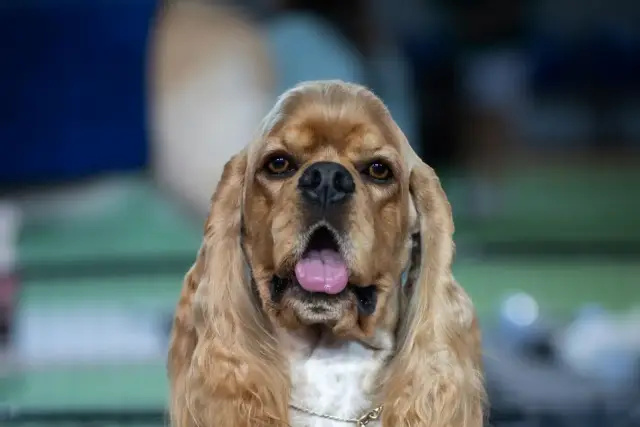
- English Cocker Spaniel: a similar-sized spaniel with a more widespread breeder network.

Kooikerhondje fun facts
 Related breedSpanish Water Dog1500 to 1980 · SpainAge of Exploration
- The white tail plume is a working feature. It was the signal that ducks followed along the pond bank.
- The Dutch name for the black ear tips is oorbellen, which means "earrings".
- The breed was rebuilt from roughly two dozen dogs, so the whole present population is closely related.
- Black ear tips are not required by every rule of the show ring, but the standard calls them strongly desired.
Frequently asked questions
How do you pronounce Kooikerhondje?
About "KOY-ker-hond-yuh". The first part sounds like "coy", and the "j" is a "y".
How big is a Kooikerhondje?
Small. The ideal is 40 cm at the withers for dogs and 38 cm for bitches. Weight is not set in the standard; typical adults weigh roughly 9 to 11 kg.
How long does a Kooikerhondje live?
The atlas data gives 12 to 14 years.
What health problems does a Kooikerhondje have?
The best-documented are patellar luxation (about 1 in 4 dogs in a Dutch study), hereditary necrotizing myelopathy and von Willebrand disease type 3, the last two with DNA tests. Choose a breeder who tests.
Is a Kooikerhondje a good family dog?
Often yes. It is playful and affectionate, though sensitive. Children should learn to treat it gently, and the dog needs daily activity.
Is a Kooikerhondje a rare breed?
Yes, outside the Netherlands. The UK Kennel Club recognised it in 2014 and the in 2018, so breeder numbers are still small in both countries.
Read next
 FamilySpanielThe whole family
 Adopt a dogDog Shelters in the NetherlandsFive big cities checked, how adoption works, chip and registration
Sources (13)
- Fédération Cynologique Internationale, Nederlandse Kooikerhondje, standard no. 314 (2010).
- Raad van Beheer (Dutch Kennel Club), breed history and recognition of the Nederlandse Kooikerhondje.
- Vereniging Het Nederlandse Kooikerhondje, breed standard and breed health pages.
- American Kennel Club, Nederlandse Kooikerhondje breed information and breed standard.
- Nederlandse Kooikerhondje Club of the USA, breed information.
- The Kennel Club (UK), Kooikerhondje breed information.
- Wangdee C., Leegwater P.A., Heuven H.C. et al., "Prevalence and genetics of patellar luxation in Kooiker dogs", The Veterinary Journal, 2014.
- Wageningen University and Research, record for the patellar luxation study in Kooiker dogs.
- "A novel IBA57 variant is associated with mitochondrial iron-sulfur protein deficiency and necrotizing myelopathy in dogs", Frontiers in Genetics, 2023 (Mandigers among the authors).
- Rieger M. et al., von Willebrand disease type 3 in Dutch Kooiker dogs, Thrombosis and Haemostasis and Veterinary Quarterly, 1998; and later DNA testing report for Dutch Kooiker dogs.
- Online Mendelian Inheritance in Animals (OMIA), entries for IBA57-related necrotising myelopathy and von Willebrand disease III in dogs.
- Fogle B., The Encyclopedia of the Dog, 2009.
- Parker H.G. et al., "Genomic analyses reveal the influence of geographic origin, migration, and hybridization on modern dog breed development", Cell Reports, 2017.