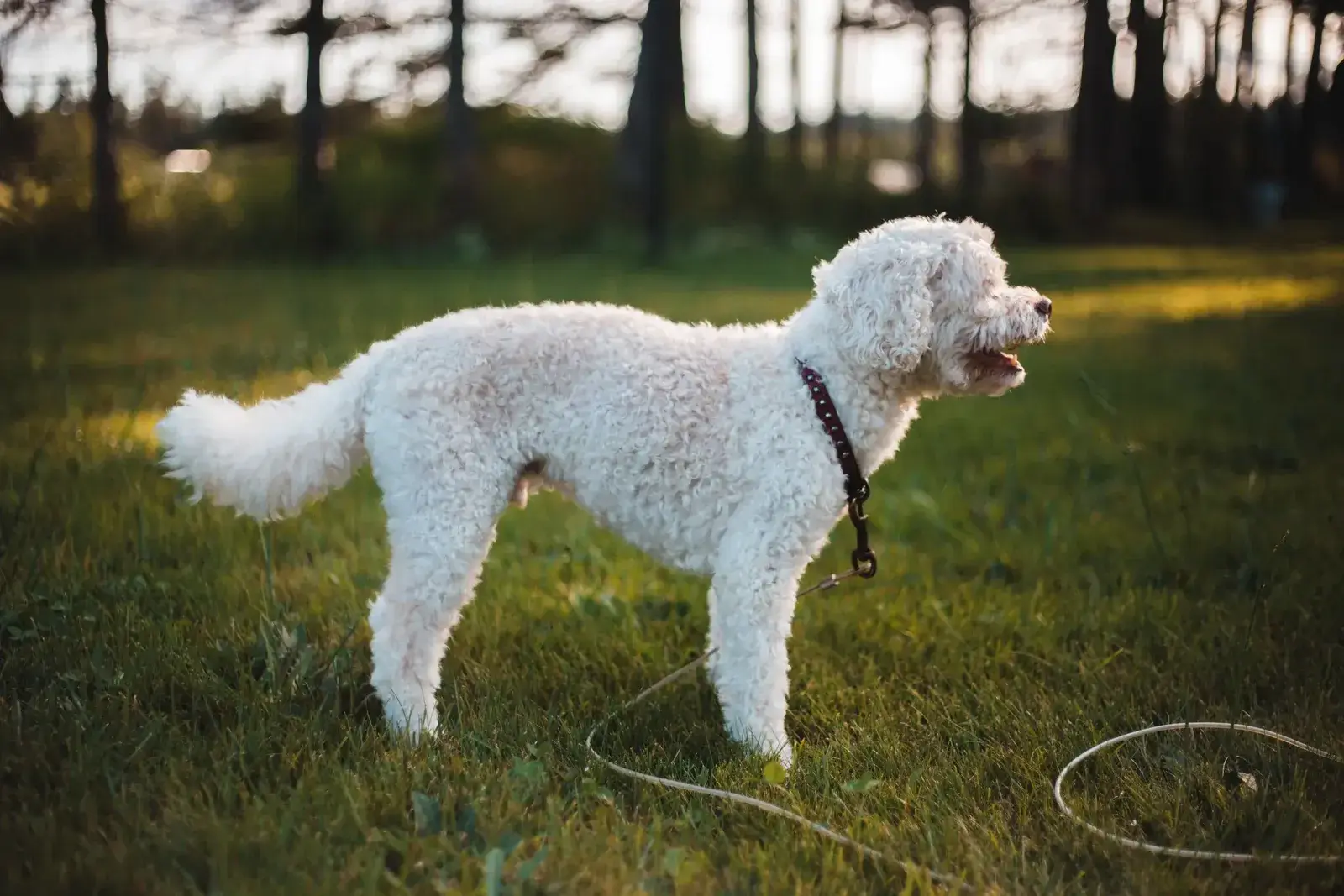
It began as a retriever of ducks in the marshes around Ravenna and Comacchio. When the marshes were drained for farmland, the same dogs found a new job: sniffing out truffles in the woods and hills of Romagna. By the 1970s the old type had nearly vanished. A group of Italian enthusiasts rebuilt it, and it is now a recognised breed in many countries and the best-known truffle dog in the world. It suits an active owner who likes training and can keep up with a coat that needs regular clipping.
Lagotto Romagnolo quick facts
 Related breedPoodle1400 to 1874 · FranceLate Middle Ages
- Country of origin
- Italy; the Romagna part of Emilia-Romagna (FCI)
- Period of development
- About 1500 to 1991 (atlas data, medium confidence); modern breed rebuilt from the 1970s and 1980s
- Original job
- Retrieving waterfowl in marshes, later finding truffles
- Type
- Water dog. FCI: Group 8, Retrievers, Flushing Dogs and Water Dogs, Section 3, standard no. 298. : Sporting Group. UK Kennel Club: Gundog Group
- Family (Parker 2017)
- Poodle
- Other names
- Romagna Water Dog, Italian Water Dog
- Height
- FCI and UK Kennel Club: males 43 to 48 cm, females 41 to 46 cm
- Weight
- FCI and UK Kennel Club: males 13 to 16 kg, females 11 to 14 kg
- Life span
- Atlas data: 14 to 16 years. Published ranges run from about 12 to 16 years; no mortality study is named
- Coat
- Dense, curly, woolly and waterproof; needs regular clipping
- Signature skill
- Finding truffles by scent
Drawn to scale in real centimetres. Its back reaches about 45 cm, just below your knee; its head about 57 cm, just above your knee.

Where it sits in the tree
Age of Exploration · 1500 to 1599

Name and origin
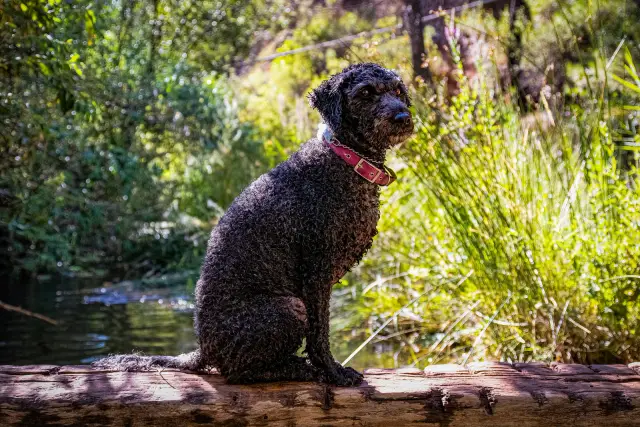 Related breedPortuguese Water Dog1200 to 1938 · PortugalLate Middle Ages
"Lagotto" comes from the Romagnol dialect word for a duck dog, from "lago", lake. "Romagnolo" means of the Romagna, the eastern part of the Emilia-Romagna region in northern Italy. The atlas data records the same etymology. The FCI lists the full name as Lagotto Romagnolo (Romagna Water Dog) and gives Italy as the country of origin.
The dog's first home was wet ground. Breed histories describe the marshes of Comacchio and Ravenna, a maze of lagoons and reed beds near the Adriatic coast, where hunters used curly-coated water dogs to retrieve ducks and coots from the water. Named dogs and exact dates from this stage are scarce; there was no studbook. The atlas data places the start of the breed around 1500, with medium confidence.

History
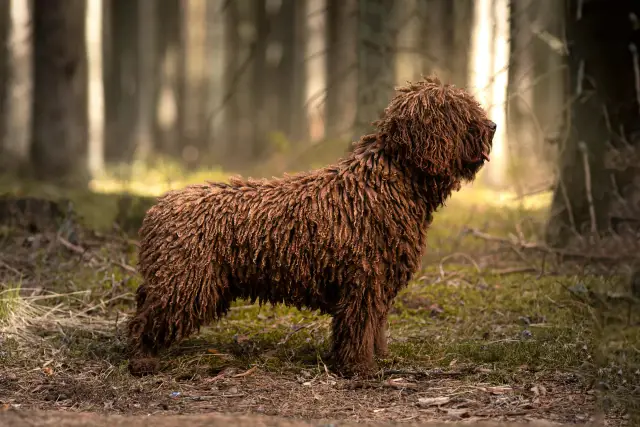 Same eraSpanish Water Dog1500 to 1980 · SpainAge of Exploration
From the marsh to the truffle woods
The shift from marsh to woodland followed the land. Over the centuries the great marshes of the Romagna lowlands were drained and turned into farmland. As the wetlands shrank, the work for a duck retriever shrank with them. Breed histories say the dogs were then turned to hunting truffles, the underground fungi that grow in the oak, poplar and willow woods of the region. Sources disagree on when. One account places the change between 1840 and 1890, and another says that by the middle of the 1800s the Lagotto was used almost entirely for truffles.
The curly coat and the habit of working close to the handler suited both jobs. A truffle dog works in cold, wet, thorny cover and has to stay near the person who will dig. A retriever of the marshes needed the same two things.
Truffle dogs without a studbook
Between the two world wars almost all truffle dogs in Romagna and the nearby hills were Lagotti, according to a history that the FCI-hosted breed document draws on. Nobody was interested in the Lagotto as a pure breed at that time, and crossbred dogs were often prized more than pure ones, because truffle hunters cared about the nose, not the pedigree. That helped the work and hurt the breed. The Lagotto had no breed club, no standard and no studbook, and the type slowly drifted.
Near loss in the 1970s
In the 1970s the number of Lagotti fell sharply and the breed came close to extinction. The FCI breed document and the Showsight breed magazine both credit a group of enthusiasts led by Quintino Toschi, then president of the local dog society and of the national kennel club (ENCI), with starting the rescue. Other members named in these accounts are Francesco Ballotta, Antonio Morsiani and Lodovico Babini. The FCI document describes their effort as a genetic reconstruction programme: they looked for dogs of the old type, still working in Romagna, and chose them for breeding.
The Club Italiano Lagotto was founded in Imola in 1988, and the FCI standard still credits the "Quintino Toschi" Italian Lagotto Club with running truffle-finding aptitude tests and trials across Italy to keep the working ability alive.
Recognition
Accounts agree that the Italian kennel club ENCI recognised the breed in 1992. Provisional FCI acceptance is dated to 1995 in most accounts, and definitive acceptance to 2005. The breed was admitted to the AKC Sporting Group and is recognised by the UK Kennel Club, which places it in the Gundog Group. The FCI standard has been revised more than once; versions are dated 2015 and 2019, and the later text lists a working trial as optional.
Relatives and DNA
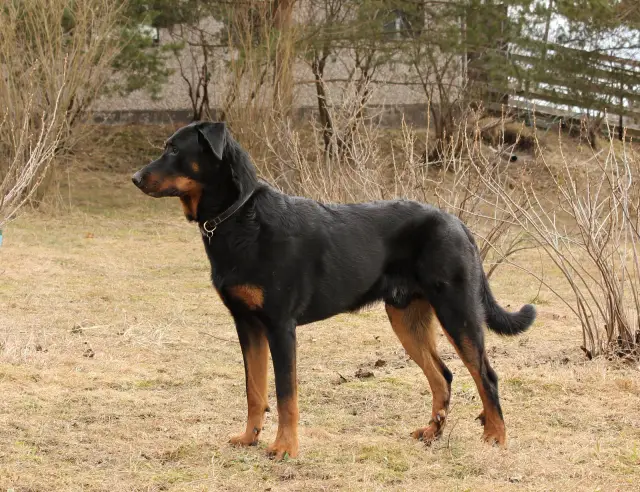 Same familyBeauceron1500 to 1896 · FranceAge of Exploration
In the DNA study by Parker and colleagues (2017, Cell Reports) the Lagotto sits in the Poodle family, the of curly water dogs and bichon types. That fits the history. The other curly water dogs of Europe, such as the Barbet, the Spanish Water Dog, the Portuguese Water Dog and the Poodle, are all in the same part of the tree. The Lagotto is not a Poodle breed in the narrow sense. It is a cousin with its own Italian history.
The atlas data lists no parent breeds or descendants for the Lagotto and holds no pairwise DNA figures, so there is no DNA chart here. The tree below shows only what the text states: the Lagotto and its curly-coated relatives sit together in one DNA family.
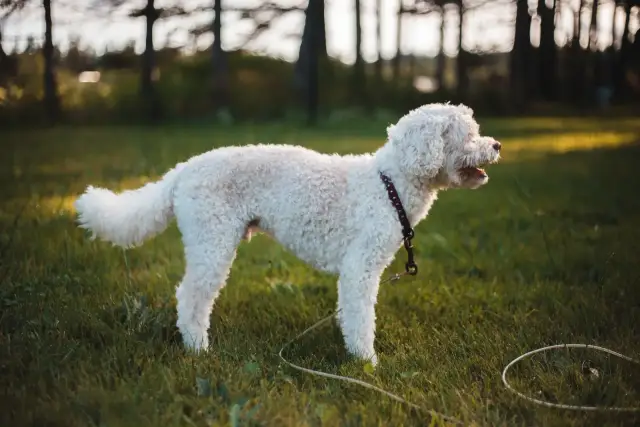 Lagotto RomagnoloItaly, marsh retriever turned truffle dogPoodlewater retriever turned companion
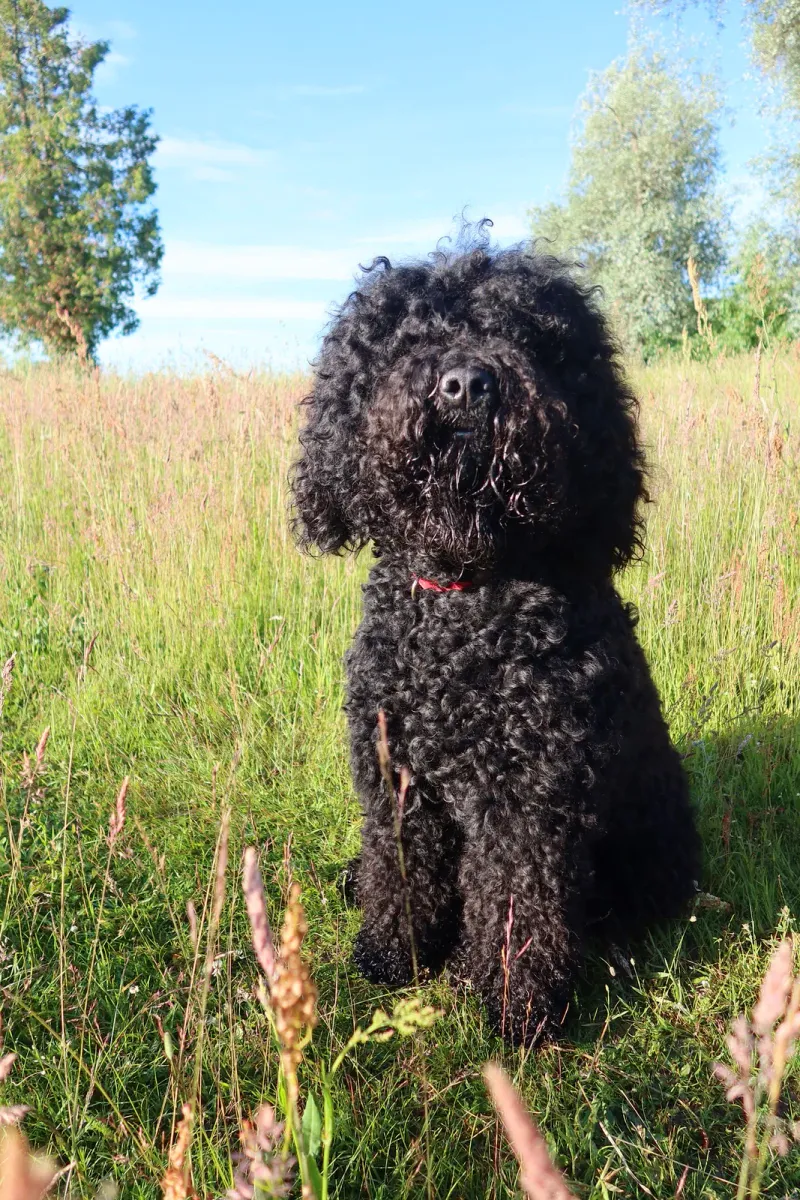 BarbetFrench curly water dogSpanish Water Dogcurly herding and water dogPortuguese Water Dogcurly working water dog
Lagotto or Poodle
The two look alike at a glance, so people mix them up. The Poodle is taller on average, comes in four sizes in the FCI standard and is clipped into show patterns. The Lagotto comes in one size, has a rougher and woollier coat, and the standard asks for a natural, trimmed look that keeps the curls visible. The Poodle was bred for the water and then for the ring and the home. The Lagotto was kept as a working nose dog until recently.
The breed standard
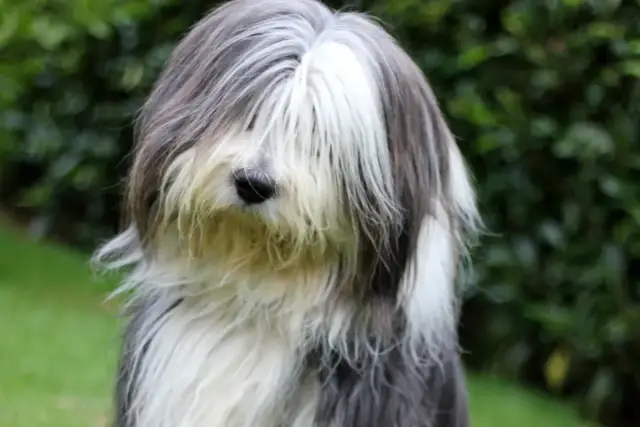
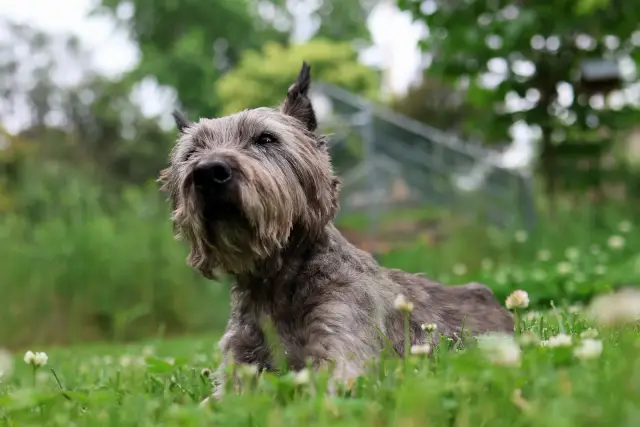 Looks relatedCairn Terrier1500 to 1910 · United KingdomAge of Exploration
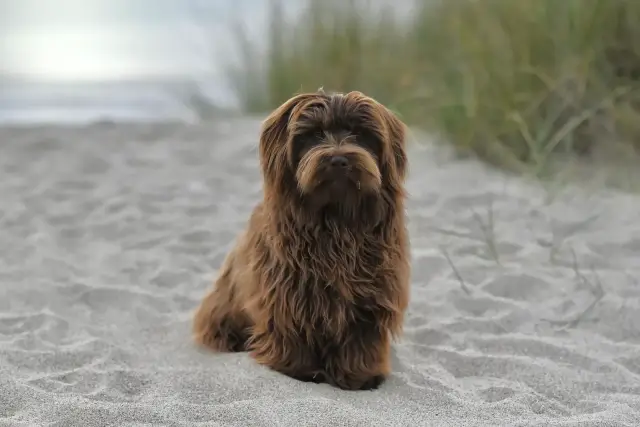
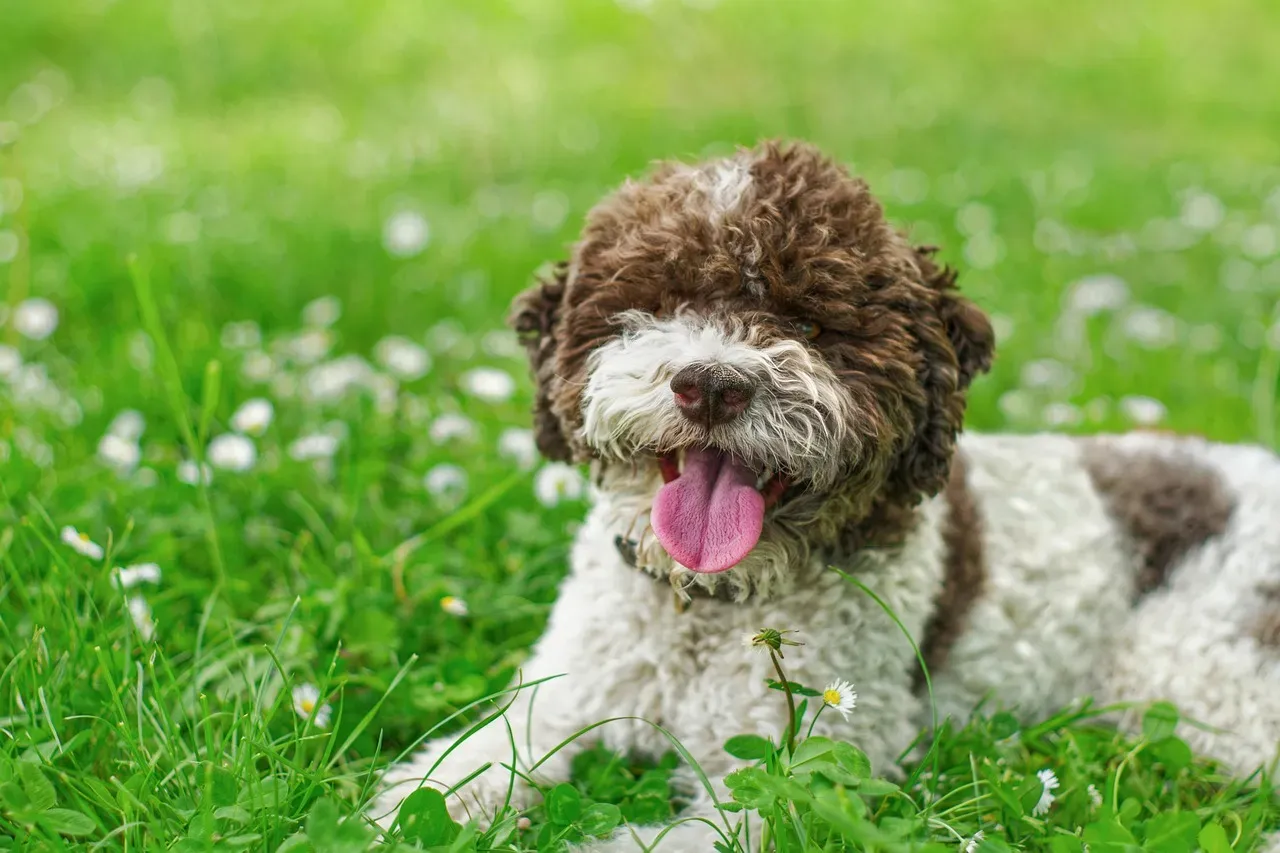
A is the written ideal that a kennel club judges dogs against. The FCI standard no. 298 and the UK Kennel Club standard agree on size and describe the Lagotto as a small to medium, solidly built dog, close to square in outline, with a dense curly coat of woolly texture.
| Trait | What the standards say |
|---|---|
| Height (FCI, UK Kennel Club) | Males 43 to 48 cm, females 41 to 46 cm. The UK Kennel Club gives ideal heights of 46 cm for males and 43 cm for females, with 1 cm tolerance either way |
| Weight (FCI, UK Kennel Club) | Males 13 to 16 kg, females 11 to 14 kg |
| Coat (FCI, UK Kennel Club) | Dense, curly and woolly with an undercoat and waterproof. Long enough that the curls and the texture show, shown in a natural state |
| Colours (UK Kennel Club) | Solid off-white; white with brown or orange markings; orange roan; brown roan; shades of brown; solid orange; brown or orange with white markings. Brown mask and tan markings are allowed |
| Pigment (UK Kennel Club) | Light to very dark brown, matching the coat colour |
| Build (FCI) | Powerful and well proportioned, nearly square |
Judges look at the coat first. The standards want a dog that is trimmed so the curl, the head and the outline can be seen, and not sculpted into a pattern. Coat that is brushed out or left to mat is faulted. In practice most pet Lagotti are clipped to one even length every few months.
 Save
Temperament
 Related breedChinese Crested Dog1500 to 1965 · ChinaAge of Exploration
The Lagotto is described by breed clubs and by the AKC as affectionate, eager to please and keen on being with its people. It has a strong nose and a lot of stamina for its size. Truffle work asks a dog to search for long periods, ignore distractions and stay in contact with the handler, and the breed still shows those habits. Many owners describe a dog that follows them from room to room, is alert to visitors and can bark at them, and needs jobs to do.
Because the breed was kept for the nose, it can be single-minded on a scent. A Lagotto that picks up a track may ignore recall until it has finished. It also has a well-known liking for digging, which makes sense in a dog that was bred to dig down to truffles. Owners who give it nose games and scent work usually report a calmer dog than those who rely on walks alone. These are descriptions by clubs and owners, not measured studies of the breed.

The coat and the "hypoallergenic" claim
 Related breedEnglish Setter1500 to 1850 · United KingdomAge of Exploration
The Lagotto's coat has a curl that traps shed hair, which is why the breed is often called low-shedding. That is true in the sense that loose hair stays in the coat until it is brushed out, and the dog does not leave a trail of hair across the house. It does not make the dog non-allergenic.
On the genetics of the curl, researchers in Finland and Switzerland have worked on the keratin gene KRT71. A known KRT71 change, a missense variant, explains curly coats in several breeds. Salmela and colleagues (2019) found a second variant in KRT71 in curly-coated retrievers, and the same second variant turned up at lower frequencies in several breeds, among them the Lagotto Romagnolo, the Bichon Frise and the Spanish Water Dog. Bauer and colleagues (2021) later studied a second KRT71 allele in curly-coated dogs, with a large Lagotto group. One curly Lagotto in the earlier study carried neither of the two variants, so the authors concluded that other alleles probably exist. The curl in the Lagotto is therefore partly explained by KRT71 and not fully.
On allergy, no breed has been proven to be allergen-free. Dog allergy is mostly a reaction to proteins from skin, saliva and urine, and the coat carries them. Vredegoor and colleagues (Journal of Allergy and Clinical Immunology, 2012) measured the main dog allergen, Can f 1, in the hair and coat of dogs sold as hypoallergenic and found more of it on those dogs than on other dogs, and no evidence that any breed deserves the label. Nicholas and colleagues (American Journal of Rhinology and Allergy, 2011) compared dust from homes with dogs sold as hypoallergenic and homes with other dogs, and found no difference in allergen levels. Neither study was about the Lagotto alone. What follows for an allergic family is simple: spend time with the individual dog, more than once, and ask an allergy doctor first.
Truffle hunting and training
 Related breedKooikerhondje1500 to 1966 · NetherlandsAge of Exploration
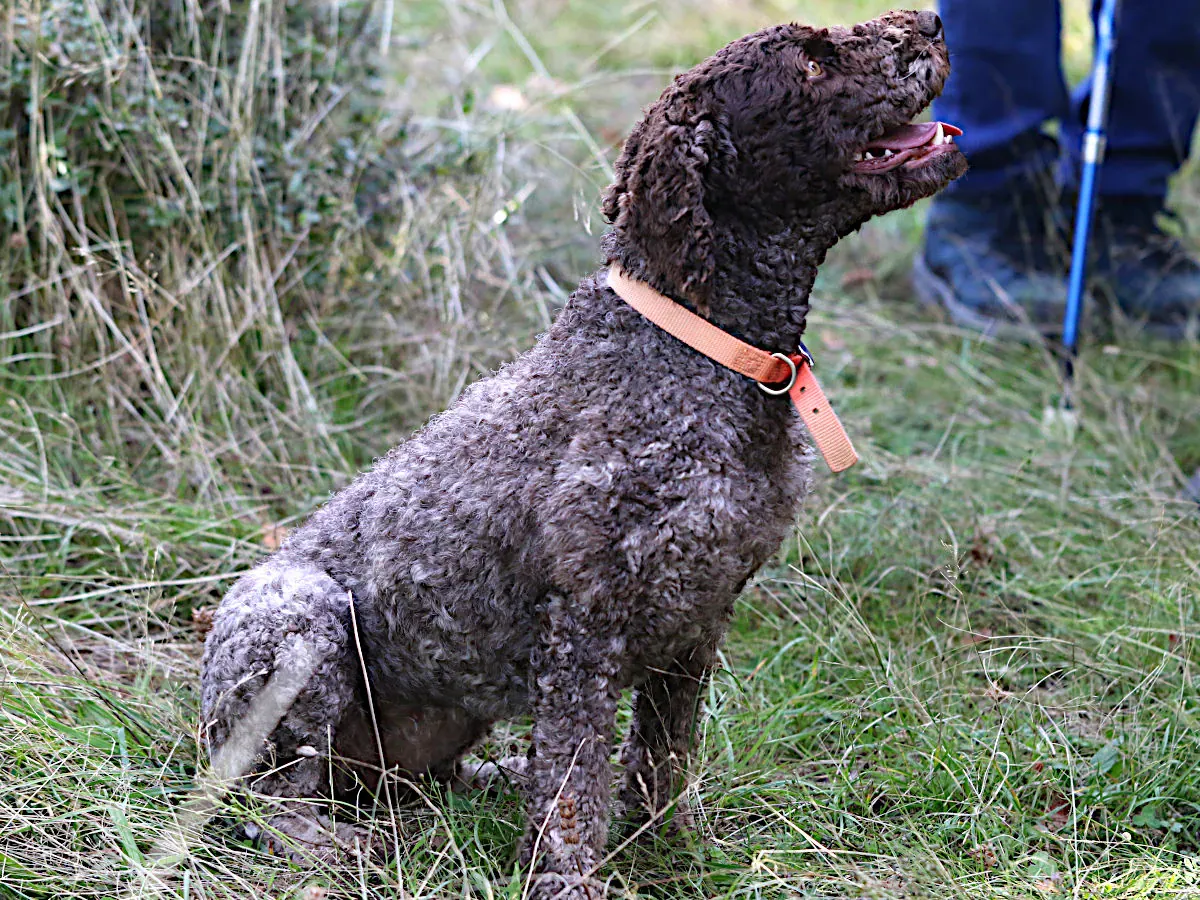
Truffle work comes first for many owners and is the breed's best-known skill, but most Lagotti today are family dogs. The basics are the same whether the goal is a real truffle forest or a nose game in the garden.
- Start early and keep it a game. Trainers describe introducing the truffle scent to puppies from around three months old, and rewarding finds with food and praise.
- Pick a clear signal. The dog should indicate a find by pausing, pointing or digging a little, not by tearing up the ground. A dog that marks the spot and lets the handler dig with care is easier to work with than one that tears at the ground.
- Reward at the find. Food reward at the spot teaches the dog that the smell, and not the digging, earns the reward.
- Build up the difficulty. Begin with a scent hidden in plain sight and move to buried scents, then to a wider area and different ground.
- Match the dog to the job. A trainer quoted by the AKC says the best truffle dogs are curious, independent, biddable and food motivated, and that other breeds can be taught too, though the Lagotto has a natural head start.
A real truffle season adds rules that training cannot teach: the law on digging, the permits, and the landowner's consent. These differ from country to country, and a new owner should ask the local club before heading into a wood.
For the groundwork that makes this possible, recall, a reliable stay, and calm around distractions, see advanced dog training, which also covers an introduction to scent work.
 Save
Coat care and grooming
 Related breedPapillon1500 to 1935 · France, BelgiumAge of Exploration
The coat grows continuously and does not shed in a seasonal way, so it needs clipping. Most owners clip the whole coat to a short, even length every two to three months, and brush the dog through at home between visits. A dog left unclipped can mat, particularly behind the ears and in the armpits, and a matted coat is uncomfortable and can hide skin trouble. The ears are hairy and sit close to the head, so they need checking for wax and moisture, a common point of advice for water dogs. These are general grooming practices, not figures from a study.
Health
 Related breedPresa Canario1500 to 1990 · SpainAge of Exploration
Most Lagotti live healthy lives. This section lists what breed clubs, researchers and vets discuss. Two inherited diseases have DNA tests, and the breed's small gene pool is the reason breeders use them. The table gives a prevalence figure only where a named study states one.
| Condition | What it is | How common | What helps |
|---|---|---|---|
| Benign familial juvenile epilepsy (BFJE, LGI2 gene) | Seizures in young puppies, usually starting at 5 to 9 weeks and fading by about 4 months; inherited as a trait, from a nonsense mutation (c.1552A>T) in LGI2 | Seppälä et al. (PLoS Genetics, 2011) found it in the Lagotto only, out of about 40 breeds tested; no breed-wide percentage is given in the study | DNA test for both parents before mating; are generally unaffected, and most affected dogs outgrow the seizures |
| Lagotto storage disease (ATG4D gene) | A neurological disease with slow loss of coordination (cerebellar ataxia), sometimes with eye movement and behaviour changes | Kyöstilä et al. (PLoS Genetics, 2015) studied more than 2,300 Lagotti; the variant c.1288G>A was strongly linked to the disease; carrier numbers are not given as a breed percentage | DNA test for both parents before mating; do not breed two carriers together |
| A loosely fitting hip joint | The UK Kennel Club hip scheme holds results for the breed; no prevalence figure is quoted here | Hip scoring of parents, lean weight, careful exercise while growing | |
| Ear infections | Wax and moisture trapped in a hairy ear | Often listed for water breeds; no figure | Regular ear checks, dry ears after swimming |
| Obesity | Extra weight, hard on joints | Not measured for the breed | Measured meals, daily exercise |
The two DNA tests. For juvenile epilepsy, the 2011 team ran a scan on 11 pairs of Lagotto littermates, one affected and one not. They mapped the disease to a region on chromosome 3, and found the nonsense mutation in LGI2. It is recessive, so a dog needs two copies. The study did not find the mutation in other breeds, and the authors proposed LGI2 as a candidate gene for human childhood epilepsies that fade. For storage disease, the 2015 team worked with clinical, pathological and genetic data, and also knocked down the matching gene in zebrafish, which caused damage in the nervous system. Both findings turned into DNA tests that breeders can use.
What this means for a buyer. The reliable practice is the same for both diseases. Ask the breeder for the DNA results of both parents for LGI2 and ATG4D. A litter from two clear parents, or from one carrier and one clear parent, cannot produce an affected puppy. Two carriers can. It is a good sign when a breeder shows the paperwork without being asked.
Life span. The atlas data gives 14 to 16 years. Breed profiles give ranges from about 12 to 16 years, none from a named mortality study, so treat this as an expectation and not a measured median.

Living with a Lagotto Romagnolo
| Daily reality | Rating | Why |
|---|---|---|
| Exercise per day | High | A working nose dog with stamina; breed clubs describe an active dog |
| Training needs | Medium | Eager to please but single-minded on scent; recall needs work |
| Grooming | High | A continuously growing coat; clipping every few months and brushing between |
| Shedding | Low | Loose hair stays in the curls until brushed out, though dander is still produced |
| Barking | Medium | Alert to visitors; can be vocal when bored |
| Time alone | Poor | Bred to work with a person; boredom brings digging and barking |
| Children | Good | Affectionate and sturdy for its size; supervise play |
| Other dogs | Good | Varies with socialisation |
| Cats and small pets | Varies | A retriever, not a chaser by breed; depends on the dog |
| Flat living | Fair | Small to medium, but needs real exercise and mental work every day |
| Heat tolerance | Fair | A dense coat; clipping helps, keep exercise to cooler hours |
| Cold tolerance | Good | A woolly, waterproof coat made for wet, cold ground |
| First-time owner fit | Fair | Friendly, but demanding of time and coat care |
A great fit if
- You enjoy scent games, nosework or tracking and want a partner for them.
- You are home for much of the day, or can take your dog with you.
- You do not mind regular clipping, or can pay for it.
- You want a medium-small dog with a lot of energy and affection.
Think twice if
- You are away for long days.
- You want a dog that is happy to lie around after a short walk.
- You have a lawn you care about, because the breed digs.
- You hope a low-shedding coat will cure an allergy. It may not.
Before you get one
Ask the breeder for the DNA results of both parents for LGI2 (juvenile epilepsy) and ATG4D (storage disease), and for hip scores. Because the breed was rebuilt from a small group of founders, the gene pool is limited, so a breeder who tracks is a good sign. Expect a wait. A national breed club is the best route to a litter or to an adult dog. Adult rescues and rehomings exist through breed clubs. For general advice on a shelter or rescue dog, see adopting a dog. Plan for the first year: socialisation, a coat clip every few months, and a job for the nose.
Similar breeds to consider
- Spanish Water Dog. A curly-coated working water dog with a similar need for a job.
- Portuguese Water Dog. A curly water dog, a little larger, with a lot of energy.
- Barbet. The French curly water dog, rare and sturdy.
- Poodle. A clever curly-coated retriever in four sizes, with a much longer show history.

Lagotto Romagnolo fun facts
- "Lagotto" comes from a Romagnol word for a duck dog, from "lago", lake.
- By the 1970s the breed was close to extinction, and a small club in Imola helped save it in 1988.
- Between the two world wars almost every truffle dog in Romagna was a Lagotto.
- The Italian kennel club recognised the breed in 1992 and the FCI gave it definitive recognition in 2005, according to most accounts.
Frequently asked questions
Where does the Lagotto Romagnolo come from?
From Romagna, in Emilia-Romagna, Italy. The lists Italy as the country of origin.
Is a Lagotto Romagnolo a good truffle dog?
Yes. It has been used almost only for truffles since the 1800s, and the breed club still runs truffle trials to keep the ability. Most Lagotti today are family pets that enjoy scent games.
How big is a Lagotto Romagnolo?
The FCI and UK Kennel Club standards give 43 to 48 cm and 13 to 16 kg for males, and 41 to 46 cm and 11 to 14 kg for females.
Does a Lagotto shed?
Little. The curly coat holds loose hair until it is brushed out. It needs clipping and brushing.
Is a Lagotto hypoallergenic?
No breed has been proven to be. Studies of dogs sold as hypoallergenic found no lower allergen levels. Spend time with the dog before you decide.
What health problems do Lagottos have?
Two inherited diseases are known: juvenile epilepsy (LGI2) and storage disease (ATG4D). Both have DNA tests. Hip scoring and ear care are also advised.
Read next
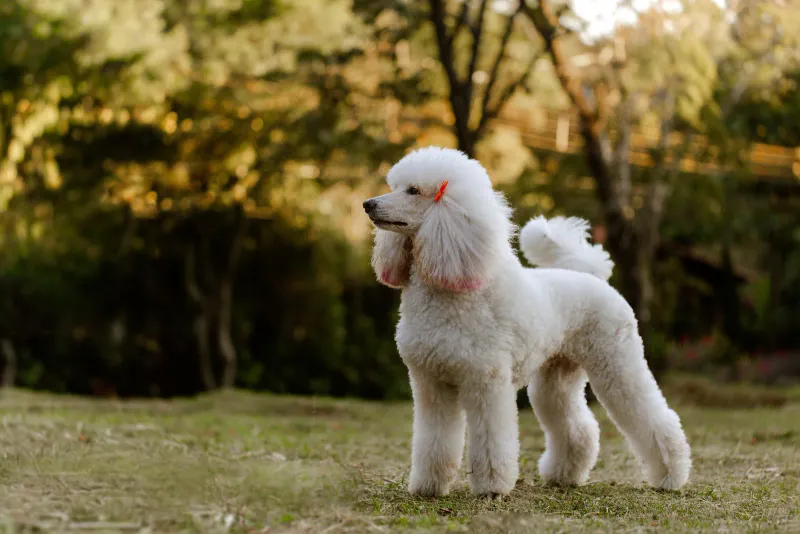 FamilyPoodleThe whole family
 Adopt a dogDog Shelters in EuropeFind dog shelters in Europe, learn how shelters differ from country to country and why adopting a dog is a good option.
Sources (13)
- Fédération Cynologique Internationale, standard no. 298, Lagotto Romagnolo (Romagna Water Dog), and the FCI breed document with the history of the breed (Quintino Toschi, genetic reconstruction).
- The Kennel Club (UK), Lagotto Romagnolo breed standard and breed information; Kennel Club hip scheme annual report.
- Dogs Australia, Lagotto Romagnolo breed page.
- American Kennel Club, Lagotto Romagnolo articles (truffle dogs and breed facts).
- Showsight magazine, Lagotto Romagnolo breed article (Club Italiano Lagotto, founding group).
- Seppälä E.H. et al., "LGI2 truncation causes a remitting focal epilepsy in dogs", PLoS Genetics, 2011.
- Kyöstilä K. et al., "A missense change in the ATG4D gene links aberrant autophagy to a neurodegenerative vacuolar storage disease", PLoS Genetics, 2015.
- Salmela E. et al., "A novel KRT71 variant in curly-coated dogs", Animal Genetics, 2019.
- Bauer A. et al., second KRT71 allele in curly-coated dogs including a large Lagotto cohort, Animal Genetics, 2019 (corrigendum 2021).
- Vredegoor D.W. et al., "Can f 1 levels in hair and homes of different dog breeds", Journal of Allergy and Clinical Immunology, 2012.
- Nicholas C. et al., "Dog allergen levels in homes with hypoallergenic compared with nonhypoallergenic dogs", American Journal of Rhinology and Allergy, 2011.
- Parker H.G. et al., "Genomic analyses reveal the influence of geographic origin, migration and hybridization on modern dog breed development", Cell Reports, 2017.
- Atlas data, Lagotto Romagnolo knowledge record (etymology, life span, family).