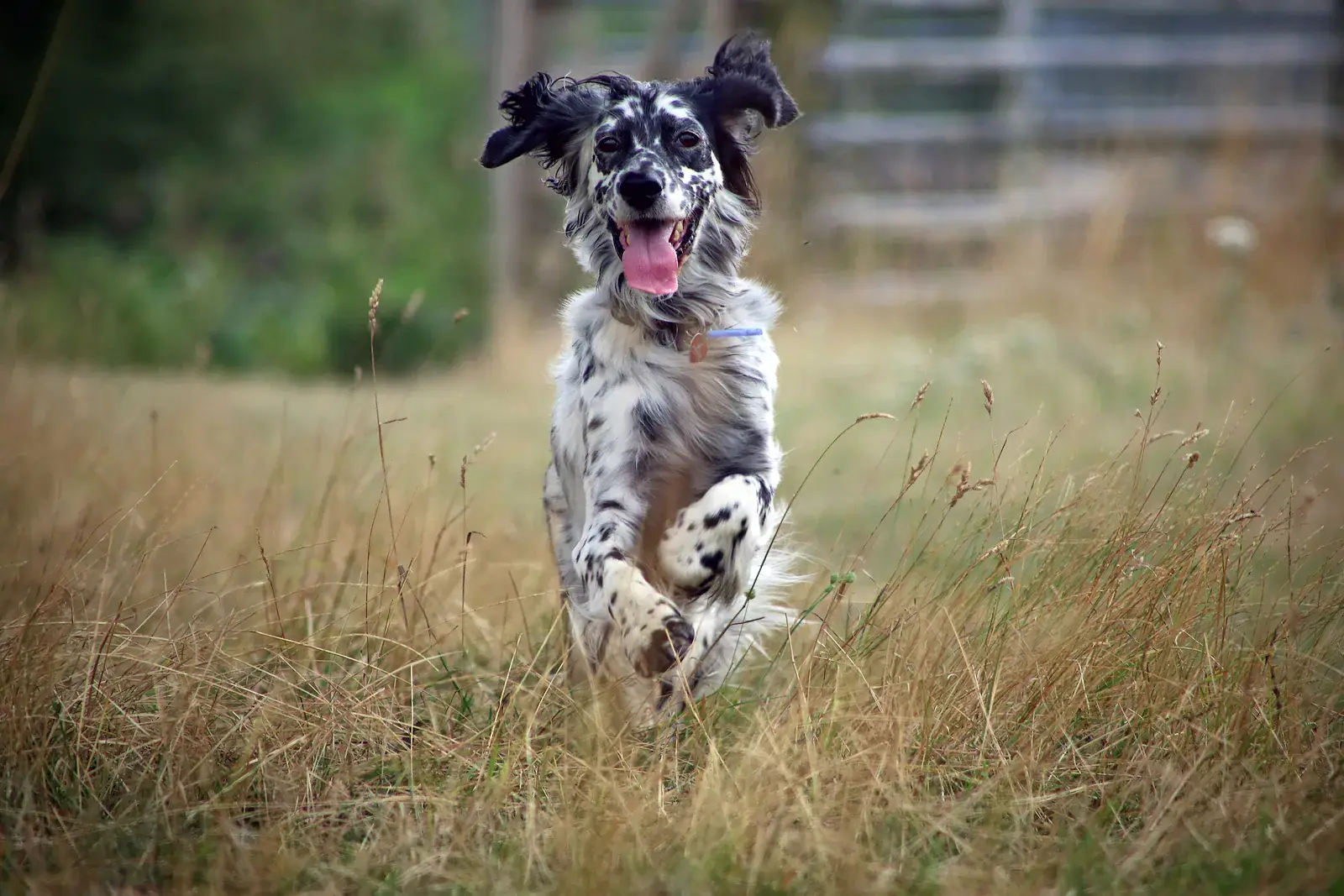
It was bred to range ahead of the hunter, find game birds by scent and freeze into a crouch, or "set", so the birds could be netted or shot. Today most are family companions and show dogs, with a smaller number of field-bred dogs. The breed is famous for its gentle, friendly nature. It suits active households that can give it more than two hours of exercise a day, regular grooming and company, and it is a poor match for owners who are out all day.
English Setter quick facts
 Related breedWirehaired Pointing Griffon1874 to 1887 · FranceVictorian Breed Boom
- Closest DNA relatives
- Gordon Setter, Brittany, Irish Setter
- Country of origin
- United Kingdom (England, Great Britain)
- Period of development
- About 1500 to 1850 (atlas data, medium confidence); modern type set in the 19th century
- Original job
- Finding game birds by scent and setting (crouching) for the hunter
- Type
- Pointer and setter (FCI Group 7, Pointing dogs, standard no. 2; Sporting Group; UK Kennel Club Gundog Group)
- Height
- UK Kennel Club standard: dogs 65 to 69 cm, bitches 61 to 65 cm
- Weight
- The Kennel Club and FCI standards give no weight
- Coat
- Long, silky, flat or slightly wavy, with long feathering on the legs, breeches and tail
- Colours
- Belton: blue, orange, lemon or liver, or tricolour. Flecked all over preferred
- Life span
- Atlas data: 10 to 12 years
- Exercise
- More than 2 hours a day (Kennel Club breed information)
- DNA group
- "Pointer Setter" clade, strong support (Parker et al. 2017)
- Other names
- Laverack setter, Llewellin setter (the field strain)
Drawn to scale in real centimetres. Its back reaches about 65 cm, mid-thigh; its head about 83 cm, your hip.

Where it sits in the tree
Age of Exploration · 1500 to 1599





Name and origin
 Related breedGerman Shorthaired Pointer1800 to 1872 · GermanyIndustrial Revolution
The name is a place plus a job. "English" gives the country. "Setter" comes from the dog's behaviour on scenting game: it sets, meaning it drops into a low, still crouch, and stays there until the hunter comes up. The crouch kept the dog from flushing the birds. The atlas data gives the same origin for the word.
The word "belton" belongs to the coat, not the dog. Edward Laverack, the breeder who did most to fix the show type, used it for his ideal of fine flecking. It is also the name of a village in the far north of England, and sources tie the two together.
The FCI lists the breed as standard no. 2 (definitive), with Great Britain as the country of origin. It is in FCI Group 7, the pointing dogs. The AKC places it in the Sporting Group and the Royal Kennel Club in the Gundog Group. The Royal Kennel Club also lists it among its vulnerable native breeds, which means registrations in the UK are low.

History
 Same eraFlat-coated Retriever1860 to 1880 · United KingdomVictorian Breed Boom
Before the standard
Setting dogs are described in English hunting writing from the 1500s, and the atlas data gives 1500 as the start of the breed's development window. Nobody knows exactly how the type formed. The atlas data lists the Old Spanish Pointer as a likely ancestor, crossed with spaniel-type dogs, with medium confidence. Early writers gave no pedigrees, so every account of these centuries is a reconstruction.
A dog described as a "setting dog" in the 1500s and a modern English Setter are not the same animal. They share a job and probably some ancestors, but the show-ring look is Victorian.
Edward Laverack
The modern English Setter owes its look to Edward Laverack (1800 to 1877). In 1825, according to the AKC, Laverack obtained a male called Ponto and a female called Old Moll, products of a line bred for 35 years. Gun Dog magazine describes Ponto as a dark blue belton and Old Moll as a light blue belton. These two became the foundation of Laverack's strain.
Laverack then bred closely from this stock and shaped a handsome, gentle, well-feathered dog. The AKC describes Laverack's dogs as the foundation of the show-ring English Setter. The story of Ponto and Old Moll comes from Laverack's own account.
Richard Purcell Llewellin
Richard Purcell Llewellin (1840 to 1925) was another English breeder. He liked Laverack's dogs but found they did not always perform well in field trials. To correct that, he crossed Laverack setters with other lines. His strain, the Llewellin setter, is today considered the field-bred English Setter. Laverack's dogs are the root of the show type.
The split matters for anyone choosing a puppy. The Llewellin type is usually lighter, faster and more driven. The show type is usually heavier in coat and bone, with a calmer pace. Both are registered as English Setters.
Dog shows and recognition
| Year | Event |
|---|---|
| About 1500 | Start of the breed's development window (atlas data) |
| 1825 | Laverack obtains Ponto and Old Moll (AKC) |
| 1878 | The AKC lists the English Setter among its nine original "charter breeds" |
The English Setter was one of the nine breeds first recognised by the AKC in 1878, which shows how popular setters were in North America in the early years of dog shows. Since Laverack's day the show type and the field type have been bred as two separate populations.

Relatives and DNA
 Same familyGolden Retriever1868 to 1911 · United KingdomVictorian Breed Boom
The atlas data lists one probable ancestor, the Old Spanish Pointer, with a note that evidence suggests the English Setter came from crosses that included the Spanish Pointer. It also lists the Bracco Italiano among its ancestors. The atlas data lists the Brittany, Flat-Coated Retriever and Blue Picardy Spaniel as breeds that descend from the English Setter. The Golden Retriever and Goldendoodle appear further down the line.
Descendant breeds
- Brittany. The atlas data lists this French pointing spaniel as a descendant. It is also the second-closest DNA relative in the table below.
- Flat-Coated Retriever. The atlas data lists the breed as a descendant of the English Setter.
- Blue Picardy Spaniel. A French breed that the atlas data lists as a descendant.
What does DNA say?
A 2017 study by Parker and colleagues (Cell Reports) analysed 1,346 dogs from 161 breeds and sorted them into clades. The English Setter falls in the "Pointer Setter" clade, with strong support. The study also measured shared : long stretches of identical DNA inherited from common ancestors. The more (Mb) two breeds share, the stronger the sign of crossing or shared founders. The study cannot say which way the genes flowed. In the atlas data the English Setter's closest breeds by are these:
Source: Parker et al. 2017, as recorded in this site's breed database.
Two results stand out. The Gordon Setter shares by far the most DNA, which fits the setter relationship: the two breeds came from the same British gundog stock. The Brittany is next, which supports the story of English Setter blood in the French breed. Only 24.5 Mb is shared with the Irish Setter, so the three setter breeds are not as close as their names suggest. The Flat-Coated Retriever and Golden Retriever both appear, a reminder that the feathered British gundogs share a thread. See the Pointer Setter family page for the wider group.
Descend from it · 3
- BrittanyFrance
- Flat-coated RetrieverUnited Kingdom
- Blue Picardy SpanielFrance
- Gordon Setter50.1 Mb 2.1%
- Brittany37.3 Mb 1.6%
- Irish Setter24.5 Mb 1.0%
- German Wirehaired Pointer14.5 Mb 0.6%
- Vizsla13.9 Mb 0.6%
- Wirehaired Pointing Griffon13.9 Mb 0.6%
- German Shorthaired Pointer13.8 Mb 0.6%
- Flat-coated Retriever11.7 Mb 0.5%
- Golden Retriever11.2 Mb 0.5%
- Spinone Italiano10.7 Mb 0.4%
Source: Parker et al. 2017. Percent of the whole genome.
| Breedwith English Setter | Shared DNA with English Setter (Mb)Shared DNA (Mb) |
|---|---|
| Gordon Setter | 50.1 |
| Brittany | 37.3 |
| Irish Setter | 24.5 |
| German Wirehaired Pointer | 14.5 |
| Vizsla | 13.9 |
| Wirehaired Pointing Griffon | 13.9 |
| German Shorthaired Pointer | 13.8 |
| Flat-Coated Retriever | 11.7 |
| Golden Retriever | 11.2 |
| Spinone Italiano | 10.7 |
Source: Parker et al. 2017, Cell Reports, shared haplotypes between 161 breeds (1,346 dogs).

The breed standard
 Looks relatedDalmatian1700 to 1890 · CroatiaEarly Modern Era
A is the written ideal that kennel club judges compare each dog against. The UK Kennel Club standard describes a dog of medium height, clean in outline, elegant in appearance and movement. It adds that the working English Setter may be proportionally lighter in build. Temperament is "intensely friendly and good natured".
| Trait | UK Kennel Club standard | Other sources |
|---|---|---|
| Height | Dogs 65 to 69 cm, bitches 61 to 65 cm | FCI: males 65 to 68 cm, females 61 to 65 cm |
| Weight | None given | None given in the FCI standard |
| Head | Carried high, long and reasonably lean, with a well-defined stop; muzzle moderately deep and fairly square | |
| Eyes | Bright, mild and expressive; hazel to dark brown, the darker the better; a lighter eye is accepted in liver beltons only | |
| Ears | Moderate length, set on low, hanging in neat folds close to the cheek | |
| Coat | Long and silky, slightly wavy but not curly; breeches and forelegs well feathered | Field types are finer in build than bench types |
| Tail | Set almost in line with the back, scimitar-shaped, with long soft feathering; never curly or ropy | |
| Colours | Blue, orange, lemon or liver belton, or tricolour (belton and tan); flecked all over preferable to heavy patches | Other colours unacceptable |
| Gait | Free and graceful, suggesting speed and endurance |
What is belton? Belton is a pattern of small flecks, also called ticking, laid over a white coat. Blue belton is black flecking on white. Orange belton is orange flecks on white, and lemon belton is the same in a paler tone. Liver belton has brown flecks. Tricolour adds tan markings to blue or liver belton. Puppies are often born mostly white, and the flecks appear over the first weeks. Kennel clubs prefer flecking spread across the whole body over big solid patches.

Temperament
 Related breedWeimaraner1810 to 1897 · GermanyIndustrial Revolution
The Kennel Club standard describes the breed in two phrases: "very active with a keen game sense" and "intensely friendly and good natured". In daily life that means a gentle, people-loving dog with plenty of energy. Many English Setters greet visitors warmly instead of guarding. Show-line dogs tend to be calmer in the house. Field-line dogs have a stronger drive to range and work, and are often busier.
The breed was made to work at a distance from the handler. It follows scent with its head high, and it can be easily drawn away by a good smell. Off-lead recall needs steady training from a young age, and a secure fence matters. The Kennel Club lists more than two hours of exercise a day. The breed enjoys long walks, fetching, field trials, scent work and agility.
Gentle dogs of this type usually respond best to patient, reward-based training. They bond closely to their people and do best with company.
Setters at work
- Quartering. The dog covers a field in wide, even sweeps across the wind to pick up the scent of birds.
- The point. On scenting game the dog stops and sets, usually with one forefoot lifted, head high and tail level.
- Steadiness. A good field setter holds the point until the hunter arrives and does not break to chase.

Health
 Related breedBeauceron1500 to 1896 · FranceAge of Exploration
Most English Setters live active lives into their early teens. The atlas data gives a life span of 10 to 12 years. No large published study of English Setter longevity has been found, so owners should treat that range as a guide. The conditions below are the ones breeders discuss most, and a calm, informed approach helps: ask for health results, keep the dog lean and test hearing early.
Information here is general. Talk to a vet about your own dog.
Deafness
Congenital sensorineural deafness is the best-documented problem in the breed. It is present at birth and comes from degeneration of the inner ear. It can affect one ear (unilateral) or both (bilateral). Strain (The Veterinary Journal, 2004) found that blue eyes and a deaf parent were associated with deafness in English Setters.
Two sources give different rates, because they use different dogs and methods:
- UK puppy study. Marsh and colleagues (Veterinary Record, 2020) tested 447 English Setter puppies in the United Kingdom. About 4.5 percent (roughly 1 in 22) had congenital sensorineural deafness: 3.6 percent in one ear and 0.9 percent in both ears. Female puppies and puppies of two parents of unknown hearing status were at greater risk.
- LSU hearing database. A table at Louisiana State University lists 751 tested English Setters with 12.4 percent deaf (about 1 in 8), mostly in one ear.
A dog deaf in one ear can look and behave normally. Hearing is tested with a BAER test, which can be done on young puppies. Breeders who test every puppy and avoid mating dogs of unknown hearing status reduce the risk.
Neuronal ceroid lipofuscinosis
Neuronal ceroid lipofuscinosis (NCL) is a fatal, inherited brain disease first studied in English Setters. Katz and colleagues (Biochemical and Biophysical Research Communications, 2005) found a change in the CLN8 gene (p.L164P) that tracks with the disease. It is , so a dog needs two copies. Affected dogs show vision loss, wobbliness, behaviour change and seizures, and rarely live past two years. A DNA test exists, and testing breeding dogs keeps it from appearing in puppies.
Other conditions
| Condition | What it is | How common | What to do |
|---|---|---|---|
| Congenital deafness | Inner-ear degeneration present from birth; one or both ears | About 1 in 22 puppies (UK study, 2020); about 1 in 8 in a US hearing database | BAER test of every puppy; breed only from tested dogs |
| NCL (CLN8) | Recessive, fatal brain disease; vision loss, seizures, early death | No published carrier rate | DNA test of both parents |
| Joint malformation of the hip | UK Kennel Club 2024 hip report: median hip score 11 across 1,071 English Setters scored in 15 years (lower is better) | Hip scoring before breeding; lean body weight |
Other conditions often discussed in the breed include underactive thyroid and bloat in deep-chested dogs. No published figure for either is given here. Owners of deep-chested dogs can ask the vet about feeding routine and the warning signs of a swollen, painful belly, which need immediate care.

Living with an English Setter
 Related breedCairn Terrier1500 to 1910 · United KingdomAge of Exploration
| Daily reality | Rating | Why |
|---|---|---|
| Exercise | High | More than 2 hours a day (Kennel Club) |
| Training needs | Medium | Willing and gentle, but easily distracted by scent |
| Grooming | High | Brushing more than once a week (Kennel Club); feathers tangle |
| Shedding | Medium | Sheds, and long feathers collect burrs and mud |
| Barking | Low to medium | Not known as a barker |
| Time alone | Poor | A people dog; bored setters can become destructive |
| Children | Good | Gentle and friendly, but large and bouncy when young |
| Other dogs | Good | Friendly by nature; bred to work in company |
| Cats and small pets | Varies | A bird dog with a chase instinct; introduce with care |
| Flat living | Poor | Needs room and a secure garden |
| Heat tolerance | Fair | Long coat; limit hard exercise in heat |
| First-time owner | Fair | Easy-going nature, but exercise and grooming demand a plan |
A great fit if you...
- enjoy long daily walks and open country;
- have time to brush a long coat several times a week;
- are home for much of the day;
- want a gentle, friendly dog and can train recall patiently.
Think twice if you...
- are away at work all day;
- cannot fence a garden or keep the dog on a lead near roads;
- want a low-grooming dog;
- need a guard dog.
Before you get one. Ask the breeder for BAER hearing results for the puppies and the parents, hip scores, and the CLN8 DNA result. Ask whether the lines are show or field, and meet the parents. The breed is listed as vulnerable in the UK, so waiting lists are common, and breed rescues exist.
Similar breeds to consider
- Irish Setter: the red setter, bolder and more boisterous.
- Brittany: a smaller pointing dog with a similar work ethic.
- Vizsla: a shorter-coated pointing breed that is very attached to its person.
- Golden Retriever: a feathered gundog with a similar friendly temperament.

English Setter fun facts
 Related breedChinese Crested Dog1500 to 1965 · ChinaAge of Exploration
- The English Setter was one of the nine original "charter breeds" recognised by the AKC in 1878.
- "Belton" may come from a village in Northumberland, and it was Laverack who used the word to describe his ideal flecked coat.
- Edward Laverack lived from 1800 to 1877, and Richard Purcell Llewellin from 1840 to 1925; the show and field English Setters are often named after them.
- The Royal Kennel Club lists the English Setter among its vulnerable native breeds.
Frequently asked questions
Are English Setters good family dogs?
Yes, for active families. The Kennel Club standard calls the temperament intensely friendly and good natured. They need space, company and plenty of exercise.
How much exercise does an English Setter need?
The Kennel Club lists more than 2 hours a day.
How long do English Setters live?
Atlas data gives 10 to 12 years.
How big is an English Setter?
The Kennel Club standard gives 65 to 69 cm for dogs and 61 to 65 cm for bitches. Neither it nor the standard gives a weight.
What colours do English Setters come in?
Blue, orange, lemon and liver belton, or tricolour. All are flecked, and big solid patches are not preferred.
Are English Setters prone to deafness?
It is the best-known inherited problem. A UK study of 447 puppies found 4.5 percent deaf, so responsible breeders test every litter.
What is the difference between a Laverack and a Llewellin setter?
The Laverack is the show type, with a heavier coat. The Llewellin is the field-bred strain, lighter and faster. Both are English Setters.
Are English Setters related to Irish Setters?
Yes, within the same DNA , but they share only 24.5 , much less than the English Setter shares with the Gordon Setter (50.1 Mb).
Read next
 Closest DNABrittany37.3 Mb shared
 FamilyPointer SetterThe whole family
 Adopt a dogDog Shelters in EuropeFind dog shelters in Europe, learn how shelters differ from country to country and why adopting a dog is a good option.
Sources (12)
- American Kennel Club, "English Setter history" and English Setter breed page.
- BVA and The Kennel Club, Annual hip report 2024, English Setter hip score data.
- Fédération Cynologique Internationale, English Setter, standard no. 2.
- Gun Dog magazine, "Centuries of careful breeding have brought a do-it-all", English Setter breed history article.
- Katz M.L. et al., "A mutation in the CLN8 gene in English Setter dogs with neuronal ceroid-lipofuscinosis", Biochemical and Biophysical Research Communications, 2005.
- Louisiana State University School of Veterinary Medicine, Breed-specific deafness prevalence in dogs.
- Marsh O.J.R. et al., "Congenital sensorineural deafness in English setters in the United Kingdom: prevalence and association with phenotype and sex", Veterinary Record, 2020.
- Parker H.G. et al., "Genomic analyses reveal the influence of geographic origin, migration, and hybridization on modern dog breed development", Cell Reports, 2017.
- Strain G.M., "Deafness prevalence and pigmentation and gender associations in dog breeds at risk00104-7)", The Veterinary Journal, 2004.
- The Kennel Club (UK), English Setter breed standard.
- Wikipedia, "English Setter".
- Atlas data, breed records and Parker 2017 shared-haplotype table (this site).