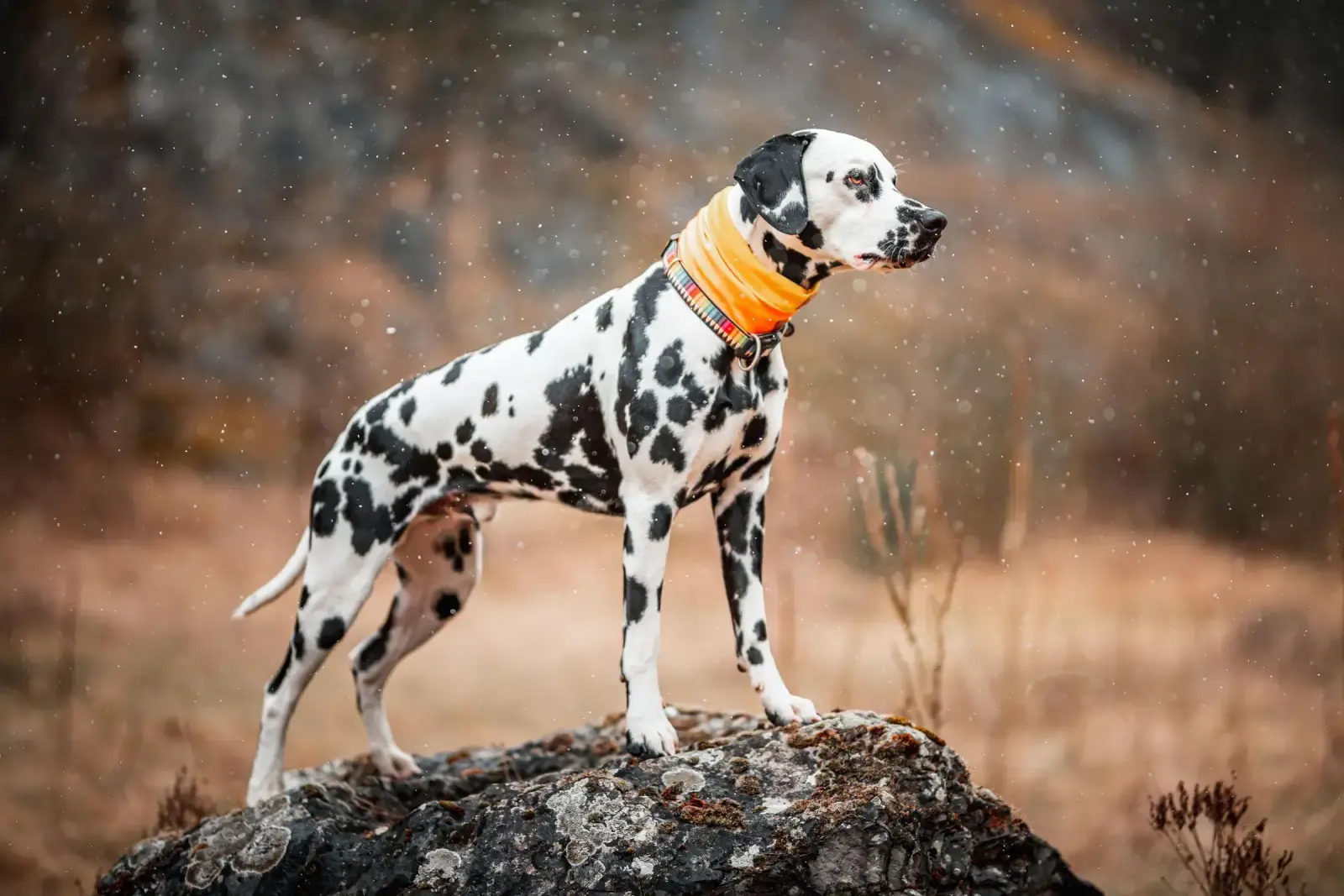
It is best known as the carriage dog that trotted beside horses, and since 1956 as the star of a children's book and two Disney films. Its body works differently from other dogs in one way: every purebred Dalmatian carries the same recessive change in the SLC2A9 gene, which makes it pass uric acid in its urine and gives it a risk of urate bladder stones. A cross to a Pointer in the 1970s produced a "low uric acid" line that the American Kennel Club accepted in 2011. Deafness is the other big health topic: in older US studies about 3 in 10 Dalmatians had hearing loss in one or both ears, and in a UK study of puppies tested from 1992 to 2019 the figure was about 1 in 6. This page covers the history, the genetics, the numbers and daily life with a very energetic dog.
Dalmatian quick facts
 Related breedIrish Setter1700 to 1886 · IrelandEarly Modern Era
- Country of origin
- Croatia (FCI); region Dalmatia
- Period of development
- 1700 to 1890 (atlas data, medium confidence); earlier depictions exist
- Other names
- Dalmatinski Pas, Dalmatiner (German), Carriage Dog, Coach Dog, Firehouse Dog
- Size
- Large; about 54 to 62 cm at the withers (FCI)
- Life span
- Atlas data: 11 to 13 years
- Coat
- Short, dense, white with round black or liver spots
- Group
- FCI Group 6 (scent hounds and related breeds), standard no. 153; AKC Non-Sporting
- Recognised by
- FCI, AKC, UK Kennel Club
- Family
- Pointer Setter (Parker 2017, weak support)
- Energy
- High: bred to run for hours beside horses
Drawn to scale in real centimetres. Its back reaches about 55 cm, just above your knee; its head about 70 cm, mid-thigh.
Where it sits in the tree
Early Modern Era · 1600 to 1799

Name and origin
 Related breedVizsla1350 to 1935 · HungaryLate Middle Ages
The name comes from Dalmatia, the Adriatic coastal region of Croatia. The FCI lists Croatia as the country of origin, and the standard carries the Croatian name Dalmatinski Pas. The dog's true birthplace is still argued. Britain gave it the job that made it famous. No document settles where the spotted dogs first appeared, so Croatia is the official origin and the early route is open.
The Dalmatian sits in the Pointer Setter family in the atlas data. That placement comes from the DNA study by Parker and colleagues (Cell Reports, 2017), and the study marks the support for the Dalmatian's place in that group as weak. It is a hint about relatives, not a proof of descent.

History
 Same eraWeimaraner1810 to 1897 · GermanyIndustrial Revolution
Spotted dogs in old art, and the 1719 description
Several early pictures are quoted as the first Dalmatians. An altarpiece in Veli Losinj, on a Croatian island, is dated to about 1600 to 1630 and shows spotted dogs. A fresco in Zaostrog, on the Dalmatian coast, is dated to the 1700s in one account. Earlier still, a spotted dog appears in a fresco of about 1360 in the Spanish Chapel of Santa Maria Novella in Florence, though how much that dog resembles a Dalmatian is a matter of opinion.
The best-attested written description is the 1719 church chronicle of Bishop Petar Bakic of Djakovo in Croatia, which names a dog as "Canis Dalmaticus". A second chronicle by Andreas Keczkemety, dated 1737, is also quoted. Some accounts go further back and give an earlier reference from the Djakovo bishopric in 1374 or 1375, but the sources disagree on the date and on which dog is meant, since that document is also linked to a Croatian sheepdog. Treat the 1374 and 1375 date as a legend until a source is checked.
The English carriage dog, 1700s and 1800s
The Dalmatian became a fashion item in Britain. Wealthy owners kept spotted dogs that trotted beside or under horse-drawn carriages, a role that gave them the name English Coach Dog. The idea was part show and part work: the dogs kept pace with the horses for many kilometres and were said to guard the carriage and horses at stops. A carriage dog needed stamina, a calm head around horses and a striking coat, and the Dalmatian had all three.
The breed's atlas date range is 1700 to 1890, which covers this period and the years in which clubs and standards fixed the type. Britannica describes the Dalmatian as best known as a coach or carriage dog, and the English name sticks to the breed in several countries.
Firehouse dogs and a changing job
The same horse skills moved to the United States, where Dalmatians ran with horse-drawn fire engines, cleared the road and guarded the horses in the station. When engines became motorised, the dogs stayed on as station mascots. This is why the breed is still called the firehouse dog and why Dalmatians appear on fire-service badges.
Dodie Smith and Disney, in brief
Dodie Smith's novel The Hundred and One Dalmatians appeared in 1956. She named the lead dog Pongo after her own Dalmatian, which her husband bought for her as a puppy in 1934. Disney released the animated film in 1961 and a live-action remake on 27 November 1996. After the 1996 film, the UK Kennel Club reported that the breed's popularity reached an all-time high, and rehoming charities later described a wave of unwanted dogs. Britannica goes as far as saying the 1961 film may have done more harm than good to the breed. The lesson that breed clubs draw is simple: this is a dog for an active owner, not a film prop.
Recognition
The FCI lists the Dalmatian as breed no. 153 with Croatia as the country of origin, in Group 6. The AKC places it in the Non-Sporting Group. The UK Kennel Club recognises it as well.
Relatives and DNA
 Same familyWirehaired Pointing Griffon1874 to 1887 · FranceVictorian Breed Boom
The atlas data records two ancestor links for the Dalmatian, and both are low confidence: a spotted Great Dane type and Pointer-type dogs. The names of the Old Spanish Pointer and the Bracco Italiano appear among ancestors in the atlas . No published DNA study gives a Dalmatian chart, so no figure for is given here.
The Pointer link is also the thread that runs through the 1970s backcross story below. The Pointer was the outcross in the backcross project described below.
Descend from it · 1
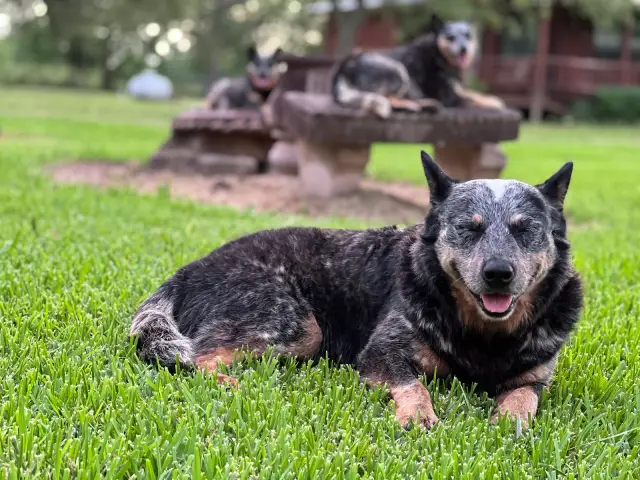
- Australian Cattle DogAustralia
The uric acid gene: SLC2A9
 Related breedAkita1600 to 1931 · JapanEarly Modern Era
What goes wrong in a Dalmatian
All dogs and most mammals break uric acid down to allantoin, which is easy to pass in urine. Dalmatians can do this too: their liver enzyme works. What they lack is the transporter that moves uric acid out of the blood into the liver and the kidney tubes for processing. As a result, uric acid is released in large amounts in the urine (hyperuricosuria), and blood levels run higher than in other dogs.
In 2008 Danika Bannasch and colleagues at UC Davis published the cause (PLoS Genetics, "Mutations in the SLC2A9 gene cause hyperuricosuria and hyperuricemia in the dog"). They found a missense variant in the SLC2A9 gene (G616T, changing amino acid 188 from cysteine to phenylalanine) plus two changes in the gene's promoter that appear to lower the amount of one form of the protein. The trait is autosomal recessive, and every purebred Dalmatian carries two copies. SLC2A9 is also a gene that affects uric acid levels in people, which is why the dog finding drew attention in human medicine.
Why only some Dalmatians form stones
High uric acid in the urine does not always form stones. In urine that is concentrated and acidic, uric acid combines with ammonia into ammonium urate, which crystallises into bladder stones. Males are far more at risk because their narrow urethra can be blocked by a stone.
Bartges and colleagues (Journal of the American Veterinary Medical Association, 1994) reviewed urate stones sent to a stone laboratory and found that male Dalmatians were 16.4 times more likely than females to be affected. A survey of Dalmatian owners by Lulich and colleagues (2004) estimated that 34 percent of male Dalmatians had had urate stones. That is an owner survey, not a clinical count, so treat it as an estimate. The practical meaning is about 1 in 3 males, much lower for females.
The low uric acid backcross, 1973 to 2011
The defect was known for decades before the gene was. In 1973 Dr Robert Schaible started a project to remove it: he crossed a Dalmatian with a Pointer, which does not carry the variant, then bred the offspring back to Dalmatians for several generations, selecting for Dalmatian type at each step. The aim was to keep the breed's looks and add one normal gene copy. Bannasch's 2008 paper confirmed the idea: the backcross dogs carried the normal version of the gene, and the dogs kept the Dalmatian type.
The politics took longer than the science. Backcross dogs were first registered with the AKC in the early 1980s, which accounts quote as fourth or fifth generation dogs, but registration then stopped, and low uric acid (LUA) dogs were registered with the United Kennel Club. In June 2011 a strong majority of Dalmatian Club of America members voted in favour of AKC registration, and in July 2011 the AKC board voted unanimously to accept the descendants of the 1973 litter into the .
Breeding a backcross dog to a purebred Dalmatian gives about half LUA puppies, which carry at least one normal gene copy, and half purebred type. UC Davis offers a DNA test, so breeders can tell the types apart.
Two honest limits apply. First, an LUA dog has a lower risk of stones, not zero risk, and no study gives a stone rate for LUA Dalmatians. Second, the Dalmatian's other health issues, deafness above all, are not touched by this cross.
Deafness in Dalmatians
 Related breedAmerican Bulldog1700 to 1980 · United StatesEarly Modern Era
Congenital sensorineural deafness is the best-studied health problem in the breed. It is present from birth and caused by the loss of the hair cells in the inner ear, so the dog is deaf in one ear (unilateral) or both (bilateral). Testing uses the BAER (brainstem auditory evoked response) test, usually from about five to six weeks of age.
- Holliday and colleagues (Journal of Veterinary Internal Medicine, 1992) tested 900 Dalmatians. About 72.0 percent were normal, 21.0 percent had no response in one ear, and 7.0 percent were deaf in both.
- Strain and colleagues (Journal of Veterinary Internal Medicine, 1992) tested 1,031 Dalmatians at three sites and looked for physical markers of deafness, such as eye colour and head patches. They found 8.1 percent deaf in both ears and 21.6 percent in one ear, a total of 29.7 percent. Blue eyes were associated with higher risk.
- Lewis, Freeman and De Risio (Journal of Veterinary Internal Medicine, 2020) analysed 8,955 UK puppies tested from July 1992 to February 2019. Overall 17.8 percent had hearing loss: 13.4 percent in one ear and 4.4 percent in both. Heritability was about 0.3, and the authors found falling rates over the years, which they link to breeders selecting against deafness.
Put plainly: about 1 in 3 or 4 in the early US studies, about 1 in 6 across the later UK years, and fewer than 1 in 20 deaf in both ears in the UK. Because heritability is moderate and the gene is not fully mapped, a hearing test of every puppy and every breeding dog remains the safest approach.
A dog deaf in one ear can live an ordinary life and often goes unnoticed. A dog deaf in both ears can be a good pet in the right home, with hand signals, a trainer's help and very careful road safety. Ask the breeder what they do with bilaterally deaf puppies.
The breed standard
 Looks relatedBlack Mouth Cur1700 to 1900 · United StatesEarly Modern Era
The FCI, AKC and UK Kennel Club standards agree on a balanced, muscular, spotted dog built for endurance. The figures below are rounded and differ by club.
| Trait | What the standards say |
|---|---|
| Height (FCI) | Dogs 56 to 62 cm, bitches 54 to 60 cm (current FCI standard no. 153; the older 1999 text gave 56 to 61 and 54 to 59 cm) |
| Height (AKC) | About 19 to 23 inches (48 to 58 cm) is the desirable height; the exact wording is not quoted here |
| Height (UK Kennel Club) | Dogs and bitches in the upper range, up to 61 cm; the exact wording is not quoted here |
| Weight (FCI, 1999 text) | About 27 to 32 kg for dogs and 24 to 29 kg for bitches |
| Coat | Short, hard, dense, sleek and glossy; pure white ground |
| Spots | Round, well defined, black or liver, placed in a wide pattern; no mixing of the two colours on one dog |
| Eyes | Dark brown in black-spotted dogs, amber in liver-spotted dogs |
| Overall | Balanced, muscular, strong and active, built for endurance and not for speed |
Spots are not present at birth. Puppies are born pure white, and the spots appear in the first weeks and keep coming for a year or two. Spots in other colours, such as lemon, are not part of these standards. The breed standards also describe the dog's gait as a steady trot with a long stride, the movement that carried it beside a carriage.
Shows do not judge hearing, so the standards say nothing about a dog's BAER result. Ask for it separately.
Temperament
 Related breedBluetick Coonhound1700 to 1945 · United StatesEarly Modern Era
The Dalmatian was bred to run for kilometres in company, and its character shows it. It is a friendly, strong, sensitive dog that tends to bond tightly with its family, and that can be reserved or wary with strangers. A young Dalmatian is an exuberant dog that learns how to be calm slowly, usually in its third year. Bored dogs destroy furniture and dig, and an under-exercised dog finds its own work.
The breed is usually described as clever and quick to learn, and it responds to positive training, but it has a stubborn, independent streak and does not forgive harsh handling. Early socialisation with people, children, other dogs and traffic helps keep that watchfulness from turning into fear. These are descriptions from breed clubs and handlers, not results of a behaviour study.

Health
 Related breedBoerboel1650 to 1983 · South AfricaEarly Modern Era
Most Dalmatians live active lives to their early teens. The atlas gives 11 to 13 years. The two big, well-studied problems are covered above, and this table puts them in one place with the rest.
| Condition | What it is | How common | What to do |
|---|---|---|---|
| Congenital deafness | Deaf in one or both ears from birth | About 1 in 6 puppies in a 2020 UK study (4.4% both ears, 13.4% one ear); about 3 in 10 in 1992 US studies | BAER test every puppy and both parents |
| Urate bladder stones | Uric acid forms stones that can block the urethra | About 1 in 3 male Dalmatians in an owner survey (Lulich et al. 2004); males far more at risk than females | Plenty of water, regular urination, a vet-planned diet, and an LUA dog if you want lower risk |
| Skin allergies | Itching, redness and chewing, often of the paws | Commonly listed in breed health information; no published figure | Vet diagnosis; allergy plans vary |
| A loosely fitting hip joint | No published breed-wide figure given here | Hip scores for breeding dogs |
Water and diet for stone-prone dogs. The usual advice, from vets and the breed clubs, is to keep the urine dilute and not too acidic. In practice this means fresh water always, frequent toilet breaks, and a diet chosen with a vet. Do not change a Dalmatian's food by guesswork.
Warning signs. Straining to urinate, small amounts, blood in the urine or crying in pain are an emergency in a male Dalmatian, because a stone can block the urethra completely. Go to a vet at once.
Choosing a puppy. Ask for BAER results on the puppy and both parents, and ask which type of DNA test result the parents have for the SLC2A9 variant. LUA puppies should have documents.

Living with a Dalmatian
 Related breedBorder Terrier1700 to 1920 · United KingdomEarly Modern Era
| Daily reality | Rating | Why |
|---|---|---|
| Exercise per day | Very high | A carriage dog built for kilometres of trotting; two long outings plus play |
| Training needs | High | Clever but strong-willed and sensitive; needs a patient, steady hand |
| Grooming | Low | Short coat, weekly brushing |
| Shedding | High | Short stiff white hairs that stick to clothes and sofas all year |
| Barking | Medium | Watchful; barks at visitors or when bored |
| Time alone | Poor | Bonds closely; may destroy things when left |
| Children | Fair | Friendly but boisterous; a young dog can knock over small children |
| Other dogs | Fair | Varies with socialisation |
| Cats and small pets | Varies | Depends on the dog and early introduction |
| Flat living | Poor | Too much energy without a garden and long daily outings |
| Heat tolerance | Fair | Short, thin white coat; sunburn on pale skin is possible |
| Cold tolerance | Fair | Short coat with no undercoat; a jacket helps in cold, wet weather |
| First-time owner fit | Fair | Lovable, but the energy and the health checks are a lot to manage |
A great fit if
- You run, cycle or hike, and you want a dog that keeps going.
- You have a secure garden and time for two long outings every day.
- You can check hearing and stone-prevention routines.
- You accept hair on everything.
Think twice if
- You want a quiet dog for a flat.
- You are away long hours.
- You are bringing a puppy because of a film.
- You cannot handle emergency vet bills for a blocked bladder.
Before you get one
Visit the kennel, meet the mother and, if possible, the father. Ask for BAER hearing results and for the uric acid test status of both parents. Be wary of any breeder who cannot show them. Dalmatians reach rescue and shelters often, especially adolescents bought without a plan, and an adult dog shows its energy and hearing before you commit; see adopting a dog.
Similar breeds to consider
- Pointer. The athletic, short-coated relative used in the backcross, with a hunting drive.
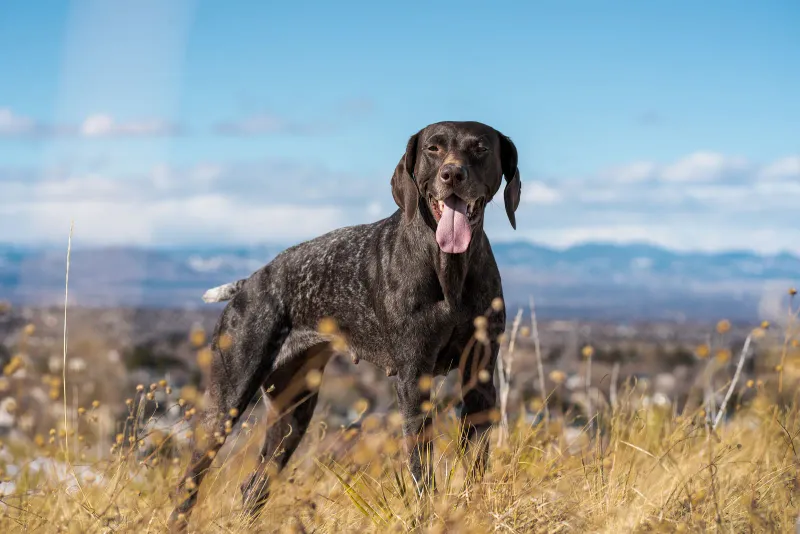
- German Shorthaired Pointer. Another tireless, short-coated dog for runners.
- Great Dane. A large, calmer breed, linked in the atlas to the Dalmatian's early ancestry.
- Australian Cattle Dog. A working breed with Dalmatian in its past and the same need for work.

Dalmatian fun facts
 Related breedCatahoula Leopard Dog1700 to 1979 · United StatesEarly Modern Era
- Puppies are born white. The spots appear over the first weeks.
- Dodie Smith's novel, which inspired Disney's film, was based on her own Dalmatian Pongo.
- Dalmatians ran with horse-drawn fire engines, and many fire stations still keep one as a mascot.
- The LUA project began in 1973, and the AKC accepted its dogs in 2011, 38 years later.
- About 1 in 23 UK puppies tested between 1992 and 2019 was deaf in both ears (4.4 percent).
Frequently asked questions
Where do Dalmatians come from?
Croatia, from the Adriatic region of Dalmatia, according to the . The English carriage dog years made the breed famous.
Why do Dalmatians have uric acid problems?
Every purebred Dalmatian carries two copies of a SLC2A9 variant, found by Bannasch's team in 2008, which means uric acid is passed into the urine at high levels.
What is a low uric acid (LUA) Dalmatian?
A dog descended from the Dalmatian and Pointer backcross begun in 1973. It carries a normal copy of the gene, so it passes less uric acid. The accepted these dogs in 2011.
Are Dalmatians deaf?
Some are. In a UK study of 8,955 puppies, 17.8 percent had hearing loss, mostly in one ear. Ask for BAER results.
Are Dalmatians good family dogs?
They can be, for active families who can give long daily exercise, but they are strong and boisterous around small children.
Do Dalmatians shed?
Yes, all year, even though the coat is short.
How long do Dalmatians live?
The atlas data gives 11 to 13 years.
Read next
 FamilyPointer SetterThe whole family
 Adopt a dogDog Shelters in EuropeFind dog shelters in Europe, learn how shelters differ from country to country and why adopting a dog is a good option.
Sources (15)
- Bannasch D. et al., "Mutations in the SLC2A9 gene cause hyperuricosuria and hyperuricemia in the dog", PLoS Genetics 4(11), 2008, and the UC Davis news release.
- Holliday T.A. et al., "Unilateral and bilateral brainstem auditory-evoked response abnormalities in 900 Dalmatian dogs", Journal of Veterinary Internal Medicine, 1992.
- Strain G.M. et al., brainstem auditory-evoked potential assessment of congenital deafness in Dalmatians and phenotypic markers, Journal of Veterinary Internal Medicine, 1992.
- Lewis T.W., Freeman J. and De Risio L., "Decline in prevalence of congenital sensorineural deafness in Dalmatian dogs in the United Kingdom", Journal of Veterinary Internal Medicine, 2020.
- Bartges J.W. et al., urate uroliths in Dalmatians, Journal of the American Veterinary Medical Association, 1994.
- Lulich J.P. et al., owner survey of urate urolithiasis in Dalmatians, 2004.
- American Kennel Club, announcement on the Dalmatian backcross project, July 2011, and the Dalmatian Club of America backcross project history.
- FCI standard no. 153, Dalmatinski Pas (Dalmatian), current and 1999 texts.
- American Kennel Club and UK Kennel Club Dalmatian breed standards.
- Parker H.G. et al., "Genomic analyses reveal the influence of geographic origin, migration and hybridization on modern dog breed development", Cell Reports, 2017.
- Fogle B., The New Encyclopedia of the Dog, 2009.
- Encyclopaedia Britannica, Dalmatian.
- Smith D., The Hundred and One Dalmatians, 1956, and the Walt Disney films of 1961 and 1996.
- UK Kennel Club, Dalmatian registration and popularity reports.
- Atlas data, Dalmatian knowledge record (dates, life span, lineage).