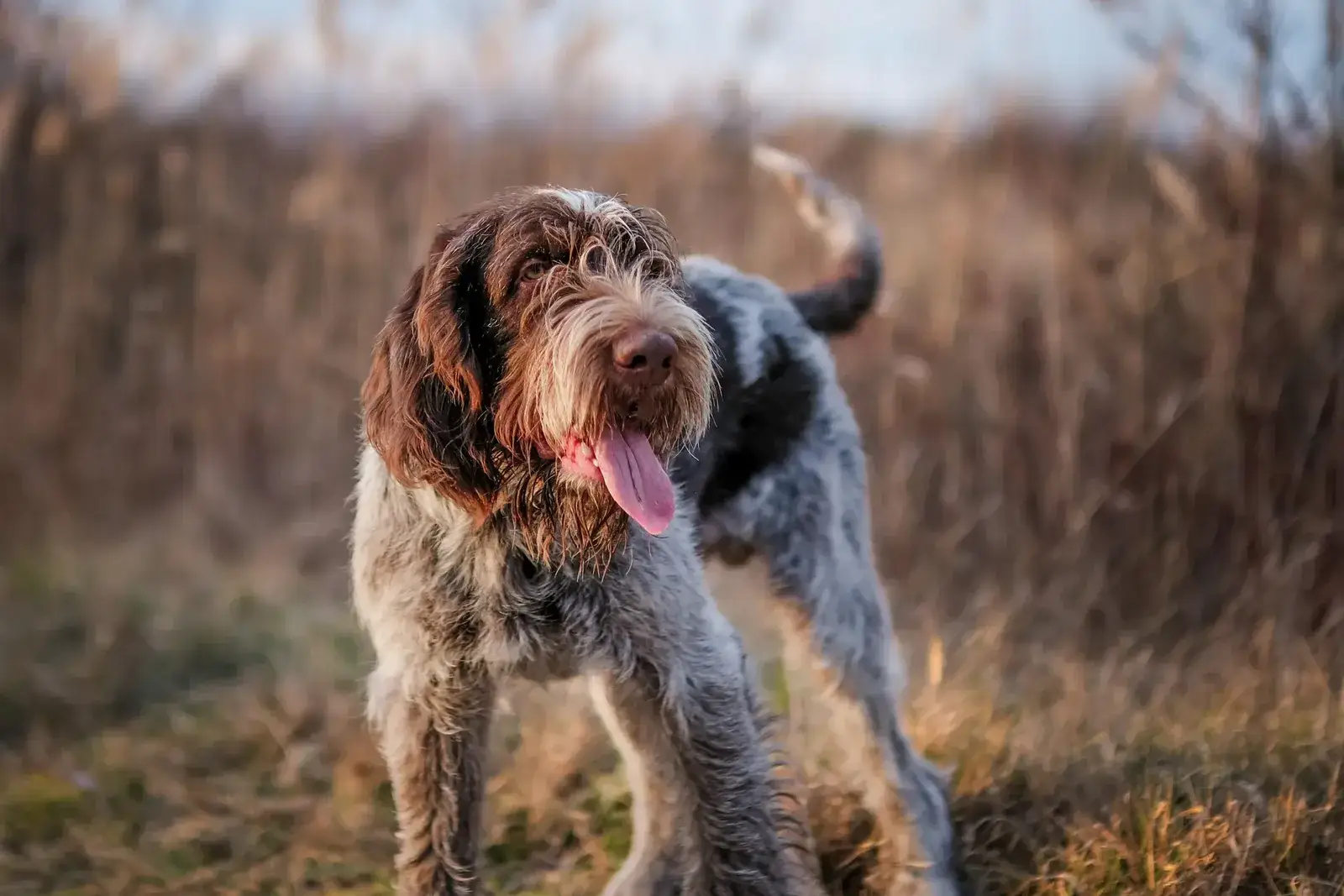
It was developed from the 1870s by the Dutchman Eduard Karel Korthals, who worked in Germany and then France. It suits active owners who want an affectionate, hard-working companion for hunting or long outdoor days, and it tends to struggle in homes that cannot give it daily running room and a job to do.
Wirehaired Pointing Griffon quick facts
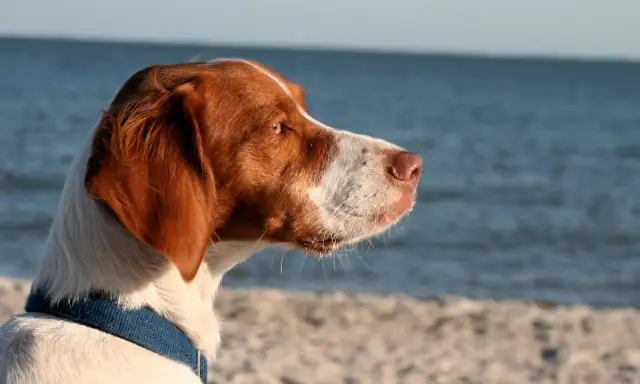 Related breedBrittany1850 to 1907 · FranceVictorian Breed Boom
- Closest DNA relatives
- German Wirehaired Pointer, German Shorthaired Pointer, Spinone Italiano
- Other names
- Korthals Griffon, Griffon d'arrêt à poil dur Korthals
- Country of origin
- France (), after a Dutch breeder developed it in the Netherlands and Germany
- Period of development
- About 1874 to 1887 (atlas data, high confidence)
- Type
- Pointing dog (FCI Group 7, standard no. 107; Sporting Group; UK Kennel Club Gundog group, import register)
- Height
- FCI: about 55 to 60 cm for males, 50 to 55 cm for females. AKC: 22 to 24 in (56 to 61 cm) dogs, 20 to 22 in (51 to 56 cm) bitches
- Weight
- Breed standards give no weight
- Coat
- Double coat: harsh, straight, wiry outer coat with a thick, fine undercoat; moustache and eyebrows
- Colours
- Steel grey with brown patches, solid brown, liver roan; white and brown or white and orange (see the standard section)
- Life span
- Atlas data: 12 to 14 years
- DNA group
- "Pointer Setter" (Parker et al. 2017)
- Descendant breeds in atlas data
- German Wirehaired Pointer, Cesky Fousek, Slovak Rough-haired Pointer, Wirehaired Vizsla
Drawn to scale in real centimetres. Its back reaches about 56 cm, just above your knee; its head about 70 cm, mid-thigh.
Where it sits in the tree
Victorian Breed Boom · 1850 to 1913
Name and origin
 Related breedWeimaraner1810 to 1897 · GermanyIndustrial Revolution
"Griffon" is a French word for a rough, wiry-coated dog, and it names the type, not a place. The "Korthals" part honours the breeder. In North America the club name is Wirehaired Pointing Griffon, while the FCI calls it Griffon à poil dur Korthals (Wire-Haired Pointing Griffon Korthals). The atlas data lists the FCI's country of origin as France, even though the breed's founder was Dutch and much of the early work took place in Germany. That gap is a trace of how the breed moved: made in the Netherlands, established in Germany, then given its final form in France.

History
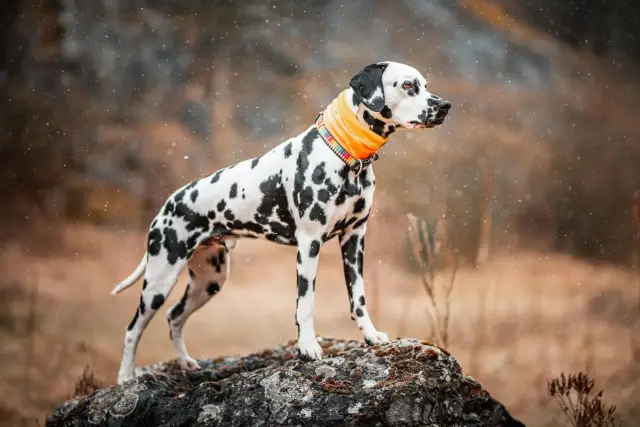 Same eraDalmatian1700 to 1890 · CroatiaEarly Modern Era
Eduard Karel Korthals
Eduard Karel Korthals was born in Amsterdam in 1851 and died in 1896. He was a wealthy young man with an annual allowance from his father, and he spent it on gundogs. Accounts date the start of his serious breeding programme to 1873, though one gives 1870. His aim was a single, all-purpose dog with a strong urge to retrieve on land and in water, a hardy coat and a close working bond with its hunter. He kept his breeding kennel, Ipenwoud, at Biebesheim am Rhein in Germany. There the breed type was set before the dogs moved into France.
The mix of dogs behind the breed is disputed. One account lists German Griffons and Pointers, Barbets, Spaniels and a Setter, but it is not well established, and earlier griffon-type dogs already existed. Treat any exact recipe as unproven.
Standard and recognition
Korthals developed the with other breeders. The American Wirehaired Pointing Griffon Association timeline places the signing and publication of the first standard in 1887, and says Korthals and 16 other breeders signed it. The American Kennel Club is said to have entered its first Korthals Griffon in the same year, a dog called Zolette (the club timeline spells it Zoletta). Several American sources give 1916 as the year of formal recognition, with the Griffon Club of America formed and a standard adopted that year and the breed shown at Westminster. A later American club, the Wirehaired Pointing Griffon Club of America, was founded in 1951, and the AKC recognised the American Wirehaired Pointing Griffon Association as national parent club in 1991.
| Year | Event |
|---|---|
| 1851 | Eduard Karel Korthals born in Amsterdam |
| 1873 | Start of Korthals' serious breeding programme (one account says 1870) |
| 1887 | Standard published; first dog entered in the AKC stud book (sources differ on details) |
| 1916 | Griffon Club of America formed and standard adopted (American sources) |
| 1951 | Wirehaired Pointing Griffon Club of America founded |
| 1991 | AKC recognises the American Wirehaired Pointing Griffon Association as parent club |
The FCI lists the breed as standard no. 107 (definitive), with France as country of origin. In the UK it sits on the Kennel Club's import register as the Korthals Griffon, so few are seen in British show rings, although shooting magazines report growing interest.
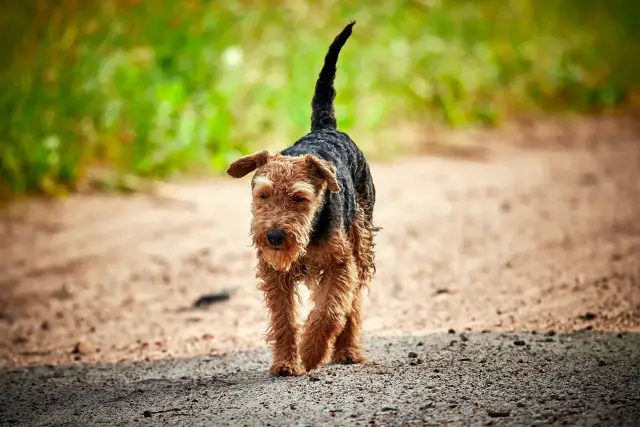
Relatives and DNA
 Same familyIrish Setter1700 to 1886 · IrelandEarly Modern Era
The atlas data lists no parent breeds for the Wirehaired Pointing Griffon. It treats it as a foundation breed of the "Pointer Setter" family. See the Pointer Setter family for the wider group of pointing and setting dogs. Its descendants in the atlas data are the German Wirehaired Pointer (the Deutsch Drahthaar), the Cesky Fousek, the Slovak Rough-haired Pointer and the Wirehaired Vizsla.
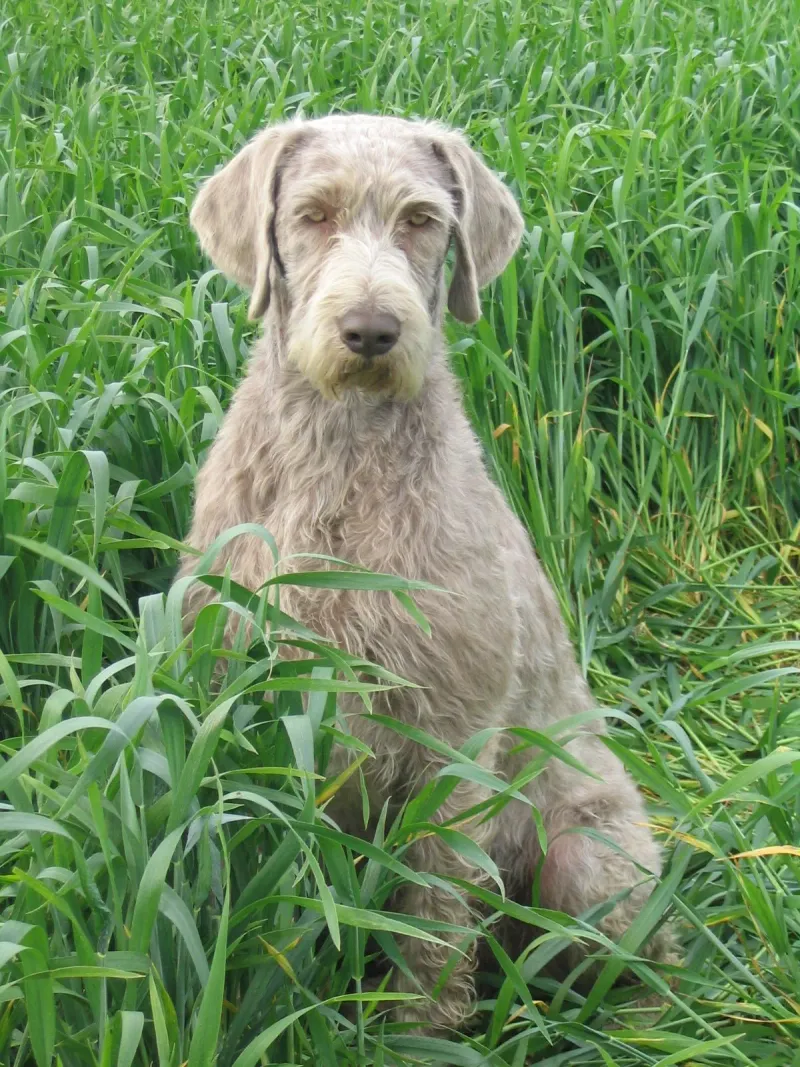
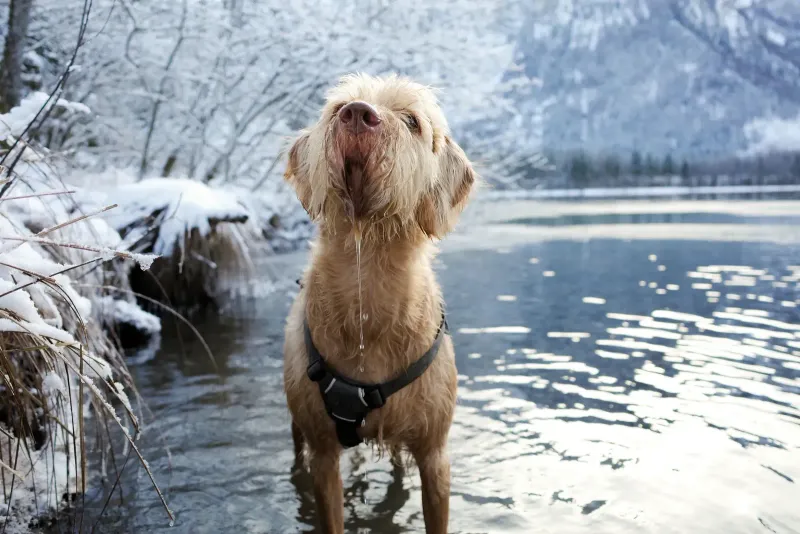
What does DNA say?
A 2017 study by Parker and colleagues (Cell Reports) analysed 1,346 dogs from 161 breeds and sorted them into 23 supported clades. The Wirehaired Pointing Griffon falls in the "Pointer Setter" clade, and the atlas data records the support for this placement as strong. The study also measured shared , long stretches of identical DNA inherited from common ancestors. The more () two breeds share, the stronger the sign of shared founders or crossing. The method cannot say which way the genes flowed.
Source: Parker et al. 2017, as recorded in this site's breed database.
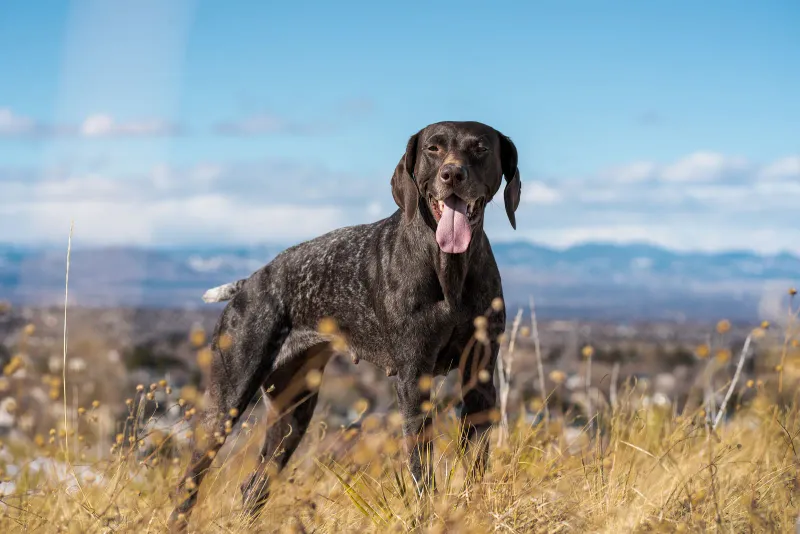
The German Wirehaired Pointer is the clear closest match, at almost twice the next breed. That fits the atlas listing of the Drahthaar as a child of the Griffon. The German Shorthaired Pointer is a distant second. The Spinone Italiano, another wire-coated Continental pointing dog, ranks third, a hint that wire coats and rough-haired pointer types shared some blood on the Continent.
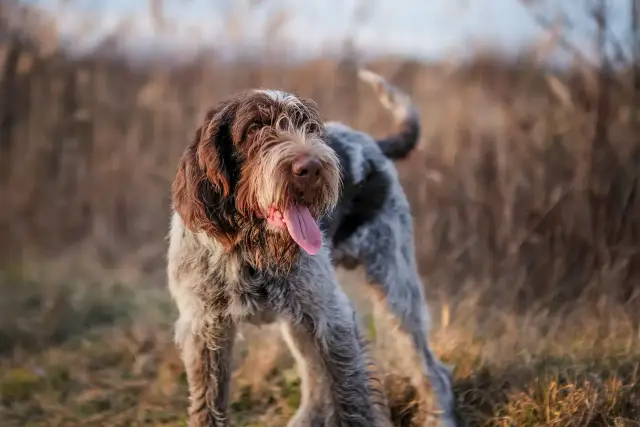
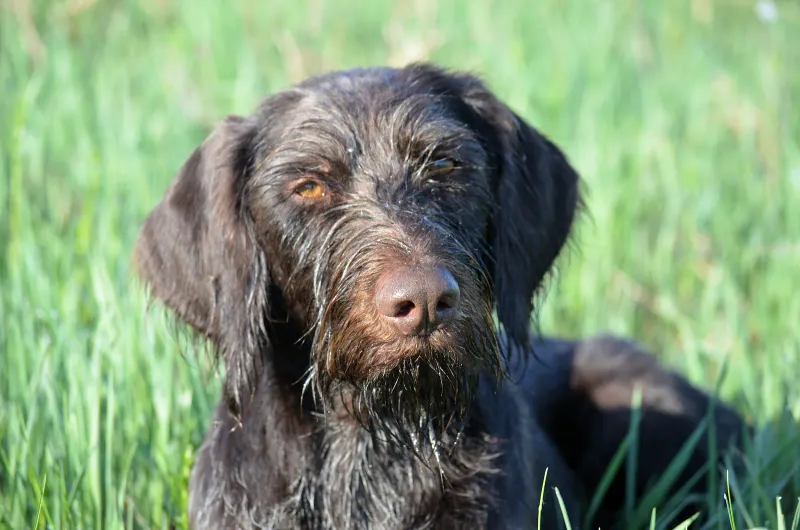
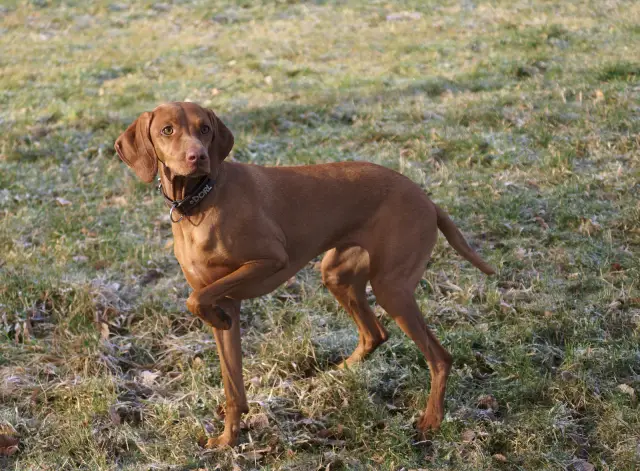
- Wirehaired Pointing Griffon and German Wirehaired Pointer
- Wirehaired Pointing Griffon and German Shorthaired Pointer
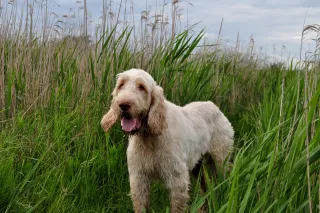
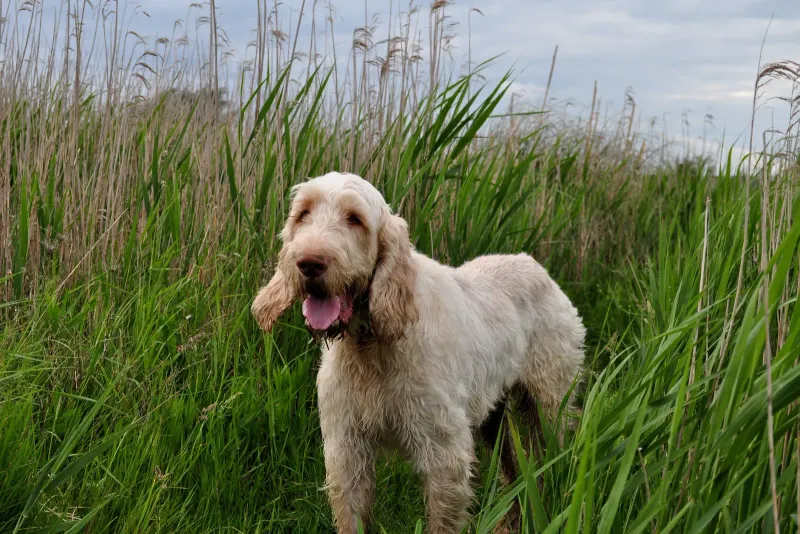 Wirehaired Pointing Griffon and Spinone Italiano
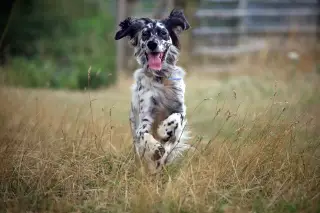
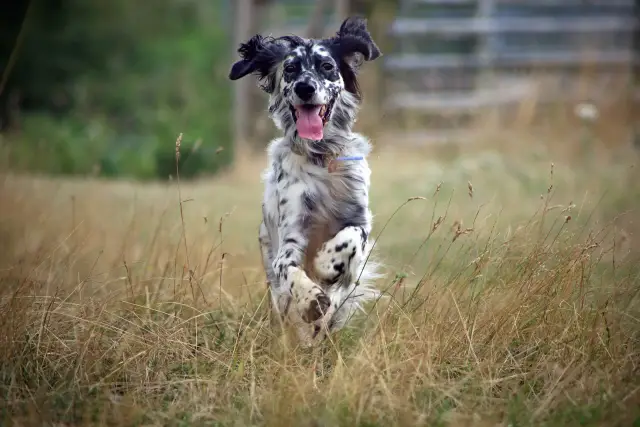
- Wirehaired Pointing Griffon and English Setter
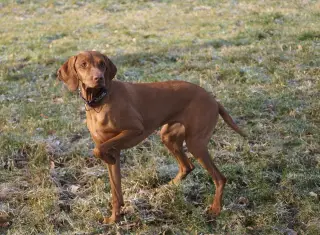
- Wirehaired Pointing Griffon and Vizsla
Descend from it · 1
- German Wirehaired PointerGermany
- German Wirehaired Pointer43.0 Mb 1.8%
- German Shorthaired Pointer23.1 Mb 1.0%
- Spinone Italiano18.0 Mb 0.8%
- English Setter13.9 Mb 0.6%
- Vizsla13.7 Mb 0.6%
- Gordon Setter12.5 Mb 0.5%
- Large Münsterländer12.3 Mb 0.5%
- Brittany12.2 Mb 0.5%
- Weimaraner11.9 Mb 0.5%
Source: Parker et al. 2017. Percent of the whole genome.
| Breedwith Wirehaired Pointing Griffon | with Wirehaired Pointing Griffon (Mb)Shared DNA (Mb) |
|---|---|
| German Wirehaired Pointer | 43.0 |
| German Shorthaired Pointer | 23.1 |
| Spinone Italiano | 18.0 |
| English Setter | 13.9 |
| Vizsla | 13.7 |
| Gordon Setter | 12.5 |
| Large Munsterlander | 12.3 |
| Brittany | 12.2 |
| Weimaraner | 11.9 |
Source: Parker et al. 2017, Cell Reports, shared haplotypes between 161 breeds (1,346 dogs).
The Wirehaired Pointing Griffon breed standard
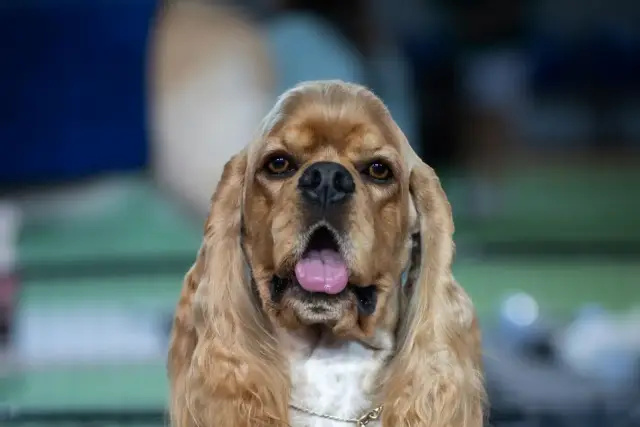 Looks relatedAmerican Cocker Spaniel1870 to 1946 · United StatesVictorian Breed Boom
A breed standard is the written ideal that judges compare each dog against. Standards describe a medium-sized, rugged, slightly longer-than-tall dog with a harsh coat, a strong body and a noble head with a long, square muzzle. The Kennel Club (UK) says its listed measurements are a guide, so individual dogs may be larger or smaller.
| Trait | What the standards say |
|---|---|
| Height | FCI: about 55 to 60 cm for males, 50 to 55 cm for females. AKC: 22 to 24 in for dogs, 20 to 22 in for bitches |
| Weight | None given in the standards used |
| Head | Long, rather square muzzle; moustache and eyebrows give a rough, wise expression |
| Coat | Double: straight, harsh, wiry outer coat over a thick, fine undercoat; never curly or woolly (Korthals Griffon Club of America) |
| Colours | FCI: steel grey with brown (liver) patches, solid brown, or liver roan; white and brown or white and orange also allowed |
| Ears | Medium, set low, lying flat and covered with short hair |
Wirehaired Pointing Griffon temperament
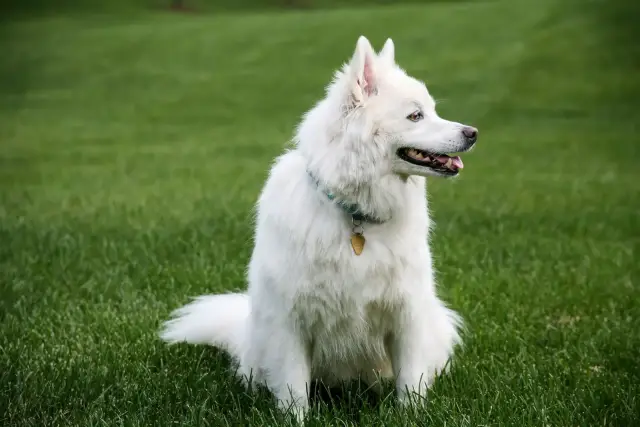 Related breedAmerican Eskimo Dog1900 to 1917 · United StatesVictorian Breed Boom
The breed is usually described as an affectionate, eager and sociable gundog that wants to be near its people. It was designed for close work with one hunter, so many bond strongly with the family and dislike being left alone for long. Most are friendly with strangers and other dogs.
In daily life that means a high-energy dog that needs space and a job. Korthals bred it as an all-rounder: point, track, flush and retrieve from land and water. Hunting instincts are strong, so recall training matters, and small pets and wildlife can trigger a chase. Training is usually easy when it is positive and consistent, and the breed can be sensitive to harsh correction. Early socialisation helps; see socialising your dog and dog training basics.
Many Griffons enjoy hunting tests, scent work, agility, long hikes and swimming. Without exercise and attention they can turn restless, noisy or destructive.

Wirehaired Pointing Griffon health
 Related breedAmerican Pit Bull Terrier1850 to 1898 · United StatesVictorian Breed Boom
Wirehaired Pointing Griffons are generally considered a healthy breed. Atlas data gives a life span of 12 to 14 years. Few published studies deal with this breed on its own, so most of what follows comes from general breed advice and from screening schemes, not from large Griffon-specific studies. For comparison, O'Neill and colleagues (The Veterinary Journal, 2013) found a median age at death of 12.0 years across all breeds in English vet records, and Lewis and colleagues (Canine Genetics and Epidemiology, 2018) found a median of 10.33 years across breeds in a Kennel Club survey.
Information here is general. A vet should look at any individual dog. For breeders, the Kennel Club scheme scores X-rays by an expert panel and publishes the results so each dog can be compared with its breed median.
| Condition | What it is | How common | What helps |
|---|---|---|---|
| Hip dysplasia | Loose or malformed hip joint that wears the cartilage | No published breed rate in the sources used | Hip scoring of breeding dogs (BVA/Kennel Club scheme or OFA); healthy weight |
| Developmental problem in the elbow joint, can cause forelimb lameness | No published figure | Elbow scoring of breeding dogs; early vet check for lameness | |
| Ear infections | Drop ears and hairy ear canals trap moisture and wax | No published figure | Dry ears after swimming; regular checks; see ear infections |
| Eyelid problems | Ectropion (loose, drooping lids) and entropion (rolled-in lids) are reported | No published figure | Vet exam; surgery for severe cases |
| Inherited eye disease | Progressive retinal atrophy is listed in breed advice | No published figure | Eye exams for breeding dogs |
Working dogs also pick up cuts, grass seeds and tick bites. Check the coat after every field trip, and see ticks and fleas for removal.

Living with a Wirehaired Pointing Griffon
 Related breedAmerican Staffordshire Terrier1850 to 1936 · United StatesVictorian Breed Boom
| Daily reality | Rating | Why |
|---|---|---|
| Exercise | High | Gundog stamina; over 2 hours a day suits many, with running room |
| Training needs | Medium | Eager and bright; needs consistency and positive methods |
| Grooming | Medium | Brush weekly; hand-strip or trim a few times a year; beard needs wiping |
| Shedding | Low to medium | Wiry coats shed seasonally, less hair on the floor than many breeds |
| Barking | Medium | Can bark when bored |
| Time alone | Poor | Bonds closely and dislikes long absences |
| Children | Good with supervision | Friendly, but big and bouncy |
| Other dogs | Good | Usually sociable |
| Cats and small pets | Fair | Hunting instinct; introduce with care |
| Flat living | Poor | Needs room and daily running |
| Heat tolerance | Fair | Double coat; hard work in heat needs care |
| Cold tolerance | Good | Wiry, water-resistant coat |
| First-time owner | Fair | Friendly, but needs time, exercise and training |
A great fit if you...
- hunt, hike or run with your dog most days;
- want a close, people-loving companion;
- can brush weekly and trim a few times a year;
- are home for much of the day.
Think twice if you...
- live in a small flat with no access to open space;
- work long hours away from home;
- want a calm, low-activity pet;
- keep small pets that a hunting dog may chase.
Before you get one. Ask the breeder for hip and elbow scores and eye test results for both parents, and about their working or show background. Expect to wait for a litter outside the main hunting regions. Breed rescue exists, and an adult's character is already visible.
Similar breeds to consider
- German Shorthaired Pointer: short-coated all-rounder with a similar drive.
- Vizsla: lean, affectionate Hungarian pointer.
- Brittany: smaller, lively pointing spaniel.
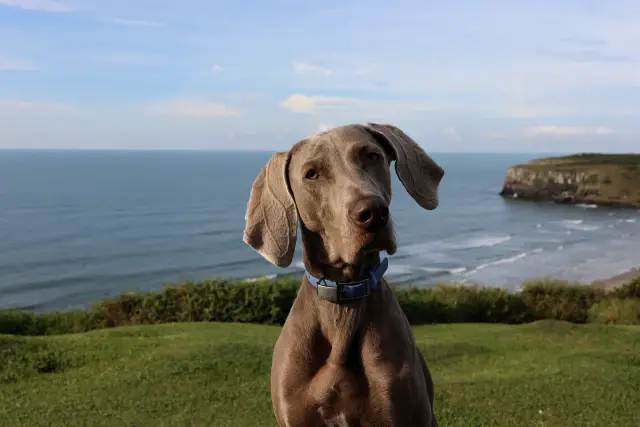
- Weimaraner: sleek, athletic pointer, more intense.
 Thinking of adopting?How to adopt a dog from a shelter or rescueHow to adopt a dog from a shelter or rescue: the process, costs in general terms, choosing a dog, the first weeks and what if it does not work out.Related breedAmerican Staffordshire Terrier1850 to 1936 · United StatesVictorian Breed Boom
Wirehaired Pointing Griffon fun facts
 Related breedAustralian Kelpie1870 to 1902 · AustraliaVictorian Breed Boom
- Korthals first bred dogs on a father's allowance of 1,800 guilders a year.
- The breed goes by two names: Korthals Griffon in Europe, Wirehaired Pointing Griffon in North America.
- The German Wirehaired Pointer shares the most DNA with it, 43 Mb.
- A Griffon's wiry coat is built for brambles and water.
Frequently asked questions
Are Wirehaired Pointing Griffons good family dogs?
They can be, for active families that give them exercise, training and company. They are large and bouncy around small children.
How much exercise does a Wirehaired Pointing Griffon need?
Plenty. Expect at least an hour or two a day, with room to run.
How long do Wirehaired Pointing Griffons live?
Atlas data gives 12 to 14 years.
Do Wirehaired Pointing Griffons shed?
Seasonally, but less loose hair ends up in the house than with many breeds. Brush weekly and strip the dead coat a few times a year.
What is the difference between a Wirehaired Pointing Griffon and a German Wirehaired Pointer?
The Griffon is the older breed. The DNA study ranks the Drahthaar as its closest relative, and the atlas lists it as a descendant.
Who created the Korthals Griffon?
Eduard Karel Korthals, a Dutchman (1851 to 1896).
Read next
Closest DNAGerman Wirehaired Pointer43.0 Mb shared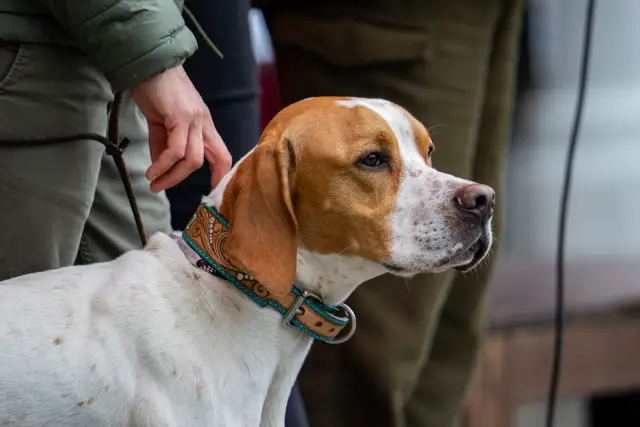 FamilyPointer SetterThe whole family
 Adopt a dogDog Shelters in FranceTen big cities checked, how adoption works, fees in euros
Sources (10)
- AKC, Wirehaired Pointing Griffon breed information.
- American Wirehaired Pointing Griffon Association, breed history and breed standards.
- Canine Chronicle, "Eduard Karel Korthals and the Korthals Griffon".
- FCI, Standard no. 107, Griffon à poil dur Korthals.
- Lewis T.W. et al., "Longevity and mortality in Kennel Club registered dog breeds in the UK in 2014", Canine Genetics and Epidemiology, 2018.
- O'Neill D.G. et al., "Longevity and mortality of owned dogs in England", The Veterinary Journal, 2013.
- Parker H.G. et al., "Genomic analyses reveal the influence of geographic origin, migration, and hybridization on modern dog breed development", Cell Reports, 2017.
- The Kennel Club (UK), Korthals Griffon breed page and hip dysplasia screening scheme.
- Wikipedia, "Wirehaired Pointing Griffon".
- Atlas data, breed records and Parker 2017 shared-haplotype table (this site).