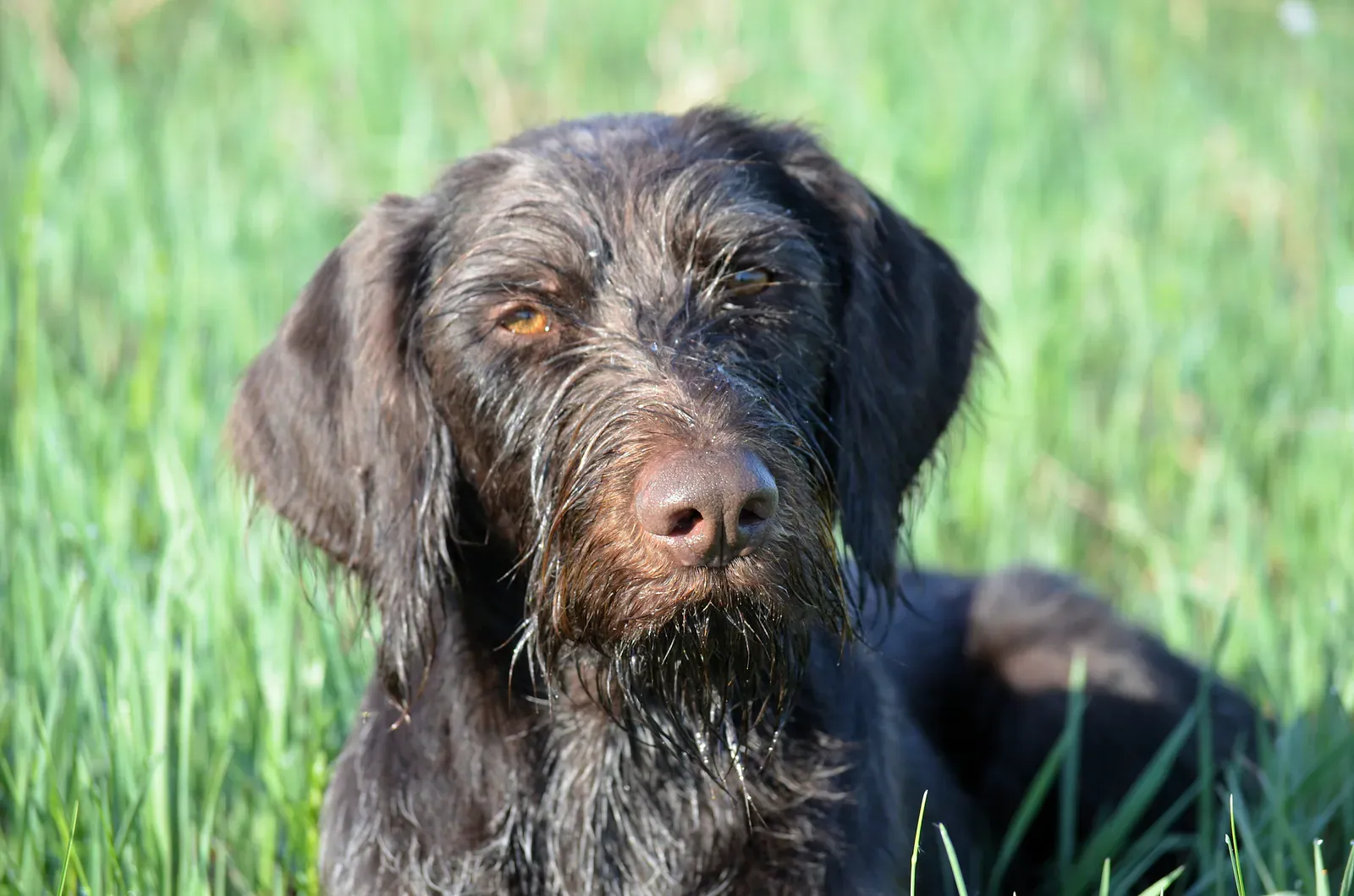
It was built in the late 1800s to find, point and retrieve on land and in water, and to track wounded game, all with one dog. It is energetic, loyal and driven, and it needs more than two hours of activity a day plus a job for its mind. It suits active owners, especially hunters, far better than a quiet household. The main health points to ask a breeder about are hip and elbow scores and a DNA test for von Willebrand disease type 2.
German Wirehaired Pointer quick facts
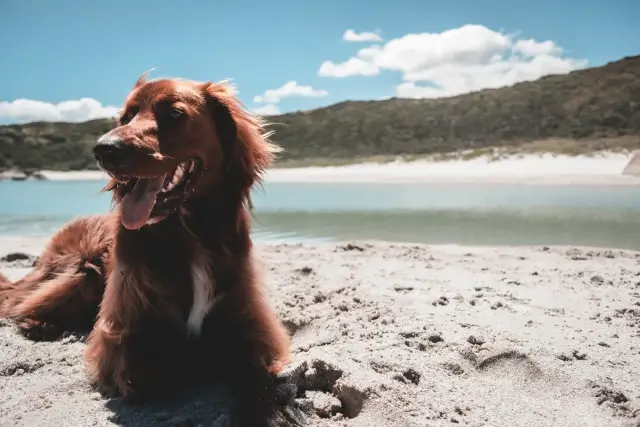 Related breedIrish Setter1700 to 1886 · IrelandEarly Modern Era
- Closest DNA relatives
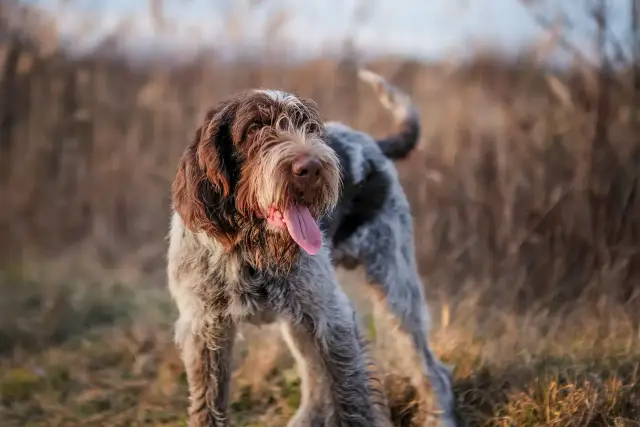
- German Shorthaired Pointer, Wirehaired Pointing Griffon, Vizsla
- Other names
- Deutsch Drahthaar (FCI: "Deutsch Drahthaar (German Wire-Haired Pointing Dog)"), Drahthaar
- Country of origin
- Germany
- Period of development
- About 1880 to 1902 (atlas data); club founded 1902
- Type
- Pointing dog (FCI Group 7, Pointing dogs, standard no. 98; AKC Sporting Group; UK Kennel Club Gundog Group)
- Height
- FCI: dogs 61 to 68 cm, bitches 57 to 64 cm
- Weight
- Not set by the FCI standard
- Coat
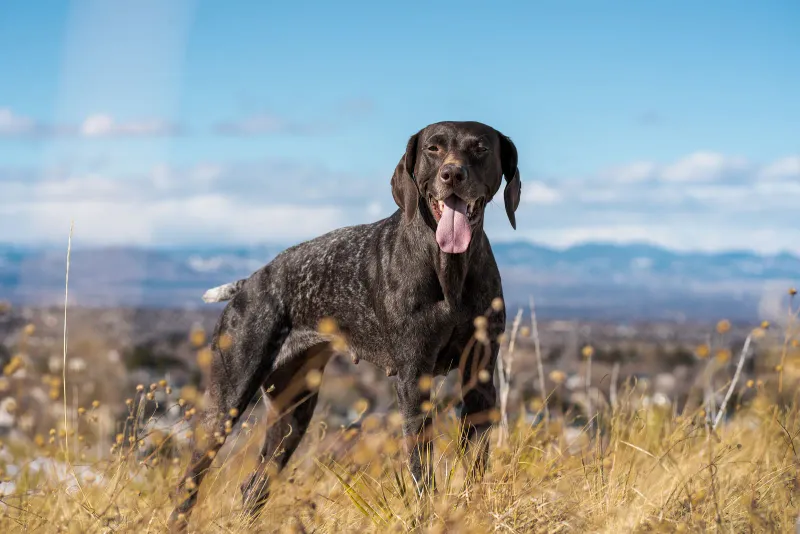
- Harsh, flat-lying wire coat over a dense, water-repellent undercoat; bushy eyebrows and beard
- Colours
- Liver and white, liver roan, solid liver, black and white (varies by club)
- Life span
- Atlas data: 12 to 14 years. A 2024 UK study reports a median of 13 years
- Exercise
- More than 2 hours a day (PDSA, for the German pointer breeds)
- DNA group
- "Pointer Setter" , strong support (Parker et al. 2017)
Drawn to scale in real centimetres. Its back reaches about 63 cm, mid-thigh; its head about 79 cm, your hip.
Where it sits in the tree
Victorian Breed Boom · 1850 to 1913
Why is it called the German Wirehaired Pointer and the Deutsch Drahthaar?
 Related breedEnglish Setter1500 to 1850 · United KingdomAge of Exploration
Deutsch Drahthaar means "German wire hair". "Draht" is wire, and "Haar" is hair, so the name describes the coat in the same way the English name does: a German pointing dog with a wiry coat. In English-speaking countries the breed is the German Wirehaired Pointer. In Germany and in the FCI, it is the Deutsch Drahthaar, and enthusiasts often say just Drahthaar or "DD".
"Pointer" describes the work: the dog finds game by scent, freezes in a pointing stance to show the hunter where it is, and waits. The Drahthaar does more than point. It retrieves from land and water, tracks wounded animals and works in forest and field, which is why German hunters call it a Gebrauchshund, a utility or "all-purpose" hunting dog.
History of the German Wirehaired Pointer
 Same eraBrittany1850 to 1907 · FranceVictorian Breed Boom
Why Germany wanted one dog for every job
In the 1800s hunting in Germany was largely a right of the nobility. After the revolts of 1848 and 1849, a new middle class took up hunting. These hunters often had no kennel full of specialist dogs and wanted one dog that could do all the work: point, retrieve, track, and swim.
Hegewald and the wire-coated dog
The leading voice for this idea was Sigismund Freiherr von Zedlitz und Neukirch, who wrote under the name "Hegewald". In an 1881 essay he described the ideal versatile dog. He is also credited with the Pudelpointer, a cross of poodle and English pointer. The FCI standard says the Deutsch Drahthaar was bred systematically from the ideas of Hegewald.
The atlas data records four parent breeds. The FCI and breed histories agree that wire coats were brought in from several sources and that the German Shorthaired Pointer was the base:
- German Shorthaired Pointer (Deutsch Kurzhaar). The atlas data lists it as the base stock from the 1880s, and one history says its blood was added sparingly later to improve field performance.
- Pudelpointer. One of the wire-coated outcrosses.
- Wirehaired Pointing Griffon (Korthals Griffon). A second outcross, giving a harsh coat and a keen, steady nose.
- German Roughhaired Pointer (Deutsch Stichelhaar). A third outcross.
Different histories stress different mixes, so treat the exact recipe as approximate. All agree on the aim: a hunting dog first and a show dog never, selected for work.
Key dates
| Year | Event |
|---|---|
| 1881 | Hegewald publishes his essay on the versatile hunting dog |
| 1891 | An organisation for testing hunting utility dogs is formed (later called the JGHV) |
| 11 May 1902 | Verein Deutsch Drahthaar (VDD) formed |
| 1904 | The Wirehaired Club renamed Verein Deutsch-Drahthaar |
| 1926 | Nearly half of dogs in the German hunting utility dog trial register are Drahthaars |
| 1954 | FCI definitive recognition |
| 1959 | German Wirehaired Pointer Club of America founded; AKC recognition |
| 1971 | VDD Group North America founded |
Established breed clubs and the hunting press reportedly ridiculed the new breed in its early years. Performance results silenced them: by 1926 the Drahthaar made up close to half of the dogs entered in the national utility trial register. After the Second World War the breed's stock was badly depleted and recovered through the 1950s. In 1984 the Drahthaar made up more than half of over 6,000 continental pointing breeds in East Germany. From 2010 to 2024 Germany averaged just over 3,000 new Drahthaar registrations a year.
Across the Atlantic
American soldiers stationed in Germany after the Second World War hunted with Drahthaars and brought dogs home. The AKC accepted the German Wirehaired Pointer in 1959. In 1971, an American soldier based in Germany helped to start the VDD Group North America, the first sister group of the German club. It had fewer than 40 members in its first five years and now has over 1,500 members, according to the Gun Dog magazine history, and produces over 1,300 puppies a year.
A point many newcomers miss: in North America two groups of breeders exist. One registers dogs with the AKC and shows them. Another follows the VDD's testing and breeding rules and may not register with the AKC at all. They share the same breed origin, but the second group puts performance testing above show-ring appearance. One source describes this as treating the two lines as separate.
Relatives and DNA
 Same familyDalmatian1700 to 1890 · CroatiaEarly Modern Era
Parent breeds (atlas data). German Shorthaired Pointer, Pudelpointer, Wirehaired Pointing Griffon and German Roughhaired Pointer (see above).
Descendant breeds
- Cesky Fousek. A Czech wire-coated pointer.
- Slovak Rough-haired Pointer. A Slovak wire-coated pointer.
- Wirehaired Vizsla. A wire-coated Hungarian breed.
Sister breeds. The atlas data lists the German Longhaired Pointer, described as closely related to the other German pointer breeds, plus the Weimaraner and the Bull Arab.
What does DNA say?
Parker and colleagues (Cell Reports, 2017) analysed 1,346 dogs from 161 breeds and sorted them into 23 clades. The German Wirehaired Pointer sits in the "Pointer Setter" clade with strong support. The study also measured shared , long stretches of identical DNA inherited from a common ancestor. More suggests a closer relationship.
Source: Parker et al. 2017, as recorded in this site's breed database.
The two top results match the history. The German Shorthaired Pointer, the base stock, comes first. The Wirehaired Pointing Griffon, one of the wire-coat outcrosses, comes second and is close behind. The rest are other continental and British gundogs, which shows how far pointing blood was shared across Europe. For the wider group see the Pointer Setter family page.
Sister breeds · 3
- German Longhaired Pointer1800 to 1879
- Weimaraner1810 to 1897
- Bull Arab1970 to 1990
Descend from it · 3
- Český FousekCzech Republic
- Wirehaired VizslaHungary
- Slovak Rough-haired PointerSlovakia
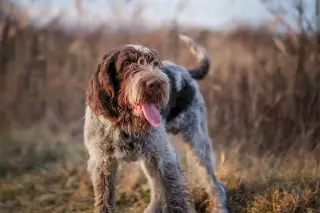
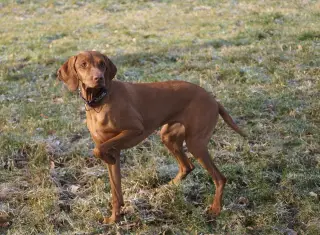
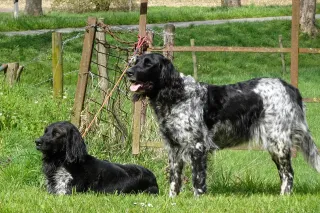
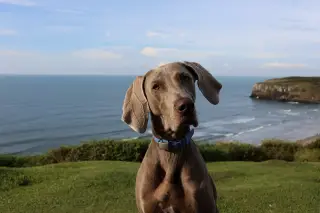
- German Shorthaired Pointer46.3 Mb 1.9%
- Wirehaired Pointing Griffon43.0 Mb 1.8%
- Vizsla21.5 Mb 0.9%
- Large Münsterländer18.0 Mb 0.8%
- Weimaraner15.6 Mb 0.7%
- Irish Setter15.6 Mb 0.7%
- English Setter14.5 Mb 0.6%
- Gordon Setter11.4 Mb 0.5%
- Spinone Italiano11.0 Mb 0.5%
- Brittany9.9 Mb 0.4%
Source: Parker et al. 2017. Percent of the whole genome.
| Breedwith German Wirehaired Pointer | Shared DNA with German Wirehaired Pointer ()Shared DNA (Mb) |
|---|---|
| German Shorthaired Pointer | 46.3 |
| Wirehaired Pointing Griffon | 43.0 |
| Vizsla | 21.5 |
| Large Munsterlander | 18.0 |
| Weimaraner | 15.6 |
| Irish Setter | 15.6 |
| English Setter | 14.5 |
| Gordon Setter | 11.4 |
| Spinone Italiano | 11.0 |
| Brittany | 9.9 |
Source: Parker et al. 2017, Cell Reports, shared haplotypes between 161 breeds (1,346 dogs).
The breed standard
 Looks relatedAmerican Cocker Spaniel1870 to 1946 · United StatesVictorian Breed Boom
A is the written ideal that kennel club judges compare each dog against. The FCI standard and the UK Kennel Club standard both describe a well-muscled, medium-to-large pointing dog, slightly longer than tall, built to work all day in rough cover, in cold water and on rough ground. The coat is the key mark of the breed.
| Trait | What the standards say |
|---|---|
| Height | FCI: dogs 61 to 68 cm, bitches 57 to 64 cm; the FCI asks that the height of the two sexes be as equal as possible |
| Coat | Dense, harsh wire coat lying flat, weatherproof, with a thick undercoat that sheds water and resists thorns; face has a beard and bushy eyebrows (FCI) |
| Colour | UK Kennel Club: black and white, liver, liver and white, with ticked variants. UKC: solid liver to liver roan |
| Size class | UKC: a medium-sized dog |
| Gait and build | Strong, lean, athletic and balanced, with deep chest and powerful hindquarters |
| One standard | The standard makes no distinction between "field" and "show" dogs (Kennel Club) |
Coat in practice. The wire coat protects against brambles, cold and water. It is not stripped by every owner. Hunting dogs often need little more than regular brushing, and show dogs are hand-stripped. The beard holds water, so owners tend to wipe it after drinking and meals. Loose hair is caught in the coat rather than falling around the house, but a Drahthaar still moults, especially in spring.
What is a German Wirehaired Pointer like? Temperament
 Related breedAmerican Eskimo Dog1900 to 1917 · United StatesVictorian Breed Boom
The AKC describes the breed as eager and affectionate, with a "can-do attitude". Hunters value a close, loyal, steady dog that works with its handler. Owners describe an intelligent dog that is devoted to its family and can be reserved with strangers.
- With family. Strongly bonded and affectionate. Often a "shadow" that wants to be with its people.
- With children. Fine with children who respect the dog, although a big, bouncy adolescent can knock a small child over without meaning to.
- With strangers. Alert and sometimes reserved. Good socialisation as a puppy matters.
- With other dogs. Usually friendly when socialised. Some males challenge unfamiliar males.
- With cats and small animals. A hunting instinct is built in. Birds, rabbits and cats outside the family are fair game to the dog's nose and eyes, so careful introduction and supervision are essential.
- Training. Clever and keen to work, but strong-willed. Reward-based training and a clear routine work well. Without a job, a bored Drahthaar tends to dig, chew and bark.
The breed's drive shows in its need for exercise. The PDSA lists over 2 hours a day for the German pointer breeds, ideally with scent work, free running and training. Retrieving, tracking, swimming and field work suit the breed; so do canicross, long hikes and scent sports. A short walk round the block is not enough for this dog.
The Drahthaar and performance testing
In Germany, breeding is tied to tests. The VDD and the hunting dog association (JGHV) run tests of nose, field work, water work, retrieving and obedience. A dog that does not pass is not bred from, which is a strong reason German lines stay working dogs. The Kennel Club notes that the breed has a single standard with no split between field and show dogs. If you want a dog for hunting, ask for test results. If you want a companion, ask how the parents were raised and how they behave at home.

German Wirehaired Pointer health problems
 Related breedAmerican Pit Bull Terrier1850 to 1898 · United StatesVictorian Breed Boom
Most German Wirehaired Pointers are tough, athletic dogs. A 2024 UK study gives a median life span of 13 years for the breed, against 12.5 years for all dogs in that study. The atlas data range is 12 to 14 years. Information here is general. Talk to a vet about your own dog.
Von Willebrand disease type 2
Von Willebrand disease is a bleeding disorder caused by a shortage or fault in a clotting protein. In 1996 Brooks and colleagues (Journal of the American Veterinary Medical Association) described a severe, form of the disease in German Wirehaired Pointers. In 2017, Vos-Loohuis and colleagues (Animal Genetics) found a variant, c.1657G, in the VWF gene present in the homozygous state only in affected dogs, and likely to cause type 2 disease in the breed. The same variant also tracked with the disease in German Shorthaired Pointers.
A DNA test is available. A mating of two is predicted to produce 25 percent affected puppies. The UK Kennel Club recommends the test, and from 6 January 2025 imported German Wirehaired Pointers, and litters from overseas sires, are registered only if proven clear or carriers of vWD type 2. No published figure gives the share of carriers in the whole breed.
Other conditions
| Condition | What it is | How common | What helps |
|---|---|---|---|
| Von Willebrand disease type 2 | Recessive bleeding disorder; DNA variant in the VWF gene (Vos-Loohuis 2017) | No published breed rate | DNA test of both parents |
| Hip joint forms badly and wears; stiffness, pain | A listed breed concern; no published rate | Hip scoring under the BVA/Kennel Club scheme; healthy weight | |
| Elbow joint malformation in growing dogs | Listed by the Kennel Club among recommended tests | Elbow scoring of breeding dogs | |
| Eye problems | Entropion (eyelid rolls in) and other inherited eye conditions | Reported in breed profiles; no rate | Eye testing of breeding dogs; surgery for entropion |
| Gastric dilatation-volvulus (bloat) | Stomach swells and twists; an emergency in deep-chested dogs | Risk in large, deep-chested breeds | Several small meals; avoid hard exercise around meals; go straight to a vet if the belly swells |
| Hypothyroidism | Low thyroid hormone; weight gain, dull coat, tiredness | Reported in the breed | Blood test; daily tablet |
| Ear infections | Drop ears and active outdoor life | Common in hunting dogs generally | Dry and check ears after swimming |
A healthy-looking dog can still carry a recessive gene. This is why testing both parents matters more than the look of one puppy.

Is a German Wirehaired Pointer right for you? Living with a Drahthaar
 Related breedAmerican Staffordshire Terrier1850 to 1936 · United StatesVictorian Breed Boom
| Daily reality | Rating | Why |
|---|---|---|
| Exercise | Very high | Over 2 hours a day (PDSA, German pointers) |
| Training needs | High | Clever, strong-willed, needs a job |
| Grooming | Low to medium | Weekly brushing, tidy beard, occasional stripping |
| Shedding | Medium | Hair is caught in the wire coat, spring moult |
| Barking | Medium | Alert; bored dogs bark |
| Time alone | Poor | Bonds closely; bored dogs destroy things |
| Children | Fair | Loyal, but big and bouncy |
| Other dogs | Fair | Usually fine when socialised |
| Cats and small pets | Poor | Strong hunting drive |
| Flat living | Poor | Needs space and a garden or open country |
| Heat tolerance | Fair | Athletic dog; limit hard work in heat |
| Cold and wet tolerance | Good | Water-resistant wire coat |
| First-time owner | Poor | Needs experience, time and consistency |
A great fit if you...
- hunt, or want a working dog for field and water;
- are active every day, in all weathers;
- enjoy training and sports such as tracking or scent work;
- are home often, or can bring the dog along.
Think twice if you...
- live in a flat with little time outdoors;
- are away from home most of the day;
- keep small pets or free-roaming cats;
- want a calm, low-effort dog.
Before you get one. Ask the breeder for hip and elbow scores, eye test results and the vWD type 2 DNA result of both parents. Ask whether the parents have passed hunting or performance tests and how they behave at home. Check whether the lines are German performance lines or North American show lines, because energy levels can differ. Breed rescue groups place adult dogs. Expect a demanding first two years of exercise and training.
Similar breeds to consider
- German Shorthaired Pointer: the base breed, with a short sleek coat.
- Vizsla: lighter-framed Hungarian pointer, close and affectionate.
- Weimaraner: grey German pointer, intense and people-focused.
- Brittany: smaller pointing spaniel, still very active.
 Thinking of adopting?How to adopt a dog from a shelter or rescueHow to adopt a dog from a shelter or rescue: the process, costs in general terms, choosing a dog, the first weeks and what if it does not work out.Related breedAmerican Staffordshire Terrier1850 to 1936 · United StatesVictorian Breed Boom
German Wirehaired Pointer fun facts
 Related breedAustralian Kelpie1870 to 1902 · AustraliaVictorian Breed Boom
- The founding club, the VDD, was formed on 11 May 1902, and by 1926 close to half of the dogs in the German utility trial register were Drahthaars.
- "Hegewald" was the pen name of Sigismund von Zedlitz und Neukirch, the breed's most influential advocate.
- A Drahthaar is a pointing dog, a retriever, a tracker and a water dog in one coat.
- The VDD Group North America now produces over 1,300 puppies a year, more than a third of Drahthaar puppies bred worldwide, according to a hunting magazine history.
- The wire coat is designed to shed water and resist thorns.
Frequently asked questions
Are German Wirehaired Pointers good family dogs?
They can be, in active families with time for daily exercise and training. They are loyal and affectionate, but big, energetic and driven, so they are not suited to every home.
How much exercise does a German Wirehaired Pointer need?
More than 2 hours a day, with training and mental work, according to the PDSA for the German pointer breeds.
How long do German Wirehaired Pointers live?
A 2024 UK study gives a median of 13 years. The atlas data gives 12 to 14 years.
Do German Wirehaired Pointers shed?
Moderately. The wire coat holds loose hair, so brush weekly, and expect heavier shedding in spring.
What is the difference between a German Wirehaired Pointer and a German Shorthaired Pointer?
The coat first: harsh wire versus short and sleek. Both are German versatile hunting dogs, and the Shorthaired Pointer is the base stock of the Wirehaired.
Is the Deutsch Drahthaar the same as the German Wirehaired Pointer?
They are the same breed under two names. Some North American breeders keep the performance-tested Drahthaar line apart from the show line.
What health tests should a breeder do?
Hip and elbow scoring, eye testing and a DNA test for von Willebrand disease type 2.
How big do they get?
standard: dogs 61 to 68 cm and bitches 57 to 64 cm at the shoulder.
Read next
 Closest DNAGerman Shorthaired Pointer46.3 Mb shared
 Sister breedWeimaraner1810 to 1897
 Adopt a dogDog Shelters in GermanyTen big cities checked, how adoption works, what it costs
Sources (13)
- Wikipedia, "German Wirehaired Pointer".
- American Kennel Club, German Wirehaired Pointer breed page.
- Brooks M. et al., "Severe, recessive von Willebrand's disease in German Wirehaired Pointers", Journal of the American Veterinary Medical Association, 1996.
- Fédération Cynologique Internationale, Deutsch Drahthaar, standard no. 98.
- Gun Dog magazine, "The history of the Deutsch Drahthaar".
- McMillan K.M. et al., "Longevity of companion dog breeds: those at risk from early death", Scientific Reports, 2024.
- Parker H.G. et al., "Genomic analyses reveal the influence of geographic origin, migration, and hybridization on modern dog breed development", Cell Reports, 2017.
- PDSA, "German Pointer breed information".
- The Kennel Club (UK), German Wirehaired Pointer breed standard and breed information page.
- United Kennel Club, German Wirehaired Pointer breed standard.
- Vos-Loohuis M. et al., "A novel VWF variant associated with type 2 von Willebrand disease in German Wirehaired Pointers", Animal Genetics, 2017.
- Fogle B., The New Encyclopedia of the Dog, 2009.
- Atlas data, breed records and Parker 2017 shared-haplotype table (this site).