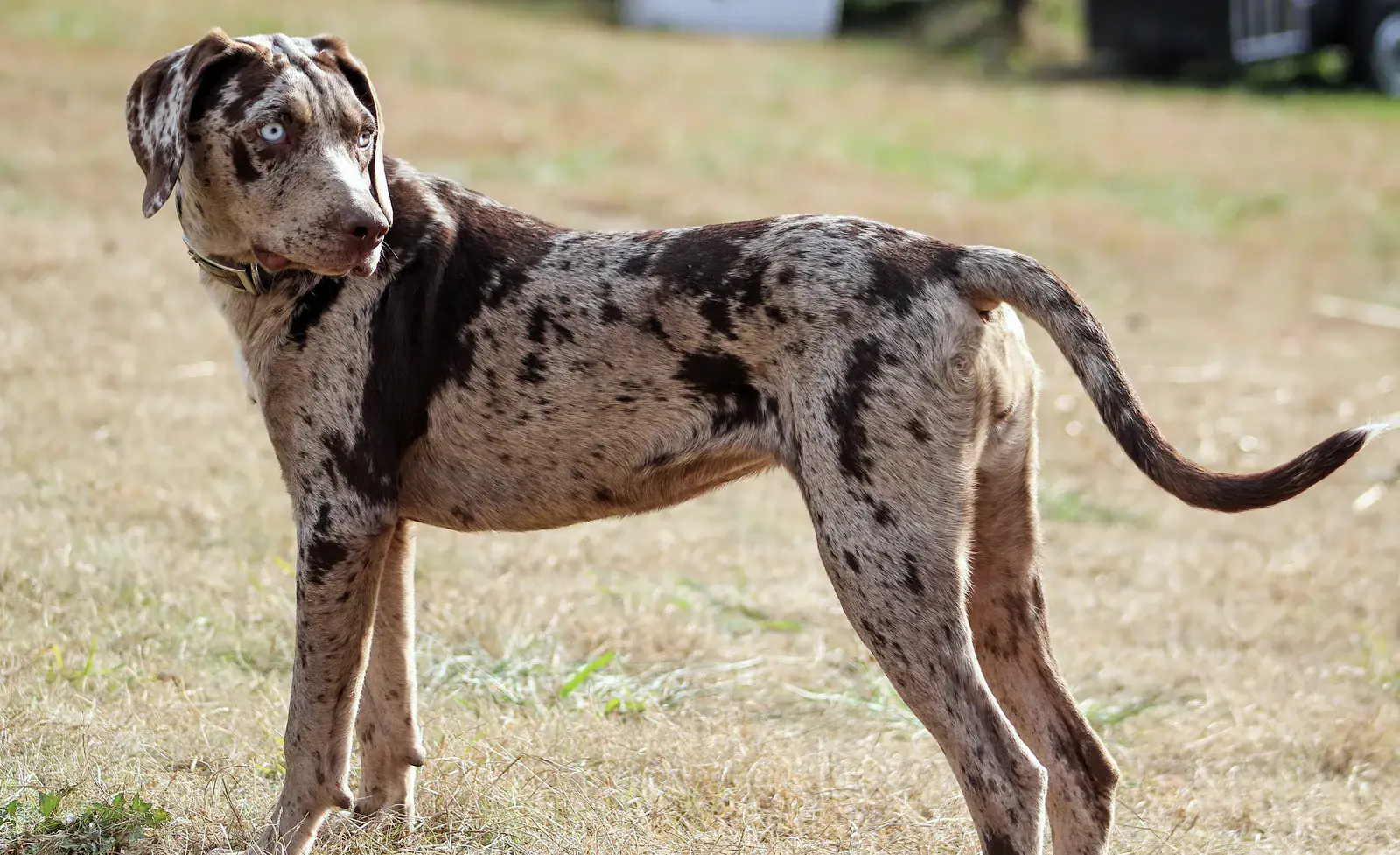
It was bred to find, bay and move semi-wild hogs and cattle in the swamps and pinewoods of the American South, and it is the official state dog of Louisiana. It is athletic, bright and strong-willed, and it is not a breed for a quiet life on the sofa. This guide covers the history (and the theories about where the dogs came from), the coat and the eyes, the deafness risk that comes with merle, the , temperament, health and what living with one is really like.
Catahoula Leopard Dog quick facts
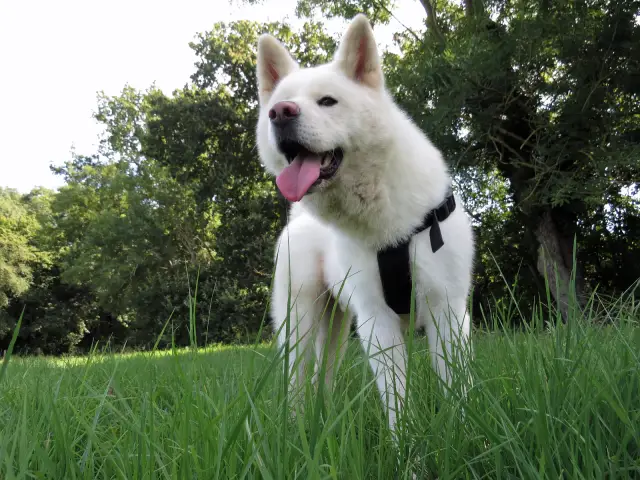 Related breedAkita1600 to 1931 · JapanEarly Modern Era
- Country of origin
- United States (Catahoula Parish area, Louisiana)
- Period of development
- Atlas data gives 1700 to 1979, medium confidence; the dates mark when records point to the type, not a single birth
- Original job
- Finding and bailing (holding at bay) wild hogs, and moving semi-wild cattle
- Type
- Cur type; UKC Herding Group
- UKC name
- Louisiana Catahoula Leopard Dog
- Recognition
- UKC (recognised 1995). AKC: Foundation Stock Service only, which is record-keeping, not full recognition. Not recognised by the FCI
- Height
- About 56 to 66 cm for males, 51 to 61 cm for females (breed overviews; the UKC standard stresses working structure over fixed numbers)
- Weight
- About 18 to 43 kg (breed overviews)
- Coat
- Short to medium, close, in many colours and patterns; merle "leopard" is the best known
- Life span
- Atlas data: 10 to 14 years
- DNA family
- American Cur and Feist (atlas data)
- Related breeds in our data
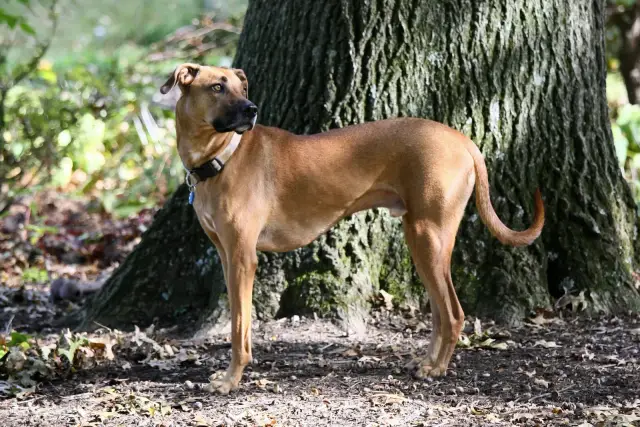
- Beauceron (said ancestor, medium confidence); family members include the Black Mouth Cur
Drawn to scale in real centimetres. Its back reaches about 59 cm, just above your knee; its head about 74 cm, mid-thigh.
Where it sits in the tree
Early Modern Era · 1600 to 1799
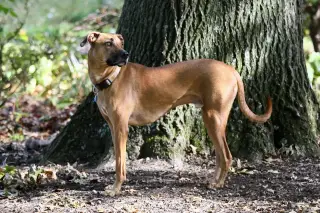
Name and origin
 Related breedBernese Mountain Dog1700 to 1907 · SwitzerlandEarly Modern Era
The name comes from Catahoula Parish in central Louisiana, around Catahoula Lake. "Leopard" refers to the spotted merle coat. The word "Catahoula" itself is often said to be a French spelling of a Choctaw word, but that etymology is a common explanation rather than a documented one. Other names in use are Catahoula Cur, Catahoula Hog Dog and, in the UKC, Louisiana Catahoula Leopard Dog.
Where the dogs came from is a real debate, and it has more legend than record. The 64 Parishes encyclopedia of Louisiana notes that claims about the breed's origin lack credible historic documentation and are best treated as informed speculation. Three theories are told most often:
- Spanish dogs crossed with Native American dogs (theory). The story says dogs that came with Spanish explorers, such as the Hernando de Soto expedition of the 1540s (said to have brought greyhounds and mastiff types), were crossed with the dogs of local peoples. No document ties a Catahoula to those dogs.
- French settlers and their Beauceron dogs (theory). French settlers are said to have crossed local dogs with Beauceron herding dogs. Accounts disagree on the date: some say the 1700s, others the 1800s. Our data records the Beauceron link as medium confidence and treats it as a cross, not a clear line of descent.
- Red wolf ancestry (older claim, now doubted). Older accounts linked the native dogs to red wolves. The 64 Parishes entry says recent DNA work points to Native American dogs descending from domestic dogs rather than from red wolves.
The honest summary is that the breed is a that took shape in Louisiana over a few centuries from mixed stock. The name "Catahoula" was in use for these dogs by the early 1800s, and the breed has been standardised only in the last few decades.

History
 Same eraBluetick Coonhound1700 to 1945 · United StatesEarly Modern Era
Swamp and pineland dogs
Settlers in the Gulf South let hogs and cattle range free, and they needed dogs that could find animals in dense brush and swamp. The Catahoula was one answer: an athletic dog that could work on its own. Its job was to track the stock, then either hold it in place by circling and barking (called "bailing" or "baying") or move it toward the farm. Hog work is the older and better known role; cattle work was done as well. The UKC Herding Group listing and the 64 Parishes entry both stress that the urge to move stock is instinct, not taught.
The Catahoula belongs to the group of American working dogs called curs. Several of its relatives, like the Black Mouth Cur, did the same sort of job. See American Cur and Feist for the whole group.
State dog and registries
Louisiana made the Catahoula its official state dog on 9 July 1979. That date is consistent across sources and the atlas record. Breed clubs followed. The United Kennel Club recognised the breed in 1995 as the Louisiana Catahoula Leopard Dog and placed it in the Herding Group. The American Kennel Club lists it in the Foundation Stock Service. That programme keeps records for breeds working toward full recognition. It allows dogs to enter some AKC companion events, but it is not full recognition. Sources differ on the year the AKC listing began (one says 1996), so check the AKC before quoting a date. Several other registries and working-dog clubs also exist, and they do not all use the same standard.

Relatives and DNA
 Same familyBoerboel1650 to 1983 · South AfricaEarly Modern Era
The Catahoula's family in our data is American Cur and Feist. The family is a DNA , in the sense of Parker et al. 2017, and it should not be confused with a kennel club group. Our data does not list figures for the Catahoula, so there is no DNA web chart here. The only parent link in our data is the Beauceron, which is recorded as "crossed with", with medium confidence, from a Wikipedia note about French settlers.
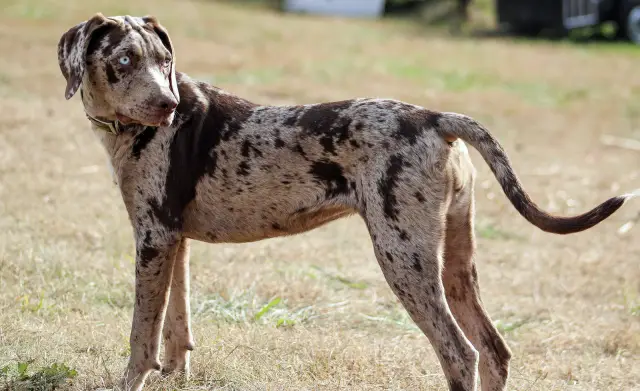 Catahoula Leopard DogLouisiana cur; Spanish and Native American dogs are also named in theories
Its closest working cousins in the same family include the Black Mouth Cur, which also came from the Gulf South, and the Blue Lacy from Texas. These are shared jobs and a shared home region, not a proven pedigree.
The coat and the eyes
 Related breedBorder Terrier1700 to 1920 · United KingdomEarly Modern Era
Merle "leopard" coat
The signature pattern is merle: a solid base colour broken by irregular patches and spots of another. Breed overviews describe a wide range of colours and patterns in Catahoulas, from blue and red merle to solids and brindles, often with tan points or white markings. The pattern comes from the merle gene (M). One copy (Mm) gives a dog with the marbled coat. Two copies (MM, a "double merle") give a dog that is mostly white and at much higher risk of hearing and sight problems.
Glass eyes
Many Catahoulas have "glass" or "cracked glass" eyes, very pale blue and almost white in some dogs, and some have one eye of each colour or an eye split in two colours. These colours are linked to the same pigment genes as the merle coat. Eye colour does not by itself mean a dog sees or hears badly, but it is one of the signs of a pigment gene at work.
The breed standard
 Looks relatedCoton de Tulear1600 to 1970 · MadagascarEarly Modern Era
A breed standard is the written ideal that a kennel club judges against. The Catahoula has no FCI standard, and the AKC treats it only in the Foundation Stock Service, so the UKC standard (revised 1 January 2008) is the main written one. The full text could not be checked for this draft, so the table below uses only the points that sources agree on.
| Trait | What the standards and overviews say |
|---|---|
| Overall | UKC: a medium to large, well-muscled, athletic dog; faults are judged by their effect on health and on the ability to do the traditional work |
| Height | Breed overviews: about 56 to 66 cm for males and 51 to 61 cm for females (Wikipedia and Hill's) |
| Weight | Breed overviews: roughly 18 to 43 kg; the range varies by source because the UKC standard does not fix weight rigidly |
| Coat | Short to medium and close; the leopard (merle) pattern is common, and solids and brindles also occur |
| Eyes | Glass, blue, brown and odd-coloured eyes all occur and are described as typical of the breed |
| Role | UKC Herding Group; traditional hog and cattle work |
Temperament
 Related breedDachshund1600 to 1888 · GermanyEarly Modern Era
Catahoulas are bright, driven and independent. They were bred to work away from a handler, and they decide for themselves how to do the job. Owners describe a loyal dog that bonds closely with its family, is alert with strangers, and has plenty of nerve. Breed overviews stress that a Catahoula needs a job; evidence on problem behaviour is anecdotal.
- Drive. The herding and bailing instinct is strong. A Catahoula may circle, nip at heels or stare down children, other pets or livestock. This is instinct, not aggression, but it needs channelling.
- Training. Clever and quick, but not eager to please for its own sake. Short, varied sessions with clear rules work better than repetition.
- Strangers and other dogs. Reserved and sometimes dominant with dogs of the same sex. Early socialisation helps.
- Small pets. The prey and herding drives make a Catahoula a poor match for cats and small animals unless it was raised with them; evidence is limited.

Health
 Related breedDalmatian1700 to 1890 · CroatiaEarly Modern Era
Most Catahoulas live healthy lives. The two points that matter most are the ones that come with the coat: hearing and sight. What follows is what breeders screen for and what owners can watch for.
Deafness
Deafness is the best documented health issue in the breed. The Louisiana State University (LSU) Veterinary School hearing programme, led by George Strain, publishes breed-by-breed results of BAER tests (a brainstem hearing test that can find deafness in one ear). Its table lists 214 Catahoulas tested, of which about 38.8% were deaf: roughly 16.8% in one ear and 22.0% in both ears. That is about 4 in 10 dogs, or roughly 1 in 2.6. Two cautions apply. The dogs tested may not be a random sample, since breeders and owners with a worry are more likely to test. And the figure pools all coat colours, so it does not show how much comes from merle itself.
The link between merle and deafness is shown more clearly in a mixed-breed study. Strain and colleagues (Journal of Veterinary Internal Medicine, 2009) tested 153 merle dogs of several breeds. Deafness was found in 4.6% in one ear and 4.6% in both ears. Among double merles (MM), 10% were deaf in one ear and 15% in both, about 1 in 4 in total. Among single merles (Mm) it was 2.7% and 0.9%, about 1 in 28. The authors concluded that dogs with two copies of the merle gene were significantly more likely to be deaf. This study was not on Catahoulas, so it is evidence for the mechanism, not a Catahoula figure.
Two further points come from the LSU pages. A dog deaf in only one ear can look like a normal hearing dog, so only a BAER test finds it, and such a dog can pass the risk to its puppies as readily as a fully deaf dog. Predominantly white Catahoulas are widely described as having a high rate of deafness.
Double merle
Breeding two merle dogs together gives, on average, a quarter of the litter as double merles. Double merles often have white coats, small or malformed eyes and hearing loss, in the figures above. Most responsible breeders avoid merle to merle pairings. Catahoulas are sold in a very wide range of colour combinations, so ask the breeder what each parent carries.
Other conditions
| Condition | What it is | How common | What helps |
|---|---|---|---|
| Deafness (one or both ears) | Hearing loss from pigment-related inner ear changes | LSU BAER table: about 4 in 10 of 214 tested Catahoulas, about 1 in 2.6 (pooled coats, possible sample bias) | BAER test of every puppy and breeding dog; no merle to merle matings |
| Sight problems in double merles | Small or malformed eyes, poor vision | Reported as frequent in double merles; no Catahoula figure found | Avoid double merle breeding; eye exam by a vet |
No named study gives a breed-wide lifespan for the Catahoula, so the 10 to 14 years in our data should be read as a project estimate with limited backing.

Living with a Catahoula Leopard Dog
 Related breedGreat Dane1600 to 1880 · GermanyEarly Modern Era
The ratings below follow the sources in this article. Where evidence is thin, the table says "Varies".
| Daily reality | Rating | Why |
|---|---|---|
| Exercise per day | High | A working stock dog; needs real exercise and a job, not just walks |
| Training needs | High | Independent and strong-willed; early, consistent training |
| Grooming | Low | Short close coat; a weekly brush |
| Shedding | Medium | Short coat that sheds; evidence thin |
| Barking | Varies | Alert and vocal in some lines; depends on the dog |
| Time alone | Poor | A working dog that needs a job; evidence anecdotal |
| Children | Varies | Herding instinct can lead to nipping at heels; supervise; evidence thin |
| Other dogs | Varies | Can be dominant with the same sex; early socialisation |
| Cats and small pets | Poor | Strong prey and herding drive unless raised with them |
| Flat living | Poor | Needs space and exercise; a secure garden at minimum |
| Heat tolerance | Good | Short coat and a Gulf South origin |
| Cold tolerance | Fair | Short coat; some dogs need a coat in hard frost |
| First-time owner fit | Poor | Strong will and drive suit experienced owners |
A great fit if
- You want a working partner for farm work, hiking, canine sports or tracking, and you can give it hours of activity daily.
- You have a secure fenced property and time for training.
- You are happy to test hearing and accept a dog that may be deaf in one ear.
- You have owned a driven, independent breed before.
Think twice if
- You live in a small flat or are away from home for most of the day.
- You have cats, rabbits or free-range animals you value.
- You want a dog that stays calm with little effort.
- You want a particular merle colour more than a tested, sound dog.
Before you get one
- Health tests. Ask the breeder for BAER hearing results for both parents and for the puppies (available at vet schools and some vet practices), and ask which colours each parent carries. Check the paperwork yourself.
- Puppy or adult rescue. Ask breed or cur-type rescues about adults. An adult from rescue has a known manner and a hearing history.
- First year. Plan for socialisation, a firm routine, mental work and a secure garden.
Similar breeds to consider
- Black Mouth Cur. A fellow Gulf South cur with the same stock sense and a solid coat, with no merle deafness question.
- Blue Lacy. A Texas ranch dog with similar drive and energy.
- Beauceron. The French herding breed named as a possible ancestor; larger, more formal, with a strong guarding nature.
- Australian Shepherd. Also merle, also herding, and also has a documented deafness risk; has a larger written health record.

Catahoula Leopard Dog fun facts
 Related breedGreater Swiss Mountain Dog1700 to 1909 · SwitzerlandEarly Modern Era
- The Catahoula became the state dog of Louisiana on 9 July 1979.
- The UKC calls it the Louisiana Catahoula Leopard Dog and recognised it in 1995.
- "Glass" eyes can be nearly white, and some dogs have two differently coloured eyes.
- A Catahoula may bay a hog without biting it, holding it in place by circling and barking until the handler arrives.
Frequently asked questions
What is a Catahoula Leopard Dog?
A medium to large Louisiana working dog bred to find and hold hogs and move cattle, known for its "leopard" coat and pale eyes.
How big is a Catahoula Leopard Dog?
Breed overviews give about 56 to 66 cm for males and 51 to 61 cm for females, and about 18 to 43 kg. The UKC standard puts working structure ahead of fixed numbers.
Are Catahoulas good family dogs?
They can be loyal and affectionate with their own people, but they are driven, strong-willed and prone to herding children. They suit active families who can train them and supervise them.
Are Catahoulas often deaf?
More often than many breeds. The LSU hearing programme lists about 38.8% of 214 tested Catahoulas as deaf in one or both ears. Ask for a BAER test.
How long do Catahoulas live?
Our data gives 10 to 14 years. No large named study was found, so treat it as an estimate.
Is the Catahoula recognised by the AKC?
Not fully. It is in the Foundation Stock Service, which is a record-keeping step. The UKC recognised it in 1995. The does not recognise it.
Read next
 FamilyAmerican Cur & FeistThe whole family
 Adopt a dogDog Shelters in EuropeFind dog shelters in Europe, learn how shelters differ from country to country and why adopting a dog is a good option.
Sources (10)
- United Kennel Club, Louisiana Catahoula Leopard Dog breed standard, revised 1 January 2008.
- American Kennel Club, Foundation Stock Service breed listing for the Catahoula Leopard Dog.
- 64 Parishes (Louisiana Endowment for the Humanities), "Louisiana Catahoula Leopard Dog".
- Louisiana State University School of Veterinary Medicine, hearing and deafness programme (Strain G.M.), breed prevalence table and genetics pages.
- Strain G.M., Clark L.A., Wahl J.M., Turner A.E., Murphy K.E., "Prevalence of deafness in dogs heterozygous or homozygous for the merle allele", Journal of Veterinary Internal Medicine, 2009.
- State of Louisiana, designation of the Catahoula Leopard Dog as state dog, 9 July 1979.
- Hill's Pet Nutrition, Catahoula Leopard Dog breed profile.
- Wikipedia, Catahoula Leopard Dog (size and history notes, used with care).
- Parker H.G. et al., "Genomic analyses reveal the influence of geographic origin, migration, and hybridization on modern dog breed development", Cell Reports, 2017.
- Alderton D., The Encyclopedia of Dogs, 2000.