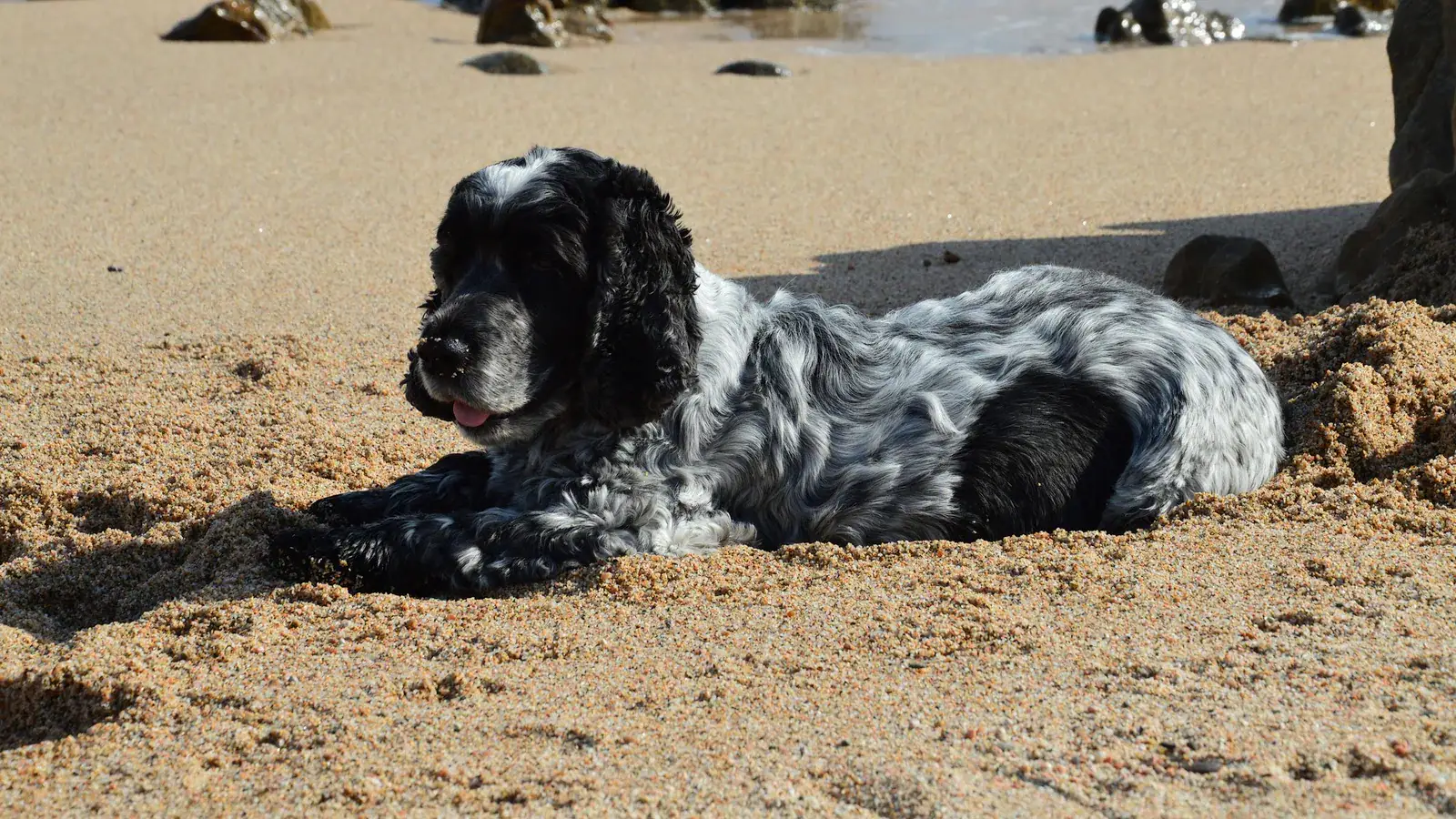
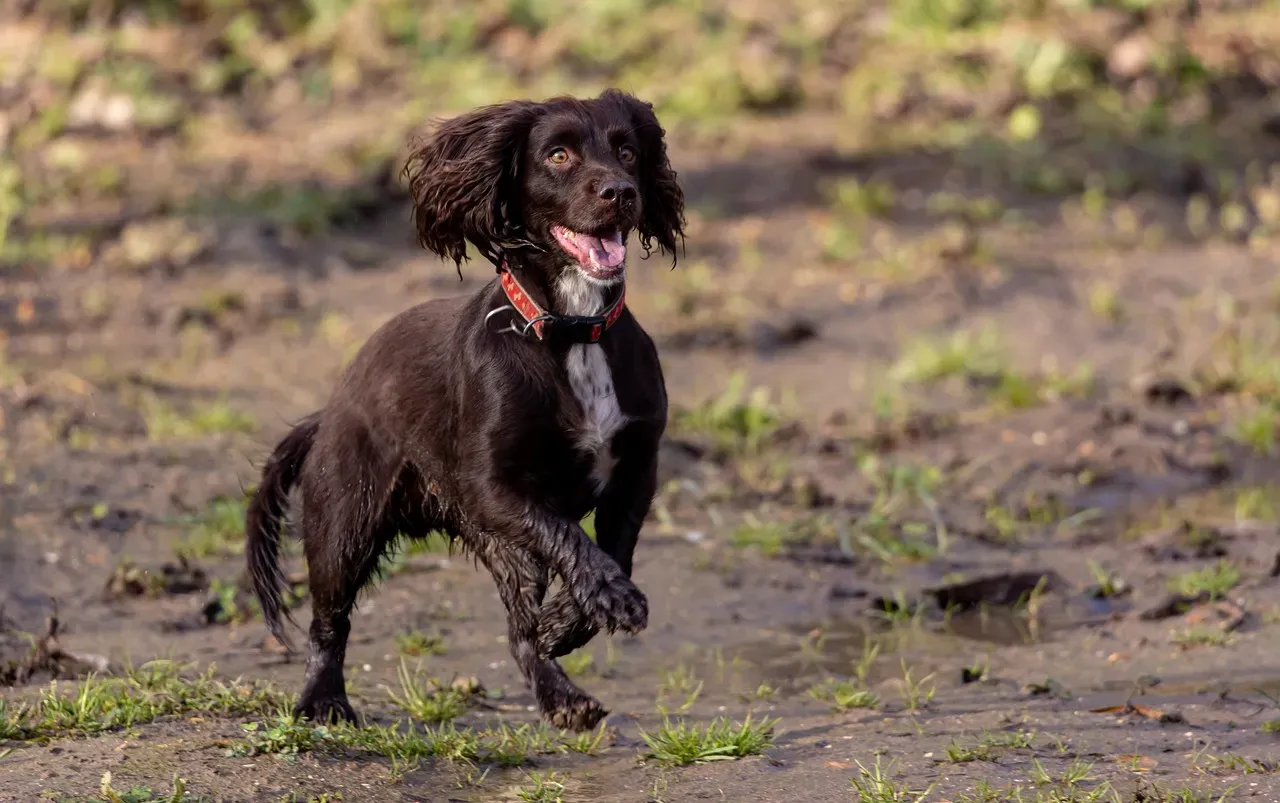
The word "cocker" comes from that woodcock work. The breed has two faces today: a long-coated show type, and a leaner, finer-coated working type that still follows the gun. Both are quick, warm, busy dogs that like to be near their people. They suit active owners who will give daily exercise, regular grooming, steady training and a close eye on the ears. A 2023 UK VetCompass study put the median age at death at about 11.4 years.
English Cocker Spaniel quick facts
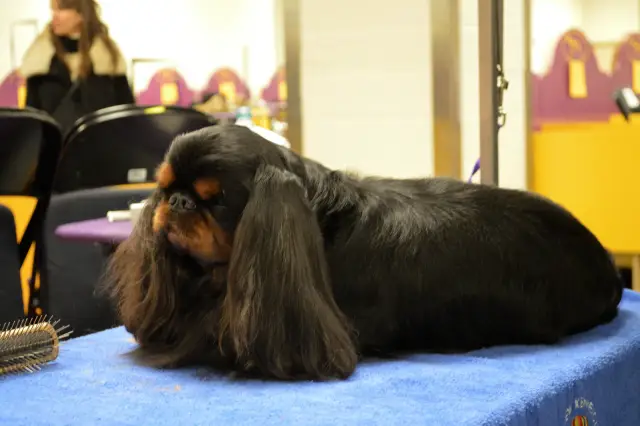 Related breedKing Charles Spaniel1600 to 1903 · United KingdomEarly Modern Era
- Closest DNA relatives
- Field Spaniel, American Cocker Spaniel, English Springer Spaniel, Cavalier King Charles Spaniel
- Country of origin
- Great Britain (England)
- Period of development
- About 1800 to 1892 (atlas data); recognised as a separate breed by the Kennel Club in 1892
- Original job
- Flushing woodcock and other game from cover, then retrieving it
- Type
- Flushing spaniel (FCI Group 8, Retrievers, Flushing dogs, Water dogs, standard no. 5; AKC Sporting Group; UK Kennel Club Gundog Group)
- Height
- FCI: dogs 39 to 41 cm, bitches 38 to 39 cm. AKC: males about 40.6 to 43.2 cm, females about 38.1 to 40.6 cm
- Weight
- FCI: about 12.5 to 14.5 kg. AKC desirable weights: males 28 to 34 lb (12.7 to 15.4 kg), females 26 to 32 lb (11.8 to 14.5 kg)
- Coat
- Silky, flat or slightly wavy, with feathering on legs, chest and belly (heavier in show lines)
- Colour
- Solids (black, red, golden, liver, with or without tan), bicolours, tricolours and roans
- Life span
- Atlas data: 12 to 15 years. UK VetCompass median age at death 11.44 years (Engdahl et al., 2023)
- Exercise
- Varies by line: a working cocker may need considerably more than a show cocker (The Cocker Spaniel Club)
- DNA family
- Spaniel family (Parker et al. 2017)
Drawn to scale in real centimetres. Its back reaches about 41 cm, just below your knee; its head about 52 cm, your knee.
Where it sits in the tree
Industrial Revolution · 1800 to 1849


Name and origin
 Related breedKooikerhondje1500 to 1966 · NetherlandsAge of Exploration
Why "cocker"? The name is linked to woodcock, a secretive, well camouflaged woodland bird that sits tight and flushes at the last moment. Wikipedia's breed article cites the Oxford English Dictionary for the idea that these spaniels were used to flush woodcock, which is why hunters talked of "cocking". For a good part of the 19th century, "cocker spaniel" was not a breed at all. It described the small kind of field spaniel that was suited to woodcock cover.
Why "English"? The word separates the breed from the American Cocker Spaniel, which grew apart from it in North America. In Britain the English type is simply called the Cocker Spaniel, which is how the UK Kennel Club lists it. Outside Britain the longer name is used. The FCI calls it the English Cocker Spaniel and gives Great Britain as the country of origin.
Where did it come from? The breed came out of the general spaniel stock of Britain, which was sorted by weight and by job well before it was sorted by pedigree. The gundog tradition behind it is much older than the breed. Spaniels are described in British writing for centuries, and the Spaniel family is also visible in modern DNA (see the relatives section). What is firm is the late Victorian story: the small spaniels kept for woodcock and for covert work were given their own show classes and then their own breed status in the 1890s.

History
 Same eraAustralian Cattle Dog1840 to 1903 · AustraliaIndustrial Revolution
From field spaniel to cocker
In the early 19th century, spaniels were grouped by size and use, not by strict breed. The smallest, handy for dense cover and woodcock, were called cockers. Larger ones were called springers or field spaniels. Accounts of this period say the groups were separated by weight, and that a puppy from one litter could be registered in different classes as it grew. This is the same muddle described in the English Springer Spaniel article, where cockers and springers shared litters. The exact weight line depends on the account, and sources give the date of the final weight-based divisions as around 1900 or 1901. Because the accounts differ, treat the details as approximate.
Obo, the foundation dog
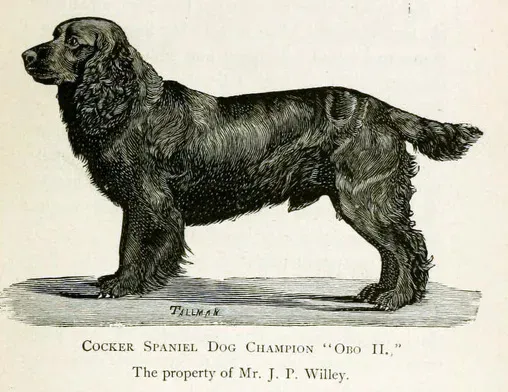
Most breed histories name one dog as the common ancestor of the modern English Cocker: Obo, born in 1879. Sources describe him as the son of a Sussex Spaniel sire and a Field Spaniel dam, and he is credited as the founder of the cocker line. His story is a good example of how Victorian breeds were built from a handful of influential dogs. Modern pedigrees of English Cockers trace back to him, a point repeated in the AKC's breed history. It is also a reminder that "the English Cocker" in the 1890s was already a narrow gene pool by modern standards.
 Save
1892: a separate breed
The Kennel Club in Britain opened the way in 1892. Several sources say it then recognised cockers as a separate class from other spaniels, after lobbying by the breeder James Farrow. The Wikipedia article on the breed and the AKC history agree on 1892. One source gives 1873 for the recognition, but that date appears to refer to the founding of the Kennel Club itself, and the atlas data uses 1893 for the date the Kennel Club separated cockers and springers. The sources do not agree on 1892 against 1893, so both are given here; most sources use 1892. The Field Spaniel, a larger and longer-bodied spaniel developed in the same years, is also dated to 1892 in one account.
Crossing the Atlantic and splitting in two
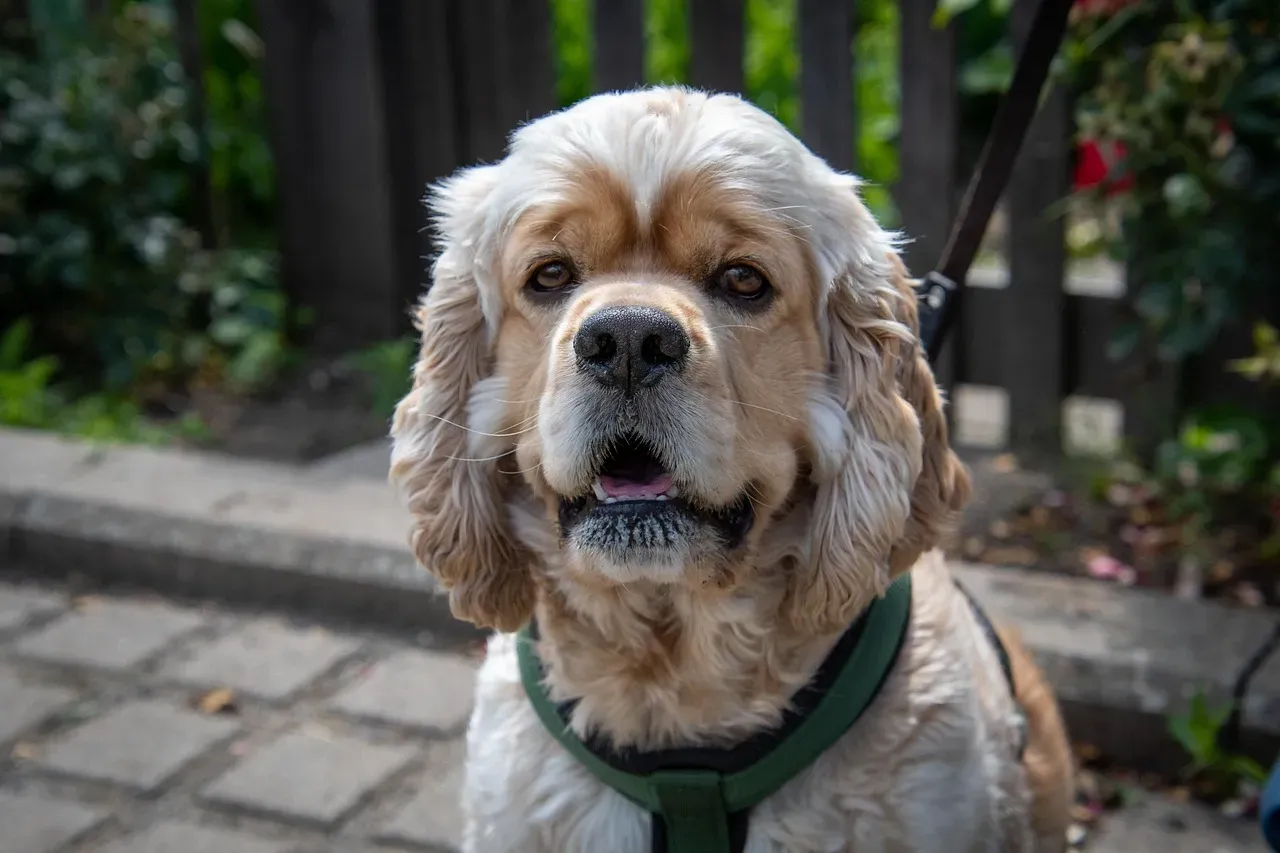
English cockers went to North America, where breeders developed a smaller, more heavily coated, shorter-muzzled show dog. For decades the two were treated as varieties of one breed, and the English type was shown with the American one. The date they were formally separated depends on the source:
- The AKC gave the English Cocker Spaniel its own breed designation in 1946 in most accounts. The AKC's own history article says the two were ultimately split into different breeds in 1947.
- The Canadian Kennel Club recognised the English Cocker separately in 1940, according to an AKC article.
- Wikipedia says the two were shown together in America until 1936, when the English type received separate status, which conflicts with the 1946 date. The sources do not agree on what happened when.
- In the UK, the Kennel Club recognised the American type as a separate breed in 1970.
The result is that two cocker spaniel breeds now exist: the English one described here, and the American Cocker Spaniel, which is a different, smaller breed in its own right. The American Cocker Spaniel is known in the United States simply as the Cocker Spaniel.
 Save
 Save
Working lines and show lines
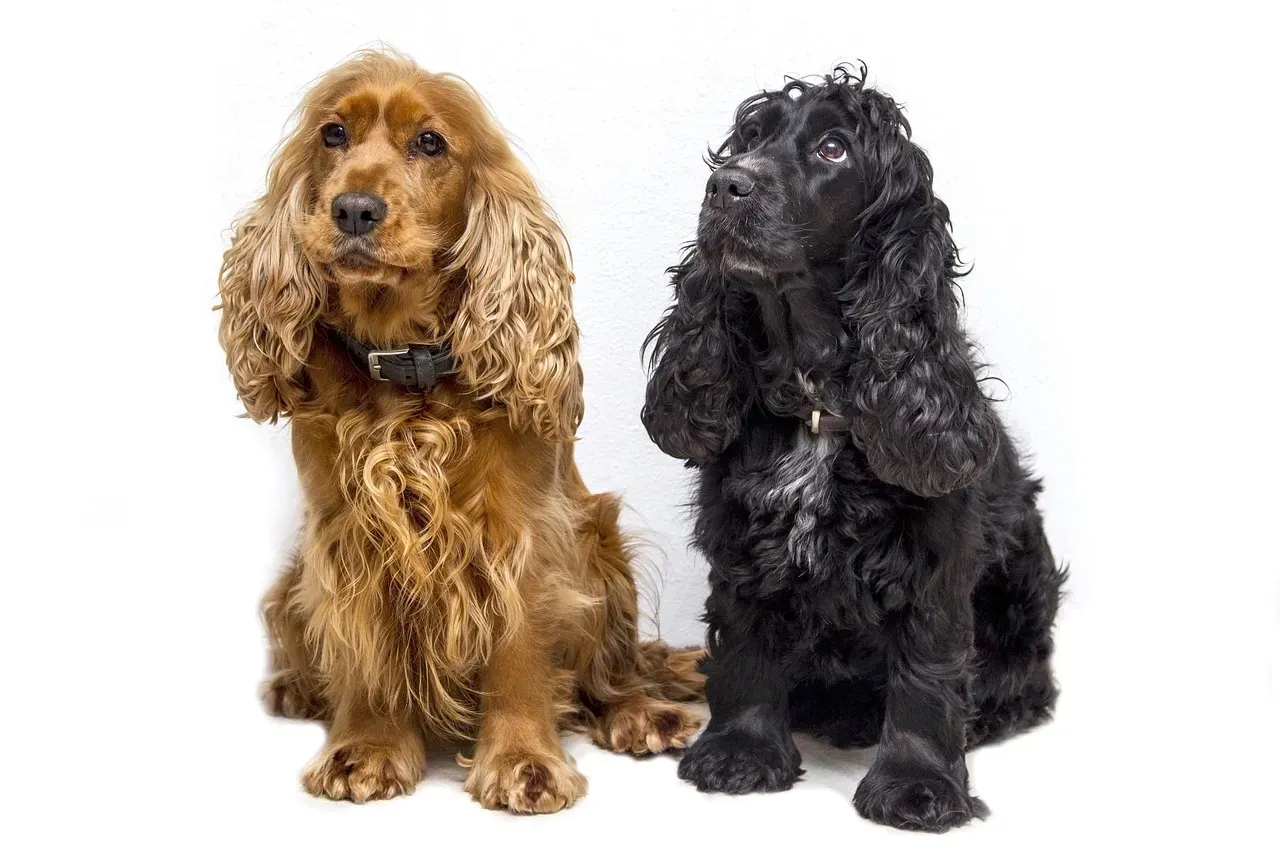
After the 1890s, the breed split into two types that still exist. The show type was selected for a profuse coat, a domed head and a more compact body. The working type was kept in shooting use and chosen for drive, nose and stamina. The Cocker Spaniel Club in the UK says a working cocker may be considerably more active than some show cockers and have enormous reserves of stamina. UK breed guides describe working types as having flatter skulls, higher-set and shorter ears, finer coats and far less feathering, with a rangier body. Both types are one breed under the same standard, and puppies from working and show lines can be registered together.
Relatives and DNA
 Same familyAustralian Shepherd1840 to 1957 · United StatesIndustrial Revolution
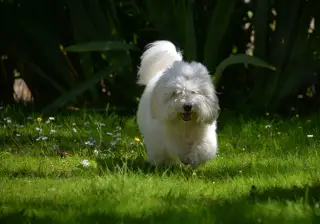
In the 2017 study by Parker and colleagues, the English Cocker Spaniel sits in the Spaniel family. Here "family" means a DNA , not a kennel club group. The atlas data records the strongest haplotype sharing with the Field Spaniel (about 137.7 Mb), followed by the American Cocker Spaniel (about 60.1 Mb), the English Springer Spaniel (about 40 Mb), the Cavalier King Charles Spaniel (about 21.1 Mb) and the Coton de Tulear (about 11.9 Mb). The very high sharing with the Field Spaniel fits the story above, in which the two types were close kin in Victorian Britain.
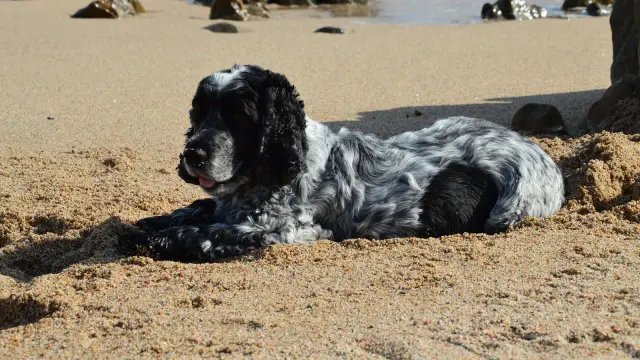

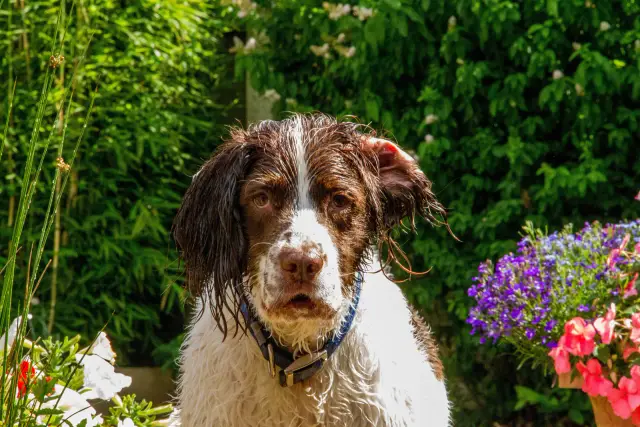

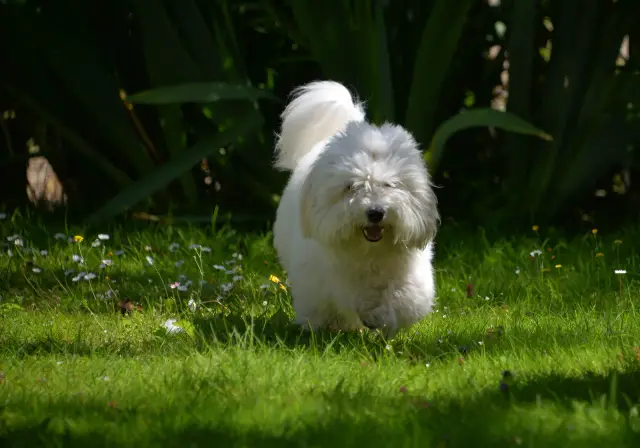
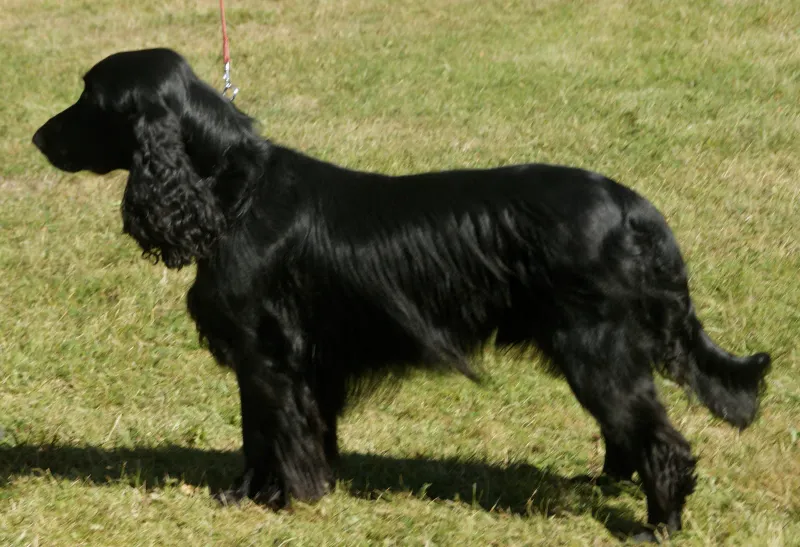 English Cocker and Field Spaniel
- English Cocker and American Cocker
- English Cocker and English Springer
- English Cocker and Cavalier
- English Cocker and Coton de Tulear
The knowledge base lists the American Cocker Spaniel and Russian Spaniel as direct descendants, with the Boykin Spaniel and the Cockapoo as later descendants. It marks the English Springer Spaniel as a sister breed with medium confidence, because the two shared litters until they were separated. For the wider group, see Spaniel, and for the closest working cousin, see the English Springer Spaniel.
American Cockerdirect descendant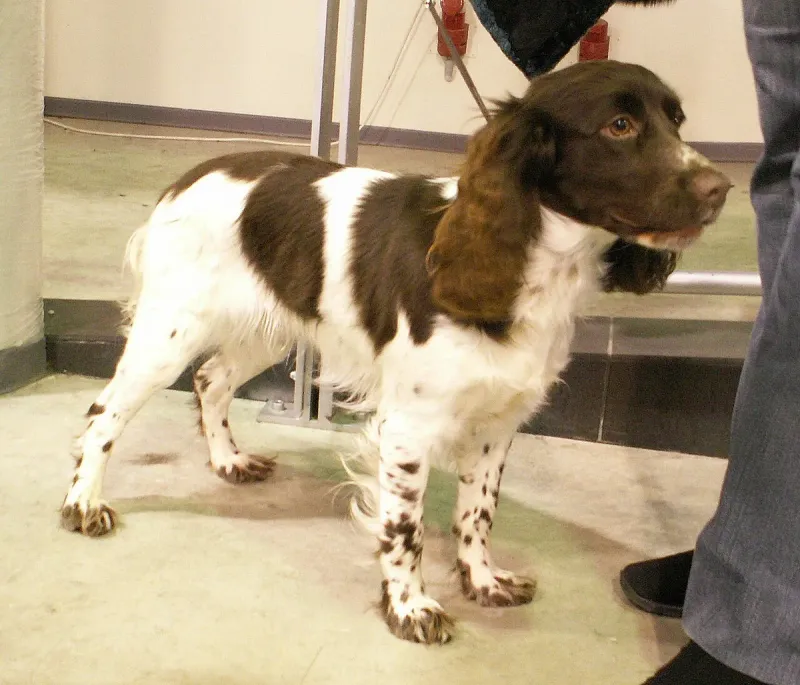 Russian Spanieldirect descendant
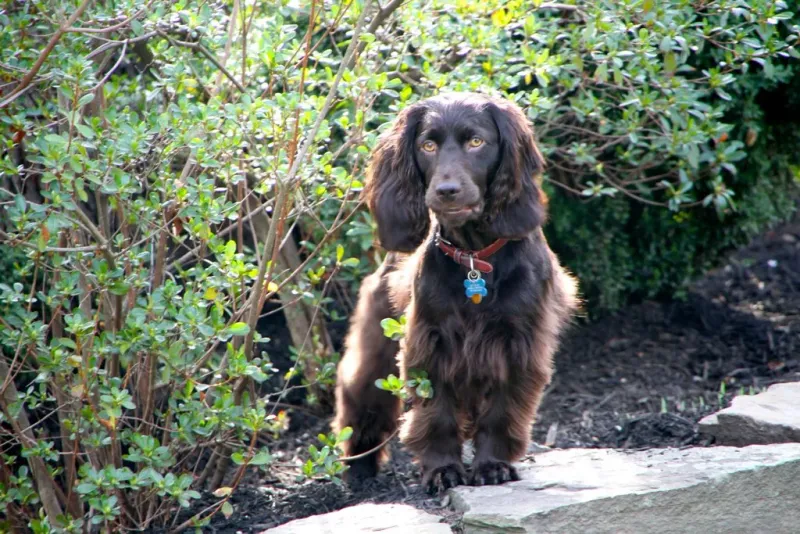 Boykin Spaniellater descendant
 Cockapoolater descendantAmerican Cockerdirect descendantRussian Spanieldirect descendantBoykin Spaniellater descendantCockapoolater descendant
 Save
Sister breeds · 1
- English Springer Spaniel1800 to 1902
Descend from it · 2
- American Cocker SpanielUnited States
- Russian SpanielRussia
- Field Spaniel137.7 Mb 5.7%
- American Cocker Spaniel60.1 Mb 2.5%
- English Springer Spaniel40.0 Mb 1.7%
- Cavalier King Charles Spaniel21.1 Mb 0.9%
- Coton de Tulear11.9 Mb 0.5%
Source: Parker et al. 2017. Percent of the whole genome.
The breed standard
 Looks relatedBouvier des Flandres1800 to 1912 · Belgium, FranceIndustrial Revolution
A is the written ideal for a breed that kennel clubs judge dogs against. The FCI, AKC and UK Kennel Club standards agree on a compact, sturdy, well balanced dog with a square outline. The numbers differ a little in how they are presented.
| Trait | FCI (no. 5) | AKC | UK Kennel Club |
|---|---|---|---|
| Height, dogs | 39 to 41 cm | 16 to 17 in (about 40.6 to 43.2 cm) | 39 to 41 cm |
| Height, bitches | 38 to 39 cm | 15 to 16 in (about 38.1 to 40.6 cm) | 38 to 39 cm |
| Weight | About 12.5 to 14.5 kg | Desirable: males 28 to 34 lb, females 26 to 32 lb (about 12.7 to 15.4 kg and 11.8 to 14.5 kg) | About 13 to 14.5 kg |
| Size penalty | None quoted in the sources seen | No size disqualification (AKC study guide) | None quoted in the sources seen |
| Colour | Not given | Not given | Solids: black, red, golden, liver, black and tan, liver and tan. Particolours (bicolours), tricolours and roans also accepted; small white chest patch tolerated on a solid |
The UK Kennel Club column is taken from the standard as reproduced on a breed club's website (West of England Cocker Club), not from the Kennel Club's own page. The FCI figures come from a copy of the standard reproduced by the Chinese Kennel Union. The Kennel Club standard states about 13 to 14.5 kg while the FCI states about 12.5 to 14.5 kg, a small difference. A blog post that gave 35.6 to 40.6 cm and 25 to 30 lb for the "AKC and UK" standards did not match the standards themselves and is not used.
Colour. The breed comes in a wide range. Solids can be black, red, golden or liver, and black or liver can carry tan points. Particolours include black and white, orange and white, liver and white and lemon and white, with or without ticking. Tricolours add tan markings, and roans can be blue, orange, lemon or liver. White anywhere on a solid dog beyond a small chest patch is penalised under the Kennel Club standard.
Show versus working type. The standard describes one breed. In practice show dogs usually carry more coat, with a more domed head. Working dogs are usually lighter in build. Both are registered and can be bred together, though many breeders keep them as separate lines.


Temperament
 Related breedBulldog1835 to 1875 · United KingdomIndustrial Revolution
The Cocker Spaniel Club describes all cockers, whatever their strain, as busy, active little dogs with minds of their own. That sums up the breed well. English Cockers are quick and affectionate, and they like to have a task, whether that is carrying a toy, following a scent trail or finding a dropped glove. The same bond that makes them warm companions also makes them sensitive to harsh handling and to being left alone for long periods, which is why the Living with section below rates time alone as a weak point.
Working and show differences. No formal study seen for this article compares the temperament of working and show types. UK breed guides disagree on how much the two differ: some describe show types as more laid back, others say the temperaments are essentially the same. The only consistent difference across sources is energy. A working cocker may need considerably more exercise and mental work than a show cocker, according to The Cocker Spaniel Club.
Training. No study seen here rates cocker trainability against other breeds, so treat this as general gundog practice: reward-based training, early recall work (a scent can take a gundog a long way) and a gundog or scent work class that uses the nose the breed was built for.
With children and other pets. Cockers are generally social and friendly, which is why they are popular family dogs, but no study seen here rates their behaviour with children against other breeds. Calm introductions, supervision with small children and early socialisation apply as they do for any dog. Their hunting past means they may chase birds or small animals when off lead.
The "rage syndrome" question
English Cockers have long been linked, in popular talk, with "rage syndrome" or "cocker rage", the idea that some dogs, especially solid-coloured ones, turn aggressive without warning. The research that is available points elsewhere.
- Podberscek and Serpell compared 217 low-aggression and 218 high-aggression English Cockers in a 1997 study on environmental influences. Owners of low-aggression dogs were more likely to be over 65 and more strongly attached to their dogs.
- The same researchers compared owner personality in a 1997 Veterinary Record study. Owners of high-aggression dogs scored as significantly more tense, less emotionally stable, shy and undisciplined than owners of low-aggression dogs.
- A Polish owner-completed survey of 503 English Cocker Spaniels, collected in November 2022 and published in 2024 by Wojewodzic and colleagues, examined factors linked to aggression in the breed.
- The 2023 UK VetCompass study recorded aggression as a diagnosis in 4.01% of English Cockers, about 1 in 25 dogs in the clinic records. That is a recorded behaviour problem, not a separate "rage" condition.
None of these sources describes rage syndrome as a proven breed-specific disease. They link aggression in cockers to the dog's home, its owner and its handling, and pain is a factor to rule out with a vet before assuming a behaviour cause. If a cocker bites or growls, a vet check and help from a qualified behaviourist are the sensible first steps.
 Save

Health
 Related breedChesapeake Bay Retriever1807 to 1918 · United StatesIndustrial Revolution
Most English Cocker Spaniels live healthy lives. This section lists what the best evidence shows, what breeders screen for and what owners can watch for. The main data comes from the 2023 VetCompass study by Engdahl and colleagues, based on the records of 10,313 English Cockers, about 3% of the 336,865 UK dogs under primary veterinary care in 2016. The paper found that the frequency of each of its top disorders was generally higher in English Cockers than in the general dog population, possibly because of the breed's long ears and looser skin.
Lifespan. The study reports a median age at death of 11.44 years (interquartile range 9.46 to 13.47), with females at 12.01 and males at 11.00. That is close to the UK average for dogs overall, which the report gave as 11.2 years. The atlas data gives a general range of 12 to 15 years, which is higher than the VetCompass median; the VetCompass figure is used here because it is measured. The most common grouped causes of death were neoplasia (cancer), mass-associated disorders and collapse.
| Condition | What it is | How common | What helps |
|---|---|---|---|
| Periodontal (gum and tooth) disease | Plaque and tartar leading to gum disease | 20.97% of dogs, about 1 in 5 (VetCompass 2023) | Tooth brushing, vet dental checks |
| Ear infection (otitis externa) | Inflammation of the ear canal | 10.09% of dogs, about 1 in 10 (VetCompass 2023) | Routine ear checks, drying ears after water, prompt vet care |
| Obesity | Excess body weight | 9.88%, about 1 in 10 (VetCompass 2023) | Measured meals, regular exercise |
| Anal sac impaction | Blocked scent glands near the anus | 8.07%, about 1 in 12 (VetCompass 2023) | Vet care; diet and weight control |
| Diarrhoea | Loose stools | 4.87%, about 1 in 21 (VetCompass 2023) | Vet check if it persists |
| Aggression | A recorded behaviour diagnosis | 4.01%, about 1 in 25 (VetCompass 2023) | Rule out pain, then qualified behaviour help |
| Familial nephropathy (FN) | Inherited kidney disease; the Cocker Spaniel Club says it may lead to kidney failure at an early age | Not given in the sources seen | DNA test of breeding dogs (listed by the Kennel Club) |
| Progressive retinal atrophy (prcd-PRA) | Inherited eye disease affecting the retina | Not given in the sources seen | DNA test and annual KC/BVA eye testing (Kennel Club, Cocker Spaniel Club) |
| A loose-fitting hip joint | Not given in the sources seen | Hip scoring of breeding dogs (Kennel Club) |
Ears. Ear problems are the most talked-about issue in the breed. Long, heavy, hanging ears limit air flow, and the VetCompass study found otitis externa in about 1 in 10 dogs. Look under the ears each week, keep the hair at the ear openings tidy as advised by a groomer or vet, and see a vet if you notice head shaking, smell, redness or scratching.
Inherited eye and kidney disease. The Kennel Club lists a prcd-PRA DNA test and an FN DNA test for the breed. A breed club advises that dogs that test as or affected should only be mated to dogs that test clear, so that no affected puppies are born. The Cocker Spaniel Club also recommends annual eye testing under the KC/BVA scheme. Because the two diseases are inherited in a way, a carrier can look and act normal. Ask a breeder for the test certificates, not just a statement that parents are "healthy".
Weight. Obesity was recorded in about 1 in 10 cockers. Cockers are enthusiastic eaters, so a measured daily food allowance, chosen with your vet, helps protect the joints and heart.
Sources of uncertainty. The VetCompass figures show the share of dogs with a diagnosis in clinic records during one year, not lifetime risk. They come from dogs seen at UK practices, and may not reflect other countries or working lines. No prevalence for FN, PRA or hip dysplasia in the breed was found, so no number is given.
 Save

Living with an English Cocker Spaniel
 Related breedGerman Shorthaired Pointer1800 to 1872 · GermanyIndustrial Revolution
| Daily reality | Rating | Why |
|---|---|---|
| Exercise per day | Medium to High | Varies by line; working lines may need considerably more (The Cocker Spaniel Club) |
| Training needs | Medium | Eager to learn; recall needs steady practice |
| Grooming | High | Long coat and feathering need regular brushing and tidy-ups; less coat on working types |
| Shedding | Medium | Sheds; evidence thin |
| Barking | Varies | Depends on training and the individual |
| Time alone | Poor | Strongly people-focused; long hours alone are a poor match |
| Children | Good | Generally social; supervision and early socialisation still apply |
| Other dogs | Good | Usually sociable; early socialisation helps |
| Cats and small pets | Varies | Flushing instinct; depends on early exposure |
| Flat living | Fair | Small to medium size, but needs daily outdoor exercise and ear checks |
| Heat tolerance | Fair | Dense coat on show types; no source rates it, so keep exercise to cooler hours |
| Cold tolerance | Good | Feathered, weather-ready coat; no source rates it directly |
| First-time owner fit | Fair | Friendly and trainable; grooming and ear care need commitment |
 Save
 Save
A great fit if
- You want an active, affectionate dog and enjoy daily walks, play and training.
- You are happy to brush the coat and check the ears every week.
- You are home for much of the day, or can arrange company for the dog.
- You like scent work, gundog training or other dog sports that use a nose.
Think twice if
- You are away from home for long hours every day.
- You want a dog that needs almost no grooming.
- You want a quiet, low-energy pet and would pick a working line.
- You have free-roaming birds or small pets and cannot manage a dog with a flushing instinct.
Before you get one
- Health tests. Ask the breeder for the hip score, the prcd-PRA DNA result, the FN DNA result and a current eye test certificate for both parents. Ask to see the original certificates. The Kennel Club's Health Test Results Finder is the place to check a UK dog's results.
- Show or working line. Ask which line the puppy comes from and how much exercise its parents get. A working-bred puppy usually needs a more active home.
- Puppy or adult rescue. Breed rescues exist and often place adults whose temperament and energy level are already known.
- First year. Plan puppy classes, gentle ear handling from the first week, and a lean weight.
Similar breeds to consider
- English Springer Spaniel. Larger, with a similar friendly nature and more stamina.
- Cavalier King Charles Spaniel. Smaller companion spaniel with a calmer routine, but with its own health needs.
- Field Spaniel. The closest DNA relative in the Parker 2017 data, bigger and less common.
- Welsh Springer Spaniel. Another British flushing spaniel, a little larger than the cocker.

English Cocker Spaniel fun facts
 Related breedJack Russell Terrier1819 to 1976 · United KingdomIndustrial Revolution
- Obo. A single dog born in 1879, said to be the son of a Sussex Spaniel and a Field Spaniel, is named in breed histories as the founder of the modern English Cocker.
- Woodcock. The word "cocker" is traced to the use of these dogs on woodcock.
- Two names, two breeds. In the US the Cocker Spaniel is the American breed, and the English Cocker is a separate breed with its own standard.
- The 1892 date. The Kennel Club's separate classification for cockers came in 1892, after lobbying by the breeder James Farrow.
Frequently asked questions
Are English Cocker Spaniels good family dogs?
They can be. They are generally friendly and social, but they need exercise, grooming and company, and supervision with young children as with any dog.
How big is an English Cocker Spaniel?
Dogs stand about 39 to 41 cm and bitches 38 to 39 cm under the standard. Weight is about 12.5 to 14.5 kg in the FCI standard and about 13 to 14.5 kg in the UK standard as reproduced by breed clubs. The gives somewhat larger numbers in inches and pounds.
How long do English Cocker Spaniels live?
The 2023 UK median age at death was 11.44 years (females 12.01, males 11.00). The atlas data range is 12 to 15 years.
What is the difference between an English and an American Cocker Spaniel?
They are separate breeds with their own standards. They share close ancestry (about 60.1 of shared haplotype in the Parker 2017 data) but the American type was bred apart in North America. The AKC separated them in 1946 or 1947, depending on the source.
Is "rage syndrome" real in cockers?
No source seen here describes it as a proven disease. Studies of English Cockers link aggression to the dog's owner, home and handling, and a vet should check for pain first.
What health problems do English Cocker Spaniels get?
The most common recorded issues were gum disease, ear infection, obesity and anal sac impaction. Breeders can screen for inherited FN and prcd-PRA with DNA tests.
Do English Cocker Spaniels need a lot of exercise?
Varies by line. Working lines usually need more than show lines.
Read next
Closest DNAAmerican Cocker Spaniel60.1 Mb sharedSister breedEnglish Springer Spaniel1800 to 1902 Adopt a dogDog Shelters in EuropeFind dog shelters in Europe, learn how shelters differ from country to country and why adopting a dog is a good option.
Sources (12)
- American Kennel Club, English Cocker Spaniel Study Guide (breed standard summary).
- American Kennel Club, "English Cocker Spaniel history" and "Cocker Spaniel history" articles.
- Engdahl K. et al., VetCompass study of 10,313 English Cocker Spaniels under UK primary veterinary care, Royal Veterinary College, 2023.
- Fédération Cynologique Internationale, English Cocker Spaniel, standard no. 5 (copy reproduced by the Chinese Kennel Union).
- Podberscek A.L. and Serpell J.A., "Aggressive behaviour in English Cocker Spaniels and the personality of their owners", Veterinary Record, 1997.
- Podberscek A.L. and Serpell J.A., "Environmental influences on the expression of aggressive behaviour in English Cocker Spaniels", Applied Animal Behaviour Science, 1997.
- Dogs Atlas breed records, English Cocker Spaniel breed data file, citing Parker H.G. et al., 2017 genome study.
- The Cocker Spaniel Club (UK), health page and frequently asked questions.
- The Kennel Club (UK), Spaniel (Cocker) breed pages, including breed health and DNA test information.
- West of England Cocker Club, breed standard page (reproducing the UK Kennel Club standard).
- Wikipedia, "English Cocker Spaniel" and "American Cocker Spaniel" articles.
- Wojewodzic et al., 2024, owner-completed survey of 503 English Cocker Spaniels on aggressive behaviour (Poland).