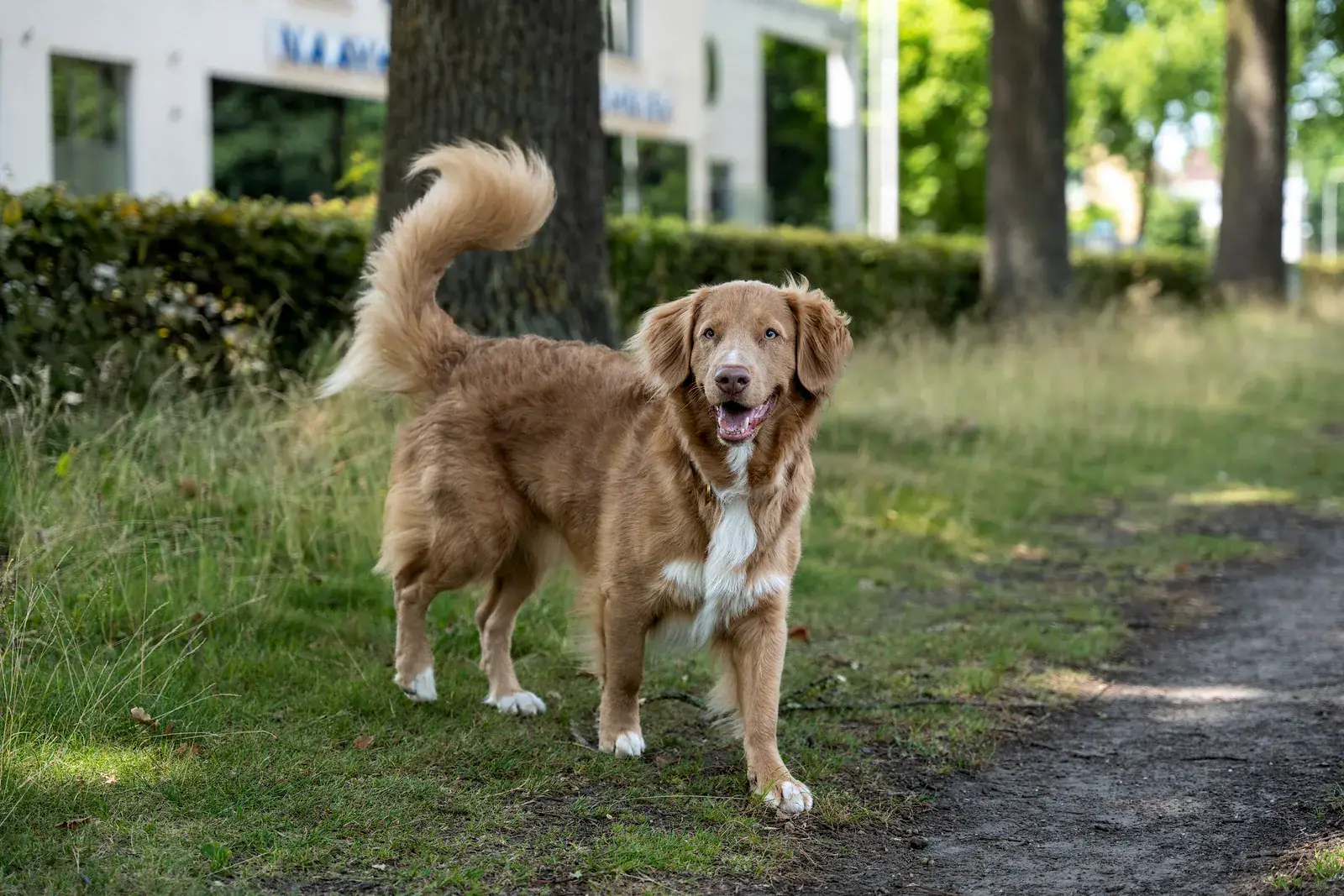
It was developed to "toll" ducks, which means playing and romping along the shore to draw curious waterfowl within gun range, then retrieving the birds from cold water. Today it is a hunting, sport and family dog. It is intelligent, energetic, sensitive and very attached to its people. It suits active owners who want a dog for training, swimming and long days outdoors. The atlas data gives a life span of 12 to 14 years.
Nova Scotia Duck Tolling Retriever quick facts
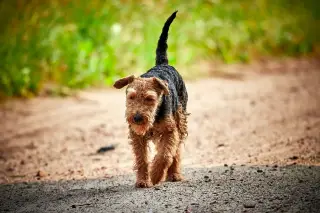
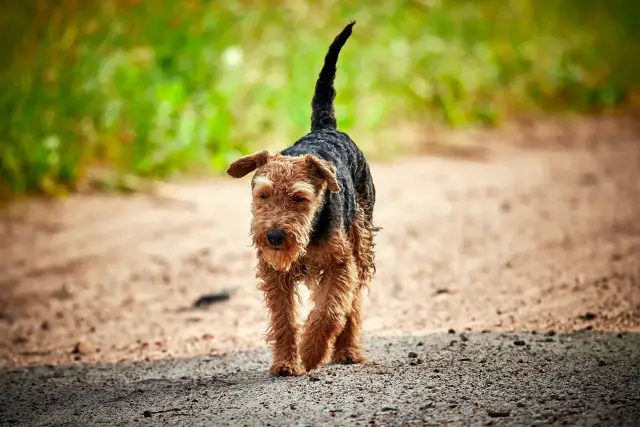 Related breedAiredale Terrier1850 to 1880 · United KingdomVictorian Breed Boom
- Closest DNA relatives
- Rough Collie, Shetland Sheepdog, American Cocker Spaniel
- Country of origin
- Canada (Little River Harbour, Yarmouth County, Nova Scotia)
- Period of development
- About 1860 to 1945 (atlas data, medium confidence); sources trace the first dogs to the early 1800s
- Original job
- Tolling and retrieving ducks and geese
- Type
- Retriever (FCI Group 8, Retrievers, Flushing dogs, Water dogs; FCI standard no. 312; Sporting Group; UK Kennel Club Gundog Group)
- Height
- Males 48 to 51 cm, females 45 to 48 cm (FCI), with 2.5 cm of tolerance
- Weight
- Not fixed by the FCI; Canadian Kennel Club guideline about 20 to 23 kg males, 17 to 20 kg females
- Coat
- Water-repellent double coat, medium length, with feathering
- Colour
- Red to orange, with white markings permitted
- Life span
- 12 to 14 years (atlas data)
- Other names
- Toller, Little River Duck Dog, Yarmouth Toller
- DNA family
- Retriever family, weak support (Parker et al. 2017)
Drawn to scale in real centimetres. Its back reaches about 48 cm, your knee; its head about 61 cm, just above your knee.
Where it sits in the tree
Victorian Breed Boom · 1850 to 1913

Name and origin
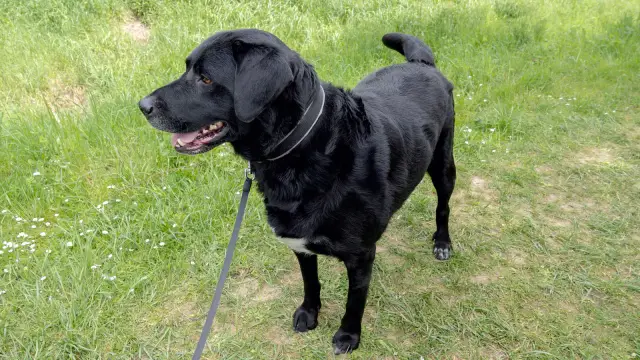 Related breedLabrador Retriever1800 to 1903 · United KingdomIndustrial Revolution
The full name has three parts that each say something. "Nova Scotia" is the Canadian province where the breed began. "Duck Tolling" describes the job. "Retriever" says what the dog does after the shot. The atlas data traces "tolling" to Middle English tollen, "to lure". In older Canadian use, to toll a duck meant to draw it in.
Early names were more local. Breeders in Yarmouth County called the dogs Little River Duck Dogs, after Little River Harbour, and they were also called Yarmouth Tollers. The Canadian Kennel Club gave the breed its present name when it recognised it in 1945.
How tolling works
A Toller works from a hide or the shore, in plain sight of the ducks. The hunter throws a stick or ball again and again, and the dog bounds along the water's edge, splashing, barking in short bursts and waving its white-tipped tail. Ducks seem to treat the sight as a curiosity, and move closer to look. Some accounts compare this to the way a fox draws birds, and breed writers often repeat the idea that early settlers had seen foxes doing it. This explanation for how the practice began is a tradition, not a documented fact. When the ducks are close enough, the hunter stands and shoots, and the Toller swims out to retrieve.
Where did the dogs come from?
The breed's own origin story is not documented. Several points are usually given.
- The Acadian story. The standard account places the first tolling dogs with Acadian and local families at Little River Harbour in the early 1800s, with the breed taking its present look in the 19th century.
- Mixed ancestors. Breed accounts say the breed was built from local farm dogs, perhaps collie types, together with retrievers, spaniels and setters. Which breeds went in varies from source to source, and no breeding records survive, so treat any list as a claim.
- A European link. One breed guide suggests that European ship dogs may have mixed with local dogs. That too is unproven.
The atlas data places the breed's period of development at about 1860 to 1945.

History
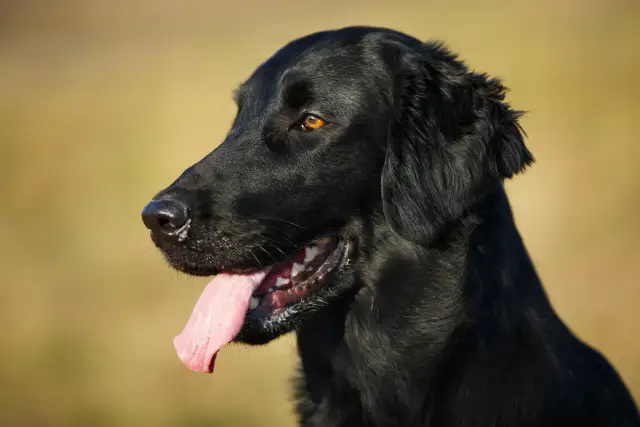 Same eraFlat-coated Retriever1860 to 1880 · United KingdomVictorian Breed Boom
Little River
Duck tolling was already a local skill before the breed had a name. Breeders at Little River Harbour selected dogs that were red, quick, keen to retrieve and happy to play on cue. The red-gold coat became the standard look.
Near disappearance and recognition
By the early 20th century the Toller was almost unknown outside Nova Scotia. The Canadian Kennel Club recognised it in 1945. Some sources date strong show-ring interest and national recognition to about 1980, while several breed histories give 1945 for the Canadian Kennel Club. It was named the official dog of Nova Scotia in 1995.
International spread
The Toller is now recognised by the FCI (standard no. 312, Canada as country of origin), the American Kennel Club in the Sporting Group and the UK Kennel Club in the Gundog Group. It remains an uncommon breed compared with the Labrador Retriever and Golden Retriever, and most Tollers live in North America, Scandinavia and Britain.
Relatives and DNA
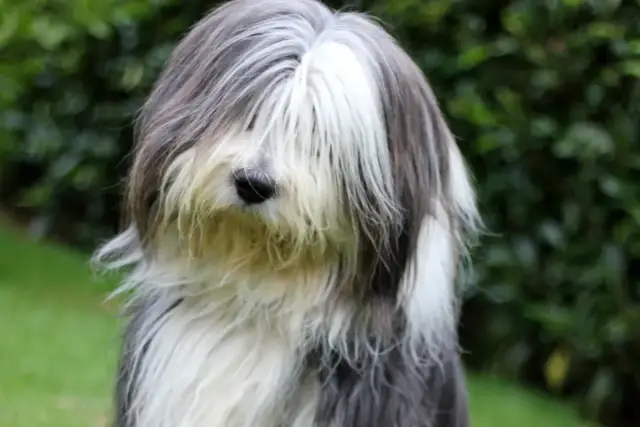 Same familyBearded Collie1500 to 1944 · United KingdomAge of Exploration
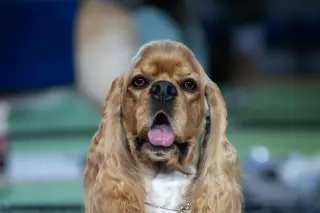
The Toller belongs to the Retriever family in the Parker 2017 DNA study, though the support for that placement is weak. The atlas data records no fixed parent breeds but links the Toller to two herding breeds through .
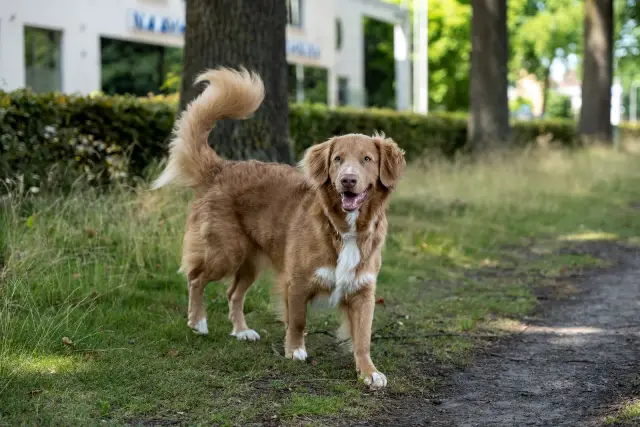
Parent lines (atlas data, medium confidence)
- Rough Collie. Shared show Collie contributed to the Toller (Parker et al. 2017). It fits accounts of farm collies in early Nova Scotia.
- Shetland Sheepdog. A second herding breed with shared DNA, also recorded with medium confidence.
What does DNA say?
Parker and colleagues (Cell Reports, 2017) studied 1,346 dogs from 161 breeds. Shared haplotypes are long stretches of identical DNA that breeds inherit from common ancestors or from crossing. More shared () means a likelier link. The study cannot say which breed gave genes to which.
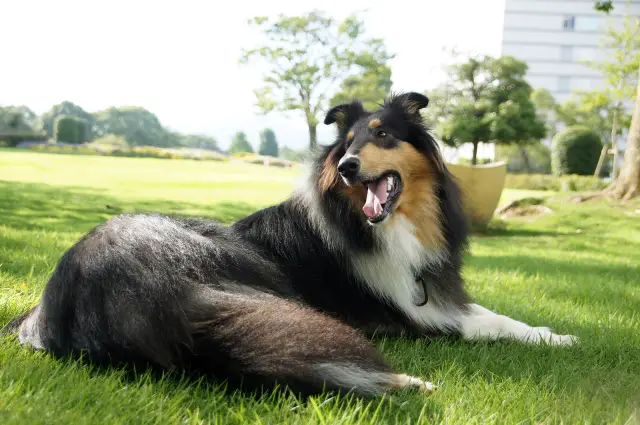
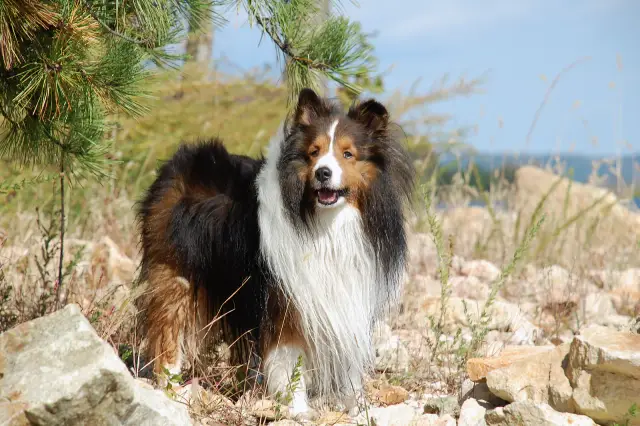
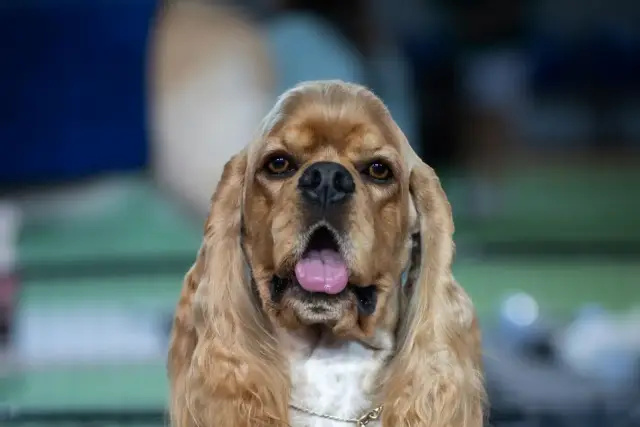
- TToller and Rough Collie
- TToller and Shetland Sheepdog
- TToller and American Cocker Spaniel
- TToller and Labrador Retriever
- TToller and Flat-Coated Retriever
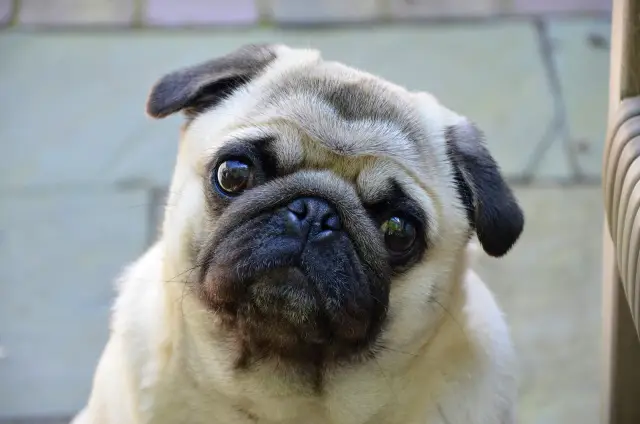
Other breeds on the list include the Pug (14.6 Mb), the Airedale Terrier (13.2 Mb) and the Bearded Collie (10.5 Mb). The pattern is mixed. Collies and spaniels sit at the top, and the other retrievers lower down. This is why the placement in the Retriever family is described as weak: the Toller's DNA does not sit cleanly among the retrievers. It fits a breed built from several kinds of working dog, not a Labrador or Golden relative. Compare the Golden Retriever and Labrador Retriever, which are far larger and grew from a different line.
- Rough Collie28.7 Mb 1.2%
- Shetland Sheepdog20.9 Mb 0.9%
- American Cocker Spaniel19.9 Mb 0.8%
- Pug14.6 Mb 0.6%
- Airedale Terrier13.2 Mb 0.5%
- Labrador Retriever13.1 Mb 0.5%
- Flat-coated Retriever11.2 Mb 0.5%
- Bearded Collie10.5 Mb 0.4%
Source: Parker et al. 2017. Percent of the whole genome.
The breed standard
 Looks relatedChesapeake Bay Retriever1807 to 1918 · United StatesIndustrial Revolution
A is the written ideal for a breed that kennel clubs judge dogs against. The Toller standards of the FCI (no. 312), the Canadian Kennel Club, the AKC and the UK Kennel Club are close to each other. The FCI text is based on the Canadian one.
| Trait | What the standards say |
|---|---|
| Height | FCI: males over 18 months 48 to 51 cm, females 45 to 48 cm; 2.5 cm either way is tolerated |
| Weight | FCI: in proportion to height and bone. Canadian Kennel Club: about 20 to 23 kg males, 17 to 20 kg females |
| Head | FCI: clean-cut, slightly wedge-shaped, with a broad skull and a moderately defined stop |
| Ears | FCI: triangular, set high and well back, medium in size, folded over and carried close to the head |
| Eyes | FCI: almond-shaped, set well apart, amber to brown, with an alert and friendly expression |
| Body | FCI: medium-sized, powerful, compact and balanced, with a deep chest and strong hindquarters |
| Tail | FCI: well feathered, carried in line with the back when alert, with the tip reaching the hock |
| Coat | FCI: water-repellent double coat; the top coat medium length, soft and straight or slightly wavy, with a dense undercoat |
| Colour | FCI: any shade of red or orange, with buff or lighter feathering; white markings are permitted on the tip of the tail, feet, chest and blaze |
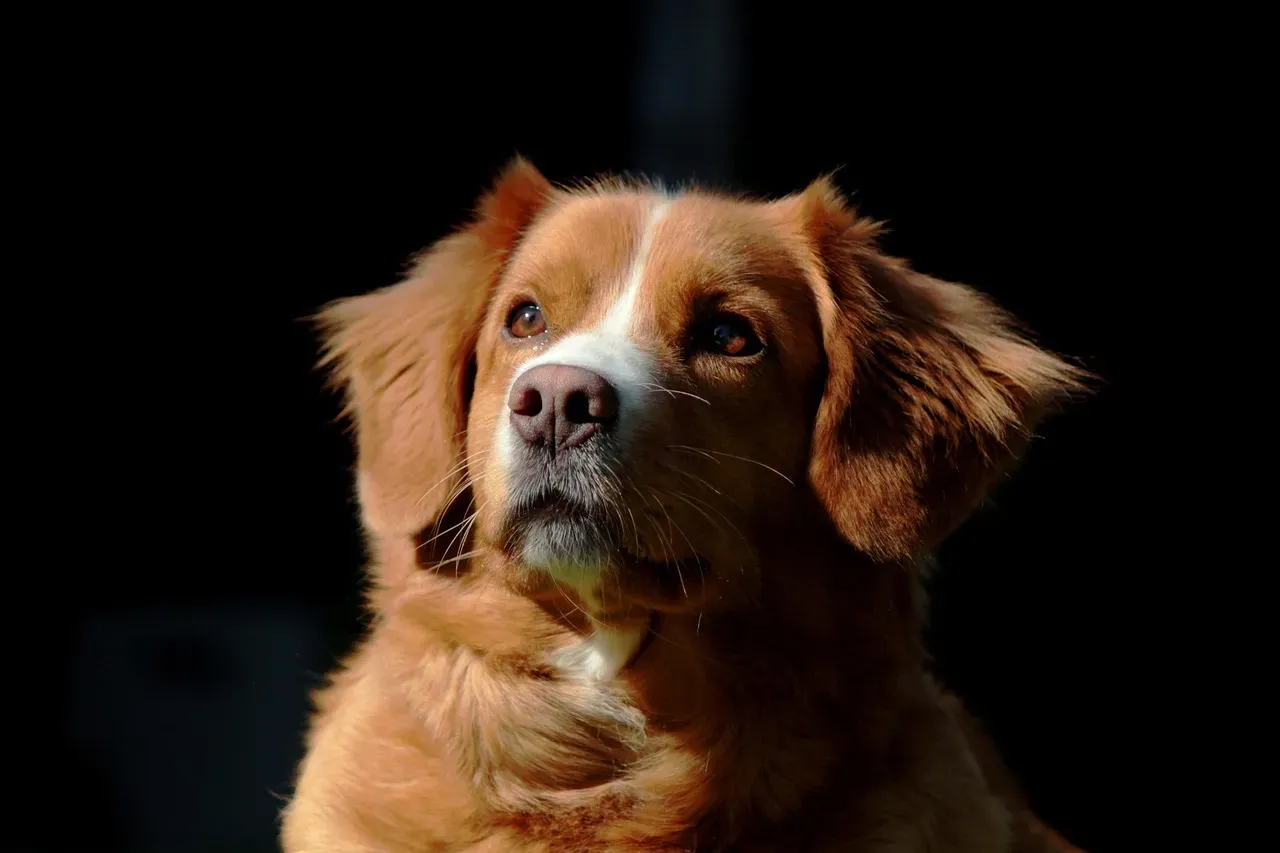
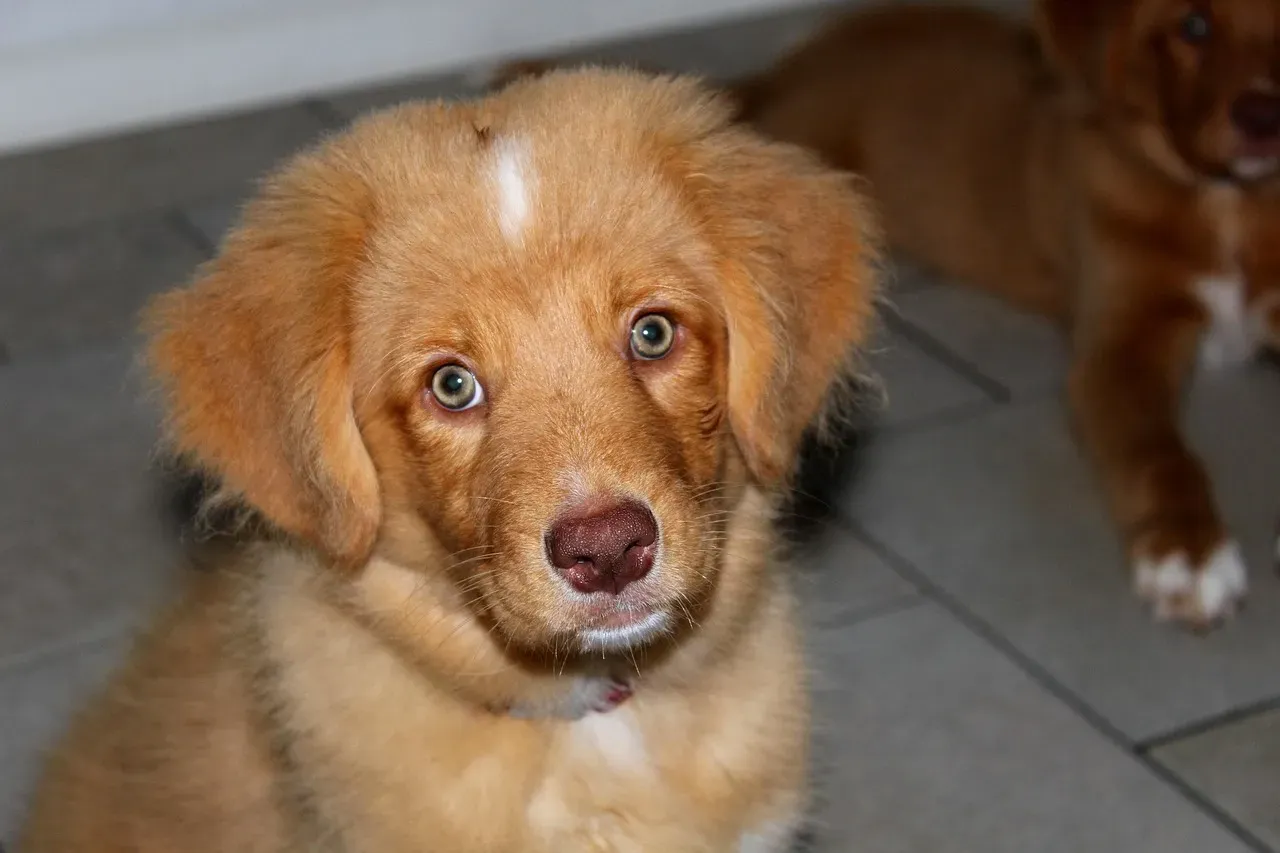
The standards describe a medium-sized, athletic, balanced dog that looks something like a small Golden Retriever with a foxy head. The expression is alert and ready.
White markings. A white tail tip, white socks, a chest patch and a blaze are allowed. These marks help the dog to show up, and they are part of the tolling picture: a waving, white-tipped tail draws attention.
Size in practice. Tollers are small for a retriever. A 20 kg adult is near the top of the range.
 Save
Temperament
 Related breedGolden Retriever1868 to 1911 · United KingdomVictorian Breed Boom
The FCI standard describes a dog that is highly intelligent, alert, outgoing and playful, with a strong retrieving drive. It adds that the Toller is affectionate and loyal, and that some dogs are reserved with strangers. Owners tend to agree.
- Driven. A Toller wants a job. Fetch is its favourite game, and it will retrieve a ball until you stop.
- Sensitive. It responds to a soft voice and reward-based training, and sulks or shuts down with harsh handling.
- Vocal. Tollers often give a distinctive scream or high bark when excited, a trait connected to tolling. Many neighbours notice.
- Reserved with strangers. The standard allows reserve toward strangers. Early socialisation keeps it from turning into shyness.
- Close to the family. Tollers bond hard. They often follow one person from room to room and do not like long hours alone.
- Children. Most are good with children they know. A Toller's excitable, mouthy retrieving can be too much for toddlers, so supervise.
- Other animals. Many get on well with other dogs. The prey drive varies; a Toller bred to chase and retrieve may chase small animals.
Training and exercise
Tollers are quick learners and enjoy obedience, agility, dock diving, scent work and retrieving trials. Breed clubs advise a lot of exercise, typically an hour or more a day, and a job, not only a walk. Without it a Toller can become noisy, restless or destructive. They also love water, and most are strong, willing swimmers.
 Save

Health
 Related breedNewfoundland1600 to 1886 · CanadaEarly Modern Era
Most Tollers live long, healthy lives. This section lists what breeders screen for and what owners can watch for, with figures where a named source gives one. Information here is general. Talk to a vet about your own dog.
Life span. The atlas data gives 12 to 14 years. No UK primary-care study gives a median life span for the breed that we can cite here.
The Toller is a small gene pool, and its health pattern has two main themes: immune-mediated disease and inherited eye disease.
| Condition | What it is | How common | What helps |
|---|---|---|---|
| Addison's disease (hypoadrenocorticism) | The adrenal glands stop making enough hormones, so the body cannot handle stress or balance salts | About 1.4 percent of Tollers, about 1 in 70, roughly 14 times the rate in other breeds (UC Davis Veterinary Genetics Laboratory). Tollers are diagnosed younger, at an average of 2.6 years against 5.5 in other breeds | Ask the breeder about family history; vets can test blood and treat with lifelong hormone replacement |
| Juvenile Addison's disease (JADD) | An inherited juvenile-onset form linked to the RESF1 gene, autosomal | No published study gives a figure for this | DNA test of breeding dogs (UC Davis offers one); can be mated to clear dogs |
| Steroid-responsive meningitis-arteritis (SRMA) | Inflammation of membranes around the brain and spine, causing fever and neck pain, usually in young dogs | About 8 percent of respondents in the Toller Club of UK 2014 health survey, about 1 in 12; this is a club questionnaire, not a controlled study | Early vet care; it responds to steroid treatment |
| Immune-mediated polyarthritis and related conditions | The immune system attacks the joints and other tissues | Reported in the breed by veterinary immunology sources; no published figure | Vet diagnosis and treatment; ask breeders about immune disease in the family |
| Progressive retinal atrophy (PRA-prcd) | Inherited loss of the light-sensitive cells in the eye, leading to sight loss | Autosomal recessive; no published breed figure | DNA test; the Kennel Club recommends testing |
| Collie eye anomaly (CEA) | Inherited eye development problem, from mild to severe | Present in the breed; no published breed figure | DNA test; the Kennel Club recommends testing |
| (DM) | Slow loss of nerve function in the spinal cord of older dogs | No published breed figure | DNA test; the Kennel Club recommends testing |
| The hip joint forms loosely and wears early | No published breed figure | Hip scoring of breeding dogs; keep puppies lean |
The UK club's 2014 survey notes five areas of DNA testing: PRA, CEA, DM, the buff coat gene and JADD. The Kennel Club and the UK club recommend PRA, CEA and DM.
A note on immune disease. Tollers carry more than their share of immune-mediated conditions. Research summarised by veterinary immunologists suggests several of them may be linked to the same gene. For a buyer, the practical advice is to ask the breeder openly about autoimmune disease in the family and to pick breeders who track it. A Toller with any early signs, such as vomiting, weakness, fever or stiffness, should see a vet promptly.

Living with a Toller
 Related breedAmerican Eskimo Dog1900 to 1917 · United StatesVictorian Breed Boom
| Daily reality | Rating | Why |
|---|---|---|
| Exercise per day | High | An hour or more of running, swimming and fetch is the usual advice |
| Training needs | High | Quick and keen, sensitive to harsh handling; needs steady reward-based training |
| Grooming | Medium | Medium-length double coat with feathering; brush a few times a week |
| Shedding | Medium | Sheds, with heavier seasonal moults |
| Barking | Poor | Known for a high-pitched bark or scream when excited |
| Time alone | Poor | Closely bonded; dislikes long hours alone |
| Children | Fair | Often good with children it knows; boisterous with toddlers |
| Other dogs | Good | Usually sociable with good socialisation |
| Cats and small pets | Varies | Retrieving and chasing drive; depends on early exposure |
| Flat living | Poor | Needs a lot of exercise and may be noisy; a garden helps |
| Heat tolerance | Fair | Thick double coat; water access helps |
| Cold tolerance | Good | Water-repellent double coat made for cold water |
| First-time owner fit | Fair | Easy to train but needs a lot of activity; a good fit for active first-timers |
A great fit if
- You are active, with time for an hour or more of exercise and games each day.
- You enjoy training, retrieving, swimming or a dog sport.
- You want a medium-sized dog that bonds closely with the family.
- You are home for much of the day.
Think twice if
- You are away most of the day.
- You want a quiet dog or live close to sensitive neighbours.
- You want a laid-back dog that is relaxed with every stranger.
- You want a dog from a large, well-documented gene pool with few immune conditions.
Before you get one
- Health tests. Ask the breeder for DNA results for PRA-prcd, CEA, DM and JADD for both parents, hip scores and an eye test, and ask about any autoimmune disease in the family. Ask for original certificates.
- Puppy or adult rescue. Breed rescues exist and may have adults whose energy and temperament are known.
- First year. Plan for puppy classes, plenty of play and mental work, early socialisation to strangers and noises, and a lean body weight.
Similar breeds to consider
- Golden Retriever. Larger and calmer, with a bigger breeding pool and its own health needs.
- Labrador Retriever. A sturdier, more relaxed retriever with a huge working and family history.
- Chesapeake Bay Retriever. Another water retriever from North America, stronger-willed and more independent.
- Brittany. A medium-sized, orange and white gundog that shares the toller's energy and trainability.

Nova Scotia Duck Tolling Retriever fun facts
 Related breedAmerican Pit Bull Terrier1850 to 1898 · United StatesVictorian Breed Boom
- The Toller is the official dog of Nova Scotia, named in 1995.
- Its name comes from a Middle English word, tollen, meaning to lure.
- Its white-tipped tail, blaze and socks help it catch the eye of waterfowl.
- The Rough Collie shares 28.7 Mb of DNA with the Toller in the Parker 2017 study, the highest of any breed.
Frequently asked questions
What is a Toller?
The short name for the Nova Scotia Duck Tolling Retriever, a medium-sized red retriever from Canada.
What does tolling mean?
Luring ducks within range by playing at the water's edge so that the birds come to look.
Are Tollers good family dogs?
Often yes, in active homes that give them exercise, training and company. Supervise young children.
How big is a Toller?
Males stand 48 to 51 cm and females 45 to 48 cm (). Typical weights are about 17 to 23 kg.
How long do Tollers live?
The atlas data gives 12 to 14 years.
What health problems do Tollers get?
Immune-mediated conditions such as Addison's disease and SRMA, and inherited eye and nerve conditions such as PRA, CEA and DM. Breeders can test for some of them.
Do Tollers bark a lot?
They are known for a loud, high-pitched cry when excited. Training helps, but it is part of the breed.
Read next
Closest DNARough Collie28.7 Mb sharedFamilyRetrieverThe whole family Adopt a dogDog Shelters in EuropeFind dog shelters in Europe, learn how shelters differ from country to country and why adopting a dog is a good option.
Sources (12)
- American Kennel Club, Nova Scotia Duck Tolling Retriever breed history and breed standard pages.
- Canadian Kennel Club, Retriever (Nova Scotia Duck Tolling) breed standard.
- Fédération Cynologique Internationale, Nova Scotia Duck Tolling Retriever, standard no. 312.
- Fogle B., The Encyclopedia of the Dog, 2009.
- Nova Scotia Duck Tolling Retriever Club of the UK, health survey 2014.
- Nova Scotia Duck Tolling Retriever Club of the UK, origins and health testing pages.
- Parker H.G. et al., "Genomic analyses reveal the influence of geographic origin, migration, and hybridization on modern dog breed development", Cell Reports, 2017.
- The Kennel Club (UK), Retriever (Nova Scotia Duck Tolling) breed standard and breed information.
- University of California Davis Veterinary Genetics Laboratory, Juvenile Addison's disease (JADD) in Nova Scotia Duck Tolling Retrievers.
- Veterinary Information Network, "Addison's and inflammatory disease in the Nova Scotia Duck Tolling Retriever" (conference summary).
- Canadian Kennel Club and regional breed histories, recognition dates of 1945 and about 1980.
- Dogs Atlas breed records and Parker 2017 shared-haplotype table (this site).