Dogs guard doors, guide the dead, eat the sun, bring fire and, in a few tales, turn on their owners. This guide walks through the best known examples, region by region.
A word on method first. Everything below is myth, belief or literature, not history. When a story is much younger than the culture it claims to belong to, or when scholars disagree about what an image meant, the text says so. Where a point rests on a named museum or scholar, that source is named in plain text and listed at the end.
Egypt: Anubis, Wepwawet and the jackal question
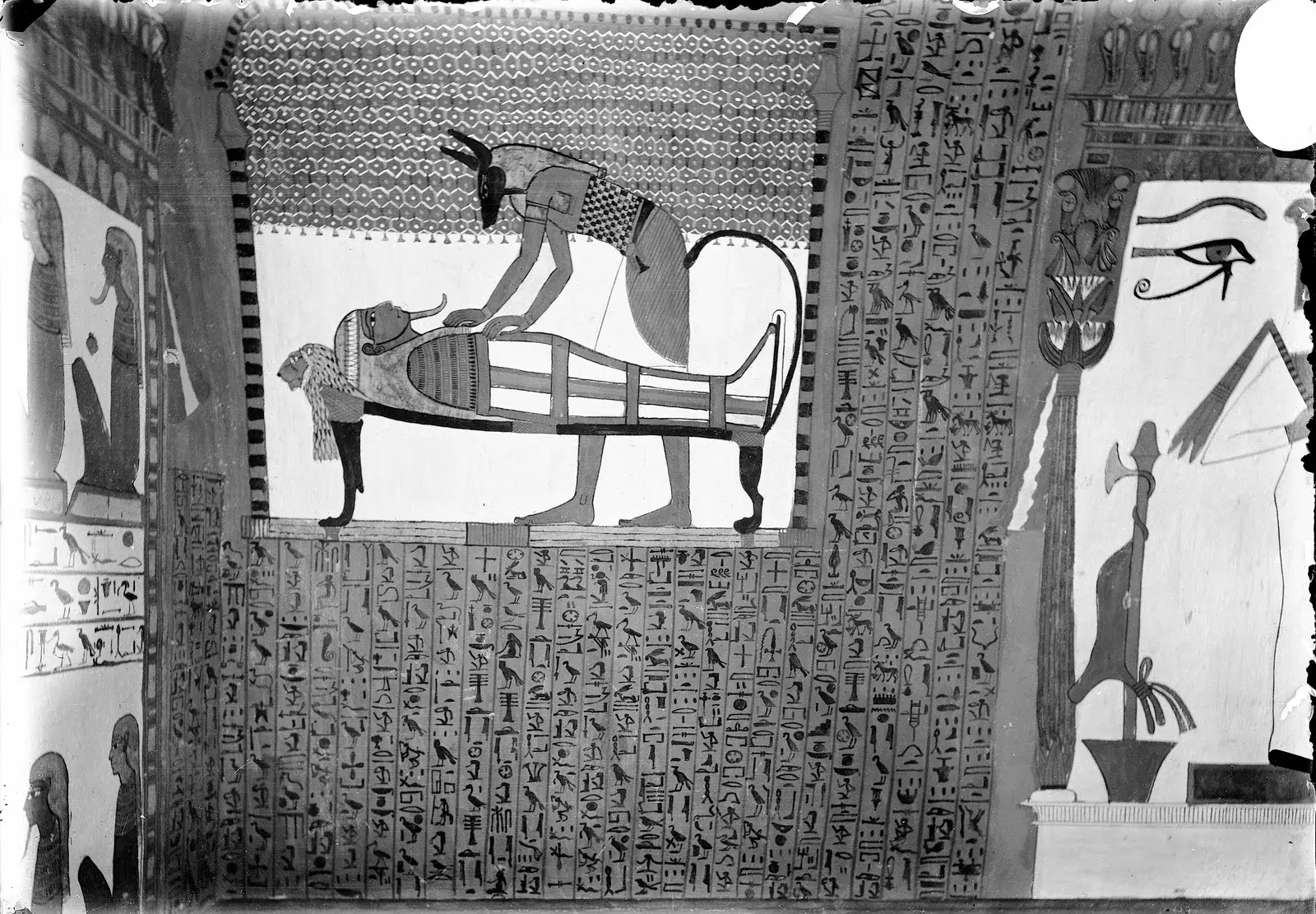
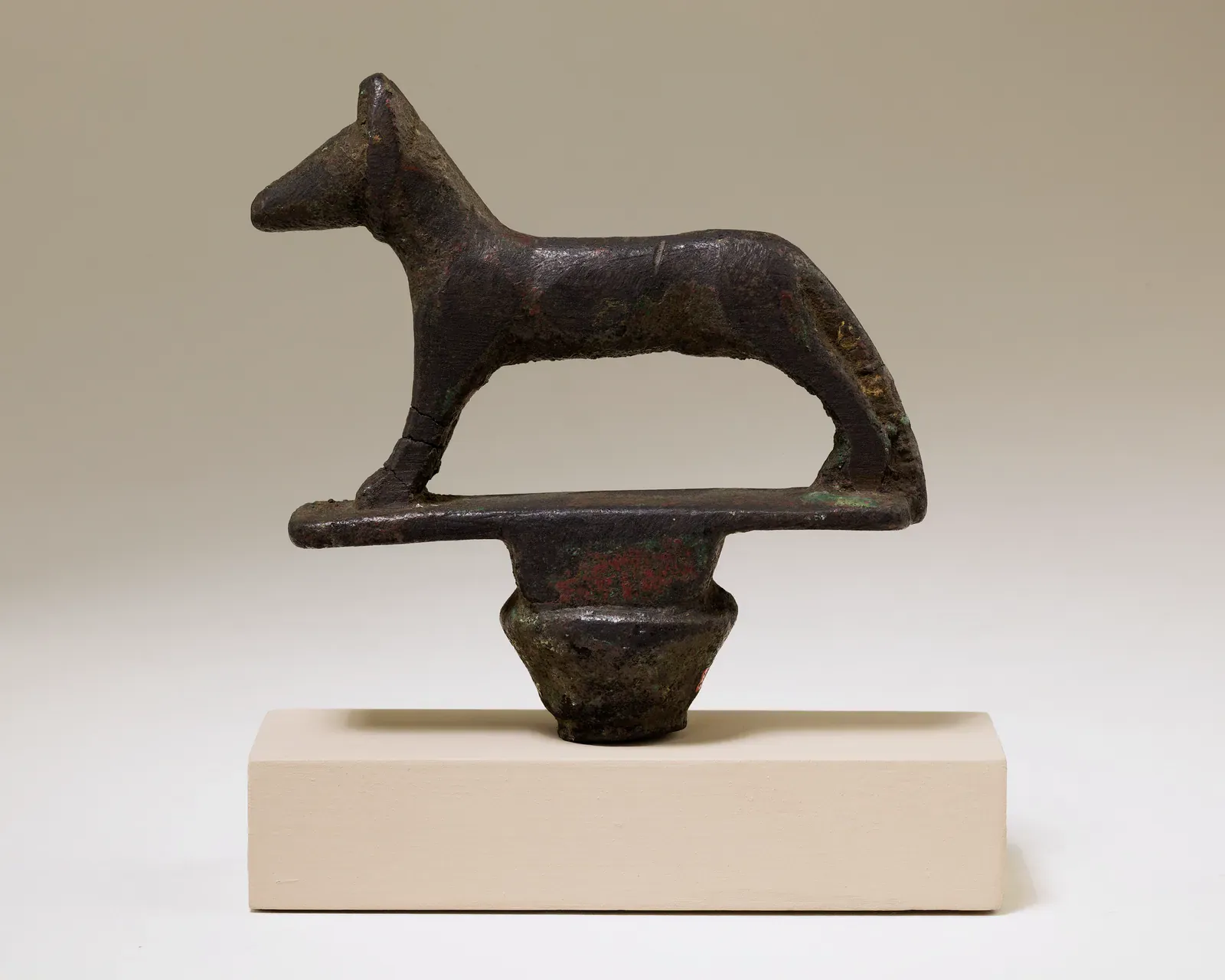
Anubis is the best known dog-like god in the world. He appears as a man with the head of a black canine, or as a crouching canine on a shrine. He presided over embalming and watched over cemeteries. In the Egyptian texts he weighs and escorts the dead. His image sat in the places where bodies were prepared and buried, so the link between a canine and death was visible to every mourner.
 GuideDog hybrids: what dogs can and cannot breed withCan dogs breed with wolves, coyotes, jackals or foxes? Wolfdogs, coydogs, the Sulimov dog and Dogxim explained, with chromosomes and DNA studies.
Wepwawet, "opener of the ways", is a second canine god. He is often shown in grey or white and was tied to war processions and to opening the road for the dead king. The Greeks later called his cult centre Lycopolis, "wolf city", which hints at how they read the animal.
Egyptian funerary texts keep the canine close to the moment of judgment. In the scene known from the Book of the Dead, the heart of the dead person is weighed against a feather, with Anubis tending the scales. A heart that is light passes on, and a heart that is heavy is eaten by a monster. The dog-like god is the helper in this scene, not the enemy: he is the one who knows the road and leads the dead along it. That role, escort rather than jailer, is the key to reading the Egyptian dog. Compare it with Cerberus, who is a jailer, and with Xolotl, who is an escort again.
Jackal or dog?
Popular books call Anubis the "jackal god", and Egyptologists generally do the same. The animal behind the image is debated. Egypt had domestic dogs from early times, and several desert canids lived nearby. In 2015 a genetic study led by Rueness and colleagues in PLOS ONE reported that the animal long called the golden jackal in Africa is a separate species, the African golden wolf. That finding made the old label "jackal" less certain for the animals Egyptians saw in the desert. It does not settle what an artist meant to show, because the divine form was stylised and does not copy a single species. The honest summary is that Anubis is a canine god, and which canine is open to argument.
The animals themselves were part of religion. Archaeologists have found mummified canines in large numbers at Egyptian sites, and the Egyptian dog-related sacred animal cults are covered in the museum literature on animal mummies. For the real dogs of Egypt, see the history of sighthounds and pariah types in Saluki and the continent-level picture in first dogs on every continent.
 Save
 GuideDogs in Legends and Fairy TalesDogs in folklore and fairy tales: Black Shuck, The Tinderbox, Saint Guinefort, Panhu, Greyfriars Bobby, Barry and Old Drum, with legend and history kept apart.GuideDog hybrids: what dogs can and cannot breed withCan dogs breed with wolves, coyotes, jackals or foxes? Wolfdogs, coydogs, the Sulimov dog and Dogxim explained, with chromosomes and DNA studies.
Mesopotamia: Gula and the clay guardian dogs
In Mesopotamia the dog belonged to the goddess Gula, patron of healing, also known under other names in different cities. Texts and temple finds link dogs with her cult, and dogs were treated as animals that could carry illness away or bring a cure. Scholars discuss how far that was symbolic and how far real dogs lived at her temples; the evidence is partial and the details vary by city and period.
 GuideDog Heat Cycle: Signs, Stages and How Long It LastsHow long dogs bleed in heat, when the first heat comes, the four cycle stages, signs, caring for her, and how males react.
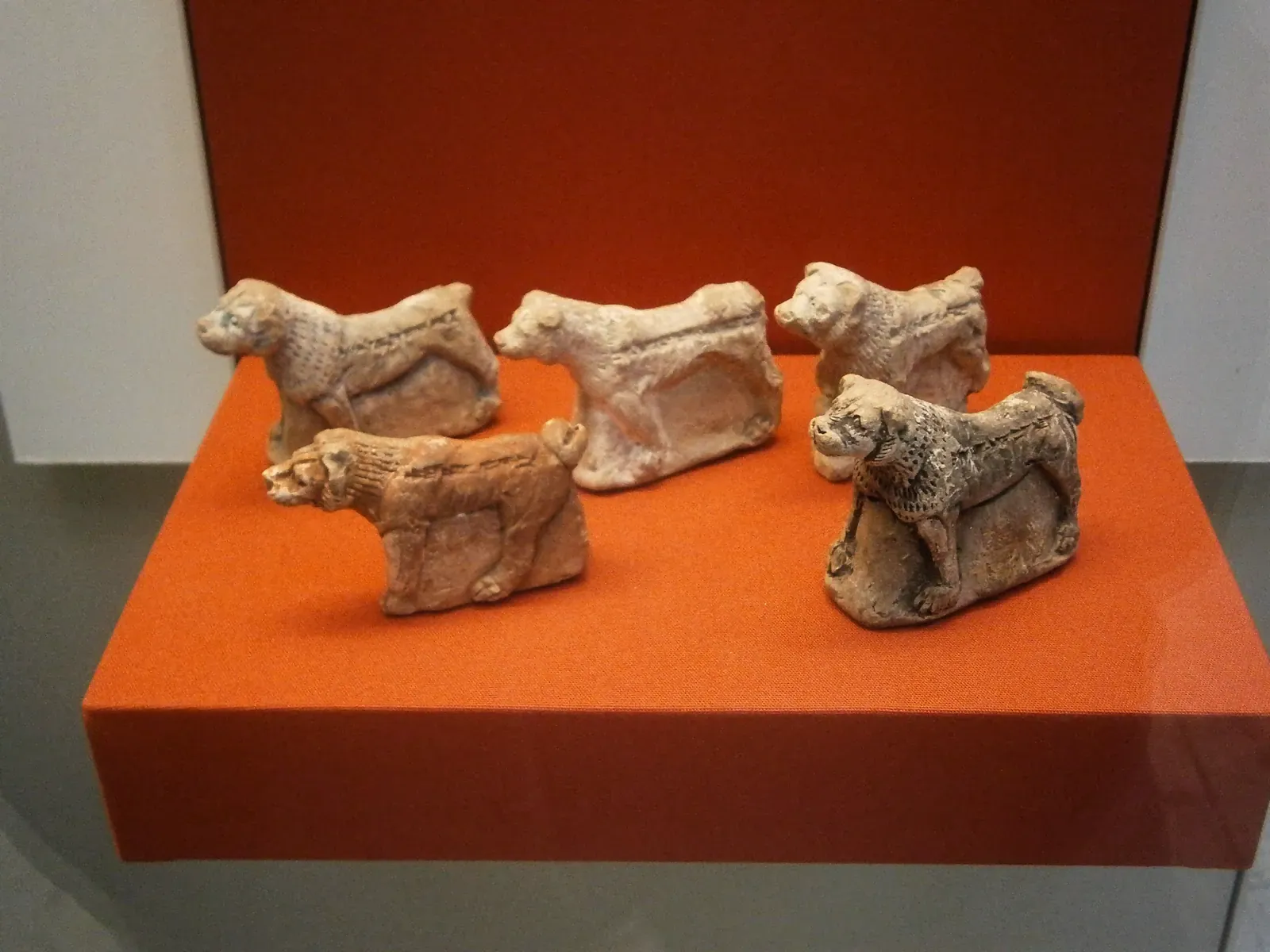
The most vivid objects are small. At Nineveh, in the North Palace attributed to the Assyrian kings, the 19th-century excavator William Kennett Loftus found a group of fired clay dogs set under a doorway. The British Museum holds five, dated to about 645 BC. Each is a dog standing alert, painted in a different colour, and each has cuneiform text on its left side. The texts are not pet names in the modern sense. They read as commands or epithets that describe what the dog is meant to do. The British Museum and Metropolitan Museum entries quote examples such as "Expeller of evil", "Catcher of the enemy" and "Don't think, bite!". Museum colour descriptions of individual figures differ between catalogues, so check the museum record for any particular dog.
The practice behind them is well documented. Late second and early first millennium BC builders buried clay or bronze dog figures under floors and thresholds to guard a building against evil, and ritual instructions for making and inscribing such figures survive on clay tablets. The dog, in this belief, was a watchman that never sleeps.
 Save
 ArticleThe first known dog on every continentEarliest accepted dog on each continent, from Bonn-Oberkassel to the dingo: dates, sites, how dogs arrived and which breeds carry those first dogs.GuideDog Heat Cycle: Signs, Stages and How Long It LastsHow long dogs bleed in heat, when the first heat comes, the four cycle stages, signs, caring for her, and how males react.
Greece and Rome: Cerberus, Argos and the dog-headed men
 GuideMy Dog Injured His Paw: First Aid and When to See a VetDog paw injury: cut pads, torn nails, grass seeds, hot pavement burns and limping.
Cerberus
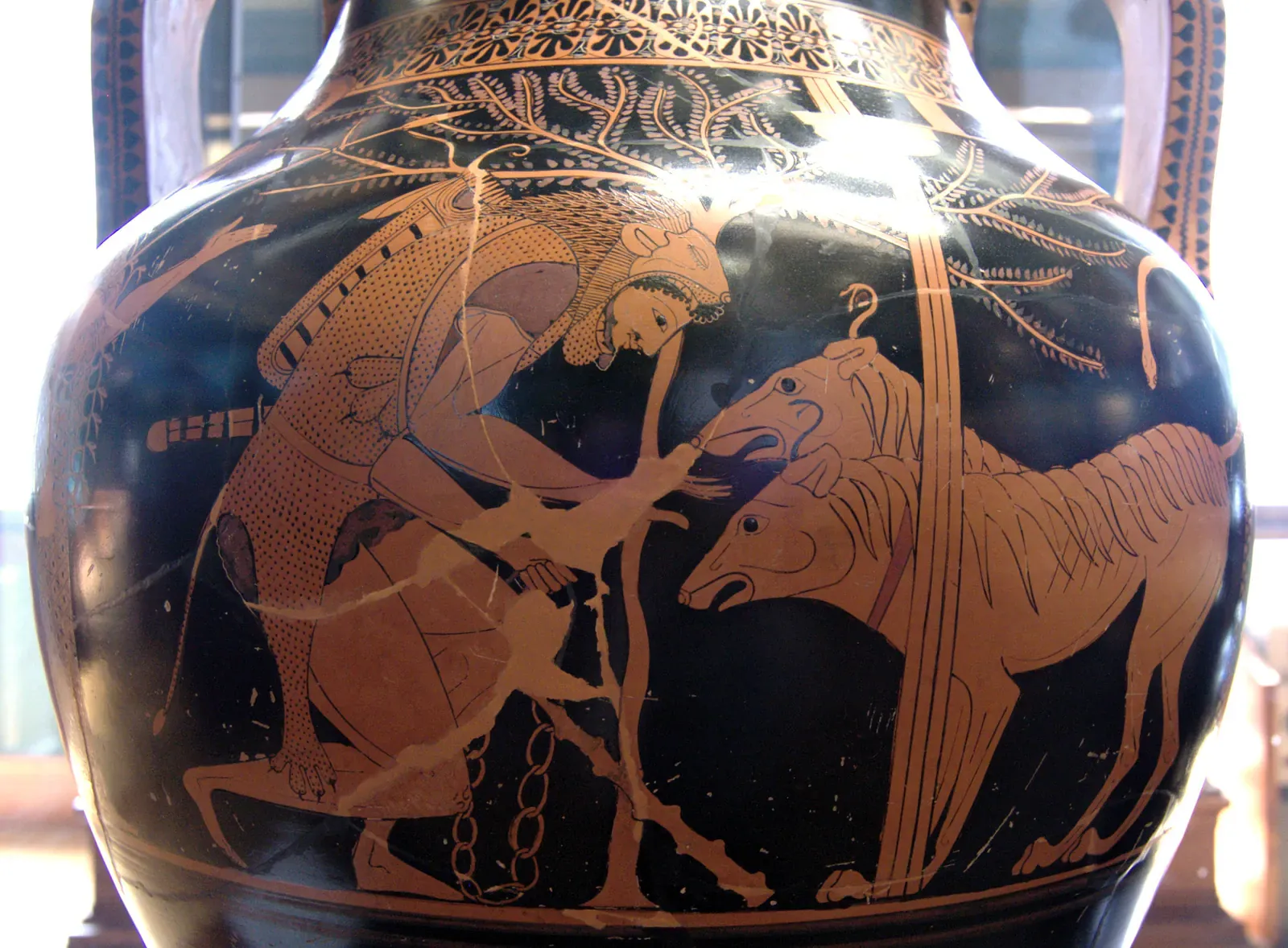
Cerberus is the hound at the gate of Hades. Hesiod's Theogony, an early Greek poem, names him as the offspring of Typhon and Echidna and gives him many heads in the oldest tellings. Later artists and writers settled on three. He fawns on those entering and prevents those inside from leaving. The twelfth labour of Heracles was to bring him up to the daylight, and vase painters loved the scene.
Argos in the Odyssey
Not every Greek dog is a monster. In Book 17 of the Odyssey, the old hound Argos lies on a dung heap, neglected. He is the only one to recognise Odysseus, disguised as a beggar, after twenty years. He wags his tail, can no longer rise, and dies. It is literature, not belief, but it shows the other side of the ancient dog: loyalty remembered across a whole life.
Cynocephali, the dog-headed men
The Greek physician Ctesias, writing at the Persian court around 400 BC, described a people of India with dog heads who wore animal skins and barked to speak. His work survives mostly through a later summary by the Byzantine scholar Photius, and Pliny the Elder repeated and extended the tradition in his Natural History in the first century AD. These Cynocephali, "dog-heads", became one of the standard "monstrous races" in medieval bestiaries and maps. Scholars treat them as a literary and geographic myth, a way to place the edge of the known world, not as a report of a real people.
St Christopher with a dog's head
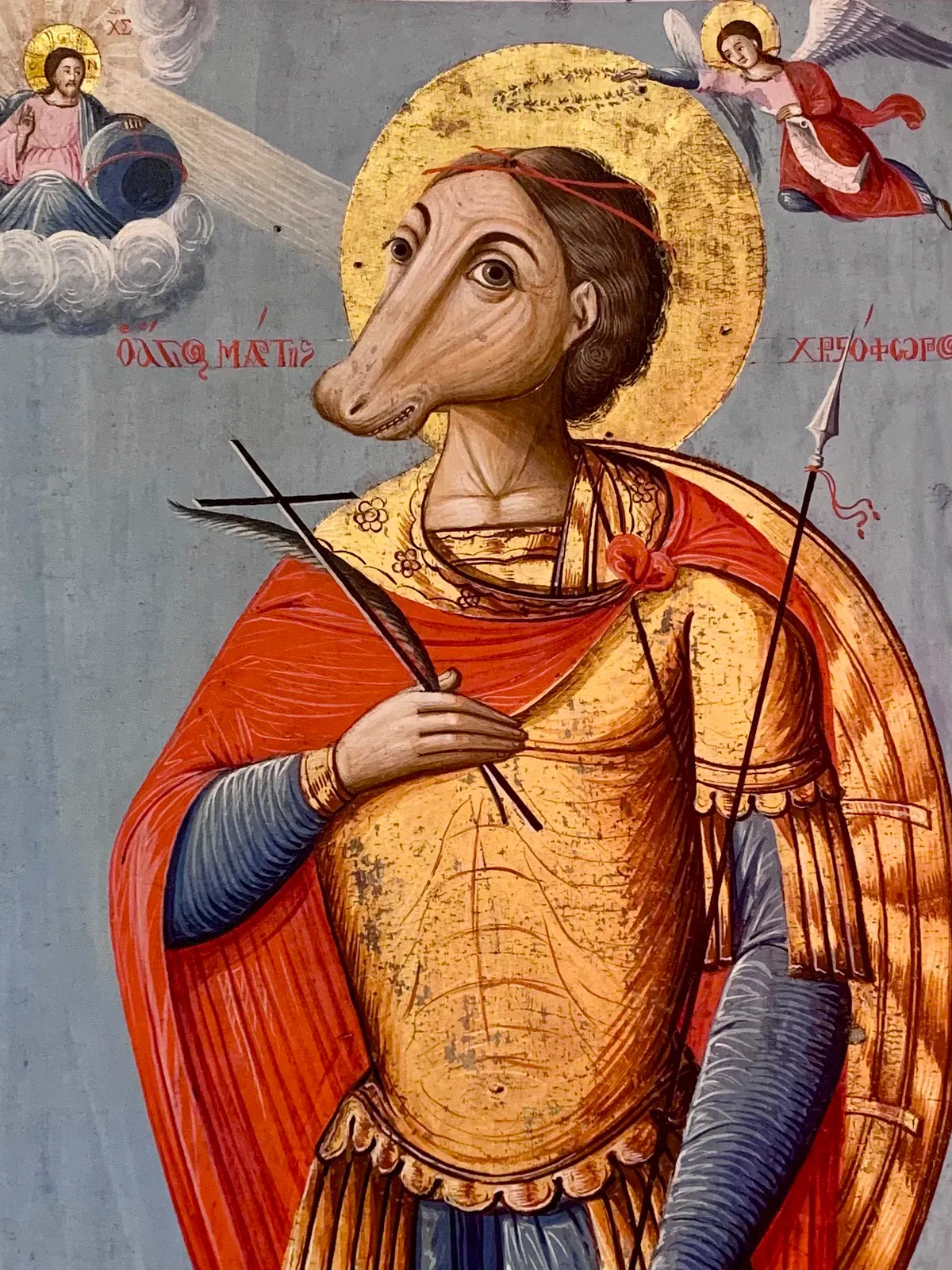
The same word reappears in Christian art. A saint called Christopher is remembered in the East with the title Cynocephalus, and a small number of Byzantine and later icons show him with a dog's head. Why is disputed. The Irish scholar David Woods has argued that the Greek tradition came to read the Greek word for "dog-headed" literally, where the Latin tradition often rendered it as "dog-like". Other writers suggest older Egyptian influence, pointing at Anubis. The dating of the first images is also debated, with some sources placing the earliest written evidence in the fifth century. The Russian Orthodox Holy Synod is reported to have forbidden the dog-headed image in 1722, and the figure remains a rare tradition, not church doctrine.
 Save
Dogs also sit at crossroads and in the night sky. The Greek goddess Hecate, linked with thresholds, crossroads and the dead, is shown in ancient texts and images with dogs, and dogs were among the animals offered to her at crossroads. The brightest star in the sky, Sirius, is called the Dog Star because it belongs to the constellation Canis Major, the Greater Dog, which the Greeks imagined as a hound at the heel of the hunter Orion. The hottest weeks of summer, when Sirius rises with the sun in the Mediterranean, became the "dog days", a phrase that survives in English. The sky dog and the underworld dog share one idea: a watcher that stands where one world meets another.
 Save
 GuideDogs of Japan: the native breeds and their storiesJapanese dog breeds explained: the six Nihon Ken, the Chin, Tosa, Japanese Spitz and Terrier, Hachiko, wartime near-extinction, DNA and who they suit.GuideMy Dog Injured His Paw: First Aid and When to See a VetDog paw injury: cut pads, torn nails, grass seeds, hot pavement burns and limping.
Norse lands: Garmr and Fenrir
Norse myth, known mainly through the Poetic Edda and Snorri Sturluson's Prose Edda (13th century), has two canine terrors.
 GuideDog Grooming Competitions and Show Standards ExplainedHow breed standards shape dog grooming, from hand-stripped terriers to Poodle show clips, and how grooming competitions and creative grooming work.
Garmr is a hound bound in a cave called Gnipahellir, and his howling is a sign that the end of the world is close. He is a guard in the way Cerberus is a guard, tied to a boundary of the dead.
Fenrir is the great wolf, not a dog, and it matters to say so. He is the son of Loki, grows too strong for the gods to keep, and is bound with the magical ribbon Gleipnir. In the telling, the god Tyr loses his hand as the price of the trick. Fenrir is destined to break free at Ragnarok and kill Odin. The Norse sources call him a wolf throughout, and this guide includes him because modern readers often file him next to dogs. He shows how close the two animals sit in human imagination, wild kin of a creature that sleeps by the fire.
 GuideSmartest dog breeds: what the rankings measure and what they missCoren's smartest dog breeds list, what it measured, what newer dog cognition research says, three kinds of dog intelligence and why smart dogs need work.GuideDog Grooming Competitions and Show Standards ExplainedHow breed standards shape dog grooming, from hand-stripped terriers to Poodle show clips, and how grooming competitions and creative grooming work.
Celtic lands: Cú Chulainn and Gelert
 GuideBanned and restricted dog breeds by countryWhich dog breeds are banned or restricted, country by country: UK, Ireland, France, Germany, Denmark, Norway, Spain, Australia and more.
The Hound of Culann
The Irish hero Cú Chulainn begins life as Sétanta. In the Ulster Cycle, a smith named Culann owns a ferocious guard dog. Sétanta kills it in self-defence, then offers to take the dog's place until a replacement is trained. From then on he is "Cú Chulainn", the "hound of Culann". The story turns a dog into a hero's name and makes guarding the core of a warrior's duty.
Gelert, a later legend
The Welsh tale of Gelert is much younger and should be labelled so. In the story, Prince Llywelyn returns from hunting, finds his baby's cradle overturned and his hound Gelert covered in blood, and kills the dog. He then finds the child alive and a dead wolf beside it, killed by Gelert. The village of Beddgelert in Gwynedd is said to be named for the dog's grave. Folklorists have long noted that this story has relatives across Europe and Asia, and the version tied to Beddgelert is generally described as a later legend that grew popular in the 18th and 19th centuries, with the "grave" marked in modern times. The name of the village may well have a different origin. Treat Gelert as a story about misplaced anger, not as a local chronicle.
 GuideBest dog breeds for familiesBest dog breeds for families, small homes, allergies, first-time owners and seniors, ranked from our breed ratings, with honest limits and a table.GuideBanned and restricted dog breeds by countryWhich dog breeds are banned or restricted, country by country: UK, Ireland, France, Germany, Denmark, Norway, Spain, Australia and more.
Asia: Tiangou, Inugami and the guardian lions
 GuideWinter Care for Dogs: Cold, Paws, Antifreeze and IceWinter care for dogs: how cold is too cold, coats, salt and antifreeze, hypothermia, frostbite, frozen ponds, dark walks and holiday hazards.
Tiangou, the heavenly dog
In Chinese tradition the Tiangou, "heavenly dog", is a dark animal that eats the sun or moon in an eclipse. The Chinese words for the events preserve the idea: the term for a solar eclipse translates as "sun eat" and for a lunar eclipse "moon eat". People made noise to scare the creature off. The shape of the Tiangou varies between sources, sometimes a dog and sometimes a meteor-like streak, and one tale makes it the dog of the archer Houyi that swallowed the moon after his wife Chang'e took the elixir. Details differ between sources, and some retellings are modern. The Tiangou is not always evil: a related figure, Xiaotian Quan, serves the deity Erlang Shen.
Inugami in Japan
Inugami, "dog spirit", is a Japanese belief in possession by a dog spirit, best documented in western Japan and Shikoku. The folklore says it can act for or against its owner's enemies. Accounts of its making are grim, and the belief had ugly social effects: families said to keep an Inugami were stigmatised in marriage and daily life. It is a story about fear of neighbours more than about dogs.
Komainu, shisa and Fu dogs
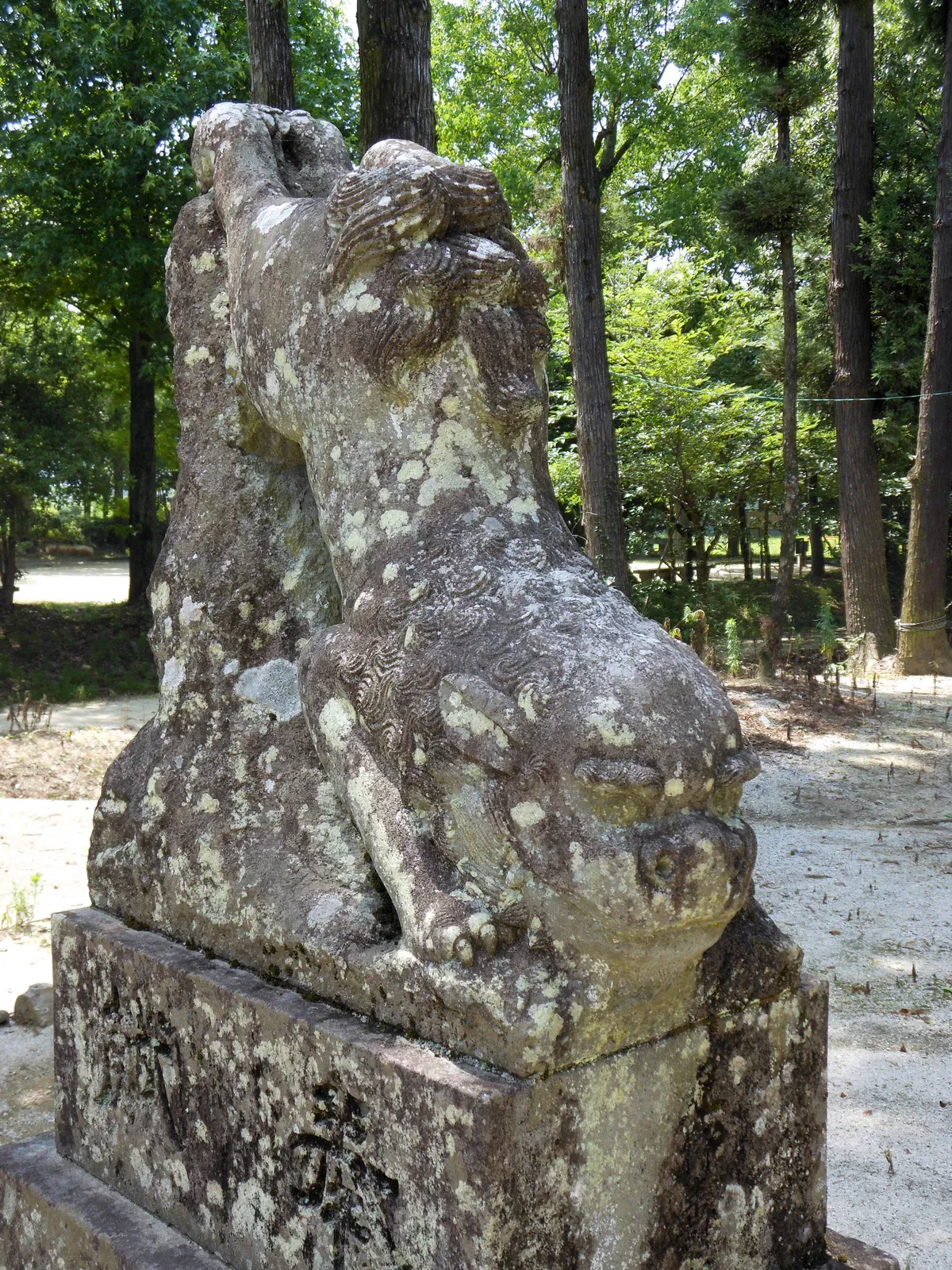
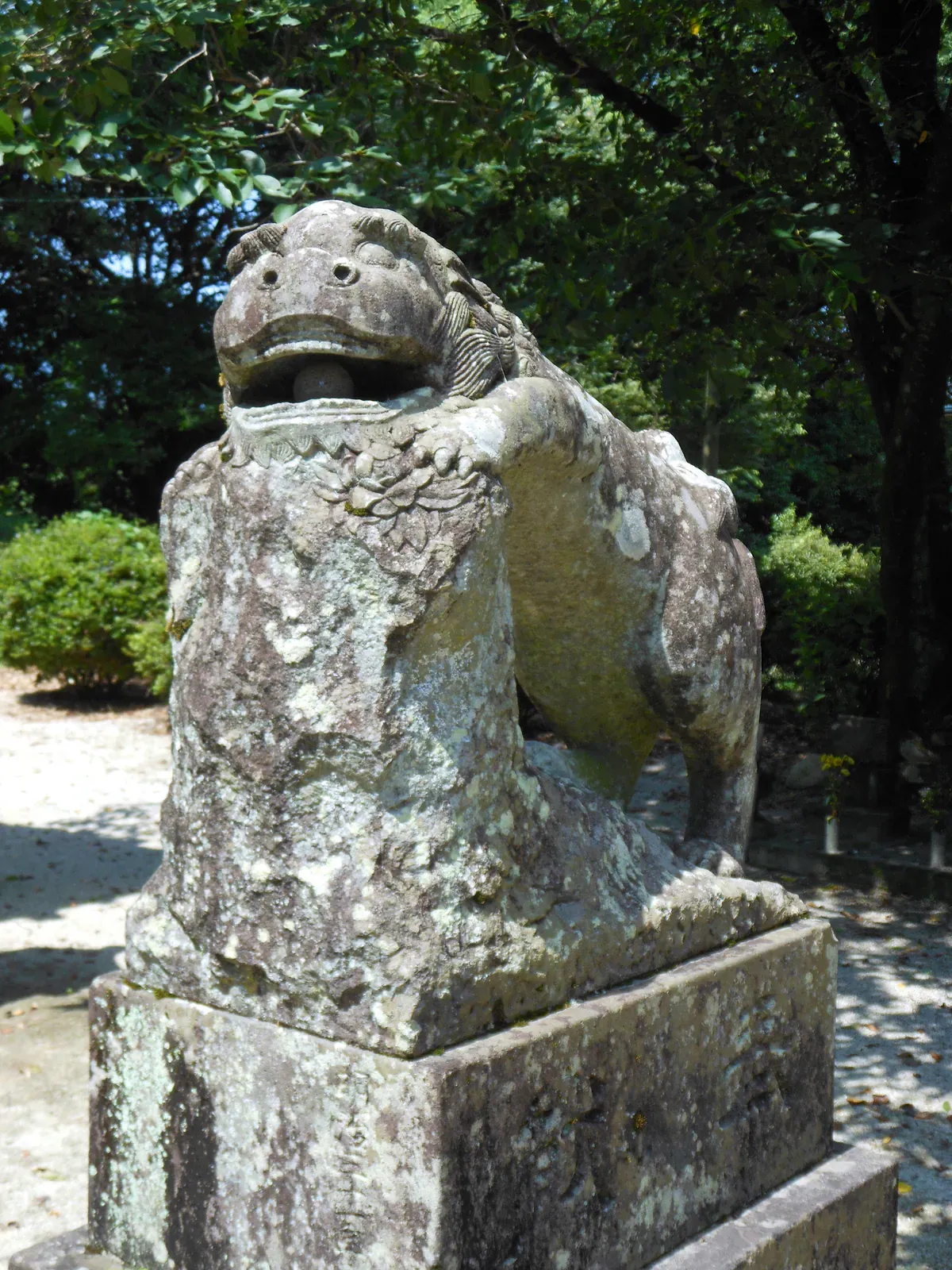
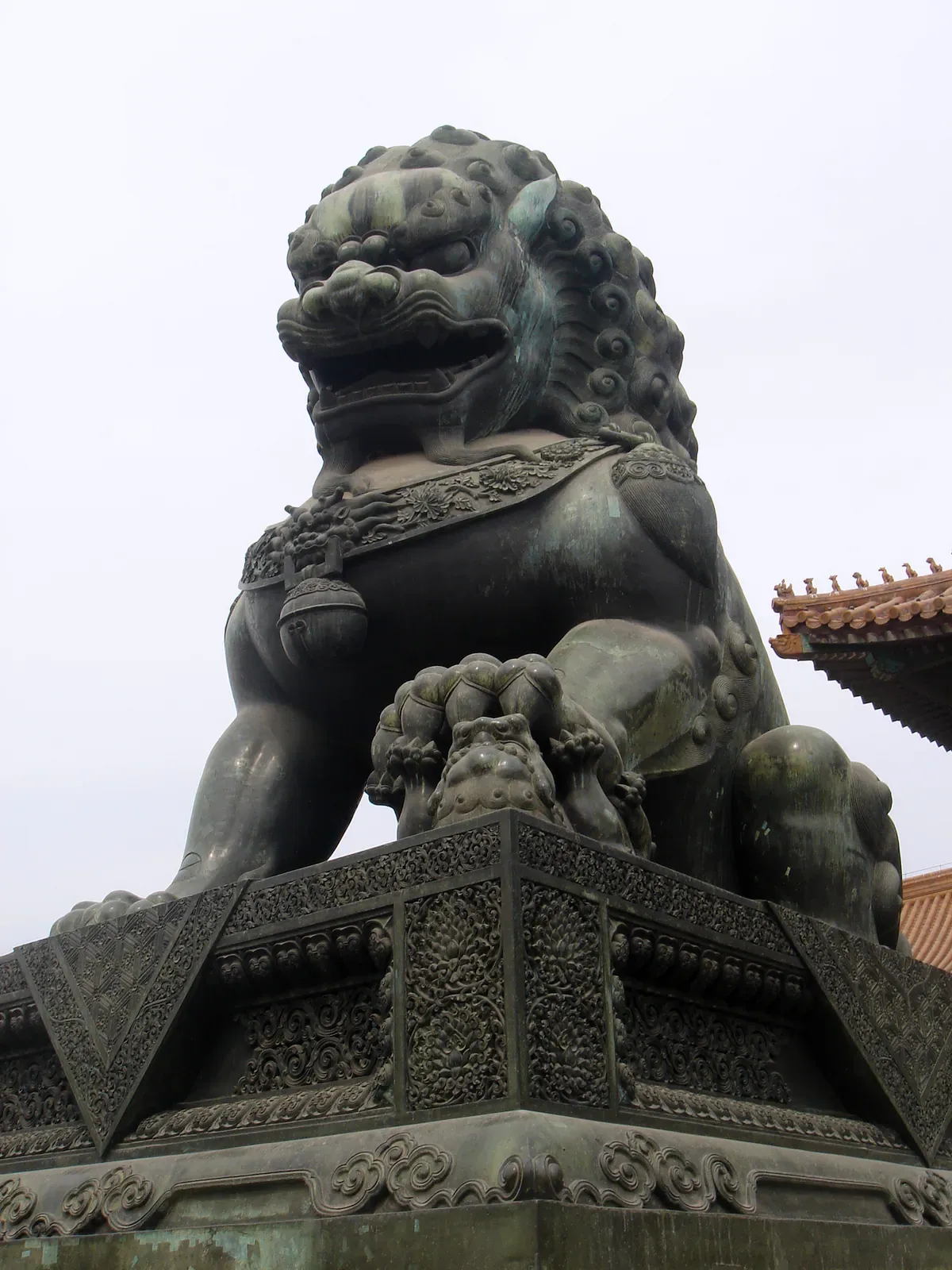
Guardian figures in pairs sit in front of shrines, palaces and temples across East Asia. Japan has komainu, "Korean dogs", usually a pair, one with open mouth and one closed. Okinawa has the shisa, a lion-dog set on roofs and gates. In the West the Chinese pair is called Fu dogs or Foo dogs, although the animal is a lion in Chinese sources. The name came from Western collectors. The mix of "lion" and "dog" in the names is a good reminder that the same guardian idea travelled across languages and animals. For the living breeds of this region see Shiba Inu and Chow Chow, neither of which is a mythical animal.
 Save
 Save
 Save
 GuideDog Clothes: When Dogs Need Coats, and a Short History of Dog FashionDo dogs need coats in winter? When clothes help, when costumes stress a dog, safe fit, reflective gear, and a short history of dog fashion and dog art.GuideWinter Care for Dogs: Cold, Paws, Antifreeze and IceWinter care for dogs: how cold is too cold, coats, salt and antifreeze, hypothermia, frostbite, frozen ponds, dark walks and holiday hazards.
The Americas: Xolotl, the Xoloitzcuintli and North American stories
 GuideLivestock guardian dogs: what they do and who they suitWhat livestock guardian dogs do, how they differ from herding dogs, 40 LGD breeds by country, the DNA evidence, and whether they make good pets.
Xolotl
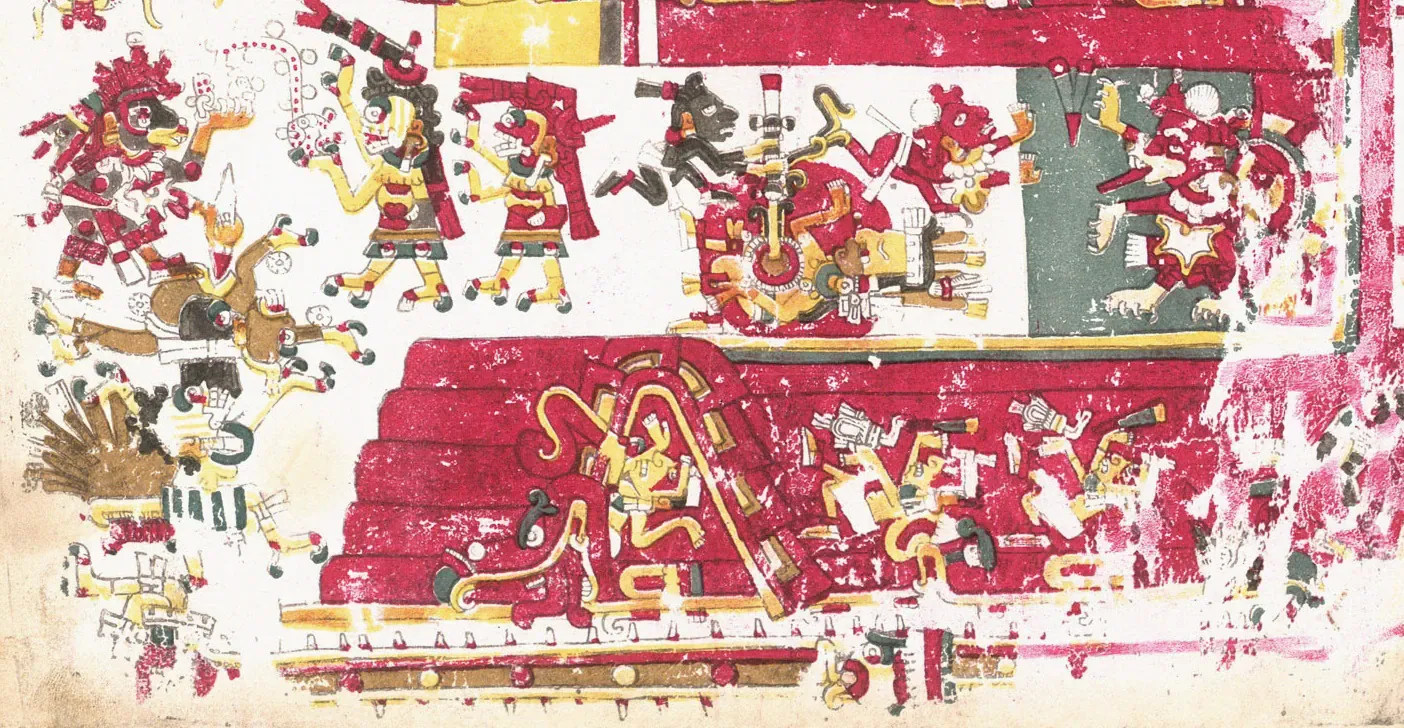
In Aztec belief Xolotl is a god linked with fire, lightning, twins and the evening star. He is shown as a dog-headed man and as a guide of the dead. The Aztec afterlife place Mictlan was reached by a long, hard journey, and the sources say the dead were helped by a dog. Colonial-era writers such as Bernardino de Sahagun recorded that a dog was killed or buried with the dead to carry them across a river. Interpretation of these accounts is debated, and later popular retellings add colour that the primary sources do not contain.
The Xoloitzcuintli
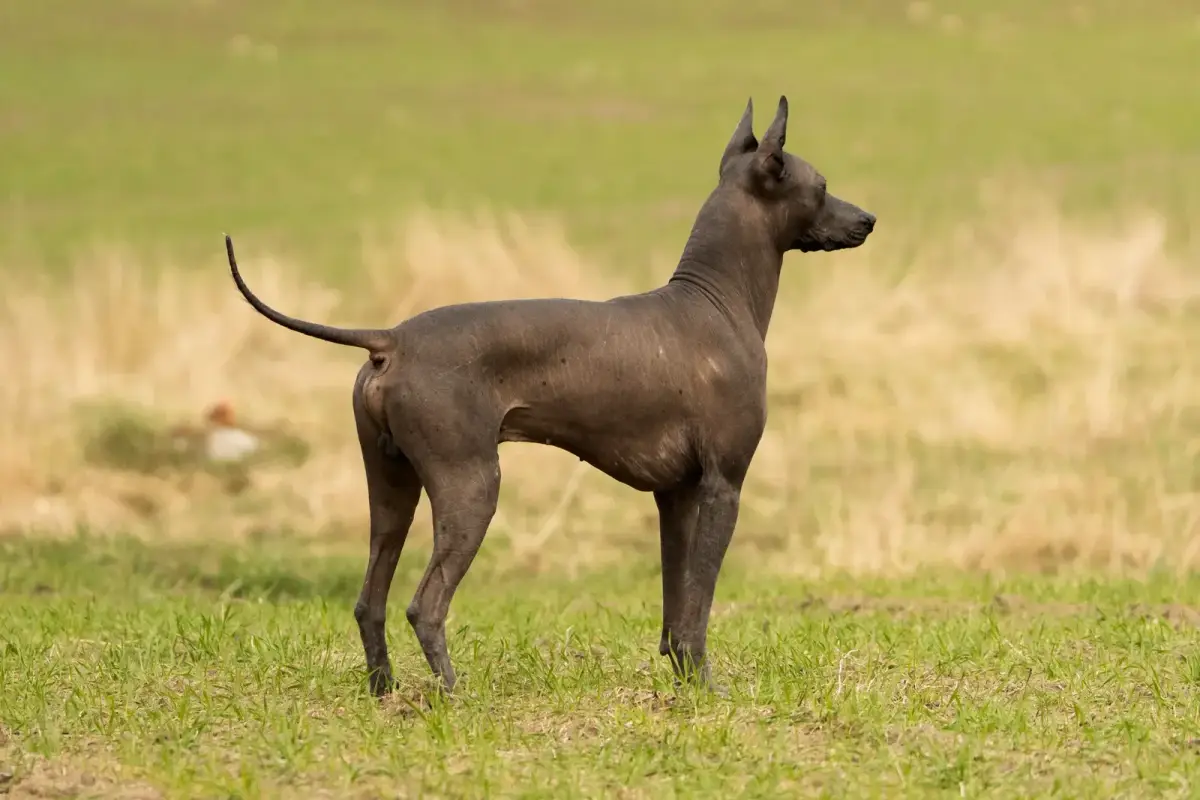
The Mexican Hairless Dog, the Xoloitzcuintli, carries the god's name, and popular writing says that Xolotl made the breed. That is folklore, not documented history. The solid facts are that hairless dogs appear in Mesoamerican art and burials, and that the breed's name comes from Nahuatl. The myth gives the breed its romance, and the real dogs are warm, alert companions in modern households.
North American dog stories
Indigenous peoples of North America hold many dog stories, and they differ greatly between nations. A few themes recur in general terms: dogs as first companions, as helpers in the hunt, as travellers on a path of the dead, and in some stories as figures who keep or lose a place beside people through an act of loyalty. These are living traditions that belong to specific peoples, and a short guide cannot do them justice. Readers who want a nation's own stories should look for tellings by community members or published collections by Native authors and tribal cultural centres. For the deep history of dogs on the continent, see first dogs on every continent.
 Save
 Save
 GuideHow to Groom a Dog: Brushing, Baths, Nails and CoatsHow to groom a dog at home: coat types, brushing, how often to bathe, cutting nails, ears, teeth, shedding, matting and whether to shave a double coat.GuideLivestock guardian dogs: what they do and who they suitWhat livestock guardian dogs do, how they differ from herding dogs, 40 LGD breeds by country, the DNA evidence, and whether they make good pets.
Africa beyond Egypt
Africa has a very large body of dog stories, from hunting tales to origin myths where the dog brings fire or carries a message between gods and people. This guide does not summarise them because a verified, citable source for specific tales was not available when it was written, and guessing would not be fair to the many peoples involved. Egypt is the one African tradition covered above.
 GuideIs your dog suited to therapy work?How to make your dog a therapy dog: temperament checklist, first training steps, how Pet Partners, TDI and Pets As Therapy assess dogs, and welfare limits.
 ArticleDog Breed Family Tree: How All Dog Breeds Are RelatedThe dog breed family tree from Ice Age wolves to 29 breed families.GuideIs your dog suited to therapy work?How to make your dog a therapy dog: temperament checklist, first training steps, how Pet Partners, TDI and Pets As Therapy assess dogs, and welfare limits.
Why do dogs guard the underworld in so many cultures?
Cerberus, Garmr, Xolotl, the Egyptian canids and the Zoroastrian "four-eyed dog" used in funeral rites all stand at borders between life and death. That is a pattern, and scholars give several explanations. These are interpretations, not facts.
 GuideHow to calm a reactive dogHow to calm a reactive dog: why dogs bark and lunge, what to do in the moment, a step-by-step training plan, what to avoid and when to get help.
- Everyday experience. Dogs lived near people and near the dead. In many places they scavenged around burial grounds and settlements. A canine at the edge of the grave is a real sight before it is a symbol.
- Night guardians. Dogs warn at night, so a dog at a threshold fits a spirit that watches thresholds.
- A shared old story. The comparative mythologist Michael Witzel has argued that a dog-guarded afterlife belongs to a very old body of stories shared across Eurasia and carried into the Americas. This is a proposal that other scholars debate, but it fits the wide spread of the motif.
- Funeral practice. The Zoroastrian rite called the sagdid, "dog-sight", brought a dog to look at a body, and the Avestan texts give dogs a role in protecting the dead from corruption. Where the dog is part of the ritual itself, its place at the gate of the afterlife follows naturally.
- Fear of what lies outside. A fierce dog at the gate of the dead is also a sign that the border is real. The stories reassure the living by explaining why the dead do not return.
- Loyalty. Dogs are the one animal expected to follow a person anywhere. A guide for the dead is a natural extension.
None of these explanations rules out the others, and no one can test a myth directly. For a look at how real dogs travelled alongside human groups, see first dogs on every continent.
What does the pattern not tell us?
It does not show that the cultures borrowed from one another in every case. The Greek and Aztec dogs, for example, may have arisen separately from the same ordinary human experience of living with dogs. Folklorists tend to be careful on this point. Similar motifs can spread by contact, descend from a shared ancient source, or appear independently, and a single example rarely lets us choose among the three. The safest reading is that the dog suited the job of border guard everywhere that people kept dogs.
 GuideDog Breeds by Country: Which Nations Made the Most?Dog breeds by country: how many breeds each nation produced in the Dogs Atlas data, from the UK and France to Japan, plus national dogs and families.GuideHow to calm a reactive dogHow to calm a reactive dog: why dogs bark and lunge, what to do in the moment, a step-by-step training plan, what to avoid and when to get help.
FAQ
Is Anubis a dog or a jackal?
He is a canine god. Popular books say jackal. A 2015 study (Rueness and colleagues, PLOS ONE) showed that the animal called the golden jackal in Africa is a separate species, the African golden wolf, so the real animal behind the image is debated. The Egyptians drew a stylised divine form, not a species portrait.
Why does Cerberus have three heads?
Hesiod's oldest account gives him many heads. Later Greek and Roman writers and artists settled on three. There is no single ancient explanation, and modern writers offer several guesses.
Were there really dog-headed people?
No. The Cynocephali come from the writings of Ctesias and Pliny the Elder and were repeated for centuries as a myth of far-off lands.
Is the story of Gelert true?
The tale is a later legend, popular in the 18th and 19th centuries, with close relatives in other countries. It should not be read as a record of a real event.
Is the Xoloitzcuintli really descended from the dog of Xolotl?
The breed has deep roots in Mesoamerica, and the god Xolotl shares its name. The claim that the god created the breed is folklore.
Are Fu dogs dogs?
In Chinese sources the guardians are lions. "Fu dog" is a Western name.
Read next
 Family storyArctic dogsRead the family's story: origins, members, DNA
 Family storyEast Eurasian dogsRead the family's story: origins, members, DNA
 GuideDogs in science and spaceSpace dogs Laika, Belka and Strelka, Pavlov's dogs, Snuppy the clone, the dog genome and scent detection: what dogs did for science, and what it cost them.
Sources (11)
- British Museum, collection records for the clay dogs excavated by William Kennett Loftus in the North Palace at Nineveh (about 645 BC).
- Metropolitan Museum of Art, collection notes on Assyrian guardian dog figurines and their inscriptions.
- Hesiod, Theogony (Cerberus).
- Homer, Odyssey, Book 17 (Argos).
- Ctesias of Cnidus, Indica, as summarised by Photius; Pliny the Elder, Natural History.
- David Woods, scholarship on the dog-headed Saint Christopher.
- Snorri Sturluson, Prose Edda; the Poetic Edda (Garmr, Fenrir, Tyr).
- The Ulster Cycle of Irish tradition (Cú Chulainn).
- Rueness and colleagues, PLOS ONE (2015), on the African golden wolf.
- Michael Witzel, The Origins of the World's Mythologies (2012).
- Bernardino de Sahagun, Florentine Codex (Aztec burial customs).