A full heat lasts about three weeks, though the range runs from two to four. Most dogs have a heat roughly every seven months, with small breeds cycling more often and giant breeds less often. This guide covers when the first heat arrives, what each stage looks like, how to care for her, how male dogs react and what to do if a mating happens by accident. It is general information. Your vet knows your dog and decides what is right for her.
What "in heat" means
"Heat" is the everyday word for estrus, the fertile part of a female dog's reproductive cycle. Vets talk about the whole cycle, which has four stages: proestrus, estrus, diestrus and anestrus. The word "heat" is often used for the first two together, when she is swollen, bleeding and attracting males.
 GuideDog Breeds by Country: Which Nations Made the Most?Dog breeds by country: how many breeds each nation produced in the Dogs Atlas data, from the UK and France to Japan, plus national dogs and families.
Unlike a human period, bleeding in dogs happens at the start of the fertile window, not at the end. The bleeding is a sign that her body is preparing to breed, and it does not mean she is unwell. It also does not mean she is ready to mate on the first day. Dogs ovulate later in the cycle, which is why the stages matter.
The cycle is controlled by hormones, and it runs on its own whether or not she mates. A dog that is not pregnant still goes through the same stages. Each dog has her own pattern, and the numbers in this guide are averages, not fixed rules.
 GuideDog Pregnancy: Length, Signs and Week by WeekHow long dogs are pregnant, signs of pregnancy, a week by week table, giving birth, false pregnancy and when to call a vet.GuideDog Breeds by Country: Which Nations Made the Most?Dog breeds by country: how many breeds each nation produced in the Dogs Atlas data, from the UK and France to Japan, plus national dogs and families.
When the first heat comes
The age of the first heat depends mostly on size. The American Kennel Club, citing veterinarian Dr Margret Casal, gives these typical ages.
 GuideHow to Groom a Dog: Brushing, Baths, Nails and CoatsHow to groom a dog at home: coat types, brushing, how often to bathe, cutting nails, ears, teeth, shedding, matting and whether to shave a double coat.
| Dog size | Typical age at first heat |
|---|---|
| Small breeds | 6 to 7 months |
| Medium breeds | 7 to 9 months |
| Large breeds | 12 to 16 months |
| Some giant breeds | 18 to 24 months |
Another AKC article notes that some small dogs can start as early as four months. These are typical ages, and a healthy dog can fall outside them. A first heat can also be mild and easy to miss. A short, light first cycle is common.
If your dog is well past two years old and has never had a heat, or if she has had heats and then stops cycling for no clear reason, mention it to your vet. Most of the time there is a simple explanation, and a check is easy.
 Save
 GuideTicks and fleas on dogs: how to check, remove and prevent themTicks and fleas on dogs: how to tell them apart, check your dog, remove a tick safely, break the flea life cycle and prevent both.GuideHow to Groom a Dog: Brushing, Baths, Nails and CoatsHow to groom a dog at home: coat types, brushing, how often to bathe, cutting nails, ears, teeth, shedding, matting and whether to shave a double coat.
How often dogs go into heat
The AKC says most dogs have a heat approximately every seven months. Size changes the pattern. Smaller breeds may come into heat as often as three to four times a year. Larger dogs such as Irish Wolfhounds, St Bernards and Great Danes may only cycle every 12 to 18 months. A few breeds, including the Basenji and the Tibetan Mastiff, typically cycle once a year.
 GuideBest dog breeds for familiesBest dog breeds for families, small homes, allergies, first-time owners and seniors, ranked from our breed ratings, with honest limits and a table.
Early cycles can be uneven. In the first year or two, the gap between heats may be shorter or longer than it later settles into. This is common and usually not a worry. Keeping a simple calendar of start dates helps you and your vet see her own rhythm.
Dogs do not have a menopause. Older females keep cycling, though gaps often become longer. A very old dog with a strange discharge or a heat that seems to go on and on should see a vet.
 ArticleThe first known dog on every continentEarliest accepted dog on each continent, from Bonn-Oberkassel to the dingo: dates, sites, how dogs arrived and which breeds carry those first dogs.GuideBest dog breeds for familiesBest dog breeds for families, small homes, allergies, first-time owners and seniors, ranked from our breed ratings, with honest limits and a table.
The four stages of the heat cycle
The Merck Veterinary Manual describes each stage. The lengths below come from the Merck tables and owner pages, with the reminder that every dog differs.
 GuideMy Dog Keeps Shaking His Head: Ear Infection GuideDog shaking head, scratching ears or smelly ears? Ear infection signs, causes, ear haematoma, emergency signs, what to do and what to avoid.
Proestrus: the start of heat
Proestrus is the first stage. The Merck table gives 7 to 10 days. A dvm360 review gives an average near nine days, with a wider range from 3 to 17 days. In this stage:
- the vulva swells
- bloody discharge begins
- males are interested in her, but she is not yet willing to mate, and she may snap at or move away from them
- she may urinate more often
Estrus: the fertile stage
Estrus is the stage when she will accept a male. The Merck table gives 5 to 10 days. The Merck owner page says it can be as short as 3 days or as long as 3 weeks, with about 9 days on average. Ovulation happens during this stage, usually two to three days after mating, according to Merck. In this stage:
- the discharge often becomes paler, pinker or straw coloured, although in some dogs it stays red
- she stands still for males and moves her tail to one side
- she may be more affectionate or more restless
This is the stage in which an accidental mating is most likely.
Diestrus: after the fertile window
Diestrus follows estrus. In a dog that is not pregnant, Merck's owner page says it usually lasts about two months. During this time progesterone is high whether she is pregnant or not. Her body can behave as if it is pregnant, which is why false pregnancy sometimes appears about a month or two after a heat. If she is pregnant, this stage lasts through the pregnancy, which is about 62 to 64 days according to Merck.
Anestrus: the rest between cycles
Anestrus is the quiet phase between one cycle and the next. The Merck material does not give a standard length for it, and it varies a lot between dogs. This is the stage that stretches longer in big breeds and shorter in small ones. Nothing needs doing during it. It is a good time to plan any vet discussion about spaying.
Quick overview
| Stage | Typical length (Merck unless noted) | Main signs |
|---|---|---|
| Proestrus | 7 to 10 days | Swelling, bloody discharge, males interested, she says no |
| Estrus | 5 to 10 days (about 9 on average) | Accepts males, discharge may lighten |
| Diestrus | About 2 months if not pregnant | Settles down, may show false pregnancy signs |
| Anestrus | Varies, no standard figure | Resting phase |
The AKC adds that the visible part of the cycle, the swelling and discharge, typically lasts three weeks and can range from two to four.
- Proestrus7 to 10 daysSwelling, bloody discharge, males interested, she says no
- Estrus5 to 10 days, about 9 on averageShe accepts males, discharge may lighten, ovulation happens
- Diestrusabout 2 months if not pregnantSettles down, may show false pregnancy signs
- Anestrusvaries, no standard figureResting phase before the next cycle
 GuideSmartest dog breeds: what the rankings measure and what they missCoren's smartest dog breeds list, what it measured, what newer dog cognition research says, three kinds of dog intelligence and why smart dogs need work.GuideMy Dog Keeps Shaking His Head: Ear Infection GuideDog shaking head, scratching ears or smelly ears? Ear infection signs, causes, ear haematoma, emergency signs, what to do and what to avoid.
How long is a dog in heat, and how long does she bleed?
A full heat lasts about three weeks, with a range of two to four. This is the question owners ask most. The bloody discharge usually starts in proestrus and often lightens during estrus. In many dogs there is visible discharge for roughly the first one to two weeks, and some dogs have light spotting for the full three weeks. Some dogs, particularly small ones, clean themselves so well that owners hardly see any blood.
 GuideMy Dog Is Panting a Lot: Normal or Worrying?Dog panting heavily? Normal vs worrying panting, heatstroke signs and cooling steps, pain, anxiety, Cushing's disease, and when to see a vet.
How much blood is not a good measure of anything. A heavy bleeder is not more fertile, and a light bleeder is not less fertile. What matters is a change from her own normal. Very heavy bleeding that soaks through many times a day, bleeding that goes on long after the usual three to four weeks, or bleeding that comes with a poor appetite, lethargy or drinking much more than usual, should be checked by a vet the same day.
 GuideDogs in myth around the worldFrom Anubis and Cerberus to Fenrir, Xolotl and the Tiangou: how cultures across the world imagined dogs as guardians, guides and monsters.GuideMy Dog Is Panting a Lot: Normal or Worrying?Dog panting heavily? Normal vs worrying panting, heatstroke signs and cooling steps, pain, anxiety, Cushing's disease, and when to see a vet.
Dog heat cycle symptoms: signs of a dog in heat
The main symptoms are a swollen vulva, bloody or straw-coloured discharge, more licking, frequent urination, mood changes and interest from male dogs. Signs usually build over several days. The most common ones are:
 GuideMy Dog's Eye Is Red: Causes and When to See a VetRed, weepy or squinting dog eye? Emergency signs, common causes like conjunctivitis and ulcers, what to do at home, what to avoid, and when to see a vet.
- Swollen vulva. Often the first sign you can see.
- Bloody or straw-coloured discharge. On bedding, floors and the dog herself.
- Licking the area more. Dogs groom a lot during heat.
- Frequent urination. She may ask to go out often, and she may squat on walks to leave small amounts of urine that carry her scent.
- Mood changes. Some dogs become clingy, others grumpy or restless.
- Tail held to the side. In estrus, she may flag her tail when touched near the base.
- Interest from male dogs. Sometimes the first clue is a male dog arriving at your gate.
Appetite may dip a little in some females, while others eat as usual. A mild change is normal. A dog that refuses food for more than a day, vomits, or seems unwell is not showing normal heat behaviour.
 Save
 ArticleDog Breed Family Tree: How All Dog Breeds Are RelatedThe dog breed family tree from Ice Age wolves to 29 breed families.GuideMy Dog's Eye Is Red: Causes and When to See a VetRed, weepy or squinting dog eye? Emergency signs, common causes like conjunctivitis and ulcers, what to do at home, what to avoid, and when to see a vet.
Behaviour of a dog in heat
Hormones change behaviour, and the changes vary a lot. Common ones include:
 GuideMy Dog Has Bad Breath: Causes and What to DoDog breath smells? Gum disease is the usual cause, but sweet or ammonia smells can mean illness.
- Restlessness and wandering. She may try to get out of the garden or slip through a door.
- Mounting or being mounted. Female dogs sometimes mount other dogs, people or cushions.
- More marking. Frequent small urine marks on walks.
- Less patience with other dogs. She may snap at males who approach too early, and sometimes at other females.
- More affection, or less. Some dogs want constant contact. Others want to be left alone.
- Pulling on the lead. She may be more interested in scents than usual.
None of this is a training failure. Her hormones are in charge for a few weeks, and most dogs return to their usual selves afterwards. Extra patience, shorter and calmer outings and a quiet place to rest are the simplest help.
 GuideWinter Care for Dogs: Cold, Paws, Antifreeze and IceWinter care for dogs: how cold is too cold, coats, salt and antifreeze, hypothermia, frostbite, frozen ponds, dark walks and holiday hazards.GuideMy Dog Has Bad Breath: Causes and What to DoDog breath smells? Gum disease is the usual cause, but sweet or ammonia smells can mean illness.
Caring for a dog in heat
 GuideLivestock guardian dogs: what they do and who they suitWhat livestock guardian dogs do, how they differ from herding dogs, 40 LGD breeds by country, the DNA evidence, and whether they make good pets.
Walks and exercise
Keep her on a lead at all times, even if she has perfect recall. A dog in estrus is driven to find a mate, and males are driven to find her. Choose quieter routes and quieter times of day. Avoid dog parks, dog beaches and any off-lead area for the whole cycle. A short fence is not a barrier for a motivated male or a motivated female, so check gates and gaps in the garden too.
Normal exercise is fine for most dogs in heat. If she seems tired, shorten walks and add gentle play at home.
Hygiene
Discharge is mostly an inconvenience. Some practical ways to cope:
- Use washable bedding and throws on her favourite spots.
- Wipe her gently with warm water and a soft cloth if she is messy.
- Keep her to rooms with easy-clean floors.
- Wash your hands after cleaning, as with any bodily fluid.
Dog nappies and pants made for the purpose are an option for some owners. Take them off regularly so the skin can breathe, and check for rubbing or redness.
Rest, food and comfort
Give her a quiet, comfortable place and a normal routine. Keep meals regular. If she is a little off her food, a warm meal at her usual time often helps. Fresh water should always be available.
Keeping her safe
Do not leave her alone in the garden, even for a few minutes. Make sure her collar tag and microchip details are up to date, in case she slips out.
Mating in your own home
If two dogs of different sexes live together, an accidental mating is a real possibility, even between dogs that are close. See the section on managing a home with a male and a female below.
 GuideDog hybrids: what dogs can and cannot breed withCan dogs breed with wolves, coyotes, jackals or foxes? Wolfdogs, coydogs, the Sulimov dog and Dogxim explained, with chromosomes and DNA studies.GuideLivestock guardian dogs: what they do and who they suitWhat livestock guardian dogs do, how they differ from herding dogs, 40 LGD breeds by country, the DNA evidence, and whether they make good pets.
Do male dogs go into heat? How they react to a female in heat
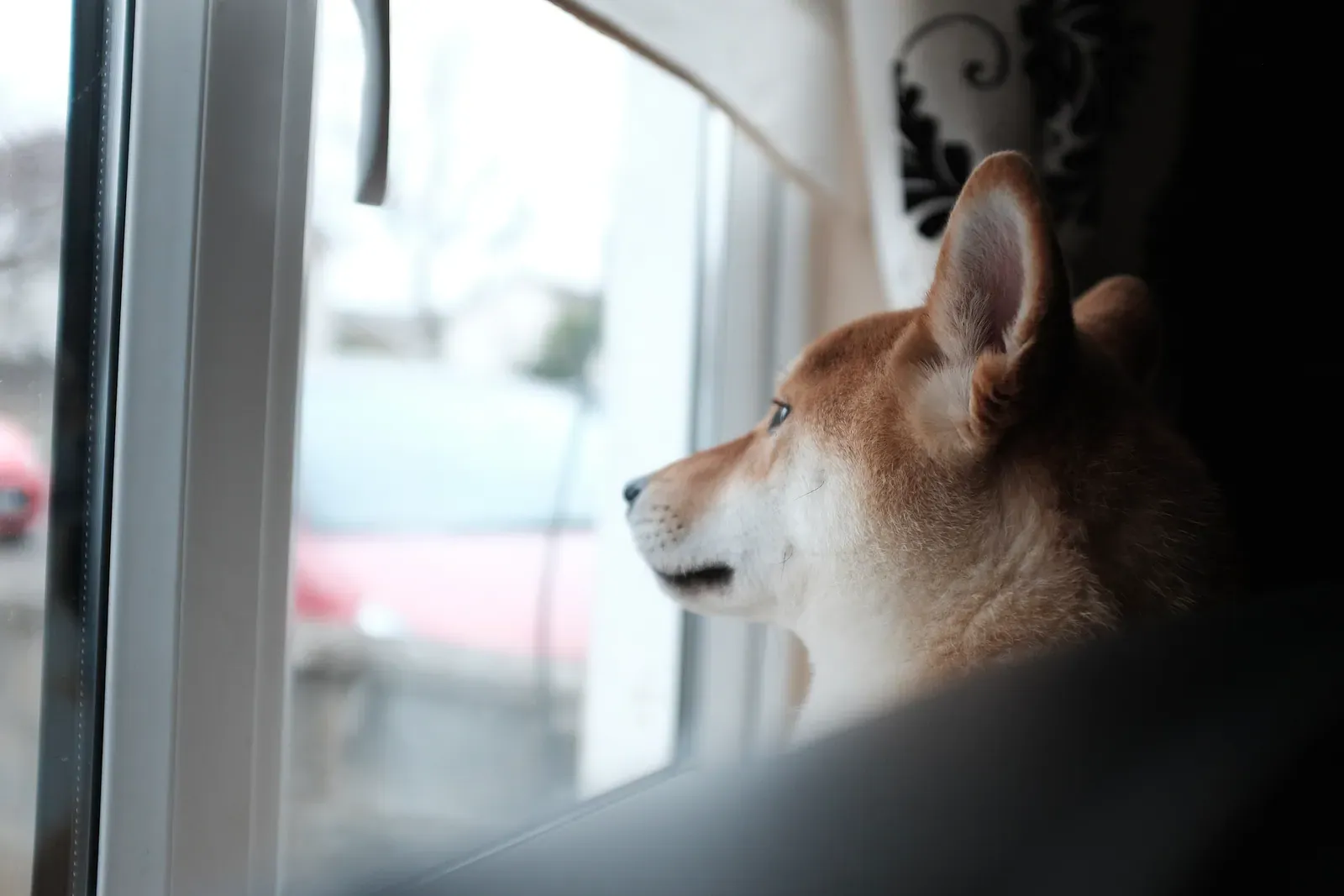
Heat is the fertile stage of a female dog's cycle, so male dogs do not go into heat themselves. They react strongly to a female who is. A male dog can detect a female in heat from a surprising distance. The scent comes from her urine and discharge, and a male can pick it up and follow it. The exact distance is not firmly established, so treat claims of kilometres with caution. What is clear is that males may know about her before you do, and they may show up at your door.
 GuideBanned and restricted dog breeds by countryWhich dog breeds are banned or restricted, country by country: UK, Ireland, France, Germany, Denmark, Norway, Spain, Australia and more.
In a male dog, you may see:
- Restlessness. Pacing, difficulty settling, not sleeping well.
- Whining or howling. Often at windows and doors.
- Appetite loss. Some males eat much less during this time.
- Escape attempts. Digging, jumping fences, bolting through doors and slipping out of collars or body straps.
- More marking. Frequent urine marking indoors and outdoors.
- Mounting. Mounting people, furniture and other dogs.
- Poor focus. He ignores commands he normally follows.
These reactions can be intense, and they are hormonal, not bad behaviour. Male dogs that are neutered often react less, though not always. Some neutered males still show interest, especially if they were neutered after they had mated before.
If a male dog you do not own is hanging around, do not let him into your garden, and speak to his owner. If you own the male, secure the fence, keep him on a lead and keep him busy with chew time, puzzle feeders and walks away from the neighbourhood female.
 Save
 GuideDog Grooming Competitions and Show Standards ExplainedHow breed standards shape dog grooming, from hand-stripped terriers to Poodle show clips, and how grooming competitions and creative grooming work.GuideBanned and restricted dog breeds by countryWhich dog breeds are banned or restricted, country by country: UK, Ireland, France, Germany, Denmark, Norway, Spain, Australia and more.
A male and a female dog in the same home
Living together during a heat is the hardest case. Careful management is needed because a mating can happen in seconds. The common approaches are:
 GuideDog laws by country: tax, insurance and licencesDog tax, compulsory liability insurance, licences, microchips and leash rules in Germany, Austria, Switzerland, Spain, Ireland, the UK, the US and more.
- Separate them completely. Different rooms with a solid door, not a baby gate. Dogs can jump or push gates. Crates help, but a crate alone is not enough if the room is shared.
- Rotate time. Take turns with the dogs in the same area, and clean the area in between to reduce scent.
- Board one dog. A trusted friend or a boarding kennel willing to take a dog in heat, or an intact male, can be the simplest answer. Ask kennels first, because many have rules.
- Walk them separately. Never walk them together during the heat.
- Supervise at all times. Even one unsupervised moment is enough.
The separation usually needs to continue for the whole visible cycle and a little beyond, as she can remain attractive and fertile for a few days after the discharge fades. Your vet can tell you when it is safe to stop.
Some owners discuss neutering the male or spaying the female with a vet to avoid this situation in the future. See the section on spaying below.
 GuideDog Clothes: When Dogs Need Coats, and a Short History of Dog FashionDo dogs need coats in winter? When clothes help, when costumes stress a dog, safe fit, reflective gear, and a short history of dog fashion and dog art.GuideDog laws by country: tax, insurance and licencesDog tax, compulsory liability insurance, licences, microchips and leash rules in Germany, Austria, Switzerland, Spain, Ireland, the UK, the US and more.
Accidental mating
If your dog mated or you think she might have, stay calm and call your vet soon. A prompt call matters because there are options that work best when started early, and your vet can explain them. Please do not try home remedies, herbal products or things from the internet. They can be harmful, and they do not work reliably. Do not try to pull the dogs apart if they are tied together. This can hurt them both. Stay calm, keep them calm and quiet, and they will separate on their own.
 GuideHow to socialize a puppy or adult dogHow to socialize a puppy or adult dog: the sensitive period, a week-by-week puppy plan, rescue dogs, safe exposure before vaccines, mistakes and a checklist.
Useful information for the call:
- the date and time of the mating
- how many days since her heat started
- her age, weight and breed
- whether she has had puppies or health problems before
- whether she is on any medication
Your vet may talk through monitoring, an early check, or medical options. The decision depends on her age, health, stage of the cycle and your wishes. A pregnancy check later may also be offered. See the dog pregnancy guide for how pregnancy is confirmed: Dog pregnancy week by week.
 GuideHow to Find a Good Dog Groomer: Questions and SignsHow to find a good dog groomer: qualifications, questions to ask, signs of good and poor care, sedation, dryers, mobile groomers and what to check after.GuideHow to socialize a puppy or adult dogHow to socialize a puppy or adult dog: the sensitive period, a week-by-week puppy plan, rescue dogs, safe exposure before vaccines, mistakes and a checklist.
Spaying: the basics
Spaying (ovariohysterectomy or ovariectomy) is surgery to remove the ovaries, and often the womb. A spayed dog no longer has heats and cannot become pregnant. It also removes the risk of womb infection (pyometra) and false pregnancy. Pyometra is a womb infection that appears most often in the weeks after a heat and needs prompt veterinary care.
 GuideAdvanced dog trainingAdvanced dog training explained: the 3 Ds, proofing, off-lead recall, formal heel, distance stays, impulse control, tricks, scent work, dog sports and Good Citizen schemes.
Opinions on the best age to spay have changed, and the right timing depends on breed, size, lifestyle and health. A systematic review by Beauvais and colleagues (2012, Journal of Small Animal Practice) found that the evidence on spaying and mammary tumours was of limited quality, and a newer systematic review (Guirguis and Beggs, Animals, 2025) found that about half the included papers showed no protective effect of early spaying. Newer research on joint health and cancers looks at timing by breed. This is a decision to make with your vet. You can read more in Male vs female dogs: what is different and what is not, which includes the timing research.
Spaying while she is in heat is often delayed, since blood flow is higher. Many vets prefer to wait a couple of months after the heat. Ask your vet what they advise for your dog.
 GuideDogs in Legends and Fairy TalesDogs in folklore and fairy tales: Black Shuck, The Tinderbox, Saint Guinefort, Panhu, Greyfriars Bobby, Barry and Old Drum, with legend and history kept apart.GuideAdvanced dog trainingAdvanced dog training explained: the 3 Ds, proofing, off-lead recall, formal heel, distance stays, impulse control, tricks, scent work, dog sports and Good Citizen schemes.
When to call a vet
Call your vet if you see any of these:
 GuideDog training basicsDog training basics: how dogs learn, what you need, and step-by-step lessons for name, sit, down, stay, recall, loose lead walking, leave it, drop it and settle, plus a 4-week plan.
- bleeding that is very heavy, or that continues beyond about four weeks
- a heat that lasts much longer than the usual three weeks
- discharge with a bad smell, or green or yellow pus-like discharge
- loss of appetite for more than a day, vomiting, lethargy or a high temperature
- drinking and urinating much more than usual, particularly in the weeks after a heat
- a swollen belly or breasts with unwell behaviour, or a dog who seems in pain
- no first heat by two years old, or heats that stop without a cause
- an accidental mating, or a possible one
Vets would always rather hear from a worried owner early. If you are unsure, a call to the clinic is free of risk.
 GuideDogs of Japan: the native breeds and their storiesJapanese dog breeds explained: the six Nihon Ken, the Chin, Tosa, Japanese Spitz and Terrier, Hachiko, wartime near-extinction, DNA and who they suit.GuideDog training basicsDog training basics: how dogs learn, what you need, and step-by-step lessons for name, sit, down, stay, recall, loose lead walking, leave it, drop it and settle, plus a 4-week plan.
Frequently asked questions
How long do dogs bleed in heat?
Usually for the first one to two weeks of the cycle, and sometimes up to three weeks as light spotting. The whole visible heat lasts about three weeks and can range from two to four (AKC). Very heavy or very long bleeding should be checked by a vet.
How long is a dog in heat?
The visible heat lasts about three weeks. The fertile stage, estrus, lasts around 5 to 10 days according to the Merck Veterinary Manual, with an average near nine days. She stays attractive to males for most of the cycle.
How often do dogs go into heat?
About every seven months for most dogs. Small breeds may cycle three to four times a year, and large breeds such as Great Danes may cycle every 12 to 18 months (AKC).
At what age is the first heat?
Small breeds are usually around 6 to 7 months, medium breeds 7 to 9 months, large breeds 12 to 16 months and some giants 18 to 24 months (AKC).
Can a dog get pregnant during her first heat?
Yes. She can become pregnant at the first heat. The AKC says it is strongly advised not to breed a young female in her first and second cycle. This site does not encourage breeding.
Do dogs feel pain during heat?
Most dogs seem comfortable. Some are a little restless or irritable. Signs of pain, fever or lethargy are not normal and need a vet.
Can I bathe my dog in heat?
Yes. Use lukewarm water and keep it short. Dry her well afterwards. Your vet can advise if she has any skin problem.
Do female dogs in heat behave differently with other dogs?
Often. She may be less tolerant, more flirtatious or more irritable. Keep introductions slow, and avoid new dogs until the cycle is over.
Why is my male dog crying and not eating?
A female in heat nearby is a common reason. It usually passes when the scent goes. If it lasts longer than a few days, or he seems unwell, talk to your vet.
Does neutering stop a male reacting to a female in heat?
It often reduces the reaction, but not always. A male neutered after he has mated before may still be interested.
Is it safe to walk my dog in heat?
Yes, with a lead and a quiet route. Avoid off-lead areas and busy dog meeting places.
Can two female dogs be in heat at the same time?
Yes. Females in the same home sometimes cycle at about the same time. They may be edgy with each other. Give each space to rest.
Read next
 Family storyWest Eurasian dogsRead the family's story: origins, members, DNA
 Family storyAncient BasalRead the family's story: origins, members, DNA
 Family storyLevantine and African dogsRead the family's story: origins, members, DNA
Sources (6)
- Merck Veterinary Manual, table "Estrous (Heat) Cycle in Female Dogs" and owner pages on management of reproduction in dogs.
- American Kennel Club, expert advice articles on when dogs go into heat and how long dogs are in heat (including Dr Margret Casal on first heat by size).
- dvm360, review "Canine estrous cycle and ovulation" (proestrus length).
- Beauvais W, Cardwell JM, Brodbelt DC. The effect of neutering on the risk of mammary tumours in dogs: a systematic review. Journal of Small Animal Practice, 2012.
- Guirguis and Beggs. Systematic review: does pre-pubertal spaying reduce the risk of canine mammary tumours? Animals, 2025.
- Hart BL and colleagues. Assisting decision-making on age of neutering for 35 breeds of dogs. Frontiers in Veterinary Science, 2020.