There is no shortcut and no website that can sell you the status. This article explains the main routes in the USA and in the UK, Germany, France, Spain, Italy and the Netherlands, what usually happens after you apply, what owner-training rules say and how to check that an organisation is genuine. For definitions and rights, read Service, therapy and emotional support dogs first.
Who checks the schools
Two international bodies set standards for training organisations:
 GuideMy Dog Keeps Licking His Paws: Causes and What HelpsDog licking paws all the time: allergies, parasites, injury, yeast and boredom.
- Assistance Dogs International (ADI) accredits organisations that train guide, hearing and service dogs. Its 2024 fact sheet lists 167 accredited members, including 55 in Assistance Dogs Europe and 91 in ADI North America. ADI calls a team trained and placed by an accredited member a "Certified Assistance Dog". Its Public Access Certification Test is run by member organisations to check that a team is ready for public places.
- International Guide Dog Federation (IGDF) sets standards for guide dog schools.
Assistance Dogs UK (ADUK), a coalition of UK charities, says its members passed an accreditation process measured against ADI and IGDF standards.
 GuideService, therapy and emotional support dogs: what's the difference?Service dog vs emotional support dog vs therapy dog: the real differences, your rights in the USA and Europe, and why online certificates mean nothing.GuideMy Dog Keeps Licking His Paws: Causes and What HelpsDog licking paws all the time: allergies, parasites, injury, yeast and boredom.
How the process usually goes
Each organisation has its own steps, but most follow the same pattern:
 GuideHow to calm a reactive dogHow to calm a reactive dog: why dogs bark and lunge, what to do in the moment, a step-by-step training plan, what to avoid and when to get help.
- Check you are eligible. Organisations accept people with specific disabilities, within an area and an age range. Some only place one type of dog, such as guide dogs or hearing dogs.
- Apply. Expect forms, a letter from a health professional and often a home or phone interview.
- Wait. Waiting lists can run from a year to several years. Reports include "a year or more" for one US veteran programme, two to three years for a guide dog in Germany (an older figure from a Bundestag paper) and at least two years in France.
- Matching. The organisation looks at your needs, home, lifestyle and the dog's temperament.
- Training together. Many schools train you and the dog together, either at a residential centre or at home. You learn the commands, dog care and how to work in public.
- Assessment. A public access or national test, where the organisation or country requires one.
- Aftercare. Reputable organisations keep in touch and reassess the team over the years.
- Check eligibilityfirstDisability, area and age range; some place one dog type
- ApplynextForms, a health professional's letter, often an interview
- Waita year to several yearsLists vary by programme and country
- Matchingafter the waitYour needs, home, lifestyle and the dog's temperament
- Training togetherresidential or at homeCommands, dog care, working in public
- Assessmentwhere requiredPublic access or national test
- Aftercareover the yearsThe organisation keeps in touch and reassesses the team
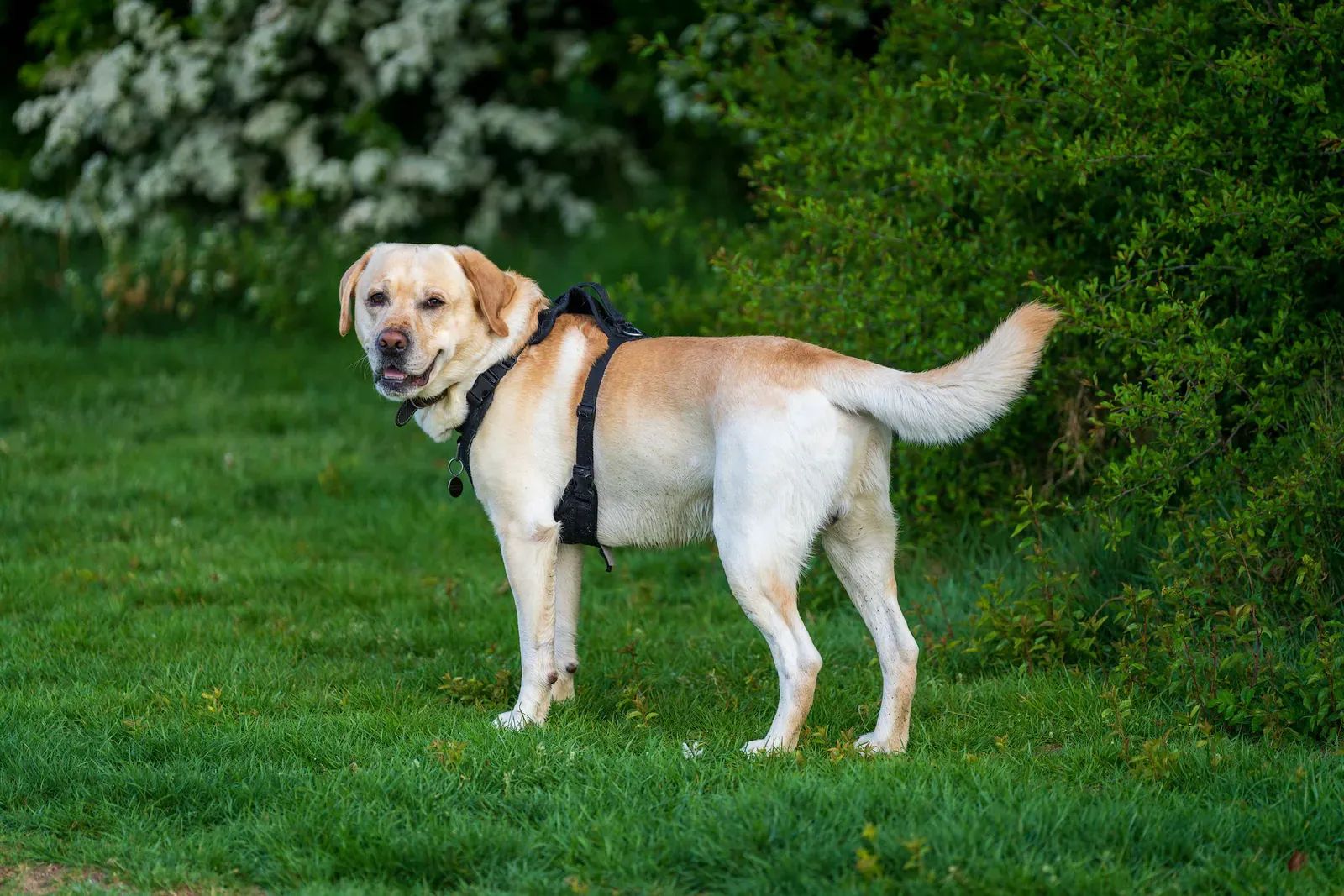
Most dogs trained by these organisations come from the Labrador, Golden Retriever and crossbreed lines. Not every puppy qualifies, so a school may take several years to bring a dog to you. Roughly half to two thirds of dogs that enter guide programmes qualify, depending on the programme and year.
 GuideIs your dog suited to therapy work?How to make your dog a therapy dog: temperament checklist, first training steps, how Pet Partners, TDI and Pets As Therapy assess dogs, and welfare limits.GuideHow to calm a reactive dogHow to calm a reactive dog: why dogs bark and lunge, what to do in the moment, a step-by-step training plan, what to avoid and when to get help.
Cost, in general terms
We do not list individual school prices. Some general points are sourced:
 GuideDog Pregnancy: Length, Signs and Week by WeekHow long dogs are pregnant, signs of pregnancy, a week by week table, giving birth, false pregnancy and when to call a vet.
- Many charities and veteran programmes place dogs free of charge, which is why waiting lists are long. Examples: Patriot PAWS in the USA gives dogs free to veterans, Hearts of Gold at West Virginia University does so for eligible veterans, and Handi'chiens in France gives the dogs free to their new owners after two years of training.
- In the Netherlands, one knowledge base reports that KNGF Geleidehonden and health insurers cover the cost of raising and training guide and assistance dogs. In Germany, guide dogs can be provided as a medical aid through health insurance, according to a federal summary. In Italy, the Lions guide dog service places its dogs free of charge.
- In the USA, programmes for civilians vary. Non-official estimates (GoodRx, citing the National Service Animal Registry) put the cost of a trained service dog at 15,000 to 30,000 dollars, up to 50,000 dollars, plus yearly upkeep. These are rough, non-official figures. The same source says Medicare, Medicaid and VA health care generally do not pay for the dog, but check your own plan.
A reputable organisation will not ask you to pay for a "registration". Be careful with any group that sells instant dogs or certificates.
 GuideHow to adopt a dog from a shelter or rescueHow to adopt a dog from a shelter or rescue: the process, costs in general terms, choosing a dog, the first weeks and what if it does not work out.GuideDog Pregnancy: Length, Signs and Week by WeekHow long dogs are pregnant, signs of pregnancy, a week by week table, giving birth, false pregnancy and when to call a vet.
USA
 GuideWhy does my dog do that? 15 common behavioursWhy does my dog lick me, stare, eat grass, spin, sigh or roll in smelly things? 15 everyday dog behaviours explained, with when to ask a vet.
Providers
- Accredited non-profit programmes. ADI North America lists accredited members. Examples we confirmed: Guide Dogs of America, which says it is ADI accredited and trains to ADI standards for public access. From the research file: The Seeing Eye and Guiding Eyes for the Blind (guide dogs), Patriot PAWS in Texas and Hearts of Gold at West Virginia University (veterans), and Give Us Paws in Houston, which trains a person's own dog. Placement of the dog may require you to meet the programme's own criteria.
- Veteran programmes. Many are free but have long waits. A news report from around 2019 reported a three to five year wait at one Texas programme. Treat this as dated and ask for the current figure.
- Private trainers. No official body accredits them, so check any trainer's methods and references yourself.
Owner-training rules
The ADA does not require professional training or certification. A dog must be individually trained to do tasks related to your disability and must be under control. That means you may train your own dog, with a trainer's help if you wish. Staff may only ask whether the dog is required because of a disability and what task it performs. See Service, therapy and emotional support dogs for the details.
Check accreditation
- Look for ADI accreditation. ADI keeps a member directory, and a school's own claim should match it.
- Ask what tasks the dog is trained for, how it is tested and what follow-up you receive.
- Walk away from anyone who says a certificate or registration gives legal rights. The ADA says it does not.
 GuideHow to Groom a Dog: Brushing, Baths, Nails and CoatsHow to groom a dog at home: coat types, brushing, how often to bathe, cutting nails, ears, teeth, shedding, matting and whether to shave a double coat.GuideWhy does my dog do that? 15 common behavioursWhy does my dog lick me, stare, eat grass, spin, sigh or roll in smelly things? 15 everyday dog behaviours explained, with when to ask a vet.
United Kingdom
 GuideDog laws by country: tax, insurance and licencesDog tax, compulsory liability insurance, licences, microchips and leash rules in Germany, Austria, Switzerland, Spain, Ireland, the UK, the US and more.
Providers
ADUK's member charities, from its own poster, are Support Dogs, Guide Dogs, Medical Detection Dogs, Dogs for Good, Canine Partners, Hearing Dogs, Dog A.I.D, Seeing Dog Alliance and Autism Dogs. Guide Dogs UK, for example, says a Labrador and Golden Retriever cross is the most common working guide dog it places. Different charities place different types of dog: guide, hearing, mobility, medical detection, autism and others. Some sources count the ADUK members differently, so use the ADUK list itself.
Owner-training rules
ADUK says not all assistance dogs are trained by an ADUK member or by a charity. The EHRC says the Equality Act 2010 applies to assistance dogs whether or not a registered organisation trained them. ID such as the ADUK ID booklet is optional and not a legal requirement. If you choose owner-training, you can still take help from qualified, positive trainers.
Check accreditation
- Check that the charity appears in ADUK's member list or ADI's UK member search.
- Read the official guidance (EHRC, ADUK) rather than a shop's or venue's own policy.
 GuideSmartest dog breeds: what the rankings measure and what they missCoren's smartest dog breeds list, what it measured, what newer dog cognition research says, three kinds of dog intelligence and why smart dogs need work.GuideDog laws by country: tax, insurance and licencesDog tax, compulsory liability insurance, licences, microchips and leash rules in Germany, Austria, Switzerland, Spain, Ireland, the UK, the US and more.
Germany
 GuideMy Dog Is Coughing: Causes and When to See a VetDog coughing, honking or hacking? Emergency signs, kennel cough, collapsing trachea, heart cough, what to do at home and when to see a vet.
Providers
The system is set by the Assistenzhundeverordnung (AHundV) (in force 1 March 2023) and the Behindertengleichstellungsgesetz. Training can be done by an approved training site or, under section 14, as self-training with advice. The AHundV lists guide, mobility, signal, warning and indicating dogs, and psychosocial assistance dogs. Guide dogs are provided as a medical aid through health insurance, but the rules for them differ.
 Save
No named, currently certified German training sites are listed. The reason is the certification problem in the system: according to Bundestag papers, the body that certified training sites returned its accreditation in April 2024. The labour ministry set a transition arrangement so that non-certified sites can keep training, with training begun after 1 March 2023 following the content in annex 4 of the AHundV. A draft paper from Bremen proposes a simplified process, modelled on Austria's, if no new body is named by 1 January 2027. The Deutscher Blinden- und Sehbehindertenverband (DBSV) was named as an example of a body that can assess a team. Verify the current process with the federal labour ministry or the DBSV.
Owner-training rules
Self-training is allowed under section 14 of the AHundV, with advice. The team takes the test (sections 15 to 18). After passing, the team is certified under section 19, valid until the dog is 10. A Hamburg administration note says the assessor can be someone who took no part in the training.
Check accreditation
- Ask whether the school is certified under the AHundV and what the transition rule means for your training.
- Ask who will examine the team and keep the written proof of the test.
- Look for the badge and ID that the regulation requires.
 GuideMy Dog Keeps Shaking His Head: Ear Infection GuideDog shaking head, scratching ears or smelly ears? Ear infection signs, causes, ear haematoma, emergency signs, what to do and what to avoid.GuideMy Dog Is Coughing: Causes and When to See a VetDog coughing, honking or hacking? Emergency signs, kennel cough, collapsing trachea, heart cough, what to do at home and when to see a vet.
France
 GuideMy Dog Is Panting a Lot: Normal or Worrying?Dog panting heavily? Normal vs worrying panting, heatstroke signs and cooling steps, pain, anxiety, Cushing's disease, and when to see a vet.
Providers
Training centres are approved by the departmental prefect for five years. Examples we confirmed: Handi'chiens, which trains assistance dogs for disabled people and gives them free after about two years of training, and the Fédération française des associations de chiens guides (FFAC) for guide dogs. A national guide dog body, ANMCGA, also appears in sources. A 2023 parliamentary question said that only a few associations are approved, and applicants may wait at least two years. The state gives an allowance to visually impaired people with a dog from a labelled school, to help cover the cost of the dog and its upkeep.
Owner-training rules
The national certificate is issued under the responsibility of the training centres, first to the host family of a dog in training and then to the disabled person who receives the trained dog. The route for an owner-trained dog is not clear, so ask the prefecture or your disability office (MDPH) before you begin.
Check accreditation
- Is the centre approved by the prefect? Ask for proof.
- Is the dog covered by the national certificate (model set by the order of 9 May 2017)?
- For access rights you also need the Carte Mobilité Inclusion with the "invalidité" and "priorité" mentions.
 GuideDogs in Legends and Fairy TalesDogs in folklore and fairy tales: Black Shuck, The Tinderbox, Saint Guinefort, Panhu, Greyfriars Bobby, Barry and Old Drum, with legend and history kept apart.GuideMy Dog Is Panting a Lot: Normal or Worrying?Dog panting heavily? Normal vs worrying panting, heatstroke signs and cooling steps, pain, anxiety, Cushing's disease, and when to see a vet.
Spain
 GuideMy Dog's Eye Is Red: Causes and When to See a VetRed, weepy or squinting dog eye? Emergency signs, common causes like conjunctivitis and ulcers, what to do at home, what to avoid, and when to see a vet.
Providers
Royal Decree 409/2025 sets one national framework for assistance dogs, replacing a 1983 decree that covered only guide dogs. ONCE, the national organisation for blind people, welcomed the decree and noted it affects more than 900 blind people who use guide dogs. Summaries list guide, service, sound-signalling, medical alert and autism support dogs, but the exact types in the BOE text may differ. The decree also reportedly covers dogs for survivors of gender and sexual violence, and reports a retirement age of 10 years (reported, not in the decree summary).
No named training schools in Spain are listed apart from ONCE. Regional rules also exist, for example in Catalonia and Castilla-La Mancha.
Owner-training rules
There are no clear rules for owner-trained dogs. Ask your regional disability authority how recognition works in your region.
Check accreditation
- Ask which authority recognises the dog and whether it is under the 2025 decree or a regional law.
- Check that recognition is valid beyond your own region, which the 2025 decree is meant to ensure.
 GuideBest dog breeds for familiesBest dog breeds for families, small homes, allergies, first-time owners and seniors, ranked from our breed ratings, with honest limits and a table.GuideMy Dog's Eye Is Red: Causes and When to See a VetRed, weepy or squinting dog eye? Emergency signs, common causes like conjunctivitis and ulcers, what to do at home, what to avoid, and when to see a vet.
Italy
 GuideMale vs Female Dogs: Differences, Myths and NeuteringMale vs female dogs: what research says about size, trainability and affection, marking, mounting, roaming, and the spay or neuter timing decision.
Providers
Guide dog schools are the clearest route. The Servizio Cani Guida dei Lions runs a centre in Limbiate, near Milan. A news report says it has trained and placed almost 2,300 guide dogs in 60 years, about 40 dogs a year, free of charge, to people across Italy. Puppies, mostly Labradors, stay with volunteer families for up to a year, then train for around six months. A sky.it report of 15 October 2026 says more than 130 blind and partially sighted people are on a waiting list. Another source lists three official schools: Scandicci (near Florence, managed by Tuscany region), Limbiate and the Scuola Triveneta in Padua, founded in 2004.
For other assistance dogs, national rules are less developed, and some regions have laws, such as Piemonte.
Owner-training rules
There are no national rules. Ask your regional health authority.
Check accreditation
- Ask whether the school is one of the official guide dog schools and how the dog's access rights under Law 37/1974 are documented.
- For non-guide assistance dogs, ask your region what recognition exists.
 GuideDog Clothes: When Dogs Need Coats, and a Short History of Dog FashionDo dogs need coats in winter? When clothes help, when costumes stress a dog, safe fit, reflective gear, and a short history of dog fashion and dog art.GuideMale vs Female Dogs: Differences, Myths and NeuteringMale vs female dogs: what research says about size, trainability and affection, marking, mounting, roaming, and the spay or neuter timing decision.
Netherlands
 GuideDogs in science and spaceSpace dogs Laika, Belka and Strelka, Pavlov's dogs, Snuppy the clone, the dog genome and scent detection: what dogs did for science, and what it cost them.
Providers
KNGF Geleidehonden calls itself the largest and oldest training institute for assistance dogs in the Netherlands. Hulphond Nederland is also named in the sources. A puppy spends its first year with a guest family, supported by the organisation. KNGF says about two hundred puppies are born each year for training, and there are too few foster families, which lengthens waits. Under a 2023 parliamentary reply, the government is looking at a certification system and national agreements on the definition of an assistance dog.
Owner-training rules
There is no official source on owner-training. Contact the organisations above or your municipality.
Check accreditation
- There is no formal legal definition, so ask about ADI or IGDF membership, and about how the dog is tested.
- Expect refusals to happen. A Dutch trade association survey (2025) reported that 44% of users had been refused access at some point. A written statement from the school can help.
 GuideAdvanced dog trainingAdvanced dog training explained: the 3 Ds, proofing, off-lead recall, formal heel, distance stays, impulse control, tricks, scent work, dog sports and Good Citizen schemes.GuideDogs in science and spaceSpace dogs Laika, Belka and Strelka, Pavlov's dogs, Snuppy the clone, the dog genome and scent detection: what dogs did for science, and what it cost them.
Travelling with an assistance dog
 GuideMy Dog Has Bad Breath: Causes and What to DoDog breath smells? Gum disease is the usual cause, but sweet or ammonia smells can mean illness.
Within Europe
Regulation (EC) 1107/2006 covers disabled passengers flying within, to and from the EU, including carriage of recognised assistance dogs in the cabin subject to national rules, at no extra charge. Tell the airline at least 48 hours before departure. "Recognised assistance dog" is not defined, and the European Disability Forum argues that medical certificates, size, weight and breed limits breach the rule, but airline practice varies. Under Regulation (EU) 576/2013 you still need a microchip, a rabies vaccination given after the chip, a wait of at least 21 days (some vaccines specify longer) and an EU pet passport from an authorised vet. There is no exemption for assistance dogs. Some countries ask for tapeworm treatment, so check the destination's rules. The UK is no longer in the EU, and travel from the UK to the EU follows separate animal health certificate rules that are outside this guide.
 Save
To and within the USA
US airlines may require the DOT Service Animal Air Transportation Form (and a second relief form for flights of eight hours or more), a current rabies vaccination and a dog that fits the foot space and is under control. Check each airline's page early and confirm the rule is still current. Check the destination's import rules for dogs before you book, as this article does not cover them.
 GuideMy Dog Is Lethargic: Causes and When to Call a VetDog tired, weak or not himself? Normal tiredness vs lethargy, emergency signs, common causes, what to note for the vet and what to avoid.GuideMy Dog Has Bad Breath: Causes and What to DoDog breath smells? Gum disease is the usual cause, but sweet or ammonia smells can mean illness.
Common mistakes
- Paying for an online "registration" and thinking it gives access rights. It does not. See Service, therapy and emotional support dogs.
- Applying to one school only. Waiting times are long. Ask whether you may apply to more than one.
- Skipping the accreditation check. Ask for ADI, IGDF or national approval in writing.
- Starting owner-training without a plan. Not every dog is suited. Ask a qualified trainer to assess your dog, and be ready for the dog to be a pet instead. A dog that is anxious or reactive is not a good fit; read our guide to the reactive dog first.
- Planning travel at the last minute. Pet travel rules take weeks, because of vaccination timing.
 GuideWinter Care for Dogs: Cold, Paws, Antifreeze and IceWinter care for dogs: how cold is too cold, coats, salt and antifreeze, hypothermia, frostbite, frozen ponds, dark walks and holiday hazards.
 GuideBorder Collie behaviour problems and how to train themBorder Collie behaviour and training: why they nip, chase, fixate and fear noise, what to do about each, and a weekly plan for owners.GuideWinter Care for Dogs: Cold, Paws, Antifreeze and IceWinter care for dogs: how cold is too cold, coats, salt and antifreeze, hypothermia, frostbite, frozen ponds, dark walks and holiday hazards.
Safety notes
- Use only reward-based training. Punishment can damage the dog's confidence and your safety.
- Retirement matters. Working dogs retire, often around ten years in countries that set an age, and you will need a plan for the next dog.
- Stay with the organisation's advice about handling and public work, particularly in the first months.
 GuideDog Grooming Competitions and Show Standards ExplainedHow breed standards shape dog grooming, from hand-stripped terriers to Poodle show clips, and how grooming competitions and creative grooming work.
 ArticleDog Breed Family Tree: How All Dog Breeds Are RelatedThe dog breed family tree from Ice Age wolves to 29 breed families.GuideDog Grooming Competitions and Show Standards ExplainedHow breed standards shape dog grooming, from hand-stripped terriers to Poodle show clips, and how grooming competitions and creative grooming work.
Read next
 GuideBanned and restricted dog breeds by countryWhich dog breeds are banned or restricted, country by country: UK, Ireland, France, Germany, Denmark, Norway, Spain, Australia and more.
 GuideDog Breeds by Country: Which Nations Made the Most?Dog breeds by country: how many breeds each nation produced in the Dogs Atlas data, from the UK and France to Japan, plus national dogs and families.GuideBanned and restricted dog breeds by countryWhich dog breeds are banned or restricted, country by country: UK, Ireland, France, Germany, Denmark, Norway, Spain, Australia and more.
FAQ
Can I train my own service dog?
In the USA, yes: the ADA requires no professional training. In the UK, owner-trained dogs are covered by the Equality Act according to the EHRC. In Germany, self-training is allowed with advice and a test. Elsewhere, rules vary or were not clear in our sources.
How long does it take to get an assistance dog?
Usually a year to several years, depending on the organisation, the type of dog and your country.
Is there a certificate I can buy?
No. Certificates and registrations sold online do not give legal rights. Real certification follows training and testing.
Does health insurance cover an assistance dog?
It depends. Dutch sources say KNGF and insurers cover guide and assistance dogs. German guide dogs can be a medical aid. In the USA, Medicare, Medicaid and VA care generally do not pay, according to a non-official source.
Can I fly from Europe to the USA with my assistance dog?
Yes, with each airline's forms and the pet travel rules on both ends. Start early.
Read next
 Family storyRetrieverRead the family's story: origins, members, DNA
 Family storyModern CrossbreedRead the family's story: origins, members, DNAFamily storyPoodleRead the family's story: origins, members, DNA
Sources (13)
- Assistance Dogs International. Global Assistance Dog Policy Statement; ADI Terms and Definitions; ADI 2024 Fact Sheet.
- Assistance Dogs UK. Poster and Guide to ADUK assistance dogs.
- Equality and Human Rights Commission. Assistance dogs: a guide for businesses.
- ADA.gov. Service Animals FAQ.
- U.S. Department of Transportation. Final rule, Traveling by Air With Service Animals (Federal Register, 2020).
- Guide Dogs of America. About us.
- Patriot PAWS and Hearts of Gold (West Virginia University) programme information, as cited in research; GoodRx, "How much does a service dog cost" (non-official).
- Bundesamt für Justiz. Assistenzhundeverordnung (AHundV); Deutscher Bundestag and Bremische Buergerschaft papers (2024 to 2026).
- Assemblée nationale. Ministerial answers and written questions on guide and assistance dogs; handicap.fr reports on the national certificate.
- Boletin Oficial del Estado. Real Decreto 409/2025; ONCE news item on the decree.
- Sky TG24 report on guide dog waiting lists (15 October 2026); disabili.com reports on Italian guide dog schools.
- Tweede Kamer reply (2023); NOS and regional news reports on KNGF; webwoordenboek.nl knowledge base (secondary).
- European Disability Forum. Position Paper on assistance dogs transport (2025). Regulation (EC) 1107/2006; Regulation (EU) 576/2013.