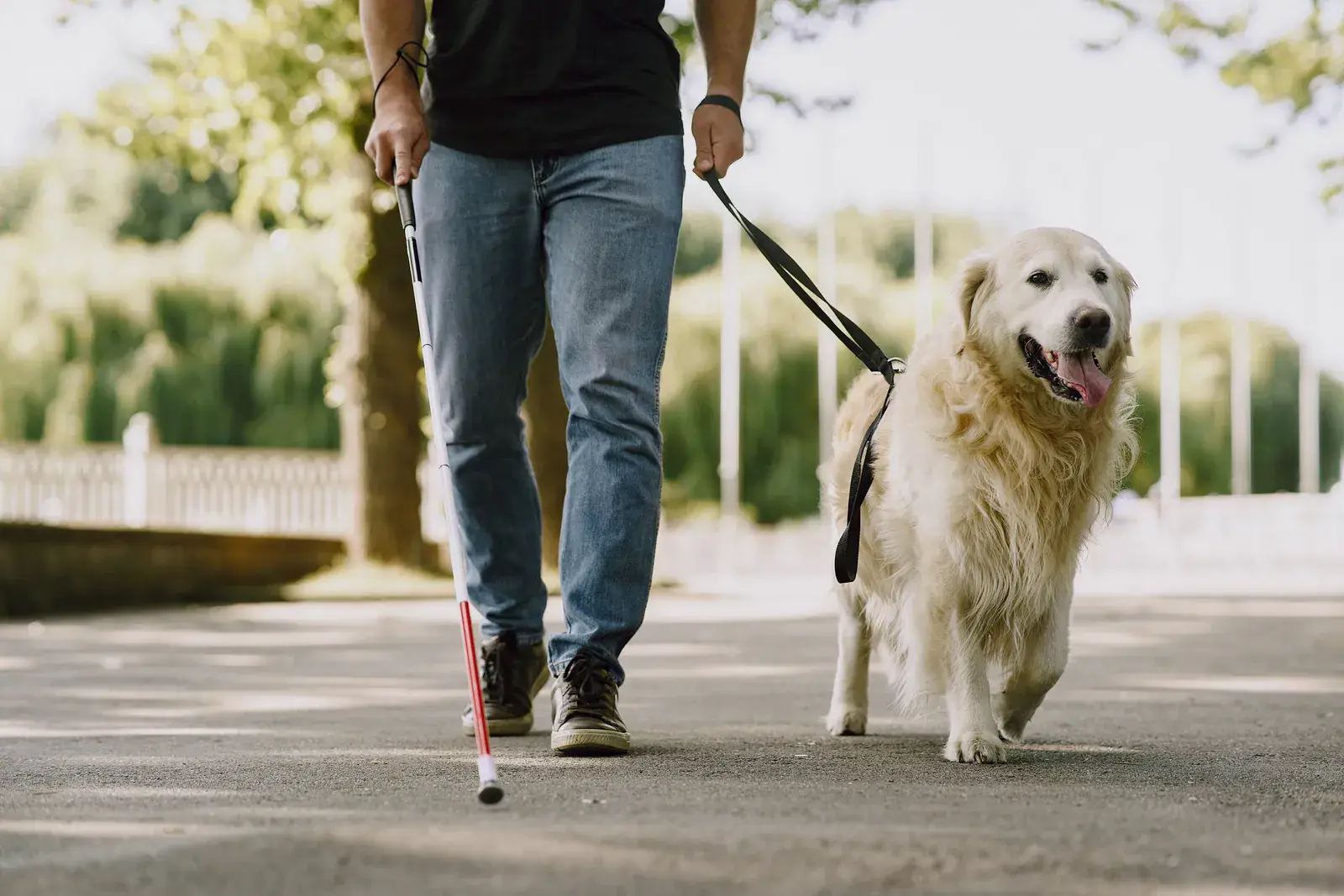
A therapy dog visits other people with its handler and offers calm company. An emotional support dog comforts its owner by being there, with no task training. Only the first has strong legal rights almost everywhere, and the rules for all three differ by country. This article sets out the definitions, then the law in the USA and in the UK, Germany, France, Spain, Italy and the Netherlands, then a comparison table and a warning about scams.
What each kind of dog does
 GuideAdvanced dog trainingAdvanced dog training explained: the 3 Ds, proofing, off-lead recall, formal heel, distance stays, impulse control, tricks, scent work, dog sports and Good Citizen schemes.
Assistance and service dogs
Assistance Dogs International (ADI) defines an assistance dog as a guide, hearing or service dog trained to do three or more tasks that reduce the effects of a person's disability. Typical types:
- Guide dogs for people who are blind or have low vision.
- Hearing dogs for people who are deaf or hard of hearing.
- Mobility dogs that pick up items, open doors and brace or pull.
- Medical alert dogs, for example for seizures or diabetes.
- Psychiatric service dogs, for example trained to sense an oncoming anxiety attack or PTSD episode and act to lessen it.
- Autism assistance dogs.
"Assistance dog" is the common term in Europe. "Service dog" or "service animal" is the term in United States law. In this article they mean the same working dog.
Therapy dogs
A therapy dog goes with a handler to visit other people, in hospitals, care homes, schools or libraries. It is chosen for temperament: calm, friendly, steady around equipment and noise. It is not trained for one person's disability, and generally has no right to enter places where pets are not allowed. Visits happen by invitation of the venue.
Emotional support dogs
An emotional support animal (ESA) comforts its owner by presence. Assistance Dogs UK (ADUK) describes emotional support dogs as animals that give comfort without task training. A pet can be very important to someone's mental health, and the bond is real. The law, however, is built around trained tasks, which is why ESAs get fewer rights.
Why the terms get mixed up
ADI notes that there is no global legal definition and that service, support and therapy dog are often used as if they meant the same thing. The result is confusion for the public, for businesses and for handlers. Learn the local legal term, because that is what a landlord, airline or shop manager will go by.
 GuideHow to get an assistance dogHow to get a service dog or assistance dog in the USA, UK, Germany, France, Spain, Italy and the Netherlands: accredited schools, waits, owner-training and travel.GuideAdvanced dog trainingAdvanced dog training explained: the 3 Ds, proofing, off-lead recall, formal heel, distance stays, impulse control, tricks, scent work, dog sports and Good Citizen schemes.
Rights in the USA
Three separate rules apply: public places, housing and air travel.
 GuideMy Dog Is Lethargic: Causes and When to Call a VetDog tired, weak or not himself? Normal tiredness vs lethargy, emergency signs, common causes, what to note for the vet and what to avoid.
Public places: the ADA
Under the Americans with Disabilities Act (ADA), a service animal is a dog individually trained to do work or perform tasks directly related to a person's disability. The ADA.gov Service Animals FAQ sets out the practical points:
- If the need for the dog is not obvious, staff may ask only two questions: is the dog required because of a disability, and what task has it been trained to perform?
- Staff may not ask for documentation, ask for a demonstration or ask about the disability.
- No certification or registration is required. The ADA says such documents do not convey any rights under the ADA. Voluntary registries are allowed, mandatory ones are not.
- A dog trained to sense an oncoming anxiety attack and act to lessen it qualifies. A dog whose presence only comforts does not.
- Emotional support animals are not service animals under the ADA. Some state or local laws may offer them more.
- Therapy dogs are outside the ADA definition.
- A separate provision covers miniature horses, which businesses accommodate where reasonable.
Owner-trained dogs count too: the ADA does not require professional training.
Housing: the Fair Housing Act
In 2020 HUD (the housing department) issued notice FHEO-2020-01, which covered service animals and "support animals", meaning trained or untrained animals that give assistance or emotional support. It said that documents sold online (a certificate, a registration, a fee plus a short quiz) are not enough by themselves to show a disability-related need that is not obvious. Reliable documentation was a signed, dated note from the person's licensed health care provider, which can be a telehealth provider.
This area is changing. Law firm reports from 2026 say HUD rescinded the 2020 notice on 22 May 2026 and moved toward a standard closer to the ADA, with more weight on training. Details may change, so check HUD directly before you apply or rent. Some states also have their own rules. Florida law, for example, says internet ESA registration alone is not enough proof.
Air travel: the DOT rule
The U.S. Department of Transportation final rule "Traveling by Air With Service Animals" (Federal Register, December 2020) defines a service animal as a dog trained to work or perform tasks for a person with a disability, including a psychiatric disability. Key points:
- Emotional support animals are no longer service animals on flights. Airlines may treat them as pets.
- Airlines may ask for the DOT Service Animal Air Transportation Form (training, behaviour and health), plus a second form on flights of eight hours or more about relief arrangements. A vet signature is no longer needed.
- Airlines may limit a passenger to two service animals, require the dog to fit in the foot space and be leashed or in a harness, and refuse a dog that poses a direct threat. They may not refuse by breed.
- A current rabies vaccination is required for service dogs in the cabin.
Airlines publish their own steps, so check yours well before the flight and confirm the rule is still current.
 GuideIs your dog suited to therapy work?How to make your dog a therapy dog: temperament checklist, first training steps, how Pet Partners, TDI and Pets As Therapy assess dogs, and welfare limits.GuideMy Dog Is Lethargic: Causes and When to Call a VetDog tired, weak or not himself? Normal tiredness vs lethargy, emergency signs, common causes, what to note for the vet and what to avoid.
Rights in Europe
There is no single European Union law on assistance dogs. The European Disability Forum (EDF, 2025) calls for EU-wide mutual recognition of assistance dogs, which shows it does not exist yet. Each country decides its own rules. Here are six, with the UK included for readers even though it is outside the EU.
 GuideBorder Collie behaviour problems and how to train themBorder Collie behaviour and training: why they nip, chase, fixate and fear noise, what to do about each, and a weekly plan for owners.
United Kingdom
The Equality Act 2010 gives disabled people the right to use shops and services without discrimination, and its section 173 defines assistance dogs. The Equality and Human Rights Commission (EHRC) guide for businesses says the law applies to assistance dogs whether or not they were trained by a registered organisation. ESAs are not defined in the Act. ADUK, a coalition of accredited charities, says emotional support dogs are not referenced in law, so providers are not legally obliged to admit them. The EHRC says that letting a disabled person bring an ESA may be a reasonable adjustment depending on the facts, so the question is contested.
Germany
Assistance dogs are covered by the Behindertengleichstellungsgesetz (BGG), sections 12e to 12l, added in 2021, and the Assistenzhundeverordnung (AHundV), in force since 1 March 2023. After the human and dog pass the test, the team is certified, and the certification runs until the dog is 10 (section 19). Handlers show a badge on the dog (coat, harness or collar) or the ID.
The system has had teething problems. Bundestag papers report that the body that accredited training sites returned its accreditation in April 2024, which left no way to certify training sites for a time. Check the current position with the federal labour ministry or a disability organisation before you plan.
France
Article 54 of the law of 11 February 2005 gives guide and assistance dogs access to public places. According to ministerial answers in the Assemblée nationale, access applies to holders of the Carte Mobilité Inclusion with the "invalidité" and "priorité" mentions, together with the dog's certificate. The national certificate model is set by an order of 9 May 2017. A 2022 answer gave fines for refusing access of up to 450 euros for an individual and 2,250 euros for a company, though other sources describe the penalty differently, so verify on Legifrance. Refusals are still reported in shops, restaurants, hotels and transport.
Spain
Royal Decree 409/2025, published in the BOE on 28 May 2025, regulates assistance dogs and their welfare across the country. It replaces a 1983 decree that covered guide dogs only, and it gives one framework for all regions, so recognition does not stop at a regional border. Summaries list several types, including guide, service, sound-signalling, medical alert and autism support dogs. Emotional support dogs are not covered. Regional laws still exist, for example in Catalonia, so check the rules where you live.
Italy
Law 37/1974 lets guide dogs enter places open to the public, with an exemption from the muzzle. Law 60/2006 added an administrative fine of 500 to 2,500 euros for obstructing access (disabili.com summary). No national law of the same strength exists for other assistance dogs, and some regions, such as Piemonte, have their own laws. Check the Gazzetta Ufficiale for updates.
The Netherlands
Refusing an assistance dog is treated as discrimination, based on the UN Convention on the Rights of Persons with Disabilities, in force there since 2016. There is no formal legal definition of an assistance dog, and the government said in 2023 it was looking into a certification system. Enforcement is weak, and a survey by the Dutch assistance dog trade association reported that 44% of users had been refused access at some point.
Emotional support dogs in Europe
No European country gives emotional support dogs legal access rights. They are not recognised in UK law, Spain's decree or, the German and French rules. Rules vary by country, so confirm locally.
 GuideHow to adopt a dog from a shelter or rescueHow to adopt a dog from a shelter or rescue: the process, costs in general terms, choosing a dog, the first weeks and what if it does not work out.GuideBorder Collie behaviour problems and how to train themBorder Collie behaviour and training: why they nip, chase, fixate and fear noise, what to do about each, and a weekly plan for owners.
Travelling in Europe with an assistance dog
Regulation (EC) 1107/2006 covers disabled passengers and passengers with reduced mobility flying within, to and from the EU. It covers carrying recognised assistance dogs in the cabin, subject to national rules, at no extra charge. "Recognised" is not defined. The European Commission guidelines say to tell the carrier at least 48 hours before departure. Pet travel rules under Regulation (EU) 576/2013 still apply: microchip, then rabies vaccination, a wait of at least 21 days before travel and an EU pet passport from an authorised vet. There is no exemption for assistance dogs. Airline practice varies, so ask each airline in writing.
 ArticleDog Breed Family Tree: How All Dog Breeds Are RelatedThe dog breed family tree from Ice Age wolves to 29 breed families.
 Save
 GuideHow to Groom a Dog: Brushing, Baths, Nails and CoatsHow to groom a dog at home: coat types, brushing, how often to bathe, cutting nails, ears, teeth, shedding, matting and whether to shave a double coat.ArticleDog Breed Family Tree: How All Dog Breeds Are RelatedThe dog breed family tree from Ice Age wolves to 29 breed families.
Comparison table
| Service / assistance dog | Therapy dog | Emotional support dog | |
|---|---|---|---|
| Main job | Trained tasks for one person with a disability | Visits other people with a handler | Comfort by presence |
| Task training | Yes, three or more tasks (ADI) | Temperament and manners, no disability tasks | None required |
| Public access (USA, ADA) | Yes | No | No |
| Public access (UK, Germany, France, Spain, Italy, Netherlands) | Yes, with country rules and conditions | Generally no | Generally no |
| Housing (USA) | Yes, changing rules | No special rights | Rules in flux, see HUD |
| Air travel (USA) | Yes, with forms | Treated as a pet | Treated as a pet |
| Certificate buys rights? | No | No | No |
 GuideDog Breeds by Country: Which Nations Made the Most?Dog breeds by country: how many breeds each nation produced in the Dogs Atlas data, from the UK and France to Japan, plus national dogs and families.
 GuideSmartest dog breeds: what the rankings measure and what they missCoren's smartest dog breeds list, what it measured, what newer dog cognition research says, three kinds of dog intelligence and why smart dogs need work.GuideDog Breeds by Country: Which Nations Made the Most?Dog breeds by country: how many breeds each nation produced in the Dogs Atlas data, from the UK and France to Japan, plus national dogs and families.
Online certificates and registrations
Websites sell "registration", "certification", ID cards and vests for a fee. Under the ADA, none of this carries rights. HUD asked the Federal Trade Commission in 2019 to look into websites selling assistance animal documents. Real recognition comes from training (and testing, where a country requires it), not from a purchase. In Europe the rules say the same in different words: a certificate follows a test or an accredited school, not a payment form.
 GuideMy Dog Keeps Licking His Paws: Causes and What HelpsDog licking paws all the time: allergies, parasites, injury, yeast and boredom.
A fake vest has a cost for real teams. Pet dogs passed off as service dogs can lunge, bark or fight, and a single incident can make a business more suspicious of genuine teams. If you live with anxiety, depression or loneliness, a dog can still help. Say so honestly, ask your doctor about a letter where the housing rules allow it and look at therapy work or a trained psychiatric service dog (see Is your dog suited to therapy work?) instead of buying a badge.
 GuideMy Dog Keeps Shaking His Head: Ear Infection GuideDog shaking head, scratching ears or smelly ears? Ear infection signs, causes, ear haematoma, emergency signs, what to do and what to avoid.GuideMy Dog Keeps Licking His Paws: Causes and What HelpsDog licking paws all the time: allergies, parasites, injury, yeast and boredom.
Common mistakes
- Calling a pet a service dog to take it into a shop. It is not fair to the dog, who may be stressed, or to the businesses and genuine teams.
- Believing a certificate is a legal pass. In the USA the ADA says it is not.
- Assuming the rules are the same everywhere. A dog recognised in one country may need extra proof in another.
- Petting a working dog. It breaks the dog's focus. Ask the handler first, and expect a "no".
- Treating a therapy dog as an assistance dog. Visiting a hospital by invitation is not the same as access rights.
 GuideHow to calm a reactive dogHow to calm a reactive dog: why dogs bark and lunge, what to do in the moment, a step-by-step training plan, what to avoid and when to get help.
 GuideDogs in Legends and Fairy TalesDogs in folklore and fairy tales: Black Shuck, The Tinderbox, Saint Guinefort, Panhu, Greyfriars Bobby, Barry and Old Drum, with legend and history kept apart.GuideHow to calm a reactive dogHow to calm a reactive dog: why dogs bark and lunge, what to do in the moment, a step-by-step training plan, what to avoid and when to get help.
Safety notes
- Laws change. Check the official body (ADA.gov, your national disability authority, the airline) before you act.
- Use rewards only when training any of these dogs. A dog under stress is not a safe working dog.
- A dog that is anxious in public, reactive or easily startled should not be put in public access work. Our guide to the reactive dog explains what to do first.
 GuideDog Pregnancy: Length, Signs and Week by WeekHow long dogs are pregnant, signs of pregnancy, a week by week table, giving birth, false pregnancy and when to call a vet.
 GuideBest dog breeds for familiesBest dog breeds for families, small homes, allergies, first-time owners and seniors, ranked from our breed ratings, with honest limits and a table.GuideDog Pregnancy: Length, Signs and Week by WeekHow long dogs are pregnant, signs of pregnancy, a week by week table, giving birth, false pregnancy and when to call a vet.
Read next
 GuideWhy does my dog do that? 15 common behavioursWhy does my dog lick me, stare, eat grass, spin, sigh or roll in smelly things? 15 everyday dog behaviours explained, with when to ask a vet.
 GuideDog Clothes: When Dogs Need Coats, and a Short History of Dog FashionDo dogs need coats in winter? When clothes help, when costumes stress a dog, safe fit, reflective gear, and a short history of dog fashion and dog art.GuideWhy does my dog do that? 15 common behavioursWhy does my dog lick me, stare, eat grass, spin, sigh or roll in smelly things? 15 everyday dog behaviours explained, with when to ask a vet.
FAQ
Do service dogs need certification?
In the USA, no. The ADA requires no certification or registration. In Germany and France, a national certificate exists and is part of how access works. In the UK, ID is optional and not a legal requirement for access.
Can emotional support dogs go in shops?
In the USA, not by right under the ADA. In most of Europe, generally no. Some places let them in by choice.
Can emotional support dogs fly?
Not as service animals in the USA since the 2020 DOT rule. Airlines may treat them as pets.
Is a psychiatric service dog the same as an ESA?
No. A psychiatric service dog is trained to do tasks, such as sensing an oncoming anxiety attack and acting to lessen it. An ESA comforts by presence.
Can a therapy dog go anywhere with me?
No. A therapy dog visits where it is invited. It has no general access right.
Read next
 Family storyRetrieverRead the family's story: origins, members, DNA
 Family storyModern CrossbreedRead the family's story: origins, members, DNA
 Family storyPoodleRead the family's story: origins, members, DNA
Sources (14)
- Assistance Dogs International. Global Assistance Dog Policy Statement; ADI Terms and Definitions.
- ADA.gov. Service Animals FAQ; ADA Requirements: Service Animals (2011).
- U.S. Department of Housing and Urban Development. Notice FHEO-2020-01 (28 January 2020); press release pr19-162 (2019).
- Duane Morris LLP. "The End of an Era: HUD's 2026 Guidance" (12 June 2026). Secondary source.
- U.S. Department of Transportation. Final rule, Traveling by Air With Service Animals (Federal Register, 10 December 2020).
- Assistance Dogs UK. Assistance Dogs, Emotional Support Dogs and Therapy Dogs.
- Equality and Human Rights Commission. Assistance dogs: a guide for businesses.
- Bundesamt für Justiz. Assistenzhundeverordnung (AHundV), 19 December 2022; Deutscher Bundestag papers 2024 and 2025.
- Assemblée nationale. Ministerial answers on guide and assistance dog access (2022 to 2025).
- Boletin Oficial del Estado. Real Decreto 409/2025 of 27 May 2025.
- Disabili.com. Summary of Italian laws 37/1974 and 60/2006. Secondary source.
- Tweede Kamer reply (2023); BNNVARA Zembla (2020); Dutch parliamentary papers citing a trade association survey.
- European Disability Forum. Position Paper on assistance dogs transport (2025).
- Regulation (EC) 1107/2006; Regulation (EU) 576/2013.