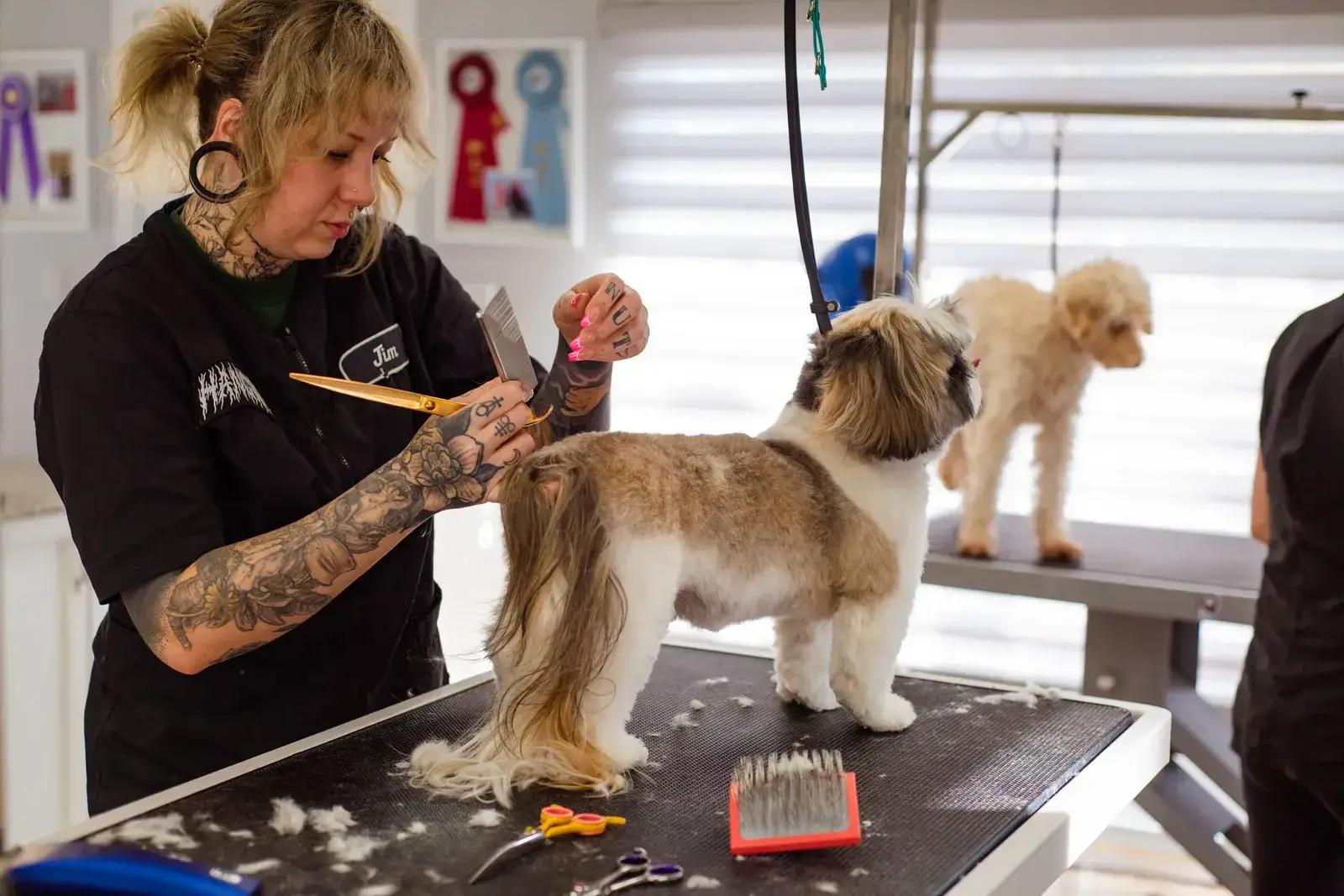
Most groomers are careful and kind. The difficulty is that in many countries the job is not regulated, so anyone can open a salon, and a certificate on the wall does not always mean much. This guide explains what qualifications exist, what to ask before the first visit, what a good and a poor groomer look like, and what to check when your dog comes home. For home care between visits, see our dog grooming guide.
Do dog groomers need qualifications?
Usually not by law. In England there is no licensing scheme for groomers. Trade sources say that, unlike dog daycare, home boarding, kennels and catteries, grooming has no licensing rules there. One UK training college states that no official qualification is needed to become a dog groomer, although training is recommended.
 GuideDog Breeds by Country: Which Nations Made the Most?Dog breeds by country: how many breeds each nation produced in the Dogs Atlas data, from the UK and France to Japan, plus national dogs and families.
The picture differs across the UK and elsewhere:
- Scotland. The Scottish Government consulted in 2023 on licensing dog groomers, with checks, experience or qualification standards and inspections. It is unclear whether the scheme has been introduced, so ask your local council.
- Wales. A 2024 Senedd research brief says the Welsh Government had no plans to license grooming establishments under its Animal Welfare Plan 2021 to 2026, although a consultation had asked for views on it. Groomers are covered by the general duties of the Animal Welfare Act 2006.
- Germany. The groomer is not a recognised training occupation. A 2025 press release from IHK Potsdam and the ZZF, the German pet trade association, says there are about 5,000 dog grooming businesses and no binding standards, and announces a certificate course for groomers.
- Austria. The public employment service says the training is not regulated by law and skills come from short courses.
- United States. Veterinarian Debra Eldredge notes that groomers are generally unregulated in most states, so checking matters more.
Rules change. Check your local council or national pet trade body for the current position.
 GuideDog Grooming Competitions and Show Standards ExplainedHow breed standards shape dog grooming, from hand-stripped terriers to Poodle show clips, and how grooming competitions and creative grooming work.GuideDog Breeds by Country: Which Nations Made the Most?Dog breeds by country: how many breeds each nation produced in the Dogs Atlas data, from the UK and France to Japan, plus national dogs and families.
Qualifications and accreditations
Because the law is thin, voluntary qualifications are the main signal. These are examples, not a full list.
 GuideDog Heat Cycle: Signs, Stages and How Long It LastsHow long dogs bleed in heat, when the first heat comes, the four cycle stages, signs, caring for her, and how males react.
| Scheme | Where | What it is |
|---|---|---|
| City and Guilds Dog Grooming Assistant (7863-02) | UK | Level 2 certificate. Covers preparing and grooming dogs before bathing, bathing, drying and biosecurity |
| City and Guilds Diploma in Dog Grooming (7863-03) | UK | Level 3 diploma aimed at professional groomers. The route in is the Level 2 assistant certificate |
| iPET Network Level 3 | UK | A level 3 grooming qualification. One supplier comparison says it has no prior requirement and assesses through theory assignments and practical tests |
| National Certified Master Groomer (NCMG), National Dog Groomers Association of America | United States | Written and practical exams by breed group, with groomers handling dogs in front of judges. Candidates need an average of 85 percent across tests to qualify for the Master Exam |
| Certificate course by IHK Potsdam and ZZF | Germany | A new certificate for groomers covering dog care, work routines, management and customer communication |
The British Dog Groomers Association, part of the Pet Industry Federation, is the main UK trade body, and it promotes recognised training and good practice.
Two cautions. First, training providers describe their own courses, and phrases like "industry benchmark" are marketing. Second, a certificate shows that someone passed a course, not that they are gentle with a frightened dog. Use qualifications together with what you see in the salon.
 GuideHow to Groom a Dog: Brushing, Baths, Nails and CoatsHow to groom a dog at home: coat types, brushing, how often to bathe, cutting nails, ears, teeth, shedding, matting and whether to shave a double coat.GuideDog Heat Cycle: Signs, Stages and How Long It LastsHow long dogs bleed in heat, when the first heat comes, the four cycle stages, signs, caring for her, and how males react.
Questions to ask a groomer
Ask these before you book, and watch how the answer is given. A good groomer is relaxed about questions.
 GuideMy Dog Keeps Shaking His Head: Ear Infection GuideDog shaking head, scratching ears or smelly ears? Ear infection signs, causes, ear haematoma, emergency signs, what to do and what to avoid.
- Do you sedate dogs? The answer should be no. Dr Eldredge advises avoiding any groomer who sedates animals, because of the risk of overdose or a serious allergic reaction. If your dog truly cannot be groomed without sedation, ask your vet about grooming at the clinic, where a medical professional is present.
- How do you dry the dogs? Ask whether cage dryers are used, for how long and whether someone watches the whole time. The SPCA of British Columbia suggests asking about constant supervision to prevent overheating. Dr Eldredge advises asking for cool air or towels rather than hot air, especially for flat-faced, older or overweight dogs.
- Is someone always with my dog on the table? The answer should be a clear yes. Dogs jump, and a hanging collar or loop is a hazard.
- Can I stay, or watch? The SPCA of British Columbia lists this as useful for anxious pets.
- What happens in an emergency? Ask about pet first aid training and which vet they use.
- How do you work with nervous or older dogs? Raise fear, aggression or arthritis before the first visit. Many groomers book longer slots and allow breaks.
- What are your qualifications and what insurance do you have? Ask them to explain, rather than relying on the wall.
- What will you do to the coat? Describe what you want, such as "short all over" or "breed trim", and ask what is realistic for your dog's coat and condition.
- What vaccinations do you require? Careful salons ask for proof, and clean tables and tools between dogs.
 GuideMy Dog's Eye Is Red: Causes and When to See a VetRed, weepy or squinting dog eye? Emergency signs, common causes like conjunctivitis and ulcers, what to do at home, what to avoid, and when to see a vet.GuideMy Dog Keeps Shaking His Head: Ear Infection GuideDog shaking head, scratching ears or smelly ears? Ear infection signs, causes, ear haematoma, emergency signs, what to do and what to avoid.
Signs of a good groomer
- You may look around. The salon smells clean, tables and tools are wiped between dogs, and dogs are not shouting in distress.
- The groomer asks about your dog's coat, health, nervousness and past clips before starting, and writes it down.
- They explain what they plan to do and say so if the coat is matted. A badly matted coat may need a short clip instead of a long brush-out, and an honest groomer says this and does not push the dog through a long, painful session.
- They take breaks, handle the dog gently and stop if the dog is distressed.
- They tell you about skin problems, lumps, ear trouble or sore teeth they notice, and suggest a vet visit without making a diagnosis.
- They are open about delays and dryers, and give honest answers about sedation.
- Your dog comes out tired but relaxed, and is not terrified of the next visit.
 GuideMy Dog Is Panting a Lot: Normal or Worrying?Dog panting heavily? Normal vs worrying panting, heatstroke signs and cooling steps, pain, anxiety, Cushing's disease, and when to see a vet.
 GuideWinter Care for Dogs: Cold, Paws, Antifreeze and IceWinter care for dogs: how cold is too cold, coats, salt and antifreeze, hypothermia, frostbite, frozen ponds, dark walks and holiday hazards.GuideMy Dog Is Panting a Lot: Normal or Worrying?Dog panting heavily? Normal vs worrying panting, heatstroke signs and cooling steps, pain, anxiety, Cushing's disease, and when to see a vet.
Signs of a poor groomer
If something goes wrong, tell the groomer, take your dog to a vet and keep photos and the vet's notes.
 GuideDogs in myth around the worldFrom Anubis and Cerberus to Fenrir, Xolotl and the Tiangou: how cultures across the world imagined dogs as guardians, guides and monsters.
- They will not let you see the salon or answer questions.
- They suggest a tranquilliser or "something to calm the dog".
- Dogs are left in a heated dryer cage without someone watching.
- The dog is left on a table alone, or tied by the neck.
- Handling is rough, shouting is common or a dog is forced through panic.
- Hygiene is poor: hair everywhere, dirty tables, tools reused without wiping.
- They push you to clip a double coat down to the skin without a reason.
- Your dog comes home with cuts, razor burn, a limp, burnt skin, red eyes or extreme fear, and the groomer shrugs it off.
 GuideMy Dog Has Bad Breath: Causes and What to DoDog breath smells? Gum disease is the usual cause, but sweet or ammonia smells can mean illness.GuideDogs in myth around the worldFrom Anubis and Cerberus to Fenrir, Xolotl and the Tiangou: how cultures across the world imagined dogs as guardians, guides and monsters.
Salon, mobile groomer or home visit?
All three can be good. The right choice depends on the dog.
 GuideDog hybrids: what dogs can and cannot breed withCan dogs breed with wolves, coyotes, jackals or foxes? Wolfdogs, coydogs, the Sulimov dog and Dogxim explained, with chromosomes and DNA studies.
| Option | How it works | Fits | Watch for |
|---|---|---|---|
| Salon | You drop the dog off. Several dogs may be in the building | Healthy, sociable dogs; coats that need a big dryer and a full table | Noise, waiting in a crate or cage, dryer use |
| Mobile groomer | A van or trailer comes to your home, usually one dog at a time | Nervous or older dogs, owners with limited mobility, households with several dogs | Space in the van, heat in summer, whether power and water are safe |
| Home visit | The groomer works in your home or garden | Dogs that cope badly with cars and noise | Floor protection and how your dog reacts to a stranger in its space |
A mobile groomer removes the car trip and the salon crowd, which many dogs find easier, but it is not automatically better. The same questions about sedation, drying and supervision apply. For a puppy, the first visit is mostly about learning that handling is safe, so ask for a short visit with just a wash and a gentle tidy.
 GuideBest dog breeds for familiesBest dog breeds for families, small homes, allergies, first-time owners and seniors, ranked from our breed ratings, with honest limits and a table.GuideDog hybrids: what dogs can and cannot breed withCan dogs breed with wolves, coyotes, jackals or foxes? Wolfdogs, coydogs, the Sulimov dog and Dogxim explained, with chromosomes and DNA studies.
Working with nervous and older dogs
Fearful dogs do best with a groomer who gives them time. Helpful signs are short, calm visits, a quiet slot with fewer dogs and permission to stop. Practise handling at home first, such as touching paws, a dryer on low and a damp cloth on the face. An older dog may need frequent breaks, a non-slip surface and a shorter session. For a dog with arthritis or a heart condition, talk to your vet before booking, and tell the groomer what the vet said.
 GuideDog Clothes: When Dogs Need Coats, and a Short History of Dog FashionDo dogs need coats in winter? When clothes help, when costumes stress a dog, safe fit, reflective gear, and a short history of dog fashion and dog art.
 ArticleDog Breed Family Tree: How All Dog Breeds Are RelatedThe dog breed family tree from Ice Age wolves to 29 breed families.GuideDog Clothes: When Dogs Need Coats, and a Short History of Dog FashionDo dogs need coats in winter? When clothes help, when costumes stress a dog, safe fit, reflective gear, and a short history of dog fashion and dog art.
After the visit
Check your dog the same day, ideally while the coat is fresh:
 GuideLivestock guardian dogs: what they do and who they suitWhat livestock guardian dogs do, how they differ from herding dogs, 40 LGD breeds by country, the DNA evidence, and whether they make good pets.
- Skin. Look under the chin, in the armpits, around the groin, behind the ears and near the nails for redness, razor burn, nicks or hot spots.
- Ears, eyes and feet. Check for redness, discharge, squinting, a limp or sore pads.
- Behaviour. A tired dog is normal. Shaking, hiding, refusing food or flinching when touched is not.
- The clip. Is it what you agreed? If not, say so politely and ask what happened.
- Next steps. Ask how often the coat needs a visit and what you can do between visits.
A tiny nick that stops bleeding is minor, but tell the groomer. Anything deeper, a burn, or a dog that seems unwell goes to a vet.
 GuideDogs of Japan: the native breeds and their storiesJapanese dog breeds explained: the six Nihon Ken, the Chin, Tosa, Japanese Spitz and Terrier, Hachiko, wartime near-extinction, DNA and who they suit.GuideLivestock guardian dogs: what they do and who they suitWhat livestock guardian dogs do, how they differ from herding dogs, 40 LGD breeds by country, the DNA evidence, and whether they make good pets.
Frequently asked questions
How do I find a good dog groomer near me?
Ask your vet, local owners and breed clubs for names, then visit before you book. Look at the salon, ask the questions above and start with a short first visit.
Do dog groomers need a licence?
Not in England, and rules vary elsewhere. Scotland has consulted on licensing and Wales has asked for views. Check your local council.
What qualifications should a dog groomer have?
None are required by law in many places. City and Guilds and iPET Network are examples in the UK, and the NDGAA certification exists in the United States. Combine them with what you see in the salon.
Is it normal for a groomer to sedate a dog?
No. Veterinary advice is to avoid groomers who sedate. If your dog needs sedation, a vet should decide it and give it, ideally at the clinic.
Are cage dryers safe?
They are usually safe but mistakes happen. Ask whether someone watches throughout and whether cool air or towels can be used, especially for flat-faced, older or overweight dogs.
Is a mobile dog groomer better?
It is easier for many nervous and older dogs. It is not a guarantee of quality, so ask the same questions.
How do I know if my groomer is good?
Your dog is calm, the clip is as agreed, you were told about anything they noticed and there are no nicks or sore skin. A good groomer welcomes questions.
How often should my dog go to the groomer?
It depends on coat and clip. Many owners of clipped breeds go every 4 to 8 weeks. Our guide on dog grooming shows how to manage between visits.
Can I ask the groomer to cut my dog's coat short?
Yes, but a groomer may advise against shaving a double coat, which protects against heat, cold and sun.
Where can I read about show trims?
Read next
 Family storyAsian ToyRead the family's story: origins, members, DNA
 Family storyEast Eurasian dogsRead the family's story: origins, members, DNAFamily storyPoodleRead the family's story: origins, members, DNA
Sources (13)
- City and Guilds, qualification pages for Dog Grooming Assistant (7863-02) and Diploma in Dog Grooming (7863-03).
- College of Animal Welfare, "Do You Need Qualifications to Become a Dog Groomer in the UK" (training provider view).
- Groomarts, comparison of City and Guilds and OCN or iPET Network Level 3 (2019, supplier view).
- National Dog Groomers Association of America, National Certified Master Groomer certification pages
- Scottish Government, consultation "Licensing activities involving animals" (2023).
- Senedd Research, research brief on licensing of dog grooming establishments (2024).
- Global Pet Industry, "Transitioning the UK grooming industry into maturity: is it time?" (trade article).
- IHK Potsdam and ZZF (Zentralverband Zoologischer Fachbetriebe), press release on the certificate course for dog groomers (August 2025).
- AMS Austria (Arbeitsmarktservice), "Die Ausbildung zum Hundefriseur".
- Debra Eldredge, DVM, advice on choosing a groomer, sedation and dryers
- SPCA of British Columbia, "How to find the best groomer for your pet".
- SheKnows, "Keep your dog safe at the groomer".
- WebMD, "Dog Grooming FAQ: What to Look for in a Dog Groomer".