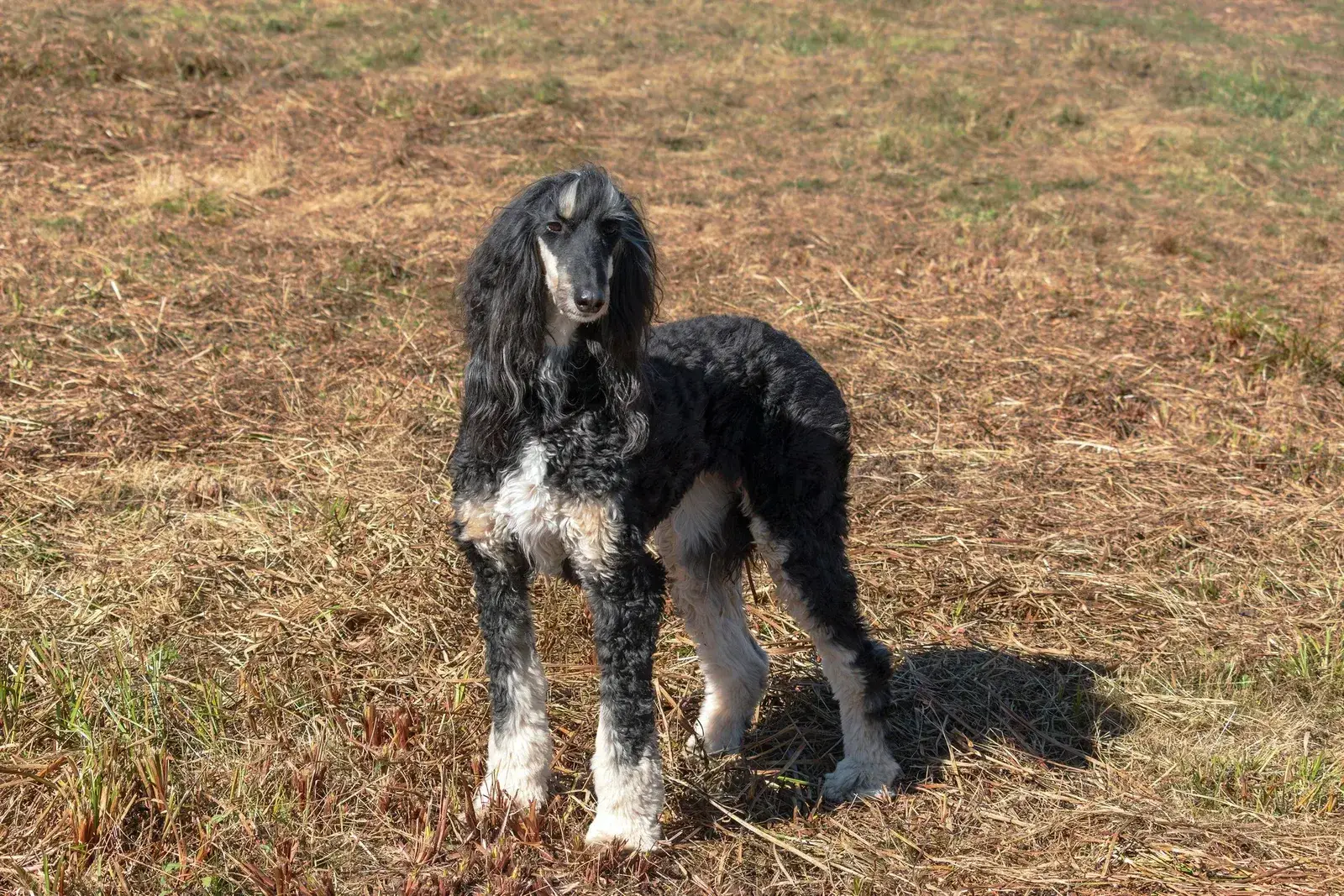
It is best known for its silky coat, its topknot of fine hair on the head and a ring-shaped curl at the end of its tail. It is also known for its manner: independent, dignified and often reserved with strangers. This guide covers where the Afghan Hound came from, what the breed standards say, what its temperament is like, which health issues have been studied, and what it takes to live with one.
Afghan Hound quick facts
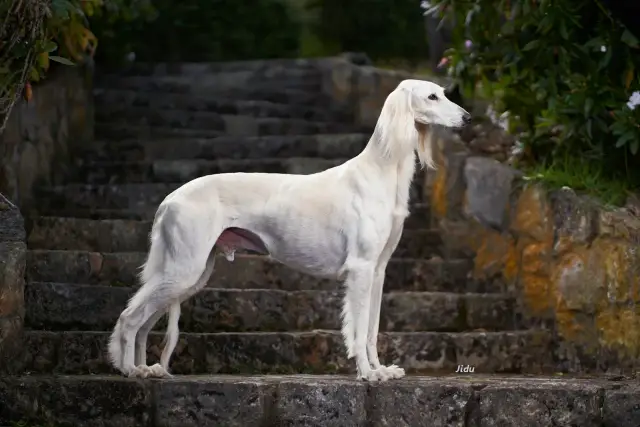 Related breedSaluki3000 BCE to 1922 · IraqAncient World
Drawn to scale in real centimetres. Its back reaches about 69 cm, mid-thigh; its head about 87 cm, your hip.
Where it sits in the tree
Early Middle Ages · 500 to 1199
Name and origin
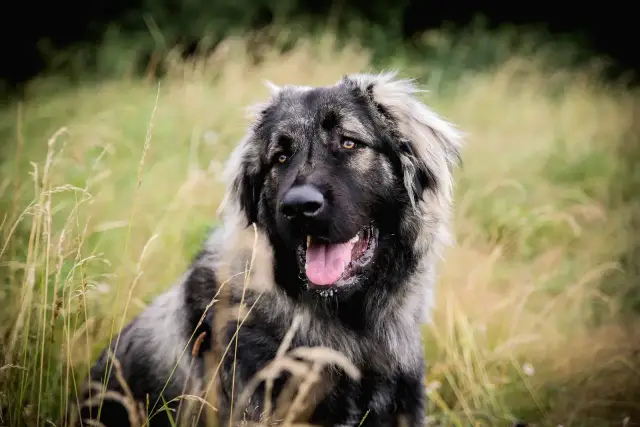 Related breedCaucasian Shepherd Dog500 BCE to 1920 · RussiaAncient World
The breed is named in English after its homeland. In Afghanistan the dog is called Tazi, written Sag-e Tāzī in Persian and Tāžī Spai in Pashto. The word tāzī is linked in our atlas data to a Persian word meaning "Arab" or "swift", and it is also the name of a wider group of sighthounds. English-speaking sources list other names for dogs of this region, including Baluchi Hound, Kuchi Hound, Balkh Hound and Kabul Hound. Which of those names fits which local type is not settled, so treat them as regional labels and not as separate breeds.
The Afghan Hound's origin is old but poorly documented. It came from Afghanistan, where nomadic people used it to course hares and gazelles over rocky country, and the breed is also credited with hunting larger game in the mountains. Our atlas data places its emergence between about 1000 and 1800, with low confidence, because no written or pictorial record firmly ties today's breed to a particular Afghan owner or place. Popular stories claim Noah took the Afghan Hound onto the ark or that it appears in cave art in ancient Afghanistan. The American Kennel Club treats the Noah story as folklore, and so should we.
What is clear is that Afghanistan held several kinds of sighthound. Breed writers describe at least two broad types:
- Desert or steppe type. Racy, fine-headed, light in coat, from the hot lowlands and Baluchistan side.
- Mountain type. Heavier coat, more bone and more angulation, from the colder uplands.
The exact number of types is argued over. One non-academic history says there are at least 13 landraces, and that some have vanished as traditional lifestyles changed, but this is not confirmed. Both main types fed into the modern show dog.

History
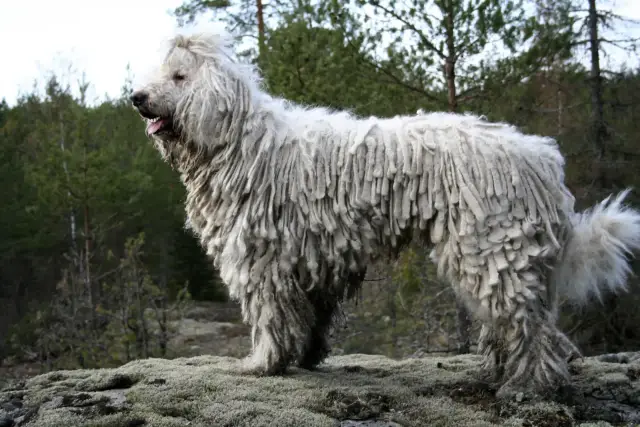 Same eraKomondor1200 to 1920 · HungaryLate Middle Ages
Hounds meet the British
Afghan-type hounds reached Europe through British military and colonial links with India and the northwest frontier. The first one to stand out was Zardin. Captain John Bariff (spelled Barff in some sources) bought him in India in 1907, and he was believed to have been born in Iran, so his exact origin is uncertain. Zardin was shown at Crufts in 1909, and his look became the model for the first written Afghan Hound standard, drawn up in 1912. The First World War stopped breeding, and none of Zardin's bloodline survives in modern pedigrees.
The Bell-Murray and Ghazni strains
The modern breed in Britain began after the war with two imports.
Bell-Murray strain (1920). Major and Mrs G. Bell-Murray and Miss Jean Manson brought a group of hounds from Baluchistan to Scotland in 1920. These were mostly desert type: light in coat, racy and fine in head. They formed the first true Afghan Hound kennel in the United Kingdom.
Ghazni strain (1925). Mary Amps ran a kennel in Kabul, and in 1925 she brought dogs to England. The foundation sire gave the strain its name and closely resembled Zardin. These were mountain types with heavier coats, more bone and more angulation. The best-known Ghazni dog, Sirdar, won Best in Show at Crufts in 1928 and 1930, according to breed histories.
The two strains competed in the show ring, and their breeders disagreed over which should set the standard. They were later merged into the one breed we know, and a new standard was written in 1948 that is still the base of current wording. Most of the early Afghans in the United States came from the Ghazni line.
Across the Atlantic and into the public eye
The AKC says the breed was recognised in 1926, the same year that Zeppo Marx brought an Afghan Hound to the United States, though another source gives 1927 for registration. Popularity grew over the decades that followed. Afghan Hounds won Best in Show at Westminster in 1957 and again in 1983, according to breed histories. A dog-world feature describes the 1970s as an unprecedented heyday for the breed, which has since declined in numbers.
Fame outside the show ring helped. The painter Pablo Picasso kept an Afghan Hound called Kabul and drew or painted the breed, including a 1962 work usually titled Femme au chien, and a Picasso sculpture inspired by his dog stands in Daley Plaza in Chicago, according to published sources. Barbie's pet is also an Afghan Hound called Beauty, according to the AKC. No source dates the doll's dog or shows it changed the breed's popularity, so that claim stays unproven.
Snuppy, the first cloned dog
In August 2005 a team at Seoul National University, led by veterinary scientist Hwang Woo-suk, announced the first cloned dog. The puppy, named Snuppy (from Seoul National University puppy), was an Afghan Hound born in April 2005. It was created by somatic cell nuclear transfer, the method used for Dolly the sheep: the nucleus of a skin cell from an adult male Afghan Hound was placed in an egg from which its own nucleus had been removed. A total of 1,095 reconstructed embryos were transferred into 123 surrogate mothers, giving two puppies, an efficiency of about 1.6 percent. One puppy died shortly after birth, so Snuppy was the only survivor. The result was published in Nature in 2005.
The story took a turn. Later in 2005 and into 2006, investigations found that Hwang had falsified data in two high-profile studies on human cloned stem cells. Doubts spread to Snuppy. Nature asked for independent checks, and in March 2006 it published two analyses, one by Elaine Ostrander's group at the US National Human Research Institute and one by a Seoul National University investigation panel. Both found Snuppy's DNA fingerprints were identical to those of the donor dog, Tai, and consistent with a genuine clone. The Seoul committee also ruled out twinning or as an explanation. So the scientist was disgraced, while the dog was real. Reports differ on small details, such as the breed of the egg donor and the birth date.
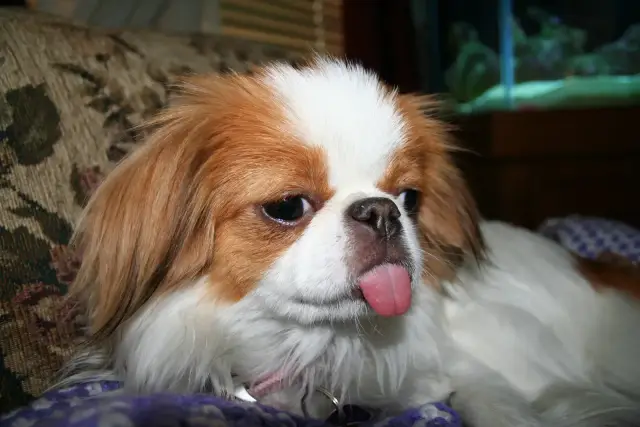
Relatives and DNA
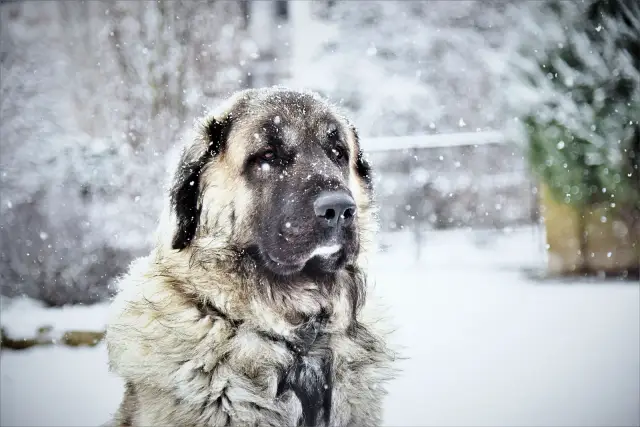 Same familyLeonberger1846 to 1895 · GermanyIndustrial Revolution
The Afghan Hound belongs to the Mediterranean family in the Parker 2017 DNA study, with strong support. In atlas data its closest DNA relative is the Saluki, with about 27.8 of segments (Parker 2017). Both are sighthounds from southwest and central Asia, so this fits what breeders had long assumed.
An earlier study, Parker and colleagues in Science in 2004, used genetic markers on 85 breeds and separated a small group of "ancient" breeds from the rest. The Afghan Hound was in that group, along with the Basenji and the Saluki. The study did not claim these dogs descend directly from the first domestic dogs, only that they differ from breeds with a recent European origin. Later work from the University of Aberdeen argued that some so-called ancient breeds, including the Afghan Hound, are no closer to the first dogs than any other breed, partly because of crossbreeding. In plain words, "ancient breed" tells you that the type is old and separate from European breeds. It does not mean the dog you meet is a living fossil.
Other sighthounds in our database include the Sloughi, the Azawakh, the Borzoi, the Greyhound and the Whippet. To see how the Mediterranean family sits among other breed families, look at the Mediterranean family page and the dog family tree.
Sister breeds · 1
- Saluki3000 BCE to 1922
- Saluki27.8 Mb 1.2%
Source: Parker et al. 2017. Percent of the whole genome.
The breed standard
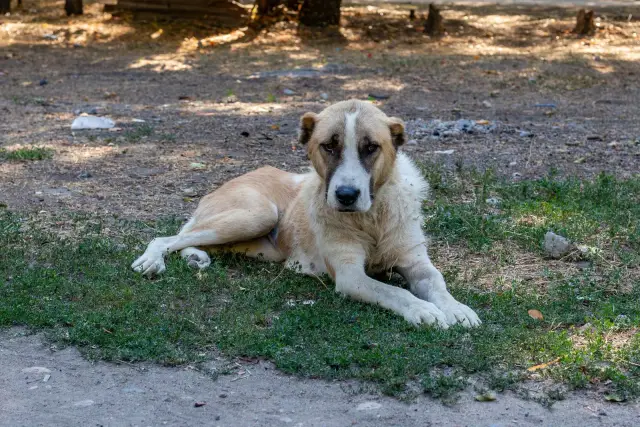
 Looks relatedPyrenean Mountain Dog1000 BCE to 1923 · FranceAncient World
A is the written ideal that a kennel club uses for judges to compare dogs against. For the Afghan Hound, the FCI (Fédération Cynologique Internationale), the AKC (American Kennel Club) and the UK Kennel Club each publish one. They agree on the main picture and differ on some measurements.
| Trait | What the standards say |
|---|---|
| Height at withers, males (FCI) | Ideal 68 to 74 cm |
| Height at withers, females (FCI) | Ideal 63 to 69 cm |
| Height (UK Kennel Club) | Same range as the FCI: 68 to 74 cm for dogs, 63 to 69 cm for bitches |
| Height and weight (AKC) | Dogs about 27 inches (69 cm) and about 27 kg; bitches about 25 inches (64 cm) and about 23 kg, with a one inch (2.5 cm) allowance either way |
| Weight (FCI) | Not stated in the standard |
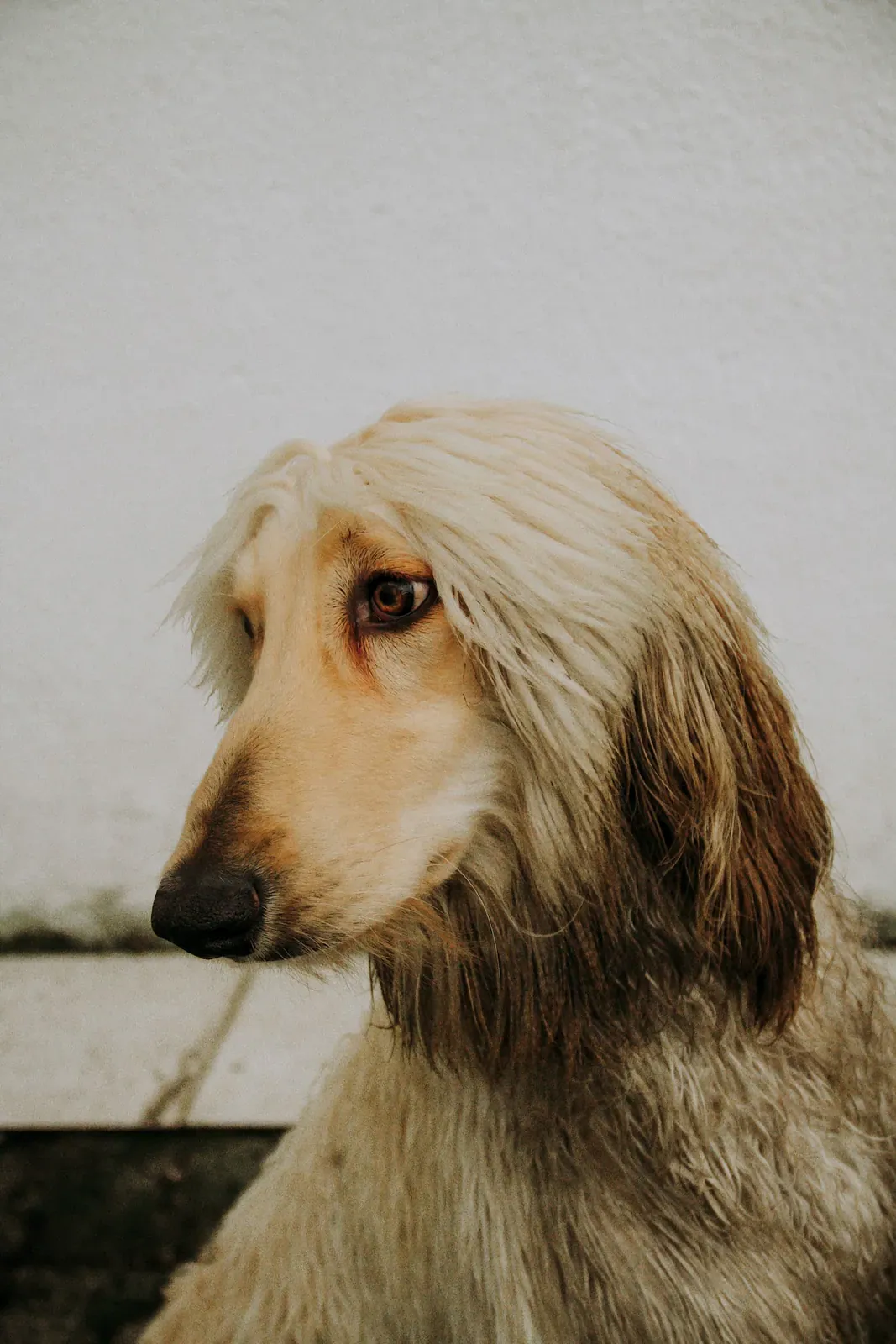
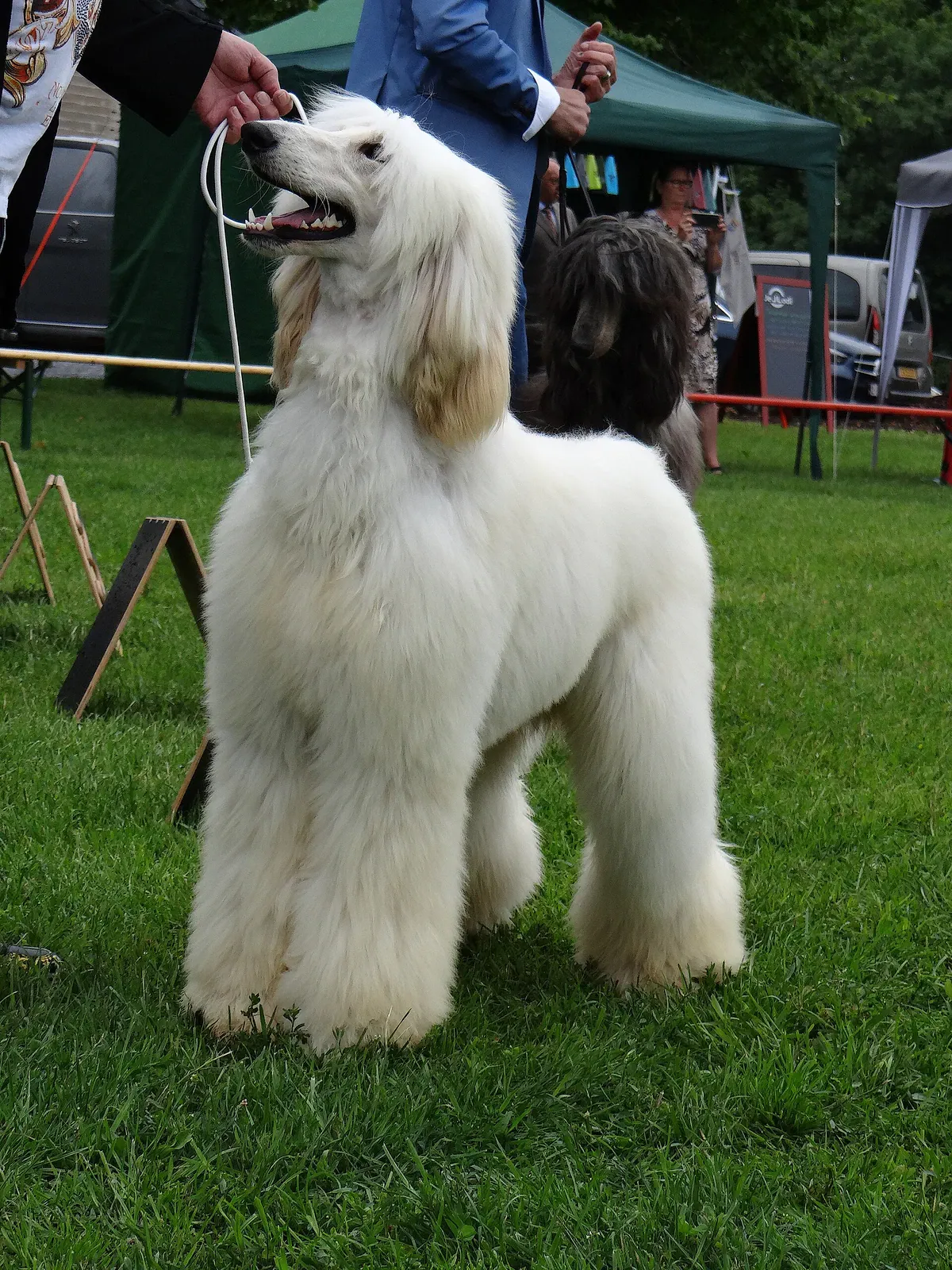
| Coat (FCI) | Long, fine and silky on the forehead backwards, with a distinct silky topknot; short and close along the saddle in mature dogs; short hair on the foreface; ears and legs well coated; clipping or scissoring is penalised |
| Colours (FCI) | All colours are acceptable |
| Colours (UK Kennel Club) | All colours acceptable except merle, which is unacceptable; white markings on the head and collar are highly undesirable |
| Head and ears (FCI, UK Kennel Club) | Long, refined head with a prominent occiput and a topknot; ears set low and well back, carried close, covered with long silky hair |
| Tail (FCI, UK Kennel Club) | Set low, with a ring at the end |
| Build (FCI, UK Kennel Club) | Strong, tall, with a level back and prominent hip bones; a free, springy gait |
The weights in the AKC row are rounded from pounds, and the FCI weight is not stated, so any figure other than these should be treated as a rough guide. Some sources quote 20 to 27 kg overall. The Afghan Hound is a large dog, but light for its height, because it is built for speed.
"Saddle" in the coat row is the area of the back where adult dogs carry short, close hair, in contrast with the long hair on the sides and legs. This pattern is one reason the Afghan Hound looks so unlike other sighthounds.
Temperament
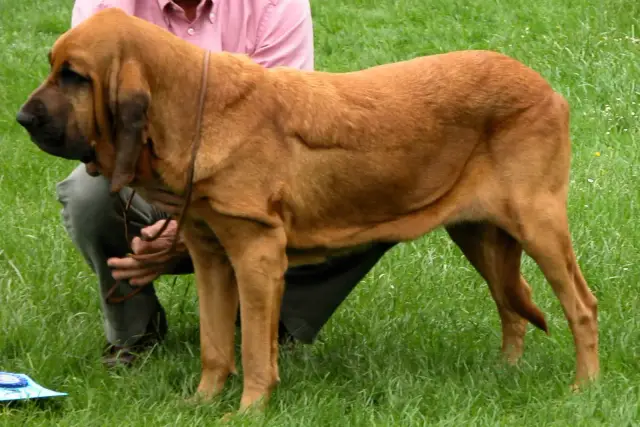 Related breedBloodhound1000 to 1100 · Belgium, FranceEarly Middle Ages
The Afghan Hound is described in the standards and by breed clubs as dignified, aloof and independent. The FCI standard speaks of an aloof and dignified dog, sometimes with a comical streak. Owners often use words like "cat-like" for its manner. See the smartest dog breeds for how this breed compares with others on trainability.
Typical features include:
- Aloof with strangers. It does not usually greet visitors with enthusiasm. A quiet, polite distance is normal.
- Close to its own people. Many Afghans are affectionate at home with family, in their own style and not clingy.
- Independent thinker. Sighthounds were bred to hunt on their own initiative at a distance from the handler, not to wait for commands. Training works with patience, short sessions and rewards. Harsh methods tend to produce a shut-down dog.
- Strong chase instinct. Anything small and fast can trigger a chase, including cats and wildlife. A recall is hard to build and should never be trusted near roads or open land.
- Playful and sometimes silly. Many Afghans keep a clownish side, particularly as young dogs.
- Quiet indoors. Sighthounds are often calm in the house after exercise, though young Afghans can be lively.
Socialisation as a puppy is important, because shy dogs can become fearful. Puppies need early, calm exposure to people, surfaces, noises and other dogs.
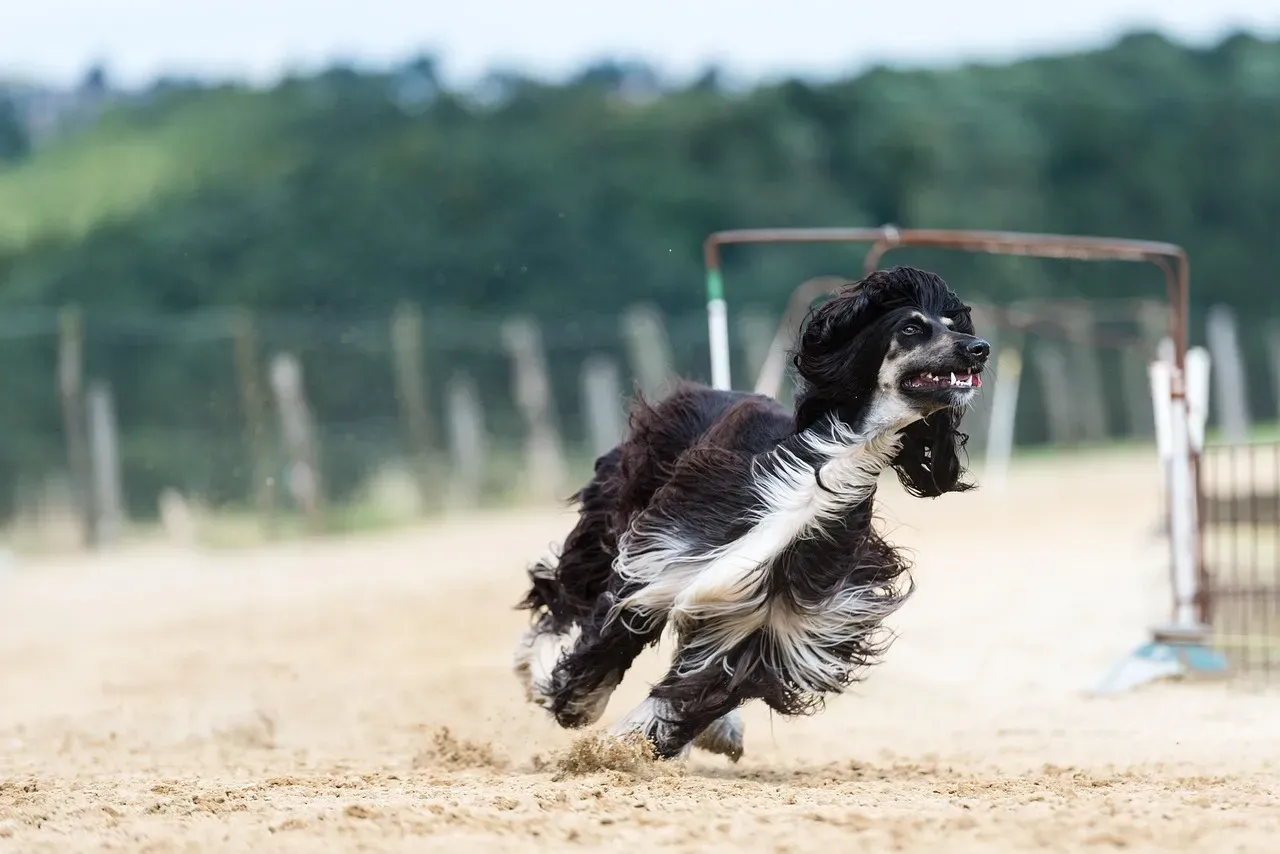 Save

Health
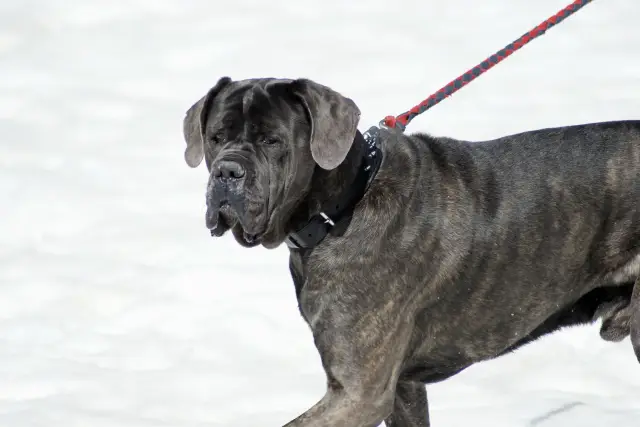 Related breedCane Corso1000 to 1996 · ItalyEarly Middle Ages
Most Afghan Hounds live healthy lives. What follows is what breeders screen for and what owners can watch for. We give numbers only where a named study gives them, and in this breed there are few.
Lifespan. Breed sources put the Afghan Hound at 12 to 14 years. UK studies of dogs that had died, which a breed-longevity table lists, report about 11 years 11 months for the breed (Adams 2010) and 12 years (Michell 1999). These are averages for dogs from earlier years. For comparison, a Kennel Club survey of purebred dogs in the UK across 169 breeds found a median age at death of 11 years and 3 months, with cancer, old age and heart disease the most frequent causes. The Kennel Club also ran a 2004 health survey on Afghan Hounds, reported by Evans, Adams and Sampson in 2008. Its figures are not quoted here. The Afghan Hound Breed Council launched a new health survey in 2026.
| Condition | What it is | How common | What helps |
|---|---|---|---|
| Chylothorax | Leakage of lymph fluid into the chest, which makes breathing difficult | Afghan Hounds are listed as a predisposed breed. In one surgical series of 22 dogs with lung lobe torsion, 8 developed chylothorax and 4 of those were Afghan Hounds. This is a clinic sample, not a prevalence figure | Prompt vet attention for fast or laboured breathing; the AKC Canine Health Foundation funded a search for a genetic risk factor, with no published result found |
| Necrotizing myelopathy | An inherited spinal cord disease that starts in adolescence | A 1977 study of 11 Afghan Hounds pointed to a simple inheritance; no prevalence figure | Ask a breeder about the family history of any affected relatives |
| Sensitivity to anaesthesia | Sighthounds can react differently to some anaesthetic drugs because they carry little body fat | General clinical caution; no study measures a rate | Tell your vet the breed before any procedure so the protocol can be adjusted |
| Eye and thyroid problems | Cataracts and underactive thyroid are mentioned in breed guides | Our sources gave no breed figure | Eye checks and thyroid blood tests, as advised by your vet and breed club |
The "how common" column is mostly "no figure" and we think that is more honest than inventing numbers. If you are buying a puppy, ask the breeder about the parents' health tests and which conditions have appeared in the line.
Other care points that are sound for any large, deep-chested dog: keep the weight lean (an Afghan Hound's ribs should be easy to feel), and ask your vet about the signs of bloat, a stomach twist that needs emergency care.

Living with an Afghan Hound
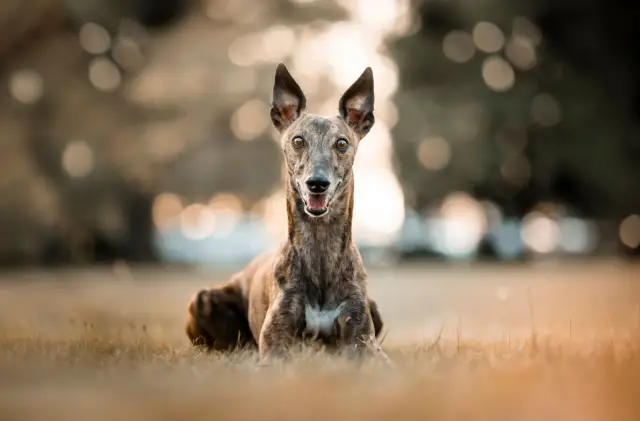 Related breedGreyhound800 CE to 1850 · United KingdomEarly Middle Ages
| Topic | Rating | Why |
|---|---|---|
| Exercise per day | Medium to high | A sighthound that needs a daily run in a fully secure space plus regular walks; breed guidance stresses safe, fenced areas |
| Training needs | High | Independent; needs patient, reward-based work, and recall is unreliable |
| Grooming time | High | Long, fine coat tangles and mats; brushing several times a week and regular bathing are standard for show and pet coats |
| Shedding | Medium | Long hair sheds in the coat and may mat first rather than fall freely; varies by dog and season |
| Barking | Low | Often quiet; varies |
| Time alone | Medium | Bonds closely to its family; long periods alone can lead to boredom and destructive behaviour; varies |
| Children | Fair | Often gentle but reserved; a tall, thin dog can be knocked over by rough play; supervise |
| Other dogs | Good | Usually fine with other dogs, especially sighthounds; varies |
| Cats and small pets | Poor | Strong chase instinct; some live with a cat they know from puppyhood, but there is no guarantee |
| Flat living | Fair | Calm indoors if exercised, but needs room to stretch out and safe running space nearby |
| Heat tolerance | Fair | Comes from a hot lowland and cold highland region; the coat can overheat a dog in strong sun; varies |
| Cold tolerance | Good | Mountain-type coat gives good protection; keep wet coats dry |
| First-time owner fit | Poor | Grooming load, independence and prey drive suit owners who already know sighthounds |
A great fit if...
- You enjoy daily grooming as quiet time with your dog.
- You have, or can reach, a fully fenced field for safe running.
- You want a dignified companion, not an eager-to-please one.
- You are patient with training and do not mind a dog that thinks for itself.
Think twice if...
- You want a dog that is friendly to every guest.
- You have a cat or other small pets that cannot be separated.
- You cannot fit in several grooming sessions a week.
- You plan to let the dog off the lead in unfenced places.
Before you get one
Ask the breeder for the health tests recommended by the national breed club, and about any cases of chylothorax, spinal disease or early death in the line. Visit the parents if possible and see how they behave with strangers. Breed rescues exist in several countries, and an adult dog can be a good match because its coat and temperament are already known. Expect the first year to focus on socialisation, coat care from the start, and teaching a calm lead walk. Choosing a vet who has treated sighthounds is a practical advantage.
Similar breeds to consider
- Saluki: its closest DNA relative in our data, lighter in coat and easier to groom.
- Whippet: a smaller sighthound with a short coat and an easy-going indoor manner.
- Borzoi: another long-coated, dignified sighthound, from Russia.
- Sloughi: a smooth-coated North African sighthound with a reserved nature.
 Save

Fun facts
 Related breedLhasa Apso800 CE to 1934 · ChinaEarly Middle Ages
- Snuppy was the world's first cloned dog, and he was an Afghan Hound. The cloning was confirmed as real by two independent DNA analyses in 2006, even though his creator was disgraced.
- Best in Show twice at Westminster. The breed won in 1957 and again in 1983, according to breed histories.
- The "swift Arab" name. Our etymology note links the local name tāzī to a Persian word for "Arab" or "swift", a fitting name for a hound built to run.
- A painter's dog. Picasso kept an Afghan Hound called Kabul, and the breed appears in his work.
Frequently asked questions
What is the Afghan Hound's temperament?
Dignified, independent and often aloof with strangers, with a quiet, affectionate side at home. It is not an eager-to-please breed, and it has a strong chase instinct.
How long do Afghan Hounds live?
Our atlas data gives 12 to 14 years. UK studies of dogs that had died give about 12 years as an average, for example 11 years 11 months (Adams 2010) and 12 years (Michell 1999).
How big does an Afghan Hound get?
Under the and UK Kennel Club standards, males measure 68 to 74 cm at the withers and females 63 to 69 cm. The gives about 69 cm and 27 kg for dogs and 64 cm and 23 kg for bitches, with some allowance either way.
What health problems do Afghan Hounds have?
Chylothorax, an inherited spinal cord disease (necrotizing myelopathy) and sensitivity to some anaesthetics are the points raised in the veterinary literature. No large study gives a prevalence figure for each, so none is quoted.
Do Afghan Hounds shed a lot?
They shed less visibly than many short-coated dogs, but the long coat mats if it is not brushed. Plan for regular grooming.
Are Afghan Hounds good with children and other pets?
They can live well with considerate children and with other dogs, especially sighthounds. They are a risk for cats and small animals, because of the chase instinct.
Is the Afghan Hound an ancient breed?
The type is old, and a 2004 study placed it with a group of non-European breeds. But a later study argued that it is no closer to the first dogs than any other breed. Its documented history in the West begins in 1907.
What colours do Afghan Hounds come in?
The FCI accepts all colours. The UK Kennel Club accepts all colours except , and dislikes white markings on the head and collar.
Which dog is the Afghan Hound most closely related to?
The Saluki, according to Parker 2017 and atlas data.
Read next
Closest DNASaluki27.8 Mb shared FamilyMediterraneanThe whole family
 Adopt a dogDog Shelters in EuropeFind dog shelters in Europe, learn how shelters differ from country to country and why adopting a dog is a good option.
Sources (14)
- Fédération Cynologique Internationale. Afghan Hound, Standard no. 228 (valid standard published 27 July 2021).
- The Kennel Club (UK). Afghan Hound breed standard.
- American Kennel Club. Afghan Hound breed standard and breed history pages.
- Parker H.G. and colleagues (2004). Genetic structure of the purebred domestic dog. Science.
- Parker H.G. and colleagues (2017). Genomic analyses reveal the influence of geographic origin, migration, and hybridization on modern dog breed development. Cell Reports.
- University of Aberdeen research on ancient dog breeds and their genetic signatures (reported in PNAS).
- Lee B.C., Hwang W.S. and colleagues (2005). Dogs cloned from adult somatic cells. Nature, 436.
- Seoul National University investigation committee and Ostrander E.A. and colleagues (March 2006). Two analyses confirming Snuppy as a clone. Nature, 440.
- The Kennel Club and Animal Health Trust (2010). Methods and mortality results of a health survey of purebred dogs in the UK.
- Evans K.M., Adams V.J. and Sampson J. (2008). The Kennel Club 2004 health survey: Afghan Hound.
- Adams (2010) and Michell (1999), UK breed longevity studies, as listed in a breed longevity table.
- Study on inherited necrotizing myelopathy of Afghan Hounds (1977).
- Neath P.J. et al., "Lung lobe torsion in dogs: 22 cases (1981 to 1999)", Journal of the American Veterinary Medical Association, 2000.
- Dogs Atlas knowledge base: Afghan Hound breed file.