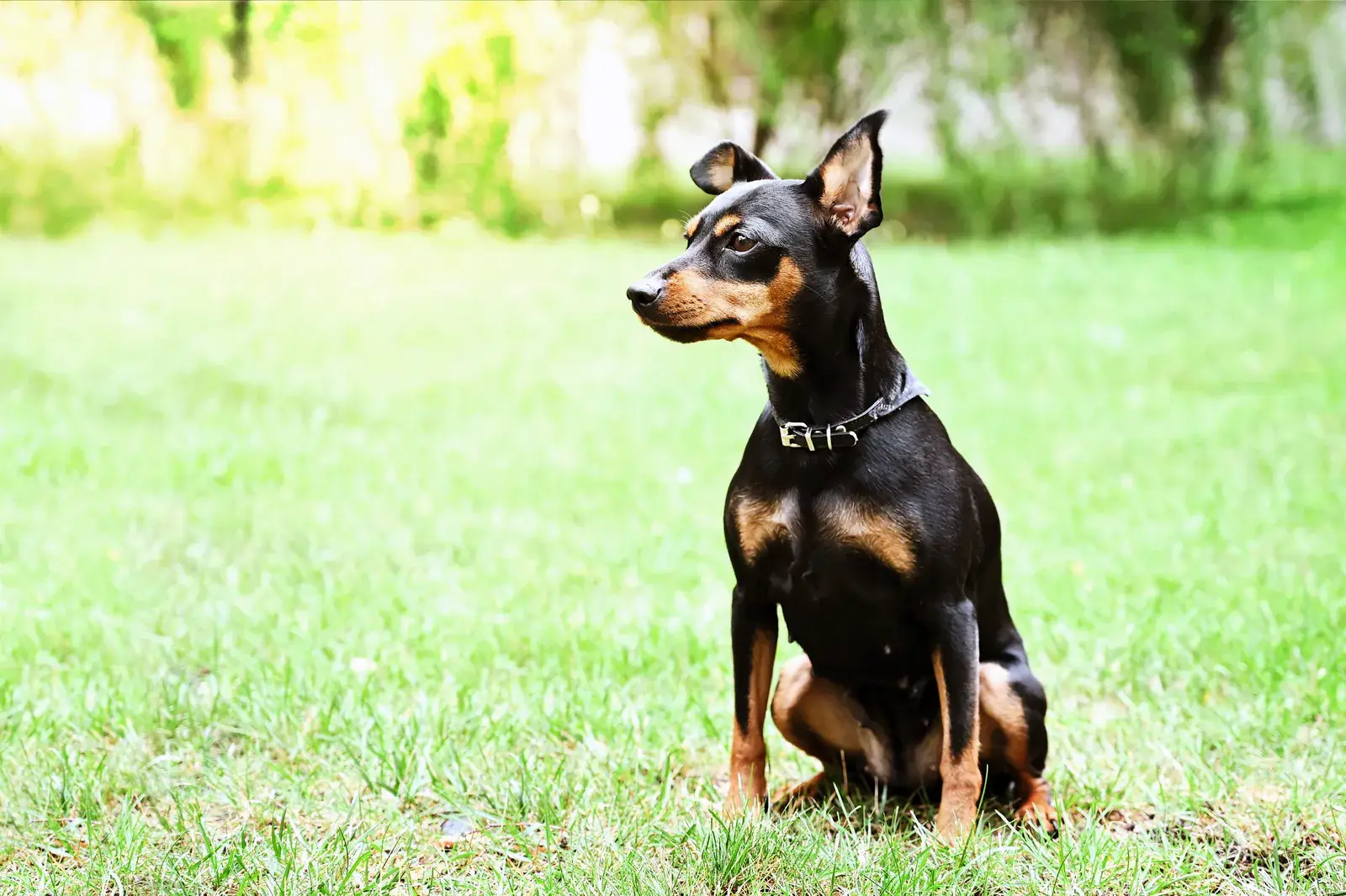
What is a pinscher?
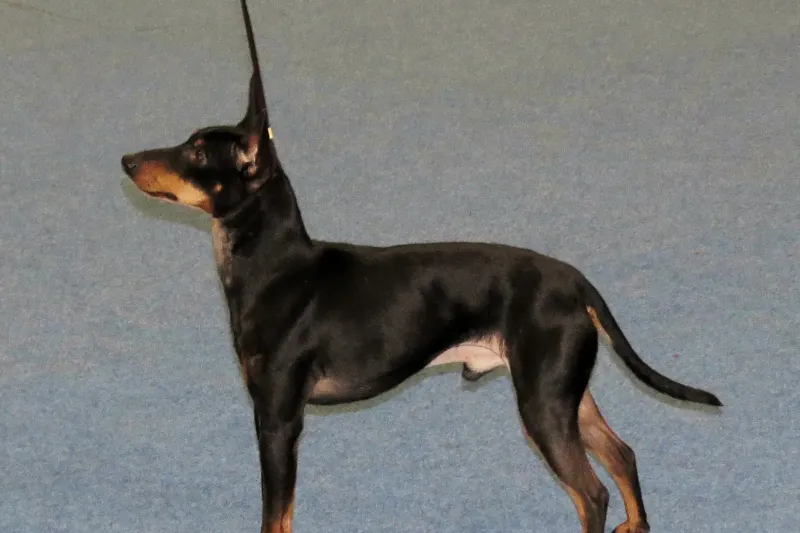
A pinscher is a short-coated German farm and stable dog, bred to kill rats and mice and to raise the alarm at strangers. The word is also used, loosely, for small smooth dogs of the same kind in other countries. The family has famous members: the Miniature Pinscher, the Affenpinscher with its monkey face, and the Manchester Terrier, which is a "terrier" in name and a pinscher in DNA.
 GuideSmartest dog breeds: what the rankings measure and what they missCoren's smartest dog breeds list, what it measured, what newer dog cognition research says, three kinds of dog intelligence and why smart dogs need work.
In this atlas, the Pinscher family is a group of 14 breeds that share DNA and history. It is a genetic family, not the same thing as a kennel club group. The Dobermann carries the word "Pinscher" in the United States, yet it is not in this family. This page explains who belongs, why, and how the breeds are tied together.
Quick facts about the Pinscher family
| Fact | Answer |
|---|---|
| Family type | Genetic clade (Parker et al. 2017) |
| Parent | European dogs |
| Breeds in this atlas | 14 (all living) |
| Breeds with DNA tested in the study | 2 |
| Main homelands | Germany (3), Belgium (2) and the United Kingdom (2) |
| Typical size | Small or toy (12 of 14). Also 2 medium |
| Core job | Killing rats and mice on farms, in stables and in towns |
| Shared look | Smooth, close coat; erect or folded ears; slim, squarish body |
| Shared temperament | Quick, bold, watchful, stubborn |
 GuideDog laws by country: tax, insurance and licencesDog tax, compulsory liability insurance, licences, microchips and leash rules in Germany, Austria, Switzerland, Spain, Ireland, the UK, the US and more.
Family or group: what is the difference?
In this atlas, "family" always means a DNA clade, a branch of the family tree found by comparing genomes. "Group" is used only for kennel club groups such as the AKC Terrier and Toy groups or the FCI Groups 2, 3 and 9.
 GuideDogs in Legends and Fairy TalesDogs in folklore and fairy tales: Black Shuck, The Tinderbox, Saint Guinefort, Panhu, Greyfriars Bobby, Barry and Old Drum, with legend and history kept apart.
The two do not match. Kennel clubs sort dogs by size and job, so this family is spread over several groups: the FCI puts the German Pinscher in Group 2, the Manchester Terrier in Group 3, and the Prague Ratter in Group 9. DNA sorts them by shared ancestry. Only two of our 14 breeds, the Miniature Pinscher and the Toy Manchester Terrier, were sampled by Parker et al. (2017), and they fall into one Pinscher clade with strong support. The other 12 are placed here by written history and looks, so they are best estimates. In the table below, the first two rows are DNA-tested and the rest are placed by history.
Where do pinschers come from?
From three places: German farms, Belgian stables and English towns.
 GuideDogs of Japan: the native breeds and their storiesJapanese dog breeds explained: the six Nihon Ken, the Chin, Tosa, Japanese Spitz and Terrier, Hachiko, wartime near-extinction, DNA and who they suit.
In German-speaking lands, farms and inns kept short-coated ratting dogs, and these are the base of the German Pinscher, the Austrian Pinscher and, through them, the Miniature Pinscher. The atlas records the Austrian Pinscher as developed from old farm pinschers that were a mixture of German Pinschers and local dogs.
In Belgium and the Netherlands, stable dogs such as the rough-coated Smousje gave rise to the Belgian Griffon and Petit Brabançon. In England, the Old Black and Tan Terrier was the base of the Manchester Terrier and the English Toy Terrier. In both countries the atlas places the breeds in this family because of their DNA ties to the German pinschers, not because of a shared country.
Why are they called pinschers?
Nobody is sure. Three ideas appear in the references, and each is a theory.
 GuideDogs in science and spaceSpace dogs Laika, Belka and Strelka, Pavlov's dogs, Snuppy the clone, the dog genome and scent detection: what dogs did for science, and what it cost them.
- From English "pinch". The Etymonline dictionary treats German Pinscher as probably taken from English "pinch", in reference to clipped ears, and dates the English word to 1926.
- From French "pincer". The AKC and other sources suggest the word comes from English "pinch" or French pincer, to seize or nip, describing what the dog does to rodents.
- Other readings. Some sources say the name means a fox-terrier type, or a "biter". Neither is backed by a reliable reference.
Other names are clearer. Affenpinscher is Affe, "monkey", plus Pinscher, for its ape-like face. Zwergpinscher, the German name of the Miniature Pinscher, means "dwarf pinscher", and its other name Reh Pinscher is said to refer to its resemblance to a small deer, the roe deer (the atlas lists it as an other name). Prague Ratter is the English version of Czech pražský krysařík, "little Prague rat-catcher". The Dutch Smoushond takes its name from smous, a slang word for a Jewish trader, whose stable dogs they reportedly were.
What is the history of pinschers?
 GuideLivestock guardian dogs: what they do and who they suitWhat livestock guardian dogs do, how they differ from herding dogs, 40 LGD breeds by country, the DNA evidence, and whether they make good pets.
Before 1800: farm dogs
Short-coated farm ratters existed across central Europe for centuries. The atlas dates the type to about 1600 for the Miniature Pinscher and the Affenpinscher, and to 800 CE for the Prague Ratter, which is a very rough date for the type, not the modern breed. No pedigrees exist for this period, so all of it is inference.
1800 to 1900: names and clubs
- 1884. The illustrator Jean Bungartz drew a "Zwergaffenpintscher" in his handbook on breed purity (Kynos). It is one of the earliest pictures of the Affenpinscher type.
- 1860s. The name Manchester Terrier is reported from about 1860, after breeders in the Manchester area, among them John Hulme, crossed the Black and Tan Terrier with a Whippet for a dog that could kill rats and chase rabbits.
- 1895. The German author Ludwig Beckmann described five pinscher varieties, including the Miniature Pinscher and the Affenpinscher, and a club for pinschers and schnauzers was formed in the same year (sources differ on the club's exact early name).
- 1880 to 1905. The Belgian Griffon and Petit Brabançon were shaped from the Smousje. The smooth black coat of the Petit Brabançon is said to have come from the Pug and the King Charles Spaniel.
1900 to 1960: toys and show rings
- 1900s. The English Toy Terrier and the Manchester Terrier were separated by weight in the show ring until 1903, per the atlas.
- 1928. The atlas dates the end of the Austrian Pinscher's development to 1928.
- 1958 to 1959. In the United States, the Toy Manchester Terrier was made a size division of the Manchester Terrier. Sources give 1958 or 1959. The AKC lists them as one breed with two varieties, with the standard in the Terrier group and the toy in the Toy group.
1960 to today: rebuilding
- 1970s. The Dutch Smoushond was rebuilt using Border Terrier crosses.
- 1980s and after. The Prague Ratter (the atlas: about 1980) and the Danish-Swedish Farmdog (FCI recognised, the atlas: 1987) became recognised breeds. The Ratonero Murciano (1997) and the Small Međimurje Dog (about 2010) are the newest members.
- Today. The Prague Ratter holds provisional FCI recognition, number 363.

What types of pinscher dogs are there?
There are 14 types of pinscher dogs in this atlas, from the Miniature Pinscher and the Affenpinscher to the Manchester Terrier and the Danish-Swedish Farmdog. All 14 are living breeds, and the Dobermann is not one of them. Here are all 14 breeds. The 2 breeds with DNA tested in the study come first. The other 12 are placed by history and are hidden until you choose to show all 14. "Appeared" is the period in which the breed or type is first documented, and some dates are rough. Only breeds with an article in this atlas are linked.
 GuideIs your dog suited to therapy work?How to make your dog a therapy dog: temperament checklist, first training steps, how Pet Partners, TDI and Pets As Therapy assess dogs, and welfare limits.
| Breed | Country | Status | Size | Appeared | DNA-tested |
|---|---|---|---|---|---|
| Miniature Pinscher | Germany | Living | Small | 1600 to 1895 | Yes (Parker 2017) |
| Toy Manchester Terrier | United States | Living | Toy | 1900 to 1934 | Yes (Parker 2017) |
| Prague Ratter | Czech Republic | Living | Toy | 800 CE to 1980 | By history |
| Affenpinscher | Germany | Living | Toy | 1600 to 1700 | By history |
| Danish-Swedish Farmdog | Denmark, Sweden | Living | Small | 1700 to 1987 | By history |
| German Pinscher | Germany | Living | Medium | 1700 to 1884 | By history |
| Austrian Pinscher | Austria | Living | Medium | 1800 to 1928 | By history |
| Dutch Smoushond | Netherlands | Living | Small | 1800 to 1905 | By history |
| Manchester Terrier | United Kingdom | Living | Small | 1800 to 1860 | By history |
| Ratonero Murciano | Spain | Living | Small | 1800 to 1997 | By history |
| English Toy Terrier | United Kingdom | Living | Toy | 1850 to 1960 | By history |
| Belgian Griffon | Belgium | Living | Toy | 1880 to 1905 | By history |
| Petit Brabançon | Belgium | Living | Toy | 1880 to 1905 | By history |
| Small Međimurje Dog | Croatia | Living | Small | 1900 to 2010 | By history |
Who descends from whom, and which ties are strongest?
Two kinds of evidence are used here. One is written history: what breeders say they crossed. The other is DNA: how many megabases (Mb, millions of DNA letters) two breeds share in matching stretches. A larger number means a closer shared ancestry, though it can also reflect a recent split or crossing.
 ArticleThe first known dog on every continentEarliest accepted dog on each continent, from Bonn-Oberkassel to the dingo: dates, sites, how dogs arrived and which breeds carry those first dogs.
The strongest ties of the two tested Pinscher breeds, from the Parker study as recorded:
| Pair | Shared DNA (Mb) | What it tells us |
|---|---|---|
| Toy Manchester Terrier and Dobermann | 24.1 | The Dobermann's recorded ancestors include the Manchester Terrier and German Pinscher |
| Miniature Pinscher and Toy Manchester Terrier | 21.1 | The strongest tie inside the family |
| Toy Manchester Terrier and Border Terrier | 19.3 | Shared terrier background |
| Toy Manchester Terrier and Wire Fox Terrier | 18.8 | Shared terrier background |
| Toy Manchester Terrier and Parson Russell Terrier | 15.7 | Terrier ties |
| Miniature Pinscher and Pomeranian | 12.7 | A small-breed link across families |
Source: Parker et al. 2017, Cell Reports, shared haplotypes between 161 breeds (1,346 dogs).
The pattern is clear. The Toy Manchester Terrier shares as much DNA with terriers as with the Miniature Pinscher, which fits its English "terrier" name and its Black and Tan Terrier roots. See Terrier.
In the written record, the German Pinscher sits at the centre. The Miniature Pinscher was listed by Beckmann in 1895 as a variety of the Pinscher, and the Austrian Pinscher came from German Pinschers crossed with local farm dogs. The Dobermann is written down as a descendant of the German Pinscher, with Rottweiler, Manchester Terrier, Greyhound and other blood. In the DNA study the Dobermann falls in the Drover family instead, so it is a sibling, and its closest ties are to the Pinscher breeds. See Drover. The Manchester Terrier comes from the Black and Tan Terrier and the Whippet. The Toy Manchester Terrier was bred down from it.
The Miniature Schnauzer is the reverse case. The atlas records it as descending from the Standard Schnauzer, crossed with the Affenpinscher, the Miniature Pinscher and the Poodle, yet DNA places the Schnauzers in their own family. See Schnauzer and the Miniature Schnauzer article.
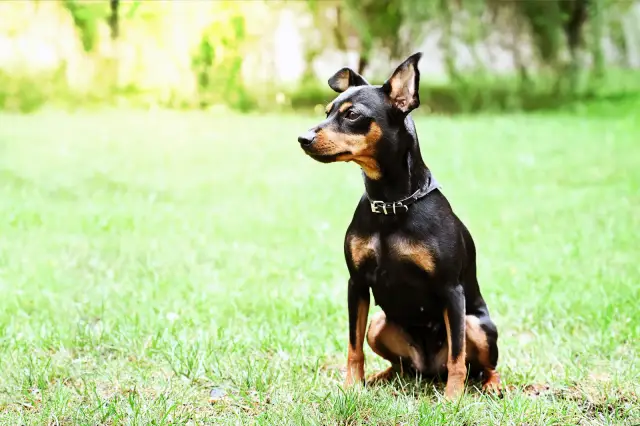 Miniature Pinscherlisted as a variety, 1895
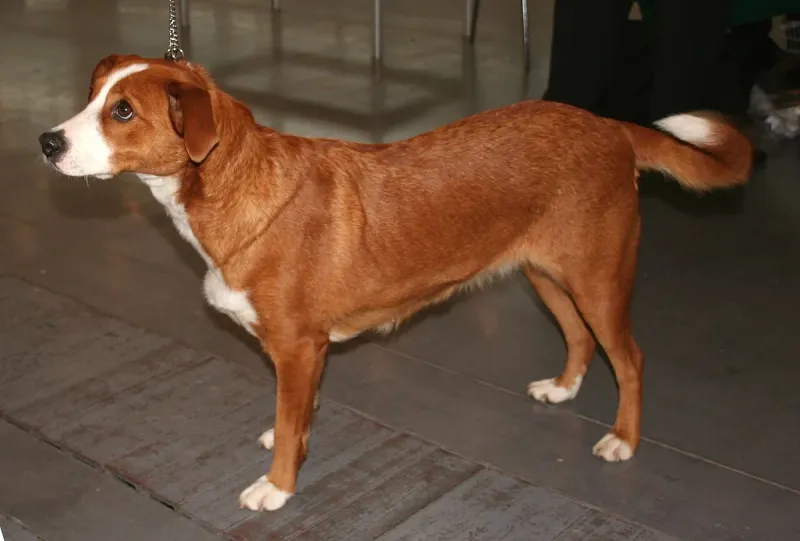 Austrian Pinscherwith local farm dogs
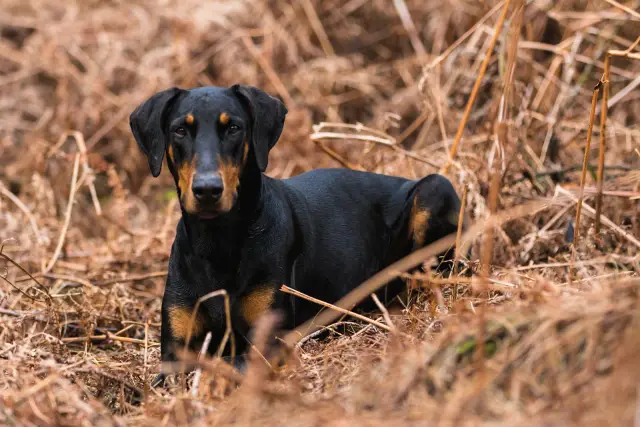 Dobermannalso Rottweiler and Manchester Terrier
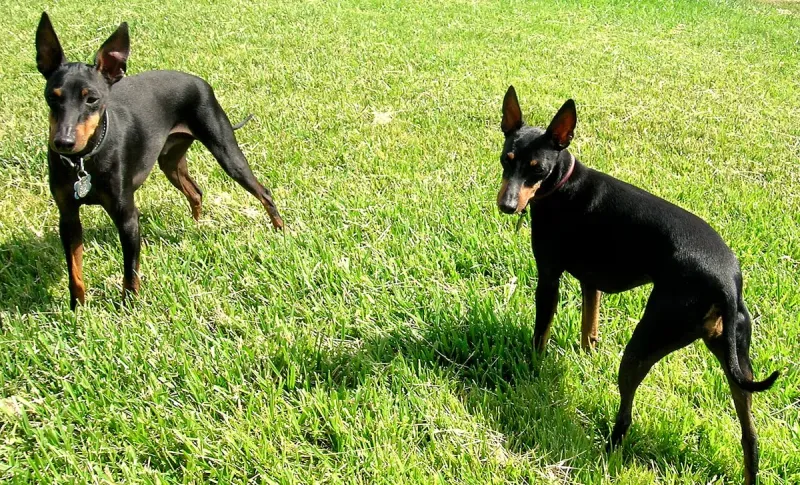 Toy Manchester Terrierbred down in size
 English Toy TerrierMiniature Pinscherlisted as a variety, 1895Austrian Pinscherwith local farm dogsDobermannalso Rottweiler and Manchester TerrierToy Manchester Terrierbred down in sizeEnglish Toy Terrier
What do pinschers have in common?
Look. A short, close coat, often black and tan or red, a slim, almost square body, and a neat head. Sizes run from the Affenpinscher and Prague Ratter, both toy dogs, to the medium German and Austrian Pinschers.
 GuideDog hybrids: what dogs can and cannot breed withCan dogs breed with wolves, coyotes, jackals or foxes? Wolfdogs, coydogs, the Sulimov dog and Dogxim explained, with chromosomes and DNA studies.
Job. Ratting. The Manchester Terrier was used in rat pits in the 1800s, a sport now illegal in Britain. The farm and stable breeds also gave a warning bark. This is why many of them are alert watch dogs.
Temperament. Quick, bold and curious, with a stubborn streak. Small members often act bigger than they are. Training should be early, calm and consistent.
Coat care. Easy. A short coat needs little brushing, but thin-coated dogs feel cold and need a coat in winter. The Affenpinscher, Belgian Griffon and Dutch Smoushond have rough coats that need more care.
What health issues are linked to pinschers?
Most pinschers live healthy lives, and the atlas gives lifespans of 12 to 16 years for the Miniature Pinscher and 12 to 15 for the Affenpinscher. Health depends on the breed, not on the family, so only a few well-documented examples are given.
 GuideHow to get an assistance dogHow to get a service dog or assistance dog in the USA, UK, Germany, France, Spain, Italy and the Netherlands: accredited schools, waits, owner-training and travel.
- Kneecap problems (patellar luxation). The kneecap slips out of its groove. A UK study of 210,824 dogs (O'Neill et al. 2016, Canine Genetics and Epidemiology) found 1.30 percent had the diagnosis, about 1 in 77 dogs overall. It was higher in several small breeds. A US teaching-hospital database study named the Miniature Pinscher among the breeds at higher risk. What helps: a lean body and a vet check of the knees.
- Hip joint disease in small dogs (Legg-Calvé-Perthes). The top of the thigh bone loses blood supply in a growing puppy. The Merck Veterinary Manual lists the Miniature Pinscher among the breeds with the highest odds, and OFA lists include the Affenpinscher and Manchester Terrier. No breed-wide prevalence has been published. What helps: a vet check if a puppy limps, and treatment, which often works well.
- Heart disease in Dobermanns. The Dobermann is not in this family, but is often asked about. Dilated cardiomyopathy runs in the breed. A deletion in the PDK4 gene was linked to it (Meurs et al. 2012, PLoS ONE), but a European cohort did not confirm the link and not all affected dogs carry it. What helps: regular heart screening as breed clubs advise. See the Dobermann article.
- Cold and thin coats. Short-coated toys lose heat quickly. This is welfare, not a disease.
Ask a vet or the breed club which tests apply to the breed before choosing a puppy.
 Save
Which Pinscher breeds are extinct?
None. All 14 are living, though several are rare. The English Toy Terrier is much less common than it was, and the Prague Ratter, Ratonero Murciano, Austrian Pinscher and Small Međimurje Dog are known mostly in their home regions.
 GuideService, therapy and emotional support dogs: what's the difference?Service dog vs emotional support dog vs therapy dog: the real differences, your rights in the USA and Europe, and why online certificates mean nothing.
 ArticleDog Breed Family Tree: How All Dog Breeds Are RelatedThe dog breed family tree from Ice Age wolves to 29 breed families.GuideService, therapy and emotional support dogs: what's the difference?Service dog vs emotional support dog vs therapy dog: the real differences, your rights in the USA and Europe, and why online certificates mean nothing.
Are there surprises in the Pinscher family?
- The Manchester Terrier is a pinscher by DNA. It is a "terrier" by name and kennel club group, and still clusters with the German pinschers.
- The Dobermann is not here. Its name says Pinscher, yet the atlas places it in Drover. See Drover.
- The Miniature Pinscher is not a small Dobermann. The Miniature Pinscher is older. Beckmann listed it in 1895, and the Dobermann is dated about 1880 to 1900.
- A very small DNA sample. Only two of 14 breeds were tested, so most of this family is inferred.
- One Belgian dog, three coats. The Belgian Griffon, Brussels Griffon and Petit Brabançon are coat varieties of one stable dog, the Smousje (the atlas; the Brussels Griffon is in Toy Spitz).
 GuideDogs in myth around the worldFrom Anubis and Cerberus to Fenrir, Xolotl and the Tiangou: how cultures across the world imagined dogs as guardians, guides and monsters.
 GuideBest dog breeds for familiesBest dog breeds for families, small homes, allergies, first-time owners and seniors, ranked from our breed ratings, with honest limits and a table.GuideDogs in myth around the worldFrom Anubis and Cerberus to Fenrir, Xolotl and the Tiangou: how cultures across the world imagined dogs as guardians, guides and monsters.
What does research say about pinschers?
- Parker et al. (2017, Cell Reports) sampled the Miniature Pinscher and Toy Manchester Terrier and grouped them in one clade.
- O'Neill et al. (2016) is a large UK study of kneecap disease across breeds.
- Meurs et al. (2012) is a study of the PDK4 gene in Dobermanns with heart disease, and later work shows the picture is mixed.
 Family storyAlpineRead the family's story: origins, members, DNA

Which pinscher suits which owner?
This is a guide to temperament, not a promise for any single dog.
 Family storyAmerican Cur & FeistRead the family's story: origins, members, DNA
- Apartment dwellers. The Miniature Pinscher, Prague Ratter and Toy Manchester Terrier are small. They need daily play and a coat in winter.
- Active families. The German Pinscher and Austrian Pinscher are athletic medium dogs that like jobs and long walks.
- Fans of character. The Affenpinscher and Belgian Griffon are comical, human-focused small dogs.
- Rural owners. The Danish-Swedish Farmdog and Ratonero Murciano were farm dogs, and they enjoy rat patrol and company.
- Gentle homes. The Dutch Smoushond is affectionate. Expect a rough coat that needs grooming.
- Rat-free zones. All members have a chase drive. Keep them leashed near wildlife and pets such as hamsters.

Fun facts about pinschers
- The Miniature Pinscher is also called the Min Pin and Zwergpinscher.
- The Affenpinscher means "monkey terrier" or "ape pinscher".
- The Manchester Terrier and English Toy Terrier were split by weight in the show ring until 1903.
- The Prague Ratter was in provisional FCI status as number 363.
- The Dutch Smoushond was rebuilt in the 1970s with Border Terrier crosses.
 Family storyAmerican ToyRead the family's story: origins, members, DNA

Related families
- European dogs: the parent of the Pinscher family.
- Drover: home of the Dobermann.
- Schnauzer: close German cousins, built partly with Affenpinscher and Miniature Pinscher blood.
- Terrier: the Black and Tan Terrier and the Manchester's terrier ties.
- Toy Spitz: the Brussels Griffon and Pug.
- dog family tree: see where every family sits.
 Family storyAncient American dogsRead the family's story: origins, members, DNA
Frequently asked questions
What are the pinscher breeds?
In the atlas: Miniature Pinscher, German Pinscher, Austrian Pinscher, Affenpinscher, Manchester Terrier, Toy Manchester Terrier, English Toy Terrier, Belgian Griffon, Petit Brabançon, Dutch Smoushond, Danish-Swedish Farmdog, Prague Ratter, Ratonero Murciano and Small Međimurje Dog.
What does pinscher mean?
It is a German word for a short-coated farm dog. The origin is uncertain. A leading idea is that it comes from English "pinch", and another that it comes from French pincer.
Is a Miniature Pinscher a small Dobermann?
No. They are separate breeds. The Dobermann is in the Drover family.
Is a Manchester Terrier a pinscher?
By DNA, yes. By kennel club group, it is a terrier.
Are pinschers good family dogs?
Many are, in homes that give exercise and training. Small members can be snappy if handled roughly.
How long do pinschers live?
Breed sources give 12 to 16 years for the Miniature Pinscher and 12 to 15 for the Affenpinscher.
Read next
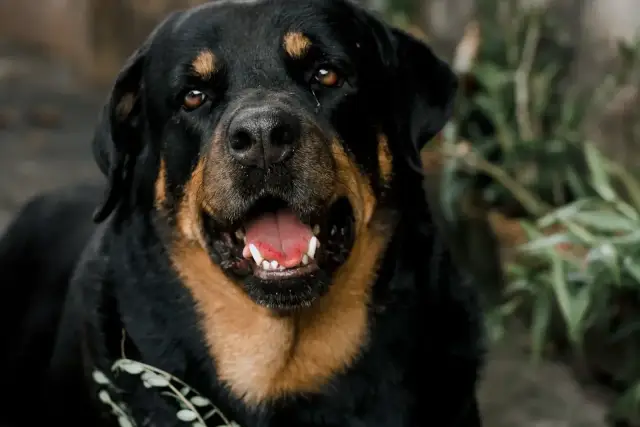 Family storyDroverRead the family's story: origins, members, DNA
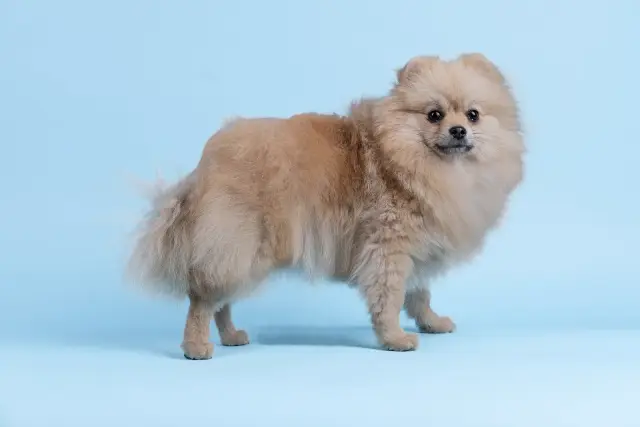 Family storySmall SpitzRead the family's story: origins, members, DNAFamily storyEuropean dogsRead the family's story: origins, members, DNA
Sources (11)
- Parker, H. G., et al. (2017). Genomic analyses reveal the influence of geographic origin, migration, and hybridization on modern dog breed development. Cell Reports, 19(4), 697 to 708.
- O'Neill, D. G., et al. (2016). The epidemiology of patellar luxation in dogs attending primary-care veterinary practices in England. Canine Genetics and Epidemiology.
- Meurs, K. M., et al. (2012). PDK4 deletion and dilated cardiomyopathy in Doberman Pinschers. PLoS ONE (as cited in the Dobermann article).
- Merck Veterinary Manual, table of heritable conformational conditions resulting in canine osteoarthritis.
- Orthopedic Foundation for Animals, Legg-Calvé-Perthes breed lists.
- Online Etymology Dictionary, entry for pinscher.
- American Kennel Club, Affenpinscher and German Pinscher breed history pages.
- Bungartz, J. (1884). Kynos: Handbuch zur Beurteilung der Racen-Reinheit des Hundes.
- Beckmann, L. (1895). Geschichte und Beschreibung der Rassen des Hundes.
- Fédération Cynologique Internationale, breed standards and group listings for the German Pinscher (184), Miniature Pinscher (185), Affenpinscher (186) and Prague Ratter (363, provisional).
- Breed records in the atlas data (Dogs Atlas, internal data).