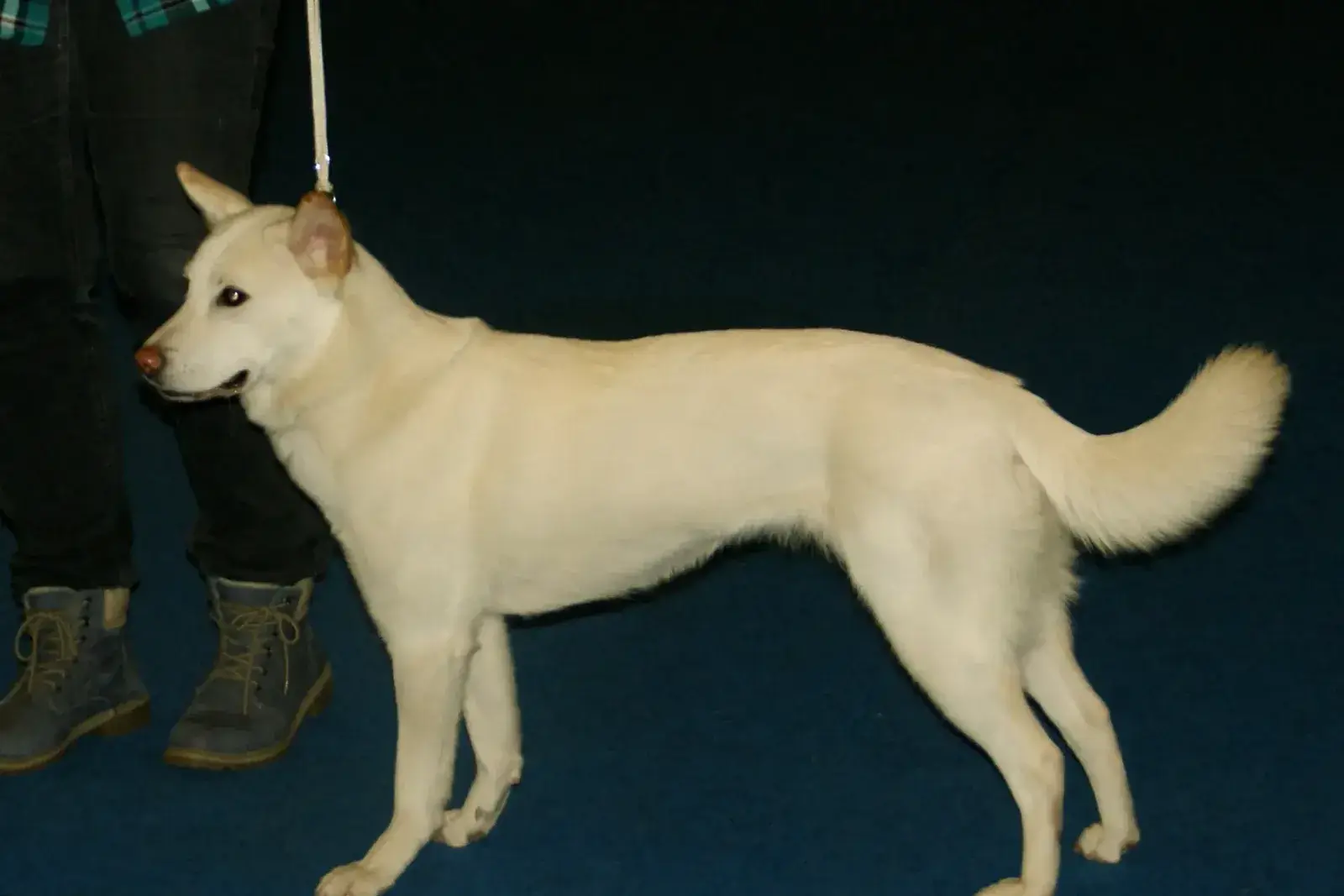
It is a hunting dog with a double coat, upright ears and a tail carried over the back, and it is a protected Natural Monument in its home country: only dogs born on Jindo Island can be registered as Jindo by the Korean government. The breed is known for fierce loyalty to one household, a strong prey drive and a talent for escaping. It suits experienced owners with a tall, secure fence and the patience to socialise a wary, independent dog.
Jindo quick facts
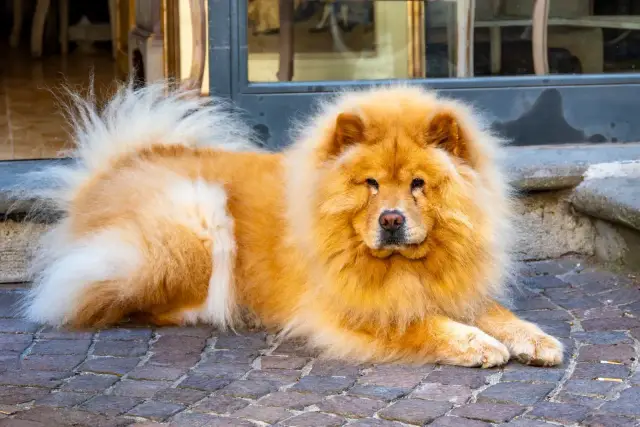 Related breedChow Chow200 BCE to 1895 · ChinaAncient World
- Country of origin
- South Korea (Jindo Island, Jindo County, South Jeolla Province)
- Period of development
- Uncertain; atlas data gives about 1200 to 1962 (medium confidence). Studied in 1937, listed as a natural monument in 1938 and again in 1962
- Original job
- Hunting water deer and wild boar on Jindo Island; later guard and companion
- Type
- Spitz and primitive type (FCI Group 5, standard no. 334, "Korea Jindo Dog"; UKC recognised 1998; Foundation Stock Service)
- Height
- FCI: dogs 50 to 55 cm, bitches 45 to 50 cm. UKC: dogs 19.5 to 21.5 inches (about 50 to 55 cm), bitches 17.5 to 19.5 inches (about 44 to 50 cm)
- Weight
- FCI: dogs 18 to 23 kg, bitches 15 to 19 kg. UKC: dogs about 40 to 50 pounds (18 to 23 kg), bitches 33 to 42 pounds (15 to 19 kg)
- Coat
- Double coat: soft dense undercoat, stiffer outer coat that stands slightly off the body
- Colours
- White, red fawn, wolf grey, black, black and tan, brindle
- Life span
- Atlas data: 13 to 15 years
- Exercise
- Medium to high energy; needs daily walks and a very secure garden
- DNA family
- Asian Spitz family (Parker et al. 2017)
- Closest relative in the atlas
- Donggyeongi, from a shared ancestor about 900 years ago
Drawn to scale in real centimetres. Its back reaches about 50 cm, your knee; its head about 63 cm, mid-thigh.
Where it sits in the tree
Late Middle Ages · 1200 to 1499

Name and origin: what does Jindo mean?
 Related breedSamoyed500 CE to 1912 · RussiaEarly Middle Ages
The breed is named after Jindo, an island off the south-west tip of the Korean peninsula. In Korean the dog is called jindotgae (진돗개), often written Jindo-gae, or Jindo-gyeon. An older English spelling, "Chindo", also appears in older books. The official FCI name is "Korea Jindo Dog", with the Republic of Korea as the country of origin.
The island matters to the breed's identity more than most place names do. Under Korean protection rules, only dogs born on Jindo Island and passed by an inspection can be officially registered as Jindo. Export of dogs from the island is hard, which is why the breed remains rare outside Korea.

History of the Jindo
 Same eraShar Pei200 BCE to 1973 · ChinaAncient World
Origin stories
Nobody can say when dogs first reached Jindo Island. The UKC breed history repeats a belief that the Jindo came from crosses between native Korean dogs and dogs brought by the Mongols during their 13th century invasion of Korea: the story says some soldiers of the Korean king withdrew to Jindo Island and kept fighting, and their dogs stayed there and developed a very pure strain. This is a tradition, not a documented record. The atlas data uses a wide window of about 1200 to 1962 because the early years cannot be dated.
What the island gave the dogs is easier to see. Jindo is separated from the mainland, so the dogs bred largely among themselves. The Korean Cultural Heritage Administration describes the dogs as having kept relatively pure blood for this reason. Local people used them to hunt water deer and wild boar.
1937 to 1938: a scientist notices the island dogs
In February 1937 Tamezo Mori, a professor at Keijo Imperial University, studied the Jindo. In May 1938 the dog was registered as the 53rd Natural Treasure of the Japanese colonial Government-General of Chosen. Some Korean sources give 1938 as the date of Natural Monument No. 53, while others give 1962. Both dates are recorded.
1962: Natural Monument No. 53
In 1962 the Government of South Korea designated the Jindo as Natural Monument (Natural Treasure) No. 53 under its heritage laws. The same number is used in both the 1938 and 1962 records. The Cultural Heritage Administration states that the dogs are covered by a Jindo dog protection law as well as the cultural properties law. The monument status explains the registration rule above and the strict controls on moving purebred island dogs off Jindo.
Baekgu, the dog that walked home
In 1993 a seven-year-old white female Jindo named Baekgu ("White Dog"), kept by an 83-year-old woman called Park Bok-dan on Jindo Island, was sold to a new owner in Daejeon, about 300 km away. She escaped and walked home, arriving after seven months, thin and tired. She stayed with Park until she died of natural causes seven years later. The story became a national sensation in South Korea and was retold as cartoons, a television documentary and a children's book. Jindo County put up a statue of Baekgu in 2004.
A second Jindo, also called Baekgu, is said to have mourned his owner after the man's death in 2000, following the funeral and refusing food for days.
1988 to 2004: onto the world stage
Jindos walked in the opening ceremony of the 1988 Seoul Olympic Games. The United Kennel Club recognised the breed on 1 January 1998, and the FCI published its standard no. 334 on 9 November 2004. The AKC lists the Jindo in its Foundation Stock Service, the first step toward full recognition. In their home country the Korean Kennel Federation and Korean Kennel Club recognise the breed, and local Jindo clubs hold specialty shows.
Jindo relatives and DNA
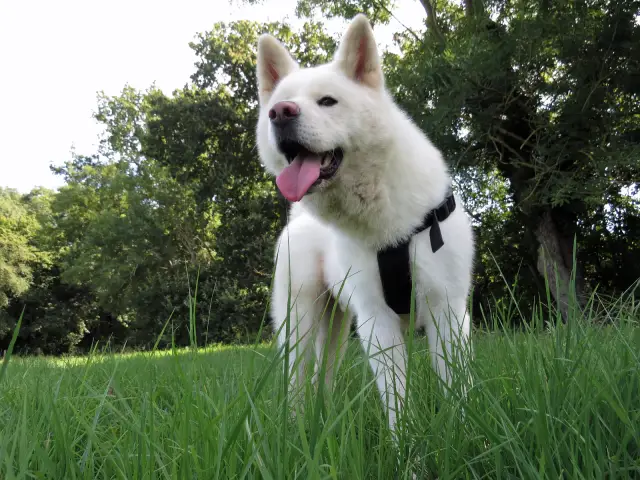
 Same familyShiba Inu300 BCE to 1936 · JapanAncient World
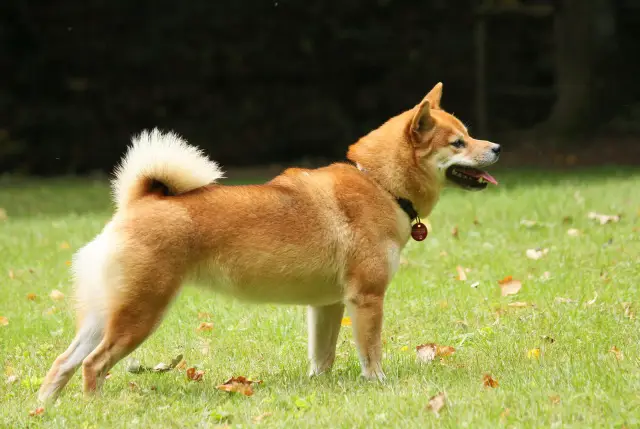
The Parker et al. 2017 study of dog breed genetics placed the Jindo in the Asian Spitz family, the that also holds the Japanese Akita and Shiba Inu. In the atlas data the Jindo's closest relative is the Donggyeongi, another Korean native breed: DNA analysis shows the two separated from a common ancestor about 900 years ago. The Sapsali, a long-coated Korean breed, is not a close relative of this pair in a whole- sequencing study of the three Korean breeds.
Three papers add detail on the Jindo itself:
- Umenishi, Han and Ikemoto (1993). The authors studied mitochondrial DNA (the maternal line) in 21 Jindos living on Jindo Island. Four types of mtDNA were found, and all four formed a single cluster. The authors read this as a sign that the breed was "considerably pure".
- Kim and colleagues (DNA Research, 2012). A whole-genome analysis of a Korean Jindo compared its mitochondrial genome with 80 other breeds and found Jindo-specific variants at 9 positions in the sequence.
- Kang and colleagues (Genomics, 2025). Deep sequencing of Jindo dogs found that the black and tan colour comes from the original Jindo Island population, which fits the breed's history. The Jindo shared with the Japanese Akita, which points to an early movement of people and dogs from Korea to Japan. The same work reported shared haplotypes with West Eurasian breeds such as the German Shepherd, linked to gene flow from West Eurasian dogs.
These studies support the idea of an old, fairly isolated population. They do not date its arrival on the island.
Sister breeds · 1
- Donggyeongi600 CE to 2012
The Jindo breed standard
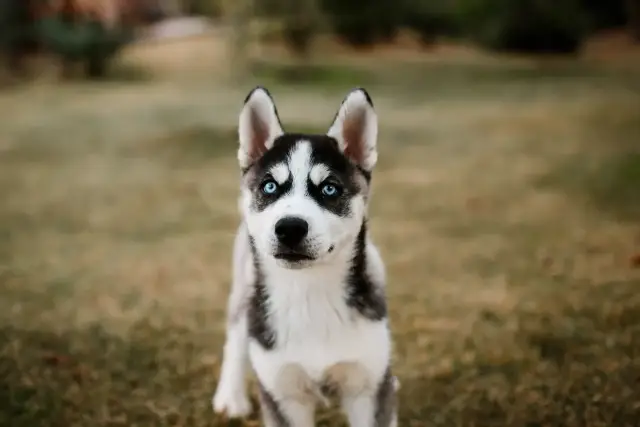
 Looks relatedSiberian Husky1000 to 1930 · RussiaEarly Middle Ages
A is the written ideal that judges compare each dog against. The FCI standard (no. 334) and the UKC standard describe a medium, well-proportioned spitz with an alert, intelligent look. The FCI standard sets the ratio of body length to height at 10 to 10.5.
| Trait | What the standards say |
|---|---|
| Height (FCI) | Dogs 50 to 55 cm, bitches 45 to 50 cm |
| Height (UKC) | Dogs 19.5 to 21.5 inches, bitches 17.5 to 19.5 inches at maturity |
| Weight | FCI: dogs 18 to 23 kg, bitches 15 to 19 kg. UKC: average 40 to 50 pounds for dogs and 33 to 42 pounds for bitches, in proportion to height |
| Head | UKC: broad, rounded skull between the ears, free of wrinkles; well-developed lower jaw gives a round or octagonal head from the front. Dogs have larger heads, bitches more fox-like faces |
| Ears | UKC: triangular, upright and leaning forward; uniquely among spitz breeds the ears splay out sideways, like aircraft wings. Puppy ears lie flat until about 5 to 6 months |
| Eyes | UKC: almond-shaped, dark brown. Light brown is not wanted, and blue eyes do not occur |
| Nose and lips | Black nose on non-white dogs; white dogs may have a flesh-coloured nose. Lips are taut and black |
| Coat | Double coat; FCI: soft dense undercoat and stiffer outer coat that stands a little off the body |
| Tail | UKC: thick and strong, at least long enough to reach the hock, loosely curled or carried in a sickle over the back. The hair beneath the tail is thick and twice as long as the shoulder coat, so it fans out |
| Colours | FCI: red fawn, white, black, black and tan, wolf grey, brindle. The Korean names are hwanggu (fawn), baekgu (white), jaegu (wolf grey), nenunbagi (black and tan, "four eyes"), hogu (brindle) and heukgu (black) |
Tonggol, Hudu and Gakgol body types
Korean owners traditionally divide the dogs in two body types. The Tonggol (or Gyeopgae) is stockier and more muscular, with body length equal to height at the withers (10 to 10). The Hudu (or Hotgae) is slimmer, with a slightly longer loin, head, muzzle and ears and a body longer than tall, at about 10 to 11. The Korean National Dog Association also names a third type, the Gakgol, a gradually emerging mix that keeps the Hudu body length and the Tonggol chest depth. Type is a matter of build, not a separate breed.
Jindo colours
White Jindos are really off-white or ivory with tan or light brown at the ear tips, back of the hind legs and tip of the tail. Fawn is the colour of ripe wheat. Wolf grey looks plain grey from a distance but is a mix of white, black and fawn hairs. Black and tan dogs, called "four eyes", have a tan spot over each eye. Brindle shows thin dark stripes on fawn, often called the tiger pattern, and the stripes appear early in life. Solid black is very rare. Some residents of Jindo Island value black, black and red, and red and white dogs as good hunters, according to Wikipedia.
Jindo temperament: loyal, alert and hard to keep in
 Related breedTibetan Mastiff1000 BCE to 1931 · ChinaAncient World
Jindos are known for a firm bond with one household and a reserved attitude toward strangers. They do not usually take food from strangers. The breed has a strong prey drive from its hunting past, a clear sense of household hierarchy and medium to high energy. It is active, clever and bored easily, so it needs frequent contact with people or other dogs.
Escape artists
Jindo owners say the same thing again and again: the dog climbs, digs and jumps. A yard needs fencing of at least about 1.8 m because of the powerful hind legs that let a Jindo jump high. A Jindo that is bored, scared or following prey will look for a way out, and the Baekgu story shows how far a determined Jindo will travel to get home. Walk the dog on a lead, and think carefully before allowing off-lead exercise anywhere without a secure fence.
What Korean owners report
A survey of 189 Jindo owners in Korea (Kim and colleagues, Journal of Veterinary Science, 2010) found behaviour problems in 151 dogs (79.9 percent). The most common were:
| Problem | Share of the 151 dogs with a problem |
|---|---|
| Excessive excitability | 46.8 percent |
| Excessive vocalisation | 30.2 percent |
| Inappropriate elimination | 17.3 percent |
| Destructive behaviour | 4.3 percent |
| Aggressive behaviour | 1.4 percent |
Twelve dogs showed two problems at once. The authors found that these problems were not significantly linked to giving the dog up, and they suggested improper raising, a lack of socialisation and too little training as likely causes. Aggression was the rarest problem in the sample.
Not a police or search dog
Reports about the Jindo as a working dog are mixed. The Korean Army uses Jindos as guard dogs at some major bases. A Korean search-dog handler said in a 2009 interview that the breed's hunting instinct is too strong for search work. In 2010 the Los Angeles Police Department tested four Jindo puppies for patrol and detection. After a year the trainers found that the dogs were too easily distracted and too eager to please their owner to suit police work. A dog that bonds strongly to one person is not a natural fit for handlers who change.

Jindo health problems
 Related breedBeagle1400 to 1890 · United KingdomLate Middle Ages
Most Jindos live long lives. The atlas data gives a life span of 13 to 15 years. No published study gives breed-wide figures for common illnesses in the Jindo, and the Korean Jindo Dog Association of America points to no formal breed-wide health survey. The list below shows what breeders and owners report, not measured rates.
Information here is general. Talk to a vet about your own dog.
| Condition | What it is | How common | What to do |
|---|---|---|---|
| Hypothyroidism | Underactive thyroid; the association says it may show as aggression, poor skin and a poor coat | No published figure | Blood test through a vet |
| Cataracts and corneal dystrophy | Clouding of the lens or cornea | Reported in some dogs; the association says this still needs to be checked in Korean Jindos | Eye exams, especially in older dogs |
| Cushing's disease | Too much cortisol; suspected in some dogs | Suspected in some dogs; no published figure | Vet check for increased drinking and thin coat |
| Hip problems | Hip joint malformation, common in medium and large breeds; named in some breed guides | No published Jindo figure | Hip scoring of breeding dogs where it is available |
| Behaviour problems | Excitability, noise and house soiling in the Korean owner survey | About 4 in 5 dogs (79.9 percent of 189) | Early socialisation, training and daily activity |
Jindos have a double coat that sheds a lot, and the coat usually needs only weekly brushing, with more during seasonal shedding.

Living with a Jindo
 Related breedBichon Frisé1300 to 1933 · Belgium, FranceLate Middle Ages
Who a Jindo suits
A Jindo suits an experienced owner who wants a loyal, independent, clean dog and who accepts that the dog will bond closely with one household. It suits people who can walk or exercise daily, who have a very secure garden, and who will start socialising the puppy early with other people and dogs.
Who should look elsewhere
A Jindo is a poor match for a household that cannot fence securely, for owners who want a dog that greets everyone, for homes with small pets that a hunting dog may chase, and for people who plan to let it off the lead. If you want a calmer Japanese or Korean spitz, compare the Shiba Inu and Akita first. See also the dog breeds by country guide for other native breeds.
Finding a Jindo outside Korea
Purebred Jindos are rare outside Korea. Since registration requires birth on Jindo Island, many dogs abroad are imports, or from small breeding programmes, or from rescue. Ask for the dog's registry papers and, if you are adopting a "Jindo mix" from a shelter, expect the DNA to be uncertain. Read the adopting a dog guide before choosing.

Jindo fun facts
 Related breedBorzoi1200 to 1650 · RussiaLate Middle Ages
- The Jindo is Natural Monument No. 53 in South Korea.
- Jindos marched in the opening ceremony of the 1988 Seoul Olympic Games.
- A white Jindo named Baekgu walked about 300 km home in seven months in 1993 and has a statue in Jindo County.
- The ears of a Jindo splay out sideways, which the UKC standard says is unique among spitz breeds.
- A Korean name for the black and tan colour, nenunbagi, means "four eyes".
Frequently asked questions
Are Jindos good family dogs?
They can be loyal and gentle with their own family, but they are reserved with strangers and need socialisation. Supervise them around children and other pets.
How big is a Jindo?
The gives dogs 50 to 55 cm and 18 to 23 kg, and bitches 45 to 50 cm and 15 to 19 kg.
How long do Jindos live?
The atlas data gives 13 to 15 years.
Why do Jindos escape?
They are strong jumpers with a hunting drive and a deep bond with their owner. A fence of at least about 1.8 m and daily exercise reduce the risk.
Is the Jindo the same as the Shiba Inu?
No. The Shiba is Japanese and smaller. Both are spitz-type breeds from East Asia and both sit in the Asian Spitz family.
Can I buy a Jindo outside Korea?
Yes, but numbers are very small. Korean law lets only dogs born on Jindo Island be registered as Jindo.
What colours do Jindos come in?
White, red fawn, wolf grey, black, black and tan, and brindle.
Read next
FamilyAsian SpitzThe whole family Adopt a dogDog Shelters in EuropeFind dog shelters in Europe, learn how shelters differ from country to country and why adopting a dog is a good option.
Sources (13)
- Wikipedia, "Korean Jindo" (used for dates, the Baekgu story and working-dog reports, checked against the other sources listed).
- Fédération Cynologique Internationale, Korea Jindo Dog, standard no. 334.
- United Kennel Club, Jindo breed standard and history.
- American Kennel Club, Jindo breed page (Foundation Stock Service).
- Korean Jindo Dog Association of America, Health.
- Jindos.net, History and utilization.
- Kim Y.M. et al., "Canine behavioral problems and their effect on relinquishment of the Jindo dog", Journal of Veterinary Science, 2010.
- Umenishi F., Han B.K., Ikemoto S., "Mitochondrial DNA polymorphism in Jindo dogs", Journal of Veterinary Medical Science, 1993.
- Kim et al., "Genome analysis of the domestic dog (Korean Jindo) by massively parallel sequencing", DNA Research, 2012.
- Kang et al., "Deep sequencing of Korean Jindo dog reveals evolutionary trajectory of coat color variations", Genomics, 2025.
- Parker H.G. et al., "Genomic analyses reveal the influence of geographic origin, migration, and hybridization on modern dog breed development", Cell Reports, 2017.
- Wikipedia, "Donggyeongi" and "Sapsali" (for the relatives and divergence date).
- Cultural Heritage Administration of Korea, English heritage search, "Jindo Dog of Jindo Island", Natural Monument No. 53.