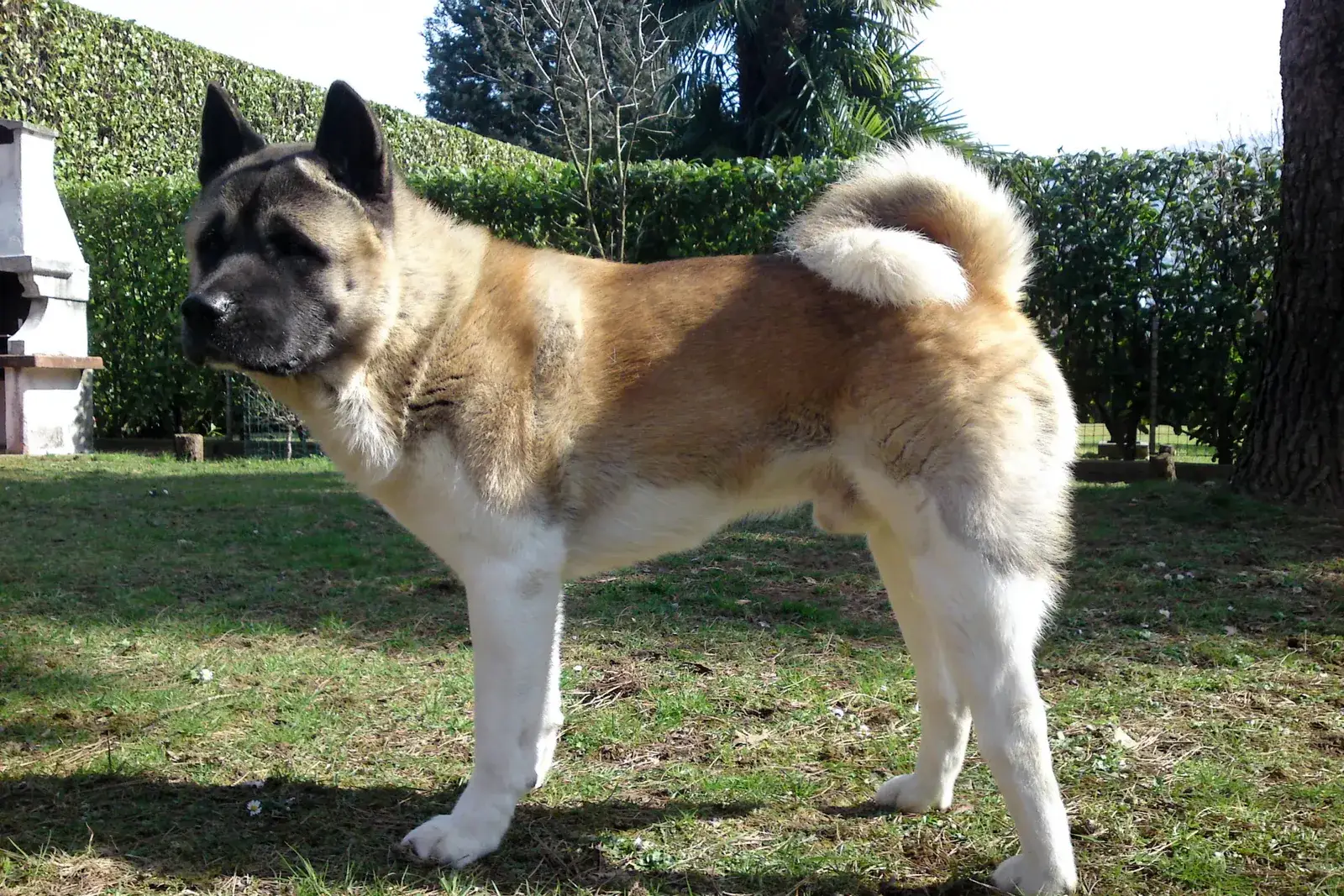
It is bigger and heavier than the Japanese Akita, with a broad bear-like head and a colour range that includes black masks, pinto and brindle. The Fédération Cynologique Internationale (FCI) has treated it as its own breed since 1999 and named it the American Akita in 2006. The American Kennel Club (AKC) registers it simply as the "Akita". Health topics to know are the immune conditions uveodermatologic (VKH-like) syndrome and sebaceous adenitis, and bloat.
American Akita quick facts
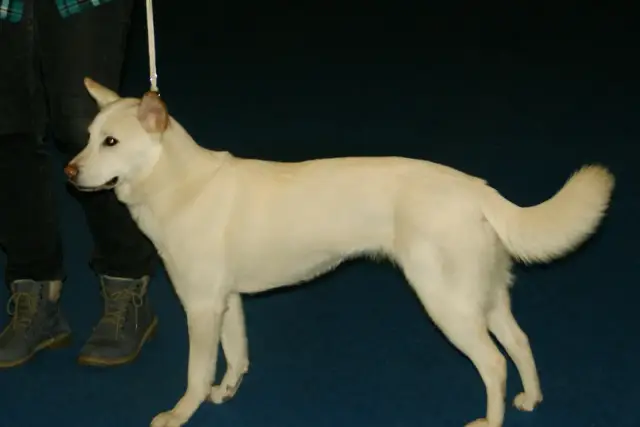 Related breedJindo1200 to 1962 · South KoreaLate Middle Ages
- Closest DNA relatives
- Akita data: Japanese Chin and Shiba Inu (13 to 14 )
- Country of origin
- FCI lists Japan as the country of origin and the United States of America as the country of development
- Period of development
- 1945 to 1956 (atlas data, high confidence)
- Original job
- Companion and guard dog; its Japanese ancestors hunted and guarded
- Type
- Spitz. FCI: Group 5, Spitz and primitive types, standard no. 344. AKC: Working Group (as "Akita")
- Other names
- Great Japanese Dog (the FCI name from 1999 to 2006); Akita (AKC)
- Height
- FCI: about 66 to 71 cm dogs, 61 to 66 cm bitches
- Weight
- Not set by the FCI standard; breed summaries give roughly 27 to 59 kg dogs and 25 to 45 kg bitches (Wikipedia, secondary)
- Life span
- 10 to 13 years (atlas data)
- DNA family
- Asian Spitz (Parker et al. 2017, atlas data, via the Akita)
Drawn to scale in real centimetres. Its back reaches about 66 cm, mid-thigh; its head about 84 cm, your hip.
Where it sits in the tree
Modern Era · 1914 to today

Name and origin
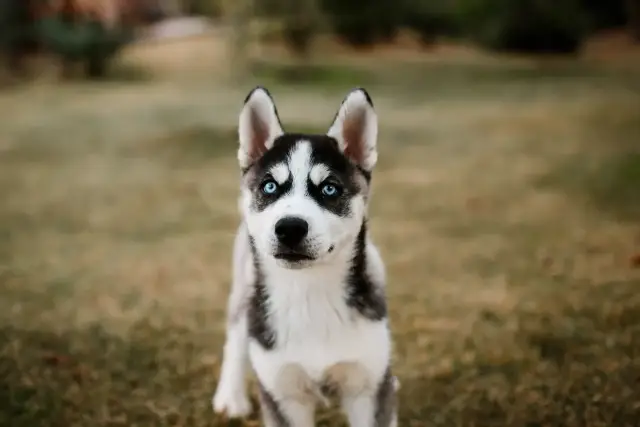
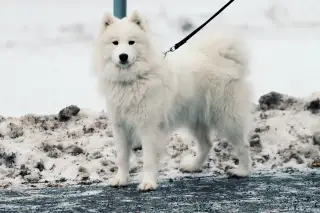
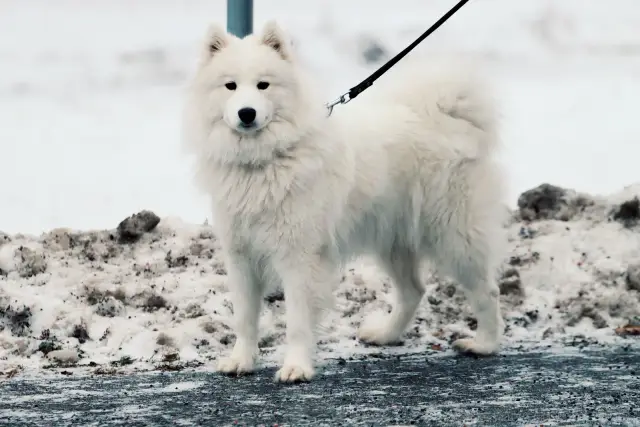 Related breedSamoyed500 CE to 1912 · RussiaEarly Middle Ages
"Akita" comes from Akita Prefecture in northern Japan. The American Akita carries the name of the Japanese breed because it began as the same dogs. The atlas data records the American type as a variety of the Akita that was kept from dogs taken to the US after World War II and then split off.
The names are the confusing part, and they depend on the club:
- FCI countries. The FCI split the two types in June 1999. The American type was first called the Great Japanese Dog and was renamed the American Akita in January 2006. The Japanese type is the Akita (standard no. 255).
- AKC. The AKC lists the American type under the plain name "Akita". The AKC's own history article says the Japanese Akita (Akitainu) entered the AKC's Foundation Stock Service in 2020. Some summaries say the AKC now treats the two as separate breeds, while others say the AKC still has one Akita, so check the AKC site for its current wording before quoting it.
- Other clubs. The UK Kennel Club and the Canadian Kennel Club have their own wording and have not been checked for this page.
Put simply: outside the FCI world, "Akita" often means what the FCI calls the American Akita, and a "Japanese Akita" is the smaller, more fox-faced dog.

History
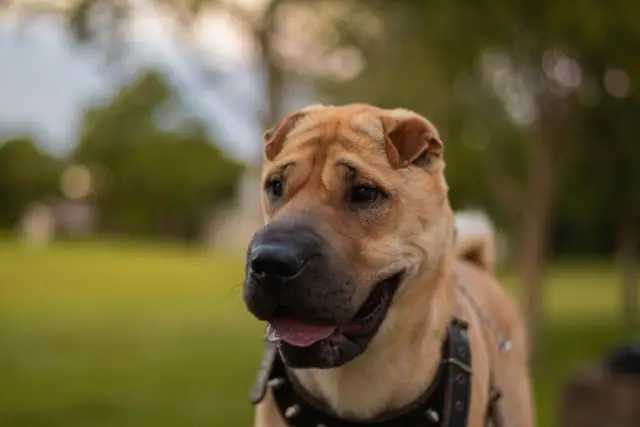 Same eraShar Pei200 BCE to 1973 · ChinaAncient World
Japanese roots
The Akita's ancestors were large spitz dogs of the mountains of northern Japan that hunted bear and boar and guarded homes. Early in the twentieth century the Akita became a national symbol, helped by the story of Hachiko, the dog that waited for its owner at Shibuya Station in Tokyo. The atlas data adds that the breed was crossed with the Tosa and the German Shepherd in the decades before the war.
The first Akitas in America
The first Akitas to reach the US are credited to Helen Keller, who was given a puppy by Japanese officials in the late 1930s. Accounts give 1937 for the first import, and the sources describe a replacement dog after the first one died young. These dogs were few, and they did not found the American breed.
After the war: servicemen and the American type
The breed took off in the US after 1945. American servicemen stationed in occupied Japan saw the dogs and brought some home. Sources describe the Dewa line, which was heavier and in many cases carried German Shepherd crossing, as the type most soldiers saw. In Japan the breed kept a smaller, fox-faced type. In the US, the larger, heavier dogs became the American standard, with a black mask and many colours accepted.
The AKC recognised the Akita in the 1970s. The two populations then drifted apart: Japan and the FCI kept the narrower Japanese standard while the American line stayed large and broad-headed.
The split
In June 1999 the FCI decided that the American-type dogs would be a separate breed, the Great Japanese Dog, renamed the American Akita in January 2006.
Today
The American Akita is a companion and watch dog. It is a large, strong-willed breed that suits experienced owners.
Relatives and DNA
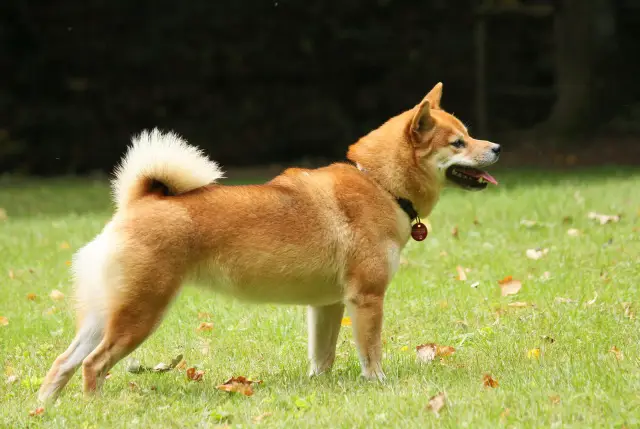 Same familyShiba Inu300 BCE to 1936 · JapanAncient World
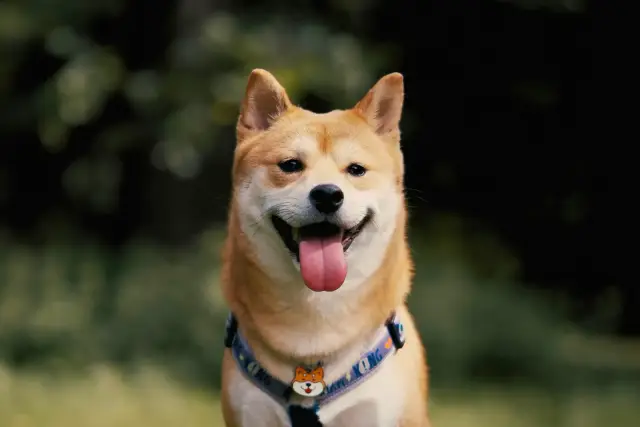
The atlas data places the American Akita in the Asian Spitz family, the Parker et al. (2017) DNA group that includes the Shiba Inu, Chow Chow and other east Asian breeds. The American Akita has no DNA figures of its own in that data set, so its genetic closeness is read from its Japanese parent. For the Akita, Parker et al. found the most with the Japanese Chin (13.9 Mb) and the Shiba Inu (13.1 Mb). These are low shared-DNA values, which shows how distinct the Akita is.
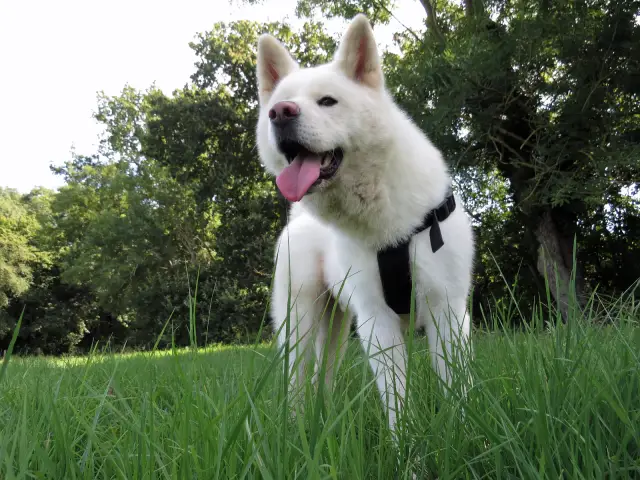
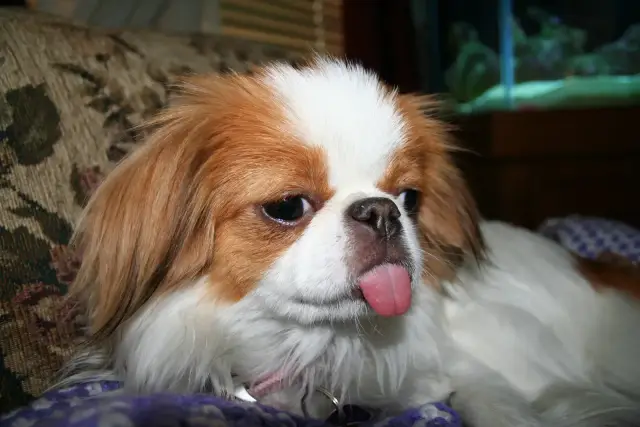
- Akita and Japanese Chin
- Akita and Shiba Inu
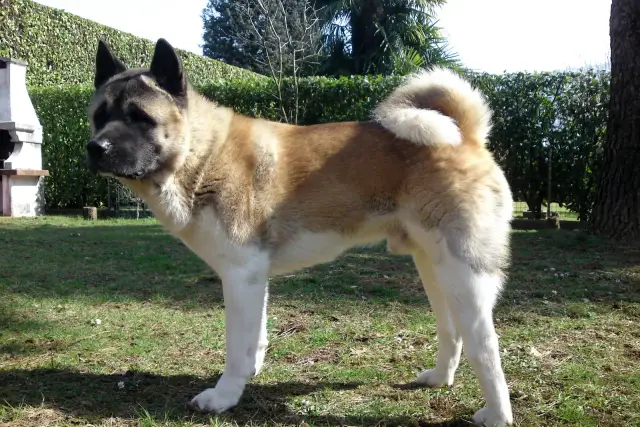 American Akitafrom Akitas taken to the US after World War II
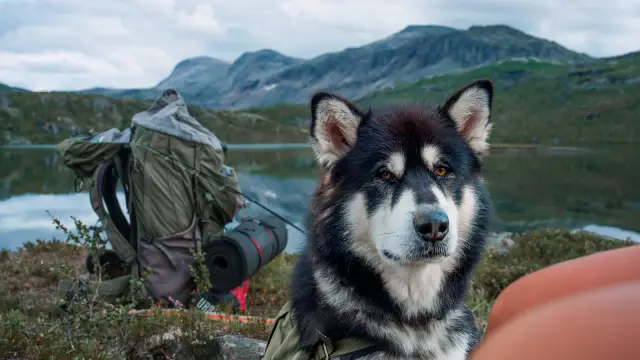
American Akita vs Japanese Akita
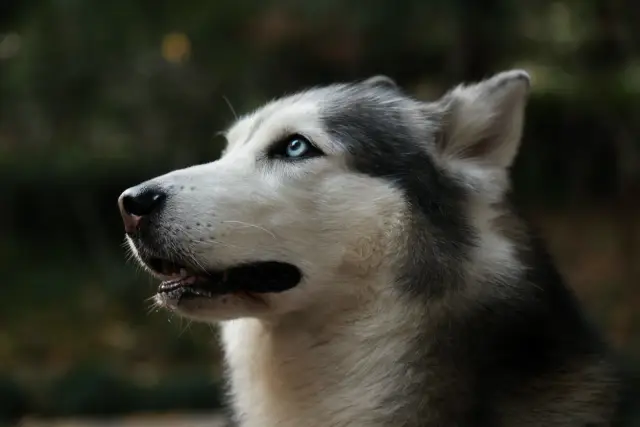 Related breedSiberian Husky1000 to 1930 · RussiaEarly Middle Ages
| Point | American Akita | Japanese Akita |
|---|---|---|
| FCI standard | No. 344, American Akita | No. 255, Akita |
| Height (FCI) | About 66 to 71 cm dogs, 61 to 66 cm bitches | 67 cm dogs and 61 cm bitches, tolerance 3 cm |
| Head | Broad, bear-like (breed guides) | Fox-like with almond eyes (breed guides) |
| Colours (FCI) | Any colour, including pinto and brindle | Red fawn, sesame, brindle and white; urajiro on all except white |
| Mask | Black mask allowed (breed guides) | No black mask (breed guides) |
| AKC | Listed as "Akita" | Foundation Stock Service from 2020 (AKC history) |
Breed guides disagree on weights and their ranges overlap, so the size gap is best read from the FCI heights, which are a few centimetres apart.
The breed standard
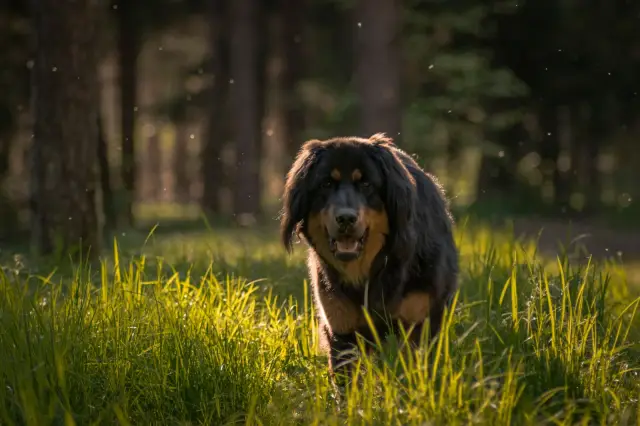 Looks relatedTibetan Mastiff1000 BCE to 1931 · ChinaAncient World
A is the written ideal a kennel club judges dogs against. The American Akita standard asks for a large, powerful, alert dog with a broad head, small triangular ears carried forward, a tail curled over the back and a thick double coat.
| Trait | What the standards say |
|---|---|
| Group | FCI: Group 5, Spitz and primitive types, standard no. 344 (definitive). AKC: Working Group, as "Akita" |
| Height, FCI | About 66 to 71 cm for dogs and 61 to 66 cm for bitches (KUSA reproduction of the FCI text) |
| Height, UKC | 26 to 28 inches (66 to 71 cm) males, 24 to 26 inches (61 to 66 cm) females |
| Height, AKC | The older AKC standards used about 25 to 28 inches for males and 23 to 26 inches for females, "or more" (1960 and 1963 texts); the current AKC text was not retrieved, so no current figure is given |
| Weight | No official weight in the sources found; Wikipedia gives 27 to 59 kg dogs and 25 to 45 kg bitches |
| Coat | Double coat: a soft dense undercoat and a straight, harsher outer coat |
| Colours, FCI | Any colour, including pinto and brindle; pinto needs a white ground with large, evenly placed patches covering the head and more than a third of the body |
| Mask | Solid white dogs have no mask (FCI) |
| Temperament, FCI | Friendly, alert, responsive, dignified, docile and courageous |
Rows for the AKC and UK Kennel Club are limited to what is stated above.
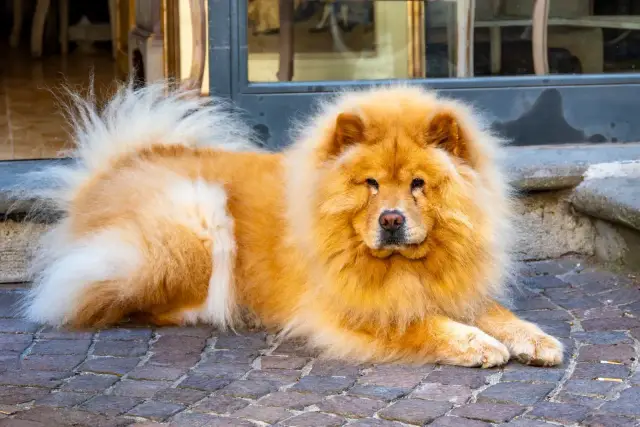
Temperament
 Related breedAmerican Bully1980 to 2004 · United StatesModern Era
The standards describe a dignified, courageous, loyal dog. In daily life it tends to be calm indoors, close to its family, and watchful with strangers. Breed guides call it independent and strong-willed, and say it is not a dog that obeys to please.
With other dogs. This is the most-discussed trait. Breed guides say the Akita can be aggressive toward unfamiliar dogs and can be more difficult with dogs of the same sex. No study gives a figure for this, so there is no number here. Practical consequences are early and ongoing socialisation, a secure fence, and care in dog parks.
With children and strangers. Akitas are loyal with their own family's children, but their size and guarding instinct mean supervision. They tend to be reserved with visitors.
Training. Akitas respond to calm, consistent, reward-based training and shut down when handled harshly. Short sessions work better than long drills, and they never become a dog that is trustworthy off lead.

Health
 Related breedBlack Russian Terrier1949 to 1984 · RussiaModern Era
Most American Akitas live long, settled lives; the atlas data gives 10 to 13 years. This section lists what breeders screen for and what owners can watch for. Where a study gives a prevalence it is quoted, and where none turned up the table says so rather than inventing a number.
| Condition | What it is | How common | What helps |
|---|---|---|---|
| Uveodermatologic (VKH-like) syndrome | An immune condition in which the body attacks pigment cells, causing eye inflammation and loss of colour on the nose and lips | About 1 in 7 in a clinic-based Akita survey (13.64%, Veterinary and Animal Science, 2020); not a breed-wide rate | Report eye redness or colour change to a vet quickly; ask a breeder about relatives with the condition |
| Sebaceous adenitis | An immune condition of the skin's oil glands, causing hair loss and scaling | The most common disease in that same survey (47.73% of the dogs studied), a clinic sample and not a breed-wide rate. In a Swedish study of 104 cases, Akitas were 10 of the cases | Skin biopsy by a vet; ask breeders about affected relatives |
| Bloat (gastric dilatation volvulus, GDV) | The stomach fills with gas and may twist, an emergency | Breed guides list the Akita as at higher risk, as for other deep-chested dogs; no study figure was verified | Several smaller meals; avoid hard exercise around meals; know the signs (swollen belly, retching with nothing coming up) and go to a vet at once |
| A loose or misshapen hip joint | Listed by breed guides; no figure found | Hip scores of the parents; keep a growing puppy lean | |
| Hypothyroidism | An underactive thyroid | Listed among the immune-mediated conditions of the breed; no figure found | Blood testing and daily tablets from a vet |
Immune disease and the gene pool. A 2005 study of American Akitas linked one immune gene variant (DLA-DQA1*00201) to a much higher risk of uveodermatologic syndrome (odds ratio about 16). The same study found nearly half of American Akitas carried two copies of a single variant at that gene, a sign of low genetic diversity in the breed. The authors list several immune conditions seen more often in Akitas, among them thyroiditis, sebaceous adenitis, pemphigus foliaceus and myasthenia gravis. Most dogs carrying the risk variant stay healthy, and this is a reason to ask about relatives and to choose a breeder who shares health history openly.
Studies in context. The 2020 survey was of Akitas examined in clinics, so it over-represents sick dogs. The percentages show what vets in that sample saw, not how many Akitas in the world have these conditions.

Living with an American Akita
 Related breedCavalier King Charles Spaniel1926 to 1945 · United KingdomModern Era
| Daily reality | Rating | Why |
|---|---|---|
| Exercise per day | Medium | Daily walks and play; not a marathon dog (breed guides) |
| Training needs | High | Independent and strong-willed; needs patient, consistent handling |
| Grooming | Medium | Thick double coat; weekly brushing, more in the moult |
| Shedding | High | Heavy twice-yearly moult (double coat in the standard) |
| Barking | Low | Often quiet but will alert; varies |
| Time alone | Fair | Attached to family; long days alone are not ideal |
| Children | Fair | Loyal with own family's children; size means supervision |
| Other dogs | Poor | Breed guides report aggression toward unfamiliar dogs; varies by individual |
| Cats and small pets | Poor | Spitz hunting heritage; evidence is thin, expect to keep apart |
| Flat living | Fair | Calm indoors, but large; needs space and walks |
| Heat tolerance | Poor | Thick double coat; no source rates it, avoid hot-day exercise |
| Cold tolerance | Good | Spitz double coat |
| First-time owner fit | Poor | Strong will, size and dog-to-dog issues suit experienced owners |
A great fit if
- You have owned large, independent breeds and enjoy calm, consistent training.
- You want a dignified, loyal house dog rather than a playmate for every dog in the park.
- You have a secure fence and a household where one dog is enough.
- You are happy to groom a thick coat and clear hair for weeks.
Think twice if
- You want a dog that makes friends with every dog it meets.
- You live in a hot climate with no air conditioning.
- You are a first-time owner with small children or a cat.
- You want a dog that obeys quickly off lead.
Before you get one
- Health tests to ask a breeder for: hip scores and a thyroid test of the parents, plus honest history of VKH-like syndrome, sebaceous adenitis and bloat among relatives.
- Puppy or adult rescue: Akita breed rescues exist, and an adult with a known dog and cat history can be easier to match than a puppy.
- First year: expect rapid growth, early socialisation, a puppy-class schedule and a heavy coat blow.
- Which Akita: check which breed a litter belongs to in your country's registry, because the American Akita and the Japanese Akita are registered differently by the FCI and the AKC.
Similar breeds to consider
- Akita. The Japanese type, smaller and fox-faced, with the same independent character.
- Shiba Inu. A small Japanese spitz with a similar attitude in a more compact dog.
- Siberian Husky. A spitz with a double coat but a much more outgoing, dog-friendly nature.
- Tosa. A giant Japanese breed that is an ancestor in the atlas data; needs very experienced owners.

American Akita fun facts
 Related breedCavapoo1990 to 2000 · United StatesModern Era
- Helen Keller is credited with bringing the first Akitas to the US in the late 1930s; accounts give 1937.
- The FCI first called the American type the Great Japanese Dog, in 1999, before choosing "American Akita" in 2006.
- The FCI accepts any colour for the American Akita, while its Japanese standard accepts only red fawn, sesame, brindle and white.
- A 2005 study found nearly half of American Akitas carried two copies of one immune gene variant, a sign of a narrow gene pool.
Frequently asked questions
What is the difference between an American Akita and a Japanese Akita?
The American Akita is larger, with a broader, bear-like head and a wider colour range, including a black mask and pinto. The Japanese Akita is slightly smaller, fox-faced and limited to red fawn, sesame, brindle and white. The treats them as two breeds.
Are they the same breed?
It depends on the club. The FCI has separated them since 1999. The lists the American type as the "Akita" and, per its own history article, took the Japanese Akita into its Foundation Stock Service in 2020. Check the AKC for its current policy.
How big does an American Akita get?
The FCI gives about 66 to 71 cm for dogs and 61 to 66 cm for bitches. Weights in breed summaries run from about 25 to 59 kg.
How long do American Akitas live?
Atlas data says 10 to 13 years.
Are American Akitas aggressive?
The FCI standard describes a friendly, docile and courageous dog, but breed guides report aggression toward unfamiliar dogs, so socialisation and secure fencing matter. No study figure was found.
What health problems do American Akitas have?
The best documented are immune conditions (VKH-like syndrome and sebaceous adenitis) and bloat. Ask breeders about relatives with these.
Read next
FamilyAsian SpitzThe whole family GuideDogs of Japan: the native breeds and their storiesJapanese dog breeds explained: the six Nihon Ken, the Chin, Tosa, Japanese Spitz and Terrier, Hachiko, wartime near-extinction, DNA and who they suit.
Sources (12)
- American Kennel Club, "Akita history and Hachiko" (the Japanese Akita and the Foundation Stock Service).
- Canine Chronicle, breed history articles on the Akita (AKC status).
- Fédération Cynologique Internationale, standards no. 344 (American Akita) and no. 255 (Akita), as reproduced by the Kennel Union of Southern Africa.
- United Kennel Club, Akita breed standard.
- Akita Club of America, 1960 and 1963 standards (as reproduced by Northland Akitas).
- Casini L. et al., "Serum 25-hydroxyvitamin D concentration in Japanese Akita dogs: A survey", Veterinary and Animal Science, 2020 (reports sebaceous adenitis and uveodermatologic syndrome among the dogs surveyed).
- Acta Veterinaria Scandinavica, 2008, "Sebaceous adenitis in Swedish dogs, a retrospective study of 104 cases".
- "Uveodermatologic (VKH-like) syndrome in American Akita dogs is associated with an increased frequency of DQA1*00201", Veterinary Immunology and Immunopathology, 2005 (via VIN).
- UC Davis Veterinary Genetics Laboratory, Akita genetic diversity project.
- Parker H.G. et al., "Genomic analyses reveal the influence of geographic origin, migration and hybridization on modern dog breed development", Cell Reports, 2017.
- Wikipedia, Akita (dog breed) (secondary, for dates and weights).
- Fogle B., The New Encyclopedia of the Dog, 2009 (atlas data source).