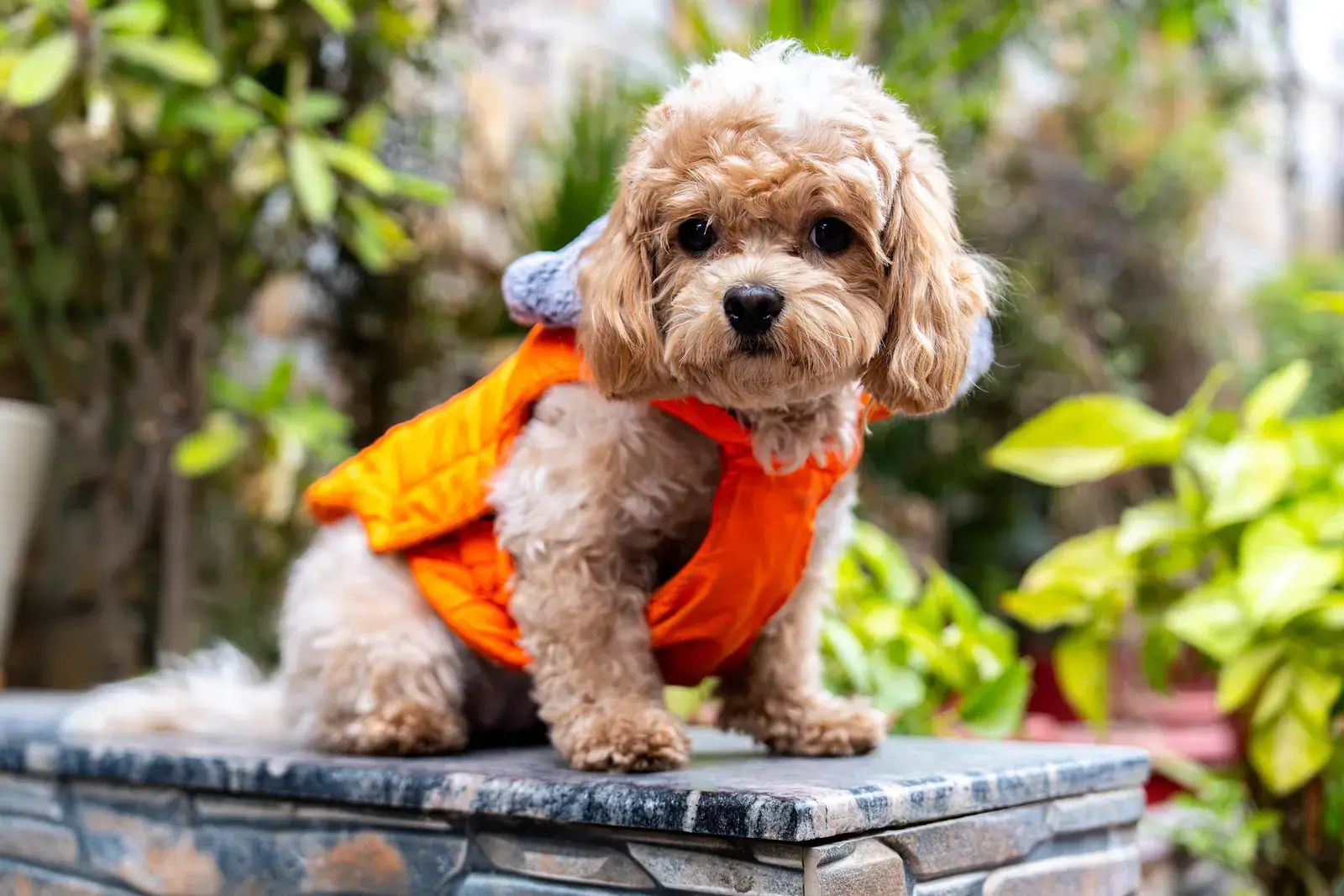
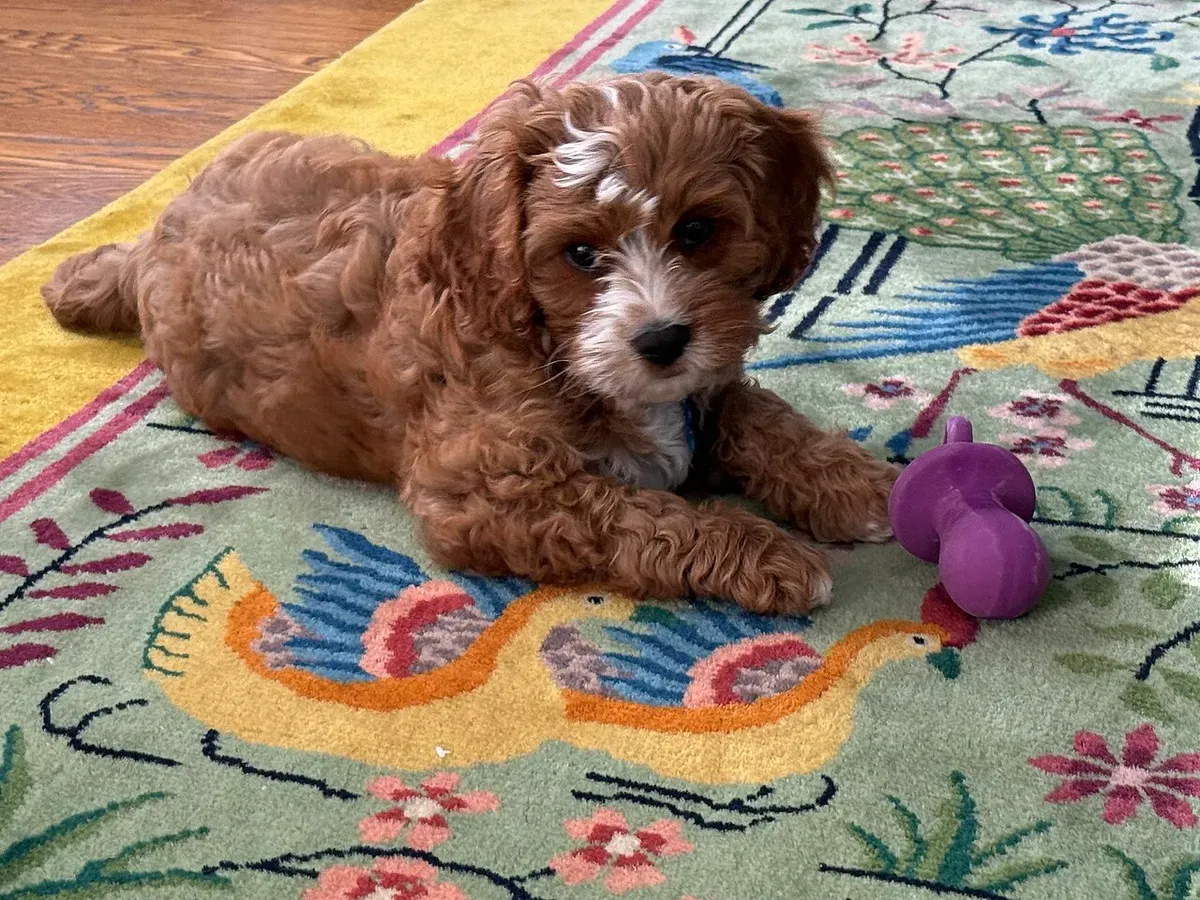
It is also called the Cavoodle, mainly in Australia, and the Cavadoodle. The pitch is a gentle, soft-coated lap dog that is easy to live with and loses less hair than a Cavalier. Many owners find exactly that. The cross is not a recognised breed with the major kennel clubs, so it has no official standard, and every litter mixes the two parents in different amounts. It also carries a question that other doodles do not: the Cavalier is a breed with well-known inherited heart and spine conditions, and a cross can inherit them. This page covers the origin, generation labels, size, coat, temperament, grooming and what the studies say about health, with no breeder promotion.
Cavapoo quick facts
 Related breedPomsky2011 to 2014 · United StatesModern Era
- What it is
- A cross of the Cavalier King Charles Spaniel and the Poodle
- Country of origin
- United States in the atlas data (medium confidence); widely said to be developed in Australia
- Period of development
- 1990 to 2000 in the atlas data (medium confidence)
- Recognition
- Not a recognised breed with the major kennel clubs
- Family
- Modern (a grouping by history, not by DNA)
- Other names
- Cavoodle, Cavadoodle
- Size
- Small; follows the Poodle size used, usually Miniature or Toy
- Life span
- Atlas data: 12 to 15 years
- Coat
- Varies: straight, wavy or curly; colours follow both parents
- Parent breeds
- Cavalier King Charles Spaniel and Poodle
Drawn to scale in real centimetres. Its back reaches about 30 cm, your shin; its head about 37 cm, just below your knee.
Where it sits in the tree
Modern Era · 1914 to today
Name and origin
 Related breedPuggle1980 to 1990 · United StatesModern Era
"Cavapoo" is a portmanteau of Cavalier and "poo", short for poodle. The Australian name "Cavoodle" combines Cavalier with "doodle", from "Pudel", the German word that gave English "poodle". "Cavadoodle" is a third form. The same pattern gave the Labradoodle, the Goldendoodle and the Cockapoo.
The origin is poorly documented. The atlas data places it in the United States, at medium confidence, in the window 1990 to 2000. Most breed guides say it was first bred on purpose in Australia in the 1990s, when other Poodle crosses were gaining ground, with a low-shedding companion dog for allergy sufferers as the aim. A veterinary group in Australia says the first Cavoodles were probably accidental matings between a Poodle and a Cavalier, and that the first recorded litter was in Australia. One source dates the cross to the United States in the 1950s, but no other source supports that date. No single breeder can be named as the creator.
The Cavapoo is not a descendant of one parent. Both breeds contributed, so in the atlas data it sits in the Modern Crossbreed family, which groups crosses by history and not by DNA.

History
 Same eraAmerican Akita1945 to 1956 · United StatesModern Era
Two companion breeds
Both parents are old companion breeds in their own way. The Cavalier was recreated in the 1920s from the long-muzzled toy spaniels seen in Stuart court paintings, and the UK Kennel Club recognised it as a separate breed in 1945. The Poodle began as a water retriever of central and western Europe and became a companion and show dog; Miniature and Toy Poodles were bred down from the larger dogs. The Cavapoo joins a spaniel built for lap company to a clever dog from a working past.
The doodle wave
The Labradoodle of 1989 showed that a Poodle cross could sell. In the 1990s breeders in Australia and elsewhere tried the Poodle with other breeds, and the small, soft-eyed Cavalier was a natural partner for people who wanted a small dog. Public attention grew after several well-known Australians were seen with Cavoodles, including the then Prime Minister Julia Gillard, according to news and breed-guide coverage. The cross travelled to the United Kingdom and North America and became one of the most popular small crossbreeds there.
No registry, many types
With no kennel club standard and no single registry, quality varies widely. Some breeders health-test both parents and keep careful records. Others breed from whatever dogs they own. Because the market is large, a Cavapoo puppy is a cross whose parents you should always be able to meet.
 Save
Relatives and DNA
 Same familyAmerican Bully1980 to 2004 · United StatesModern Era
The relatives of the Cavapoo follow from the cross. A 2017 study by Parker and colleagues (Cell Reports) analysed 1,346 dogs from 161 breeds and sorted them into 23 supported clades. The Cavalier King Charles Spaniel sits in the Spaniel , and the Poodle in the Poodle clade of its own. The atlas data holds no DNA study of the Cavapoo itself, so there is no DNA chart here, and no study states how much of each parent a given puppy carries.
Through the Cavalier the Cavapoo shares ancestry with the older King Charles Spaniel and, in the atlas data, the Maltese. Through the Poodle it shares ancestry with the Barbet, a French water dog. Other Poodle crosses are the Labradoodle, the Goldendoodle and the Cockapoo; see Modern Crossbreed for all of them.
F1, F1b and multigenerational
 Related breedBlack Russian Terrier1949 to 1984 · RussiaModern Era
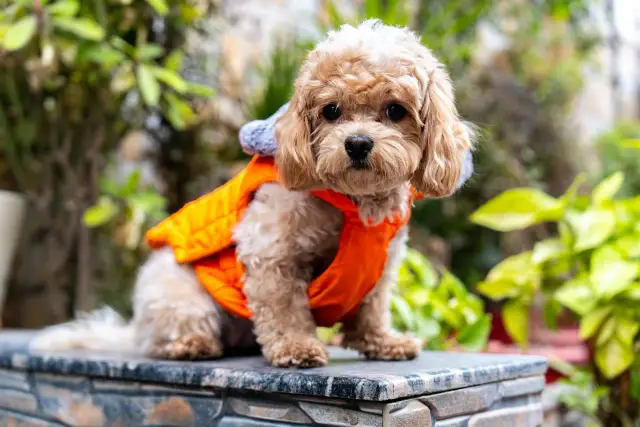
Breeders label Cavapoos by generation. The label describes the parents and does not guarantee the puppy.
- F1. A first cross: one Cavalier parent and one Poodle parent. About half the ancestry comes from each breed. Puppies in the same litter can differ in coat and size.
- F1b. An F1 mated back to a Poodle (or sometimes to a Cavalier). Mating back to a Poodle is usually done to get a curlier coat, and the puppy carries about three quarters Poodle ancestry.
- F2. Two F1 dogs mated together.
- Multigenerational. Dogs from Cavapoo parents of several generations, bred to settle coat, size and temperament.
Generation matters for health in a way that is easy to miss. A Cavapoo with one Cavalier parent, an F1, carries half Cavalier ancestry. An F1b mated back to a Poodle carries about a quarter. One breed-guide source says Cavapoos share only half their DNA with Cavaliers and are therefore at lower risk, but this is an argument and not a measured result: no published study measures heart or spine disease in Cavapoos by generation. Published guidance on which generation gives which coat comes mostly from breeders and disagrees. Treat a generation label as a note on ancestry, not a promise.
No breed standard: what to expect
 Looks relatedCavalier King Charles Spaniel1926 to 1945 · United KingdomModern Era
A is the written ideal a kennel club judges dogs against. The Cavapoo has none from the , the American Kennel Club or the UK Kennel Club, because none recognises it. Breeder groups have written their own, so two dogs sold under the same name can look very different.
What can be said comes from the parents. The Cavalier King Charles Spaniel standard of the UK Kennel Club gives 5.4 to 8.2 kg, and the gives a height of about 30 to 33 cm. The Poodle comes in four varieties; the FCI gives 24 to 28 cm for a Toy and 28 to 35 cm for a Miniature. A cross of those lands in between, and most Cavapoos are small dogs, often 5 to 10 kg. Because a Miniature Poodle is larger than a Toy, the Poodle parent decides much of the size. Adult size is a guess from a puppy, so ask for the actual weights of both parents.
| Trait | What the parent breeds say |
|---|---|
| Height | Cavalier, AKC: about 30 to 33 cm. Toy Poodle, FCI: 24 to 28 cm. Miniature Poodle, FCI: 28 to 35 cm. Cavapoo: varies |
| Weight | Cavalier, UK Kennel Club: 5.4 to 8.2 kg. Toy Poodle roughly 2 to 4 kg, Miniature 5 to 8 kg. Cavapoo: small, varies with the Poodle size used |
| Coat | Cavalier: silky, long, with feathering. Poodle: dense, curly, continuous growth. Cavapoo: straight, wavy or curly |
| Colours | Cavalier: Blenheim, tricolour, ruby, black and tan. Poodle: many solid colours. Cavapoo: apricot, red, cream, black, chocolate, Blenheim and parti colours are all seen |
| Ears | Both parents carry long hanging ears, so Cavapoo ears hang and can trap moisture |
Coat types
 Related breedCzechoslovakian Wolfdog1955 to 1999 · Slovakia, Czech RepublicModern Era
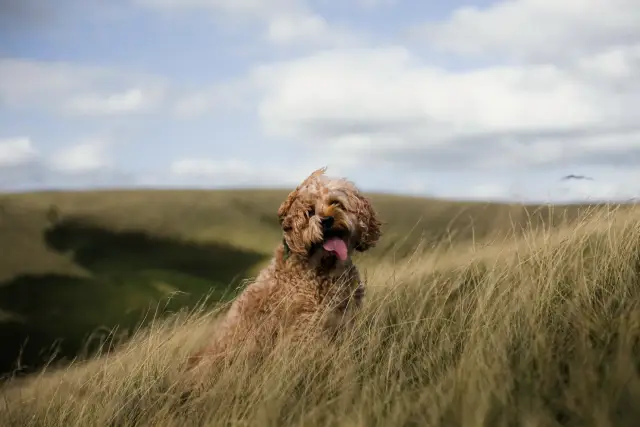
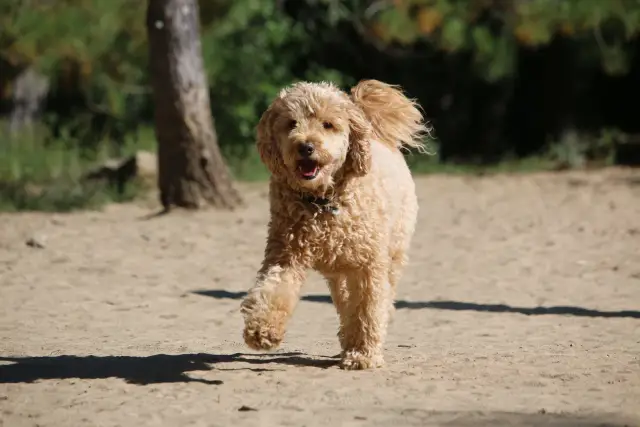
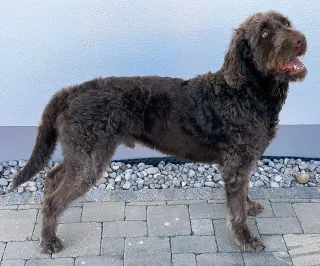
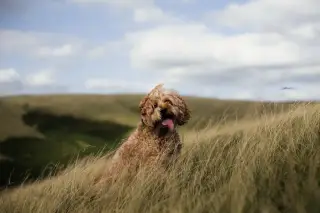
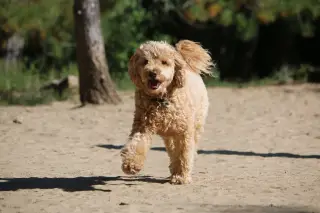
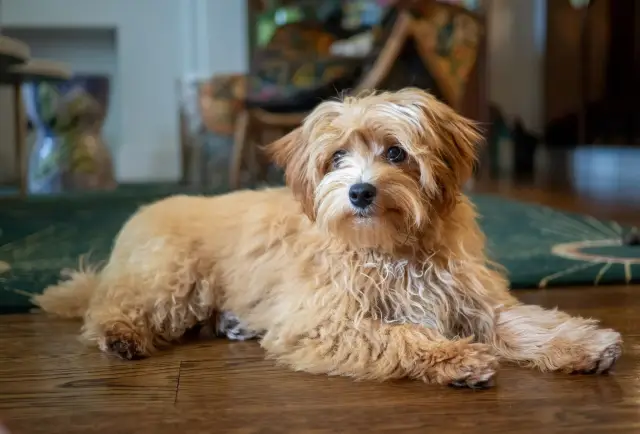
The coat is a main reason people choose a Cavapoo, and its most variable feature. The Cavalier has a silky, fairly long single coat that sheds moderately. The Poodle has a curly coat that grows continuously, sheds little loose hair and mats easily. The Cavapoo can get either pattern or something between them.
- Curly coat. Closest to the Poodle. Sheds least and mats most easily. Needs brushing every few days and clipping every six to ten weeks.
- Wavy coat. Soft waves with some feathering. Sheds a little. Brushing several times a week.
- Straight coat. Closest to the Cavalier. Sheds the most, and has the Cavalier's silky feel and ear feathering.
Breeder and groomer guidance says curly coats shed least and straight coats most. That is a pattern reported by breeders and not a measured finding. Coats also change as puppies mature, and the puppy coat is a poor guide to the adult coat. A litter can include all three types.
The "hypoallergenic" claim
 Related breedDogo Argentino1928 to 1973 · ArgentinaModern Era
Cavapoos are often sold as hypoallergenic. The evidence does not support that for any dog. The main dog allergen, Can f 1, is found in saliva and skin flakes as well as hair, so a low-shedding coat does not remove it. Vredegoor and colleagues (Journal of Allergy and Clinical Immunology, 2012) measured Can f 1 in hair and homes across breeds and found no clear lower levels for the breeds sold as hypoallergenic. Nicholas and colleagues (American Journal of Rhinology and Allergy, 2011) compared homes with hypoallergenic and non-hypoallergenic dogs and found no lower allergen levels in the first group.
Individual dogs and individual allergic people differ, so some people do react less to some dogs. If allergies matter in your household, spend time with the actual dog before you commit. A breeder who guarantees a non-shedding, allergy-safe puppy is promising something no one can measure.
Temperament
 Related breedMiniature American Shepherd1968 to 2015 · United StatesModern Era
Most Cavapoos are described as gentle, affectionate and eager to be near their people. The Cavalier is known as a friendly companion that wants to be with its family, and the Poodle adds quickness and a lively streak. A cross can inherit any mix of these, so the best guide is the temperament of the two actual parents.
Common traits reported by owners and breeders:
- People oriented. They follow the family from room to room and greet visitors warmly. They are poor guard dogs for that reason.
- Clever and willing. They learn tricks and routines quickly and respond well to reward-based training.
- Moderate energy. A Cavapoo needs daily walks and play but is generally calmer than a working breed of the same size.
- Prone to separation worries. Companion dogs bred to sit close to people often struggle when left alone for long days. Teach short absences early.
The 2024 doodle survey (Bryson et al.) was about physical health, so these traits come from breed descriptions and not from a measured study. Behaviour varies between litters, which is another reason to meet the parents.

Training and activity
 Related breedNeapolitan Mastiff1946 to 1949 · ItalyModern Era
A Cavapoo needs roughly 30 to 60 minutes of exercise a day, split between walks and play. That is less than a retriever cross needs, but a bored young dog will still chew, bark or follow you into every room. Short, regular training sessions with rewards work better than long drills, and scent games and puzzle feeders keep a clever dog busy.
Start puppy classes and social contact with people, dogs and household noises early. Practise being left alone in small steps, since separation worry is the most common complaint reported for this kind of companion dog. Small dogs also need house training with patience: a small bladder means frequent trips outside in the first months.
Grooming
Grooming is the part owners most often underestimate. A curly or wavy coat tangles close to the skin, and once it mats the only fix may be clipping the dog short.
- Brushing. Every two to three days for wavy and curly coats, down to the skin with a comb as well as a brush. Behind the ears, under the legs and around the collar mat first.
- Clipping. Every six to ten weeks for most dogs, by a groomer or at home with practice.
- Ears. Long hanging ears hold moisture. Check weekly, dry after bathing and trim ear hair with a vet or groomer's guidance.
- Eyes, nails and teeth. Wipe tear stains gently, trim the nails every few weeks and brush the teeth several times a week. Small dogs are prone to dental disease.
Groomer visits are a regular part of the cost and time budget for the life of the dog.
Health
Most Cavapoos live healthy lives. This section gives what the studies say, then what is known about the two parent breeds, which is the best guide to what the cross can inherit. A cross can inherit conditions from either parent, and it can also avoid them.
The cross itself. Bryson, O'Neill, Brand, Belshaw and Packer ("The doodle dilemma", PLoS ONE, 2024) from the Royal Veterinary College surveyed owners of 9,402 dogs: Labradoodles, Cockapoos and Cavapoos, and six parent breeds. They compared the risk of the 57 most common canine disorders. For about 87 percent of those comparisons there was no difference between the crosses and their parent breeds. In the rest, the crosses had a higher risk in about 7 percent and a lower risk in about 6 percent. All three crosses had higher risk of ear infections than their non-Poodle parent breeds. The study was an owner survey, not a clinical-records study. Its message is that the cross is not reliably healthier than its parents. It does not say it is worse. The study does not give a figure for heart murmurs or syringomyelia in Cavapoos, and no other peer-reviewed study found for this page does either.
The Cavalier parent. This is the main health question for the cross. Two inherited conditions are common enough in the Cavalier King Charles Spaniel that breeders screen for them.
- Myxomatous mitral valve disease (MMVD). The heart's mitral valve thickens and leaks, heard by a vet as a murmur. In an echocardiography study of 126 Cavaliers aged 8 years or older (Animals, 2021), a murmur was heard in 89 percent, about 9 in 10 dogs. In the Danish Kennel Club breeding scheme, 10 percent of 1,380 examinations of young breeding dogs, about 1 in 10, found a murmur (Birkegård et al., 2016).
- Chiari-like malformation and syringomyelia. A skull that is too small for the brain, and fluid-filled pockets in the spinal cord. Reported prevalence of syringomyelia in Cavaliers is about 39 to 46 percent, about 1 in 2 to 2.5 dogs (Dutch and Danish MRI study, Frontiers in Veterinary Science, 2024).
These figures are for purebred Cavaliers. They are not figures for Cavapoos, and no published study gives a Cavapoo figure, so none is applied here. What can be said is that the Cavapoo can inherit the conditions, and that a breeder who screens the Cavalier parent is the best protection. Cavapoos with a Cavalier grandparent or great-grandparent are lower in Cavalier ancestry, but this has not been measured for these conditions.
The Poodle parent. Health in the Poodle depends on size. Toy and Miniature Poodles are listed for progressive retinal atrophy (prcd-PRA), kneecap problems and small-breed dental disease. No named study gives a breed-wide percentage for these conditions, so none is given here.
| Condition | What it is | How common | What helps |
|---|---|---|---|
| Mitral valve disease | Gradual thickening and leaking of the heart valve, heard as a murmur | About 1 in 10 young breeding Cavaliers had a murmur; 9 in 10 of Cavaliers over 8 years (Birkegård et al. 2016; Animals 2021). No figure for Cavapoos | Heart screening of the Cavalier parent by a specialist, regular heart checks, healthy weight |
| Chiari-like malformation and syringomyelia | Skull too small for the brain, with fluid pockets in the spinal cord; can cause neck pain and scratching | About 1 in 2 to 2.5 Cavaliers (Frontiers in Veterinary Science, 2024). No figure for Cavapoos | MRI screening of the Cavalier parent; see a vet for neck pain or scratching |
| Ear infections | Wax, moisture and infection in the ear canal | Higher in all three doodle crosses studied than in their non-Poodle parent breeds (Bryson et al. 2024) | Dry ears, weekly ear checks, trimming ear hair |
| Progressive retinal atrophy | Inherited loss of vision; a tested condition in Poodles | exist in the Poodle parent; no figure for the cross | DNA test and eye exam of the Poodle parent |
| Kneecap problems | The kneecap slips out of place; seen in small breeds | Listed for Miniature and Toy Poodles; no figure for the cross | Vet kneecap check of both parents |
| Dental disease | Tartar, gum disease and tooth loss | Common in small breeds; no figure for the cross | Daily tooth brushing, vet dental checks |
What helps. A cross has two sets of health risks, and breeders cannot rely on "hybrid vigour" to remove them. Ask for the heart screening certificate and the MRI result of the Cavalier parent, and the eye and DNA test results of the Poodle parent. A breeder who cannot show them is not testing.
Life span. The atlas data gives 12 to 15 years for the Cavapoo. This is a range and not a measured median. The atlas range for the Cavalier is 9 to 14 years, with heart disease as the main influence on life span, and for the Poodle 12 to 16 years. No published study gives a median life span for Cavapoos.

Living with a Cavapoo
| Daily reality | Rating | Why |
|---|---|---|
| Exercise per day | Medium | A small companion cross; roughly 30 to 60 minutes of walks and play |
| Training needs | Medium | Clever and willing; needs early socialisation and house training |
| Grooming | High | Brushing every few days for curly coats and clipping every six to ten weeks |
| Shedding | Varies | Depends on the coat; curly coats shed least, straight coats most |
| Barking | Medium | Varies with the dog; some bark at visitors or when alone |
| Time alone | Poor | Companion stock from both sides; many dogs struggle when left for long days |
| Children | Good | Both parents are known as gentle; a small dog needs handling taught to young children |
| Other dogs | Good | Varies with socialisation |
| Cats and small pets | Good | Low prey drive in the Cavalier side; depends on the dog and the introduction |
| Flat living | Good | Small size suits flats with daily outings |
| Heat tolerance | Fair | A coat that needs clipping; exercise in cooler hours |
| Cold tolerance | Fair | A small dog with a lighter coat may need a coat in winter |
| First-time owner fit | Good | Friendly and trainable; grooming and health checks are the main work |
A great fit if
- You want a small, affectionate dog that wants to be near you.
- You are ready for a regular grooming and clipping routine.
- You will meet the individual dog and both of its parents before choosing.
- You will ask for heart and MRI results for the Cavalier parent.
Think twice if
- You expect a non-shedding, allergy-proof dog. The evidence does not support that.
- You are away for long days.
- You want a coat that looks after itself.
- You hope a cross means no health risk, especially on the Cavalier side.
Before you get one
Meet the mother and, if possible, the father. Ask which Poodle size was used and the actual weights of both parents. Ask for the Cavalier parent's heart screening certificate and MRI result, and for eye and DNA test results of the Poodle parent. Ask how old the Cavalier parent is and whether a murmur has been found. Be careful with any breeder who sells puppies as hypoallergenic, "guaranteed" non-shedding or "healthier than a purebred". Cavapoos and other doodles also end up in shelters and rescues, and an adult dog shows its coat and temperament before you commit; see adopting a dog. Plan for the first year: puppy classes, grooming appointments, house training and slow practice at being alone.
Similar breeds to consider
- Cavalier King Charles Spaniel. The spaniel parent, a recognised breed with breed health schemes and a standard.
- Poodle. The other parent, a recognised breed in several sizes, with a coat that sheds little.
- Cockapoo. A Poodle cross with the Cocker Spaniel, with a similar size and coat.
- Goldendoodle. The same idea with a Golden Retriever, for people who want a larger dog.

Cavapoo fun facts
- "Cavoodle" is the usual Australian name, and the name Cavapoo is more common in the United Kingdom and North America.
- Both parent breeds were bred for company, one at the Stuart court and one as a water retriever turned show dog.
- The 2024 Royal Veterinary College study counted Cavapoos alongside Labradoodles and Cockapoos, the three most common doodle crosses in the sample.
- The atlas data places the Cavapoo in the Modern Crossbreed family, which groups crosses by history and not by DNA.
Frequently asked questions
What is a Cavapoo?
A cross between a Cavalier King Charles Spaniel and a Poodle, usually a Miniature or Toy. It is not a recognised breed with the major kennel clubs.
What is the difference between a Cavapoo and a Cavoodle?
Nothing in the dog. Cavoodle is the usual Australian name for the same cross.
How big does a Cavapoo get?
Small, often 5 to 10 kg. The Poodle size used decides much of it, so ask for the weights of both parents.
Are Cavapoos hypoallergenic?
No breed or cross has been shown to be. Studies of dogs sold as hypoallergenic found no lower allergen levels in homes. Spend time with the dog first.
How long do Cavapoos live?
The atlas data gives 12 to 15 years. No published study gives a median for the cross.
Do Cavapoos get heart disease like Cavaliers?
They can, since the Cavalier parent may pass on the tendency. No published study gives a figure for Cavapoos, so screening the Cavalier parent matters.
Read next
 FamilyModern CrossbreedThe whole family
 Adopt a dogDog Shelters in EuropeFind dog shelters in Europe, learn how shelters differ from country to country and why adopting a dog is a good option.
Sources (13)
- Bryson G. et al., "The doodle dilemma: how the physical health of designer crossbreeds compares to their purebred progenitors", PLoS ONE 19(8), 2024, and the Royal Veterinary College summary.
- Parker H.G. et al., "Genomic analyses reveal the influence of geographic origin, migration and hybridization on modern dog breed development", Cell Reports, 2017.
- Prieto Ramos J. et al., "Clinical and Echocardiographic Findings in an Aged Population of Cavalier King Charles Spaniels", Animals, 2021.
- Birkegård A.C. et al., "Breeding Restrictions Decrease the Prevalence of Myxomatous Mitral Valve Disease in Cavalier King Charles Spaniels over an 8- to 10-Year Period", Journal of Veterinary Internal Medicine, 2016 (Danish Kennel Club breeding scheme).
- Limpens C. et al., "The effect of MRI-based screening and selection on the prevalence of syringomyelia in the Dutch and Danish Cavalier King Charles Spaniels", Frontiers in Veterinary Science, 2024.
- UK Kennel Club, Cavalier King Charles Spaniel breed standard.
- American Kennel Club, Cavalier King Charles Spaniel breed standard.
- FCI, Poodle breed standard (varieties and heights).
- Poodle Club of America health statement, 2024, and UK Kennel Club health information for the Poodle.
- Vredegoor D.W. et al., "Can f 1 levels in hair and homes of different dog breeds", Journal of Allergy and Clinical Immunology, 2012.
- Nicholas C. et al., "Dog allergen levels in homes with hypoallergenic compared with nonhypoallergenic dogs", American Journal of Rhinology and Allergy, 2011.
- Greencross Vets (Australia), Cavoodle owner's guide, on the origin of the cross.
- Atlas data, Cavapoo knowledge record (dates, life span, lineage).