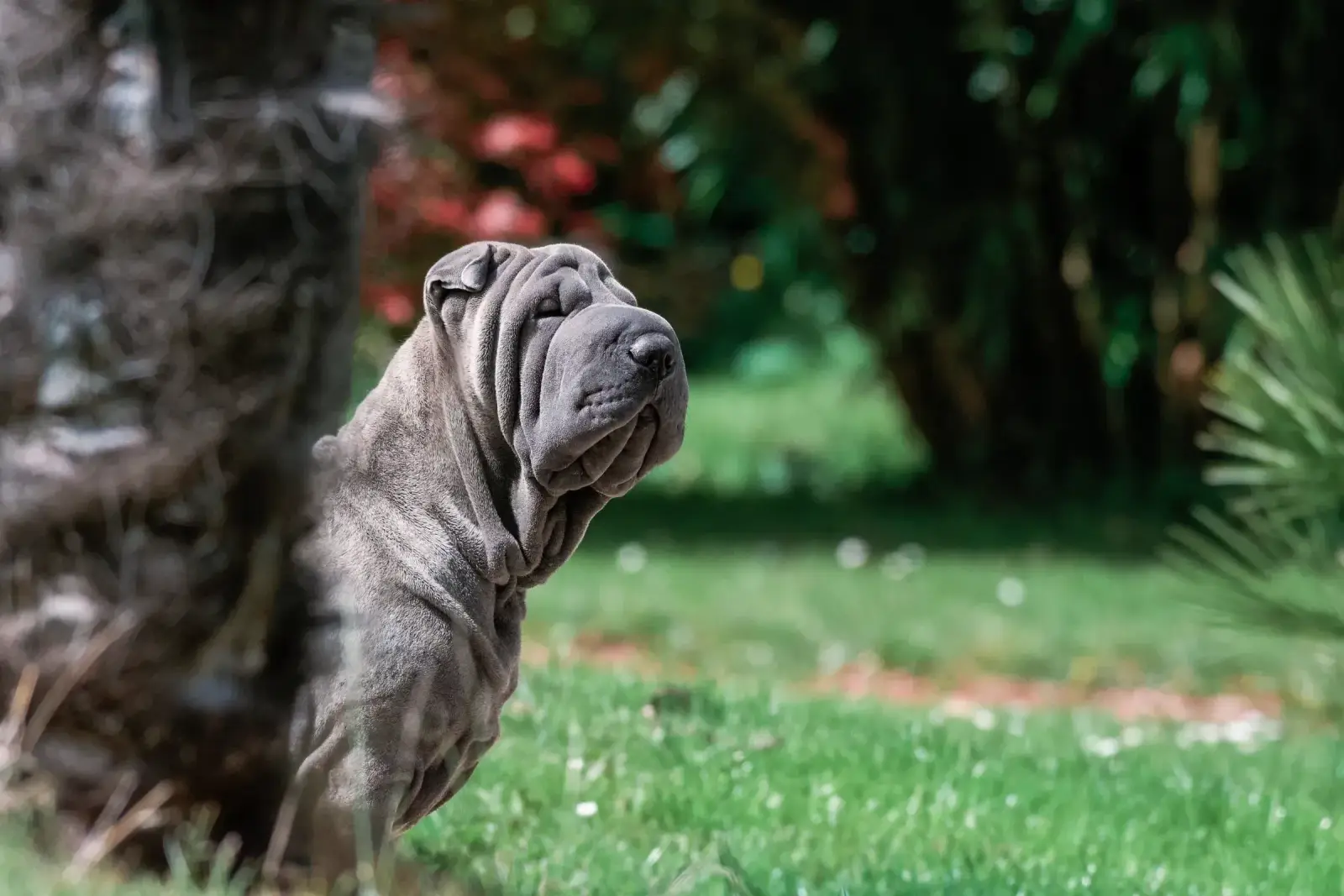
The modern breed is young. It was built in the late 1940s by the Italian-Swiss writer and dog fancier Piero Scanziani, after a dog at the 1946 Naples show caught his eye. The Italian standard followed in 1949 and the FCI accepted the breed in 1956. The story that it descends from the war dogs of ancient Rome is a tradition and not a documented line. Its nearest relative in the Parker 2017 DNA study is the Cane Corso. Expect a dog of 50 to 70 kg that drools, snores, guards and bonds hard with its family, and a short life of about 7 to 9 years. This page covers the history, the standard, the health issues and what it takes to live with one.
Neapolitan Mastiff quick facts
 Related breedAmerican Staffordshire Terrier1850 to 1936 · United StatesVictorian Breed Boom
- Country of origin
- Italy (FCI); region Campania
- Period of development
- 1946 to 1949 (atlas data, high confidence)
- Other names
- Mastino Napoletano, Mastino; Mastín napolitano (Spanish), Mastino Napoletano (German)
- Size
- Giant; dogs 65 to 75 cm, bitches 60 to 68 cm at the withers (FCI)
- Weight
- Dogs 60 to 70 kg, bitches 50 to 60 kg (FCI)
- Life span
- Atlas data: 7 to 9 years
- Coat
- Short, hard, dense; grey, black, brown or tawny shades, often brindled
- Group
- FCI Group 2 (molossoid breeds), standard no. 197; Working
- Recognised by
- FCI, AKC, UK Kennel Club
- Family
- European Mastiff (Parker 2017, strong support)
- Energy
- Low to moderate: heavy and slow, with short bursts when guarding
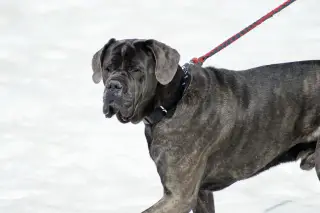
Drawn to scale in real centimetres. Its back reaches about 68 cm, mid-thigh; its head about 86 cm, your hip.

Where it sits in the tree
Modern Era · 1914 to today
Name and origin
 Related breedBoerboel1650 to 1983 · South AfricaEarly Modern Era
The breed is named for Naples, the city on the Italian coast that was the home of its first fanciers, and the FCI lists Italy as the country of origin with the region Campania in the atlas. "Mastiff" comes from the Old French word mastin, itself from Latin mansuetus, "tame". The Italian name Mastino Napoletano is used in Italy and in German, and the Spanish name is Mastín napolitano.
In the old Italian countryside, the people of the south kept large guard dogs for farms and houses. Italians called such dogs "cani da presa", catch dogs, a name that covers dogs used to hold cattle and guard property. The Neapolitan Mastiff of today is a breed standardised from those local dogs in the 1940s. The atlas records the period as 1946 to 1949 with high confidence, because the breed's start can be tied to dated events.
The atlas note on the breed sums up the point: it is a modern breed built by Piero Scanziani from a dog seen at the 1946 Naples show, with an Italian standard in 1949 and FCI recognition in 1956. A descent from the dogs of ancient Rome is a tradition, not a record.

History
 Same eraBoston Terrier1870 to 1893 · United StatesVictorian Breed Boom
Guard dogs of southern Italy before 1946
Farms and villages of Campania and neighbouring regions kept heavy guard dogs for centuries. They looked alike in a general way, big, powerful, loose-skinned and with a strong head, but they were not bred to a written standard. The dogs were kept for use, and their owners did not log pedigrees. Because of this there are no breed records before the 1900s, and any link back to antiquity has to be labelled as a tradition.
The classic claim is that the Neapolitan Mastiff descends from the molossus, the heavy dog of ancient Greece and Rome. The idea is old and popular, and some writers, including Scanziani himself, argued for it. No record or DNA result shows a direct line, so treat the link as a legend. What can be said is that the Neapolitan Mastiff looks like the heavy dogs seen in old Roman reliefs, and that the Mediterranean world kept such guard dogs for many centuries.
The 1946 show in Naples
In 1946, just after the Second World War, a dog show in Naples included a group of local guard dogs. Accounts place the show at the Castel dell'Ovo, the seaside fortress in the city. The dogs were shown as catch dogs, and the group was uneven in type: they did not look like one breed. The show itself was not a success for them, because of the lack of uniformity.
Piero Scanziani, a Swiss-Italian journalist and writer and a lover of dogs, saw them and was struck by one dog in particular, a big male named Guaglione, a Neapolitan word that means roughly "kid" or "lad". Scanziani acquired Guaglione. Some English-language pages call him a painter, but most accounts describe him as a writer and journalist, so the writer is the safer description.
Scanziani and the first standard, 1947 to 1949
Scanziani set about selecting dogs of one type from the local stock, and began his work in 1947. He wrote the first standard for the breed and, in 1949, the Italian national kennel club, ENCI (Ente Nazionale della Cinofilia Italiana), officially recognised it. He saw the dog as a living survivor of the ancient Roman molossus, and he pushed the name "Roman molosser" for a time, but the name used in the end was Neapolitan.
Because the breed grew from a small number of dogs picked in the late 1940s, it is a genetically narrow population. That is common in breeds shaped in the twentieth century from a handful of chosen individuals, and it is one reason breeders talk about the breed's health and type with care.
FCI recognition and spread, 1956 onward
The FCI accepted the breed in 1956 as no. 197 in Group 2. After that the breed spread across Europe and to North America. The American Kennel Club lists it in the Working Group, and the UK Kennel Club recognises it as well. The breed is still uncommon, and a litter is usually small.
Film and popular fame
Neapolitan Mastiffs are often credited with playing Fang, Hagrid's dog in the Harry Potter films. The breed's loose, wrinkled look suits the role. As with any breed that reaches film, the lesson from breed clubs is that the screen dog and the household dog are different animals. A giant guard dog is a long commitment and not an impulse buy.
Relatives and DNA
 Same familyBoxer1880 to 1904 · GermanyVictorian Breed Boom
In the Parker 2017 DNA study, the Neapolitan Mastiff falls in the European Mastiff group, which the atlas calls the European Mastiff family, with strong support. Its closest listed relative is the Cane Corso, at 189.8 of . That is a very high figure, which means the two Italian guard-dog breeds are close relatives in the study. The atlas records the link as medium confidence and notes that both come from the traditional guard dogs of Italy and are described as closely related.
No other breed link with a shared DNA figure is listed in the atlas for the Neapolitan Mastiff, so no other figure is given here. The atlas lists no parent or descendant breeds. The Cane Corso is its sibling.
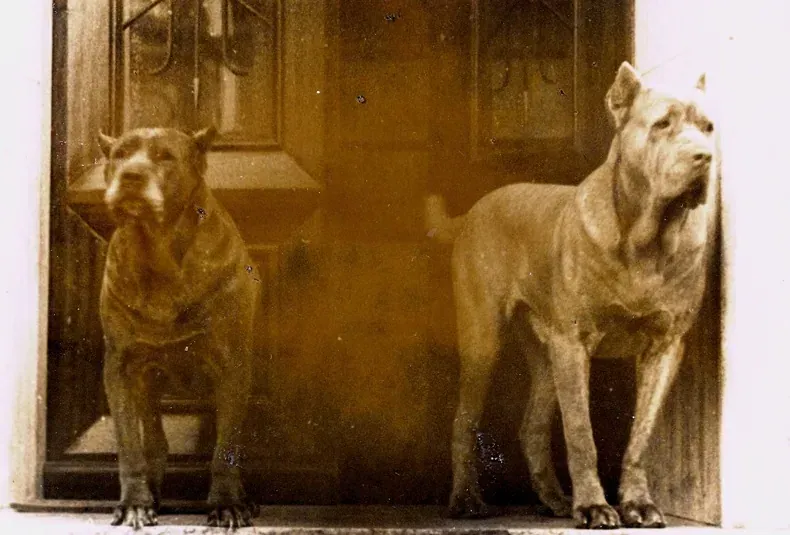
The two breeds were shaped in the same period from the same kind of dogs. The Cane Corso is a leaner, more athletic dog with a longer muzzle, a short close coat and a more active temperament, while the Neapolitan Mastiff is heavier, looser in the skin and calmer. Many people choose between the two on looks and activity level, and the DNA figure is a reminder of how much they share.
 Save
Sister breeds · 1
- Cane Corso1000 to 1996
- Cane Corso189.8 Mb 7.9%
Source: Parker et al. 2017. Percent of the whole genome.
| Breed | Shared DNA (Mb) |
|---|---|
| Cane Corso | 189.8 |
Source: Parker et al. 2017, Cell Reports, shared haplotypes between 161 breeds (1,346 dogs).
The Neapolitan Mastiff breed standard
 Looks relatedBull Terrier1850 to 1888 · United KingdomVictorian Breed Boom
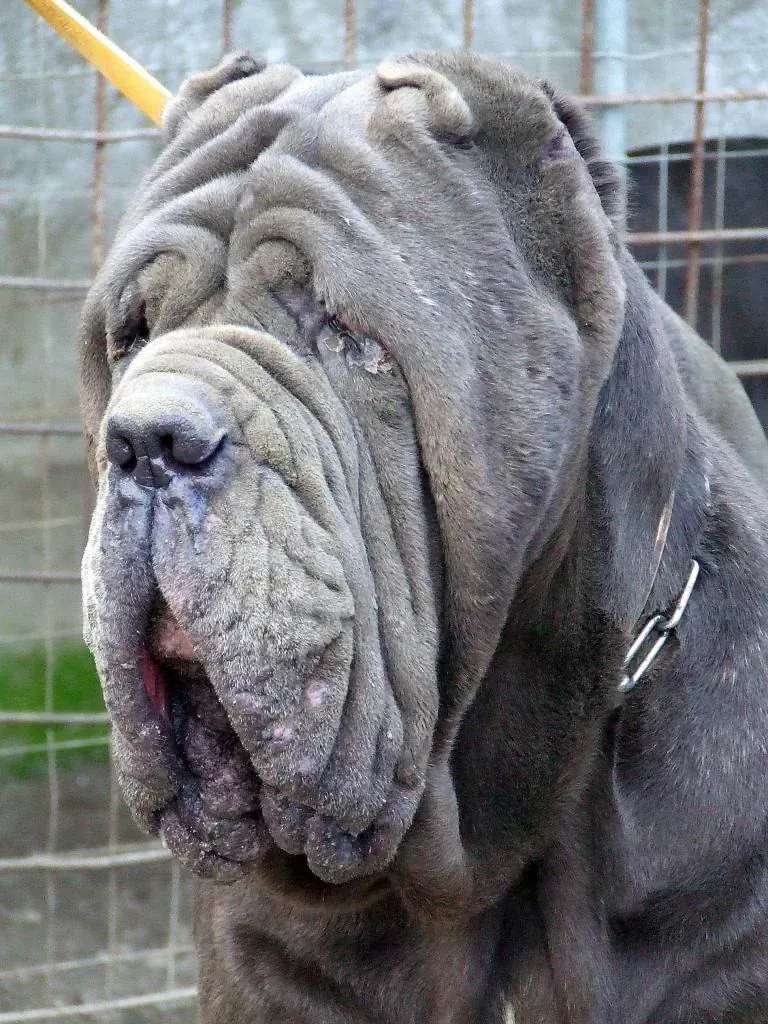
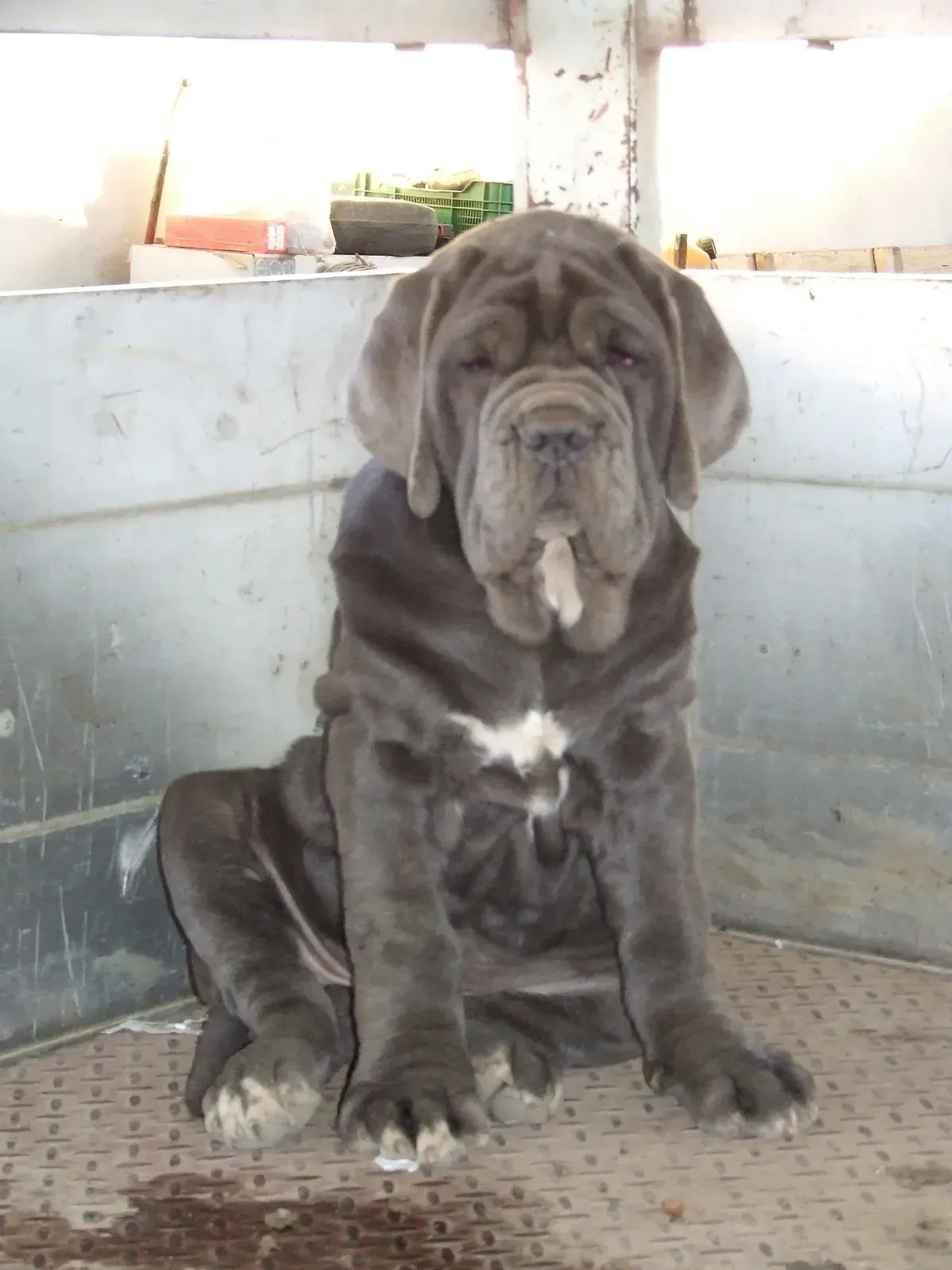
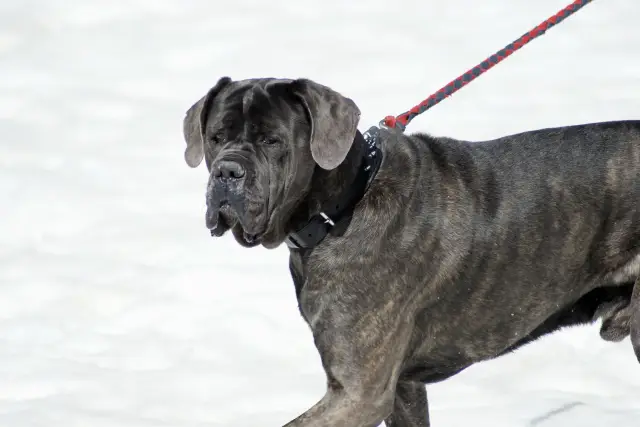
The Italian, FCI and other standards describe a massive, heavy-boned dog, longer than it is tall, with abundant loose skin and a rolling gait. Figures below are from the FCI standard no. 197, current text, where a number is given.
| Trait | What the standards say |
|---|---|
| Height (FCI) | Dogs 65 to 75 cm, bitches 60 to 68 cm at the withers |
| Weight (FCI) | Dogs 60 to 70 kg, bitches 50 to 60 kg |
| Proportions (FCI, Italian standard) | Body length about 15 percent more than the height at the withers; a rectangular build, not a square one |
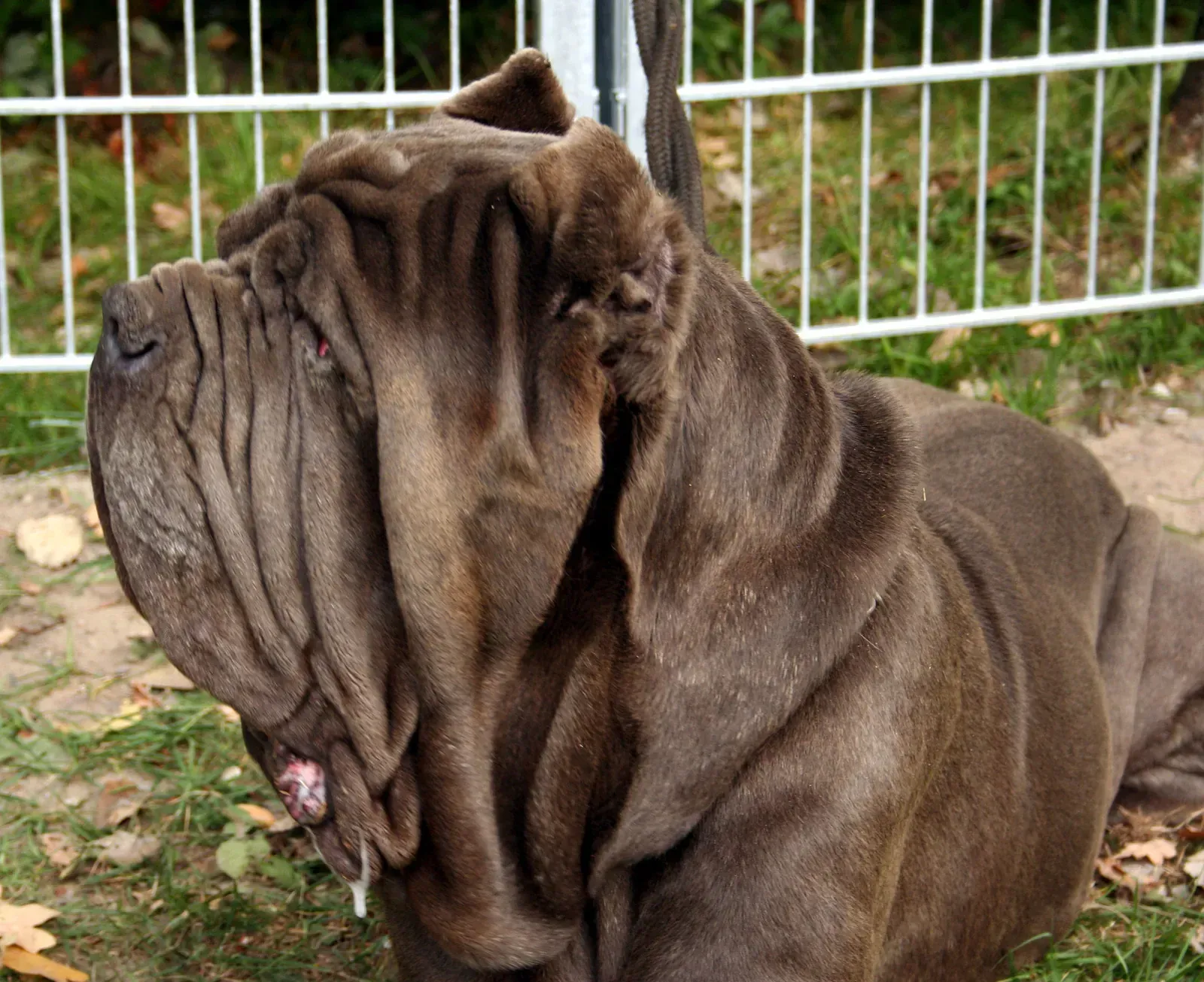
| Skin (FCI) | Abundant, loose, with folds and wrinkles on the head, neck and body; a line of fold runs from the outer corner of the eye down to the corner of the mouth |
| Dewlap | A double dewlap is described in the standard, with the dewlap starting at the lower jaw and going to the chest |
| Coat | Short, hard, dense, of even length, without feathering |
| Colour | Grey (blue), black, mahogany, tawny and hazel, with brindle shades in each; small white patches on the chest and toes are allowed |
| Head | Massive and short, with the skull and muzzle of about equal length |
| Gait | Slow and bearlike, with a lumbering rolling walk and a trot of great power |
A breed-club writer in a show magazine noted that wrinkles over the skull, muzzle, dewlap and shoulders are central to the standard, and that anything beyond that is an exaggeration that judges should fault. This is a useful note for owners. An extremely loose-skinned dog can have trouble with its eyes, its folds and its breathing, and a dog bred with moderation has fewer of these issues.
The skin is a feature of the breed. It is not an extra, and it needs care. The rest of the standard asks for a strong dog that can move and work, not a dog that struggles to walk.
 Save
Neapolitan Mastiff temperament
 Related breedBulldog1835 to 1875 · United KingdomIndustrial Revolution
A Neapolitan Mastiff is a devoted, calm and watchful dog in its family, and a serious guard. Its character is that of a livestock and property guardian: quiet in the house, suspicious of strangers, and ready to act if it sees a threat. It tends to bond very hard with its own household, and many follow their person from room to room.
It is not a dog that needs fast games. It needs early, wide and patient socialisation with people, other dogs and strange places, because an unsocialised giant guard dog is a real risk. Without training a puppy that weighs 30 kg at six months can pull an adult off their feet, so basic obedience and lead manners are not optional. The breed responds to calm, fair and consistent handling and not to harsh methods, which tend to make a strong-willed dog resentful.
These descriptions come from breed clubs and handlers and not from a behaviour study. Individual dogs vary with their breeding, their upbringing and the care taken in socialising them.
Guarding, strangers and other animals
Many Neapolitan Mastiffs are wary of strangers and will not accept a visitor easily. A well-raised dog is quiet and aloof, not aggressive, and it will often stand between its family and the door. Meeting visitors on lead and with the owner's calm lead is the safer routine. Some dogs are dominant with other dogs of the same sex, and some have a strong chase and hold instinct that makes small animals risky. A household with cats or small dogs needs careful early introduction.
Exercise
Despite its size, the breed does not need hours of running. A couple of calm walks a day and some time in a secure garden suit an adult. Puppies and adolescents should not be over-exercised, because a fast-growing giant breed can damage its joints with too much running, jumping and stair work. Heat is a risk, and a heavy dog with a short muzzle and thick skin overheats easily, so walks in summer should be early or late.
 Save

Neapolitan Mastiff size, weight and growth
 Related breedBullmastiff1860 to 1924 · United KingdomVictorian Breed Boom
The FCI standard gives dogs 65 to 75 cm and 60 to 70 kg and bitches 60 to 68 cm and 50 to 60 kg. Real dogs often weigh more than the standard's figure, and a large male can pass 70 kg. This is a giant dog by any measure, and it fills a car boot and a sofa.
Growth is fast. A puppy gains several kilograms a week in its first months, and the joints and bones are still soft long after the dog looks large. Breeders and vets advise a lean, steady growth with a diet planned for large-breed puppies, no forced running, no jumping from a height and no stairs for the youngest dogs. An adult reaches full height at about one year and fills out until about two to three years.
Because of the size, the practical costs are higher in almost every area: food, a large crate and bed, a big car, vet fees paid by weight, boarding and insurance if you hold it. Plan for those before choosing a giant breed.
Health
 Related breedDogo Argentino1928 to 1973 · ArgentinaModern Era
The atlas gives a life span of 7 to 9 years. That is short, even among giant breeds, and it is a main fact to weigh when choosing the breed. No breed-wide health survey with clear prevalence figures turned up for the Neapolitan Mastiff, so the table gives no numbers where none are published. The conditions below are the ones consistently named in breed and veterinary information.
| Condition | What it is | How common | What to do |
|---|---|---|---|
| Cherry eye | The gland of the third eyelid pops out as a red lump at the corner of the eye | Often named as the most common breed-specific eye problem; no published figure | Vet surgery to tuck the gland back; do not leave it |
| A loosely fitting hip joint that wears and becomes painful | Consistently listed as a top joint problem; no published figure | Hip scoring of both parents; keep the puppy lean | |
| Abnormal elbow joint development | Listed with hips; no published figure | Elbow scoring of breeding dogs | |
| Dilated cardiomyopathy (DCM) | The heart muscle weakens and the heart enlarges | Named as a major concern; a genetic part is suspected; no published figure | Heart scans (echocardiogram) of breeding dogs; heart checks from about 2 to 3 years |
| Gastric dilatation and volvulus (bloat) | The stomach swells and can twist, an emergency | A known risk of large deep-chested breeds; no published figure for this breed | Smaller meals, no hard exercise around meals, know the signs |
| Skin fold dermatitis | Infection and soreness in the folds of the face and body | Common in loose-skinned breeds; no published figure | Clean and dry the folds daily |
| Heat stress | Overheating in warm weather | Heavy coat, thick skin and a short muzzle raise the risk; no published figure | Shade, water, early and late walks, cool rooms |
| Eyelid problems (ectropion, entropion) | The lower lid sags, or the lid turns in | Linked to loose facial skin; no published figure | Vet check, with surgery for severe cases |
Cherry eye and eyelids. The loose facial skin of the breed leads to eye issues. Cherry eye is an urgent but fixable problem: a vet can reposition the gland surgically, and removing it is no longer favoured because it can lead to dry eye.
The heart. DCM is named repeatedly for the breed and for giant dogs in general. A vet-oriented guide advises echocardiography and Holter monitoring, starting around 2 to 3 years of age in predisposed breeds. Ask the breeder whether the parents have heart scans and what the results were.
Bloat. The signs are a swollen, hard belly, retching without bringing anything up, drooling and restlessness. It is an emergency, and the dog must go to a vet at once.
Joints and growth. Keep the puppy lean, feed a diet designed for large breeds and avoid hard exercise while the bones grow. Both parents should have hip and elbow scores from a national scheme.
Skin folds. A damp fold under the lip or nose breeds yeast and bacteria. Wipe the folds with a soft cloth and dry them, and keep the face clean after meals and drinking.
Choosing a puppy. Choose a breeder who health tests, can show hip, elbow, eye and heart results for both parents, and who breeds for moderate skin and a sound structure. A short lifespan makes the parents' ages and their causes of death a fair question to ask. A very exaggerated, droopy-eyed look is a warning sign, not a feature.
 Save

Drooling, snoring and housework
 Related breedDogue de Bordeaux1300 to 1896 · FranceLate Middle Ages
A Neapolitan Mastiff drools, mostly after drinking and eating, and shakes strings of saliva onto the walls. It snores loudly. It sheds a short coat all year, with moderate hair. A cloth over the shoulder, a bib or towel at mealtime, and a washable floor all help. Grooming is simple: a weekly rub with a rubber brush, folds cleaned daily, nails kept short and ears checked. The work of the breed is mainly in the folds and in the clean-up.
Living with a Neapolitan Mastiff
 Related breedEnglish Mastiff1300 to 1880 · United KingdomLate Middle Ages
| Daily reality | Rating | Why |
|---|---|---|
| Exercise per day | Low to moderate | Calm walks and garden time; no hard running while growing |
| Training needs | High | A giant guard dog needs early training and socialisation |
| Grooming | Low to medium | Short coat; skin folds need cleaning every day |
| Shedding | Medium | Short hair all year |
| Drooling | Very high | Heavy jowls and loose lips |
| Barking | Low to medium | Usually quiet, with a deep bark when guarding |
| Time alone | Poor | Bonds closely; may be anxious or destructive when left |
| Children | Fair | Devoted and tolerant, but huge; always supervise |
| Other dogs | Fair | Can be dominant with dogs of the same sex |
| Cats and small pets | Varies | Needs early introduction |
| Flat living | Poor | Large size, stairs and heat are hard in a small home |
| Heat tolerance | Poor | Thick skin, short muzzle and heavy body |
| Cold tolerance | Fair | Short coat with little undercoat |
| First-time owner fit | Poor | Size, strength and guarding need an experienced, confident handler |
A great fit if
- You have owned large, strong dogs and can handle one with calm authority.
- You have a house with a secure garden and solid fencing.
- You want a quiet, devoted guardian and are at home a lot.
- You accept drool, snoring, daily fold care and a short life.
Think twice if
- You are a first-time dog owner or you have a small flat.
- You have many visitors or you want a dog that welcomes strangers.
- You are away at work for long hours.
- You live in a hot climate with no cool space.
- You cannot cover the vet bills of a giant breed.
Before you get one
Visit the breeder, meet the mother and, if possible, the father, and see how the adults behave with strangers. Ask for hip, elbow, eye and heart results, and ask how old the parents are and how long their relatives lived. Check local rules, because some towns and housing contracts restrict large guard breeds; see dog laws by country. An adult from a rescue shows its temperament before you commit, and giants often reach shelters when the owners misjudged the size; see adopting a dog.
Similar breeds to consider
- Cane Corso. Its closest relative in the DNA study: lighter, more athletic and more active, with a short close coat.
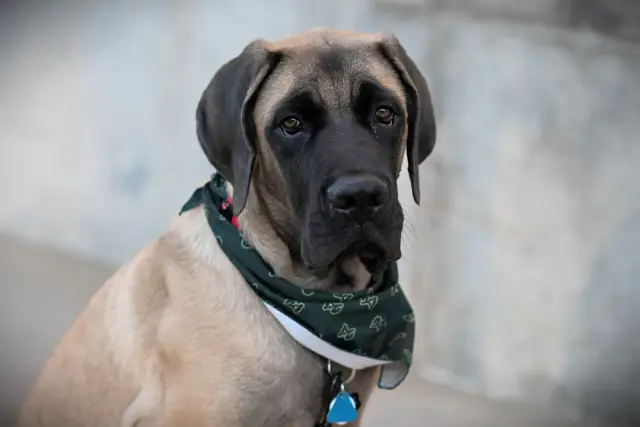
- English Mastiff. A giant, calm British guard dog, also with a short life and a heavy build.
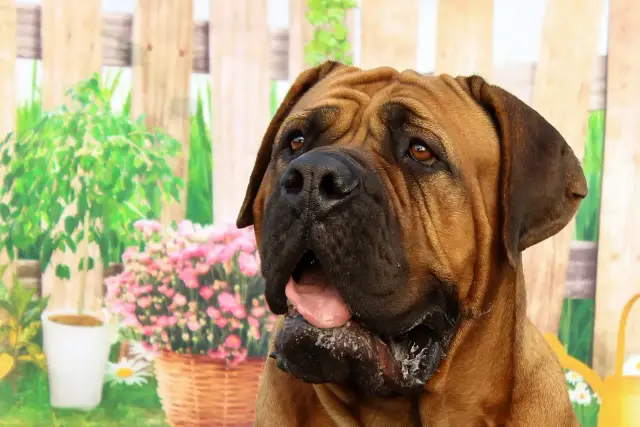
- Dogue de Bordeaux. A French giant with folded skin and a very loyal temperament.
- Bullmastiff. A smaller, powerful guard dog with a short coat and a calmer, steady character.

Neapolitan Mastiff fun facts
 Related breedFrench Bulldog1850 to 1898 · FranceVictorian Breed Boom
- The breed's modern history starts with a single dog show in Naples in 1946.
- Piero Scanziani wrote the first standard, and the Italian kennel club recognised it in 1949.
- Scanziani's dog Guaglione has a name that means "kid" or "lad" in the Neapolitan dialect.
- The FCI standard says the body should be about 15 percent longer than the dog is tall.
- Neapolitan Mastiffs are often credited with playing Fang, Hagrid's dog, in the Harry Potter films.
- The Cane Corso shares 189.8 Mb of DNA with it in the Parker 2017 study.
Frequently asked questions
Where does the Neapolitan Mastiff come from?
Italy, from the area around Naples in the region of Campania, according to the and the atlas. The modern breed was set in 1946 to 1949.
Is the Neapolitan Mastiff descended from Roman war dogs?
It is a popular tradition, argued by the breed's founder Piero Scanziani, but there is no record or DNA result that proves it.
How big does a Neapolitan Mastiff get?
The FCI standard gives dogs 65 to 75 cm and 60 to 70 kg, and bitches 60 to 68 cm and 50 to 60 kg.
How long do Neapolitan Mastiffs live?
The atlas data gives 7 to 9 years, which is short even for a giant breed.
Are Neapolitan Mastiffs dangerous?
They are strong guard dogs and can be wary of strangers, so training, socialisation and secure fencing are needed. Well-raised dogs are usually calm with their families, but they are not suited to inexperienced owners.
What is cherry eye in a Neapolitan Mastiff?
The gland of the third eyelid slips out and appears as a red lump at the inner corner of the eye. It is common in the breed and needs a vet to replace it.
Do Neapolitan Mastiffs drool?
Yes, a lot, especially after drinking and eating.
What is the difference between a Neapolitan Mastiff and a Cane Corso?
Both are Italian guard dogs and close relatives. The Neapolitan Mastiff is heavier, with loose skin, wrinkles and a dewlap, and it is calmer. The Cane Corso is lighter, more athletic and more active.
Read next
 Closest DNACane Corso189.8 Mb shared
 FamilyEuropean MastiffThe whole family
 Adopt a dogDog Shelters in EuropeFind dog shelters in Europe, learn how shelters differ from country to country and why adopting a dog is a good option.
Sources (12)
- FCI standard no. 197, Mastino Napoletano (Neapolitan Mastiff), the current text and the older versions.
- ENCI (Ente Nazionale della Cinofilia Italiana), Mastino Napoletano standard and breed history.
- American Kennel Club, Neapolitan Mastiff breed standard and breed history.
- UK Kennel Club, Neapolitan Mastiff breed standard and breed information.
- Showsight Magazine, Neapolitan Mastiff breed articles, including the 2013 article on the standard and wrinkles.
- Parker H.G. et al., "Genomic analyses reveal the influence of geographic origin, migration and hybridization on modern dog breed development", Cell Reports, 2017.
- Fogle B., The New Encyclopedia of the Dog, 2009.
- Encyclopaedia Britannica, Neapolitan mastiff.
- Scanziani P., writings on the Mastino Napoletano and the 1946 Naples show, as reported in breed histories.
- Neapolitan Mastiff Club of America, breed history and health information.
- Veterinary information on dilated cardiomyopathy screening in predisposed large breeds, including echocardiography and Holter monitoring.
- Atlas data, Neapolitan Mastiff knowledge record (dates, life span, lineage, DNA links).