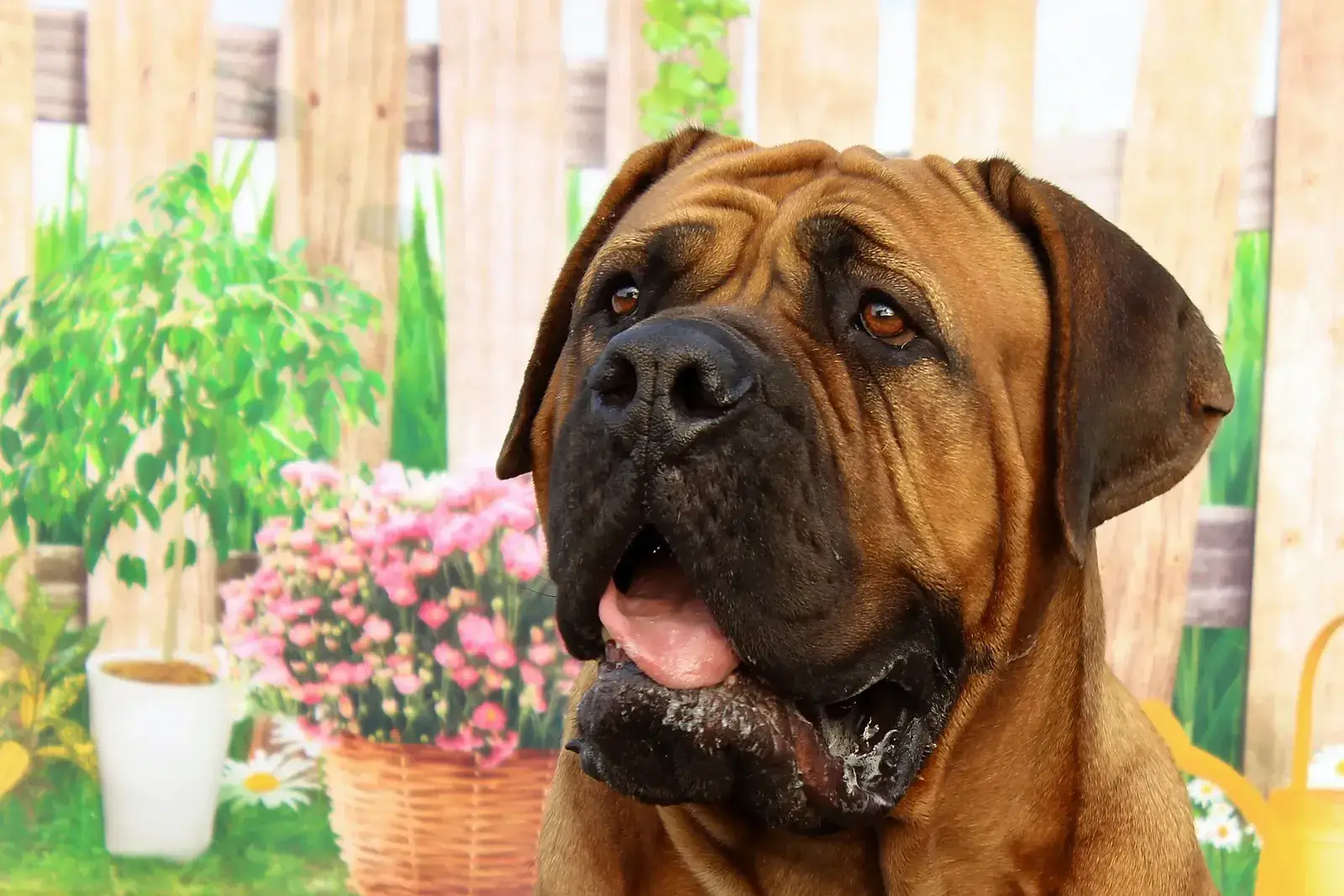
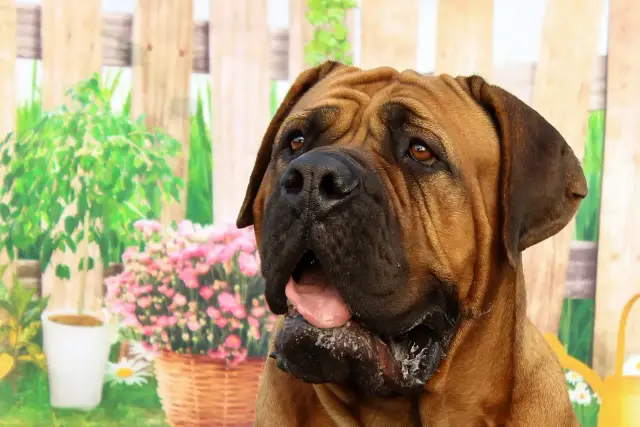
Dogs stand 60 to 68 cm and weigh at least 50 kg. It is loyal and calm at home, and it is one of the shortest-lived breeds in UK studies, with heart disease the main concern. It suits experienced owners with space, time and a budget for a giant dog.
Dogue de Bordeaux quick facts
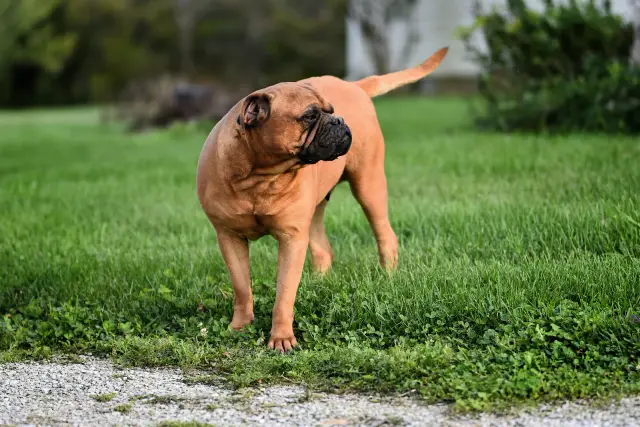 Related breedBullmastiff1860 to 1924 · United KingdomVictorian Breed Boom
- Closest DNA relatives
- Boxer, English Mastiff, Bulldog
- Descendant breeds
- Dogo Argentino (atlas data)
- Country of origin
- France (Aquitaine, around Bordeaux)
- Period of development
- About 1300 to 1896 (atlas data); modern standard in the 1970s
- Type
- Mastiff, Group 2 (Pinscher and Schnauzer, Molossoid and Swiss Mountain and Cattledogs), standard no. 116; Working Group; UK Kennel Club Working Group
- Height
- Dogs 60 to 68 cm, bitches 58 to 66 cm (Royal Kennel Club)
- Weight
- Dogs at least 50 kg, bitches at least 45 kg (Royal Kennel Club)
- Coat
- Fine, short and soft, on thick, loose-fitting skin
- Colours
- Self-coloured fawn, from mahogany to Isabella; black mask, brown mask or no mask
- Life span
- Atlas data: 5 to 8 years
- DNA group
- "European Mastiff" (Parker et al. 2017)
Drawn to scale in real centimetres. Its back reaches about 63 cm, mid-thigh; its head about 80 cm, your hip.
Where it sits in the tree
Late Middle Ages · 1200 to 1499

Name and origin
 Related breedCane Corso1000 to 1996 · ItalyEarly Middle Ages
"Dogue de Bordeaux" is French for "mastiff of Bordeaux". "Dogue" is the old French word for a mastiff-type dog, and the city of Bordeaux gives the breed its name. English speakers also call it the French Mastiff or Bordeaux Mastiff. In Germany it is the Bordeauxdogge, and in Spanish the Dogo de Burdeos.

History
 Same eraFrench Bulldog1850 to 1898 · FranceVictorian Breed Boom
Medieval roots
The breed is often described as one of the oldest French breeds, but written proof is thin. The FCI links its ancestors to the "alans vautres", big hunting and holding dogs mentioned in French texts from as early as the fourteenth century. The atlas data places the start of the breed's development around 1300 with medium confidence. Stories give it roles as a guard of estates, a hunter of large game, a butcher's dog and a fighting dog. The butcher's dog role is the best supported: AKC and other histories say butchers particularly favoured the breed. Fighting history is repeated widely but not documented in the sources used.
The 1863 show and the early standards
The FCI standard's history notes that the first French dog show took place in Paris in 1863, at the Jardin d'Acclimatation, and that several dogs of the type were shown there. The FCI standard lists four stages of standard writing: a first standard by Pierre Megnin in his 1896 book on the breed, a second by Professor J. Kunstler in 1910, a third by Raymond Triquet with Dr Maurice Luquet in 1971, and a fourth reformulated by Triquet in 1993. An FCI training document instead names Kunstler's 1910 text as the first standard, so sources disagree on who was first.
Near loss and revival
By the 1960s, the Second World War and changing farm and city life had brought the breed close to dying out in France. Raymond Triquet, a schoolteacher, set out to revive it. AKC tells how he paired two dogs from rival breeders, and their pup Mowgli became important to the modern type. He wrote the book Saga of the Dogue de Bordeaux and the standard of the 1970s. Breeders around him rebuilt the foundation of the breed in the same decade. A narrow gene pool follows from this history. A study of Dogue de Bordeaux in Israel notes the breed has been through several genetic bottlenecks and has a small effective population size.
Abroad: Turner and Hooch and recognition
The 1989 film Turner and Hooch, with Tom Hanks, introduced many Americans to the breed. The AKC recognised it in 2007, and the UK Kennel Club gave it championship status in 2016. The breed's size, drool and a high-profile career in film made it popular, and breeders in several countries now work on health screening, especially for the heart.
Relatives and DNA
 Same familyBoerboel1650 to 1983 · South AfricaEarly Modern Era
The atlas data lists no parent breeds for the Dogue de Bordeaux. Its only descendant listed is the Dogo Argentino, which was created in Argentina using several breeds and is listed as a child of this breed in the atlas data. For the wider group see the European Mastiff family page.
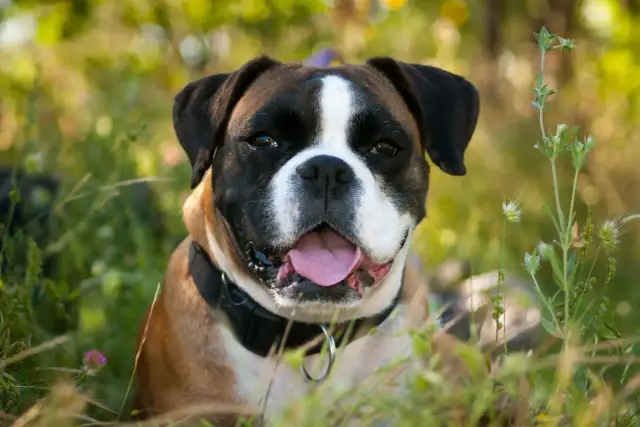
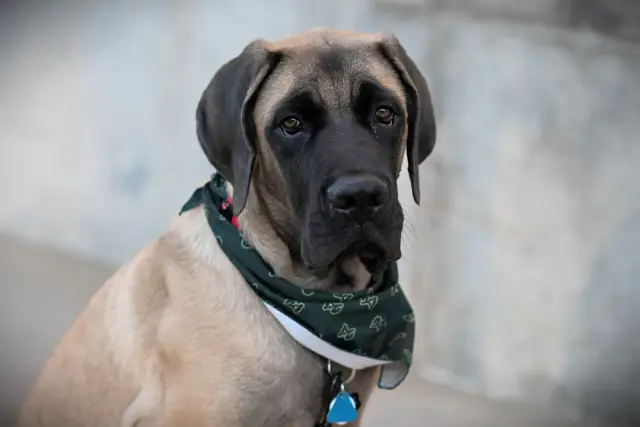
A 2017 study by Parker and colleagues (Cell Reports) sorted 161 breeds into DNA clades. The Dogue de Bordeaux falls in the "European Mastiff" clade, with strong support. The study also measured shared , long stretches of identical DNA from common ancestors. More () shared suggests a closer link; the study cannot say which way genes flowed.
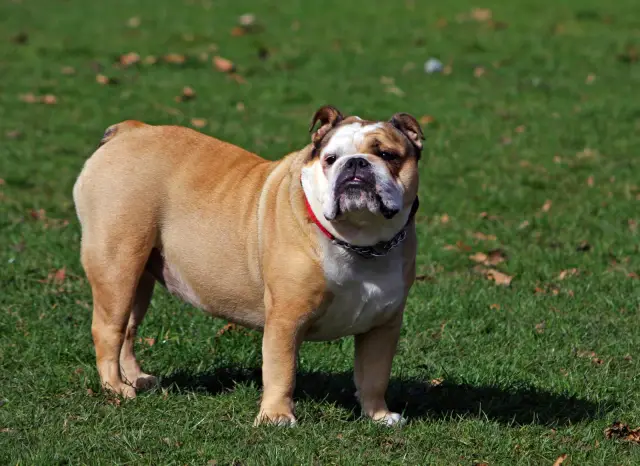
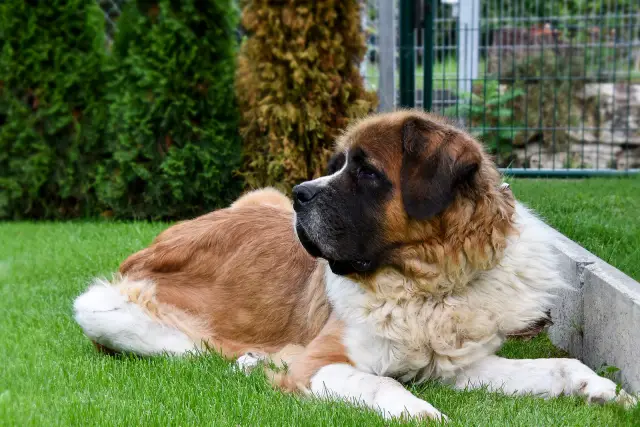
- Dogue de Bordeaux and Boxer
- Dogue de Bordeaux and English Mastiff
- Dogue de Bordeaux and Bulldog
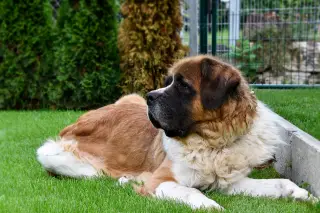
- Dogue de Bordeaux and St. Bernard
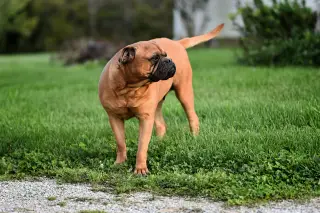
- Dogue de Bordeaux and Bullmastiff
The Boxer result is the surprise, since the English Mastiff might be expected to come first. Both the Cane Corso and the Boerboel also appear in the table, a sign of how widely mastiff blood spread.
Descend from it · 1
- Dogo ArgentinoArgentina
- Boxer50.5 Mb 2.1%
- English Mastiff26.2 Mb 1.1%
- Bulldog21.8 Mb 0.9%
- St. Bernard18.0 Mb 0.8%
- Bullmastiff18.0 Mb 0.8%
- Cane Corso17.2 Mb 0.7%
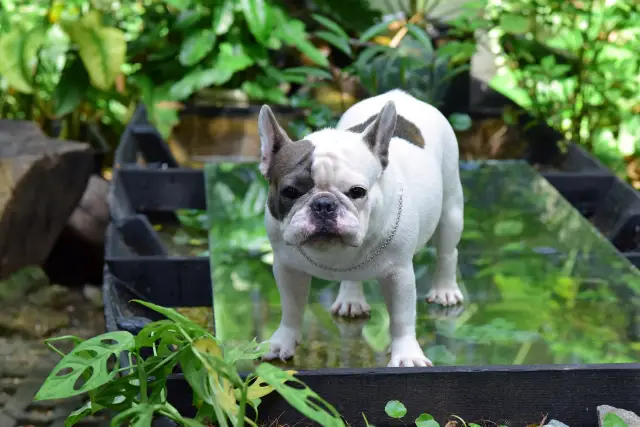
- French Bulldog15.1 Mb 0.6%
- Boerboel11.6 Mb 0.5%
- Kerry Blue Terrier11.4 Mb 0.5%
- Staffordshire Bull Terrier11.3 Mb 0.5%
- American Staffordshire Terrier11.2 Mb 0.5%
- Boston Terrier10.7 Mb 0.4%
Source: Parker et al. 2017. Percent of the whole genome.
| Breedwith Dogue de Bordeaux | with Dogue de Bordeaux (Mb)Shared DNA (Mb) |
|---|---|
| Boxer | 50.5 |
| English Mastiff | 26.2 |
| Bulldog | 21.8 |
| St. Bernard | 18.0 |
| Bullmastiff | 18.0 |
| Cane Corso | 17.2 |
| French Bulldog | 15.1 |
| Boerboel | 11.6 |
Source: Parker et al. 2017, Cell Reports, shared haplotypes between 161 breeds (1,346 dogs).
The breed standard
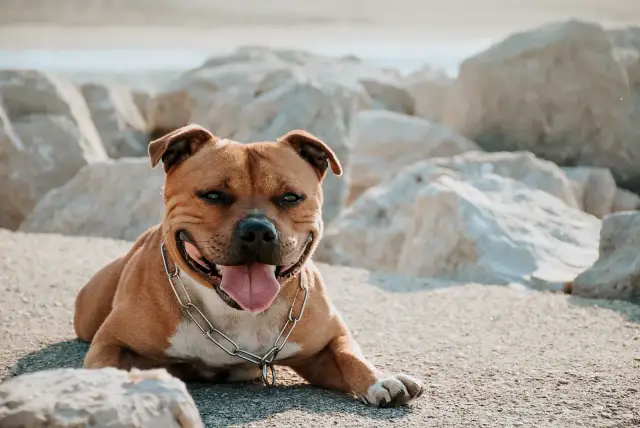 Looks relatedStaffordshire Bull Terrier1800 to 1935 · United KingdomIndustrial Revolution
A is the written ideal that judges compare each dog against. The Royal Kennel Club standard describes a dog "powerful with muscular body" and a "harmonious outline". It should not be leggy or too low to the ground. The FCI standard is no. 116.
| Trait | What the standards say |
|---|---|
| Height | Royal Kennel Club: dogs 60 to 68 cm, bitches 58 to 66 cm |
| Weight | Royal Kennel Club: dogs at least 50 kg, bitches at least 45 kg |
| Head | Broad, wider at the ears than at the eyes, with a distinct median groove and a "pronounced stop forming a near right angle with the muzzle" (Royal Kennel Club) |
| Coat | Fine, short and soft on thick, loose skin; folds on the ribs or limbs are highly undesirable (Royal Kennel Club) |
| Colours | Self-coloured fawn, mahogany to Isabella; chocolate highly undesirable; limited white on the chest and feet allowed; white on the head or body highly undesirable (Royal Kennel Club) |
| Mask | Black (not above the eyes), brown (brown nose and eye rims) or none (Royal Kennel Club) |
| Tail | Very thick at the base, tip preferably reaching the hock, carried low, never curled over the back (Royal Kennel Club) |
| Gait | Free, supple and close to the ground; "absolute soundness essential" (Royal Kennel Club) |
| Temperament | Naturally protective and alert, brave without being aggressive (Royal Kennel Club) |
Temperament
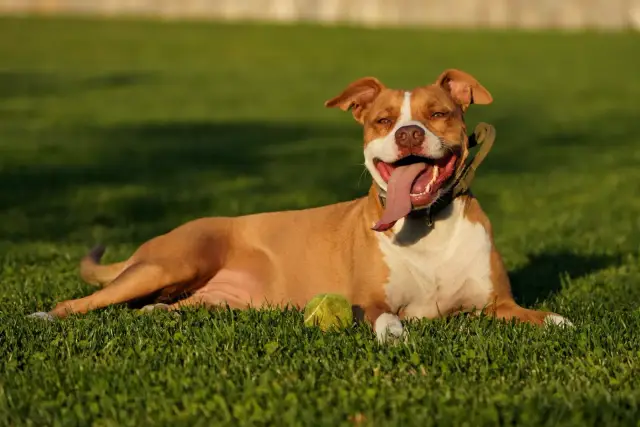 Related breedAmerican Staffordshire Terrier1850 to 1936 · United StatesVictorian Breed Boom
A Dogue de Bordeaux is a natural guardian, and the standard says brave without being aggressive. In a home setting it is typically calm, loyal and very attached to its people, and happiest close to them. A giant dog that is alert but not reactive is the target of careful breeders. Early and steady socialisation matters more with this breed than with a small dog, because an unruly adult weighs 50 kg or more.
Three realities to plan for. First, guarding instincts can show as suspicion of strangers, so introduce the puppy to many people, places and other dogs. Second, the breed can be stubborn, so training should start young and rely on calm consistency. Third, it often drools and snores. The atlas data has no breed-wide behaviour survey for the Dogue de Bordeaux, so any figure for aggression or dog-to-dog problems would be a guess.

Health
 Related breedBoston Terrier1870 to 1893 · United StatesVictorian Breed Boom
The Dogue de Bordeaux is among the shortest-lived breeds studied. O'Neill and colleagues (The Veterinary Journal, 2013) analysed first-opinion vet records for 102,609 dogs in England and named the Dogue de Bordeaux and the Great Dane as the shortest-lived breeds, against an overall median of 12.0 years. An earlier survey of UK breed-club members, Adams and colleagues (Journal of Small Animal Practice, 2010), reported a median longevity of 3.8 years for the breed. The atlas data gives a range of 5 to 8 years. Information here is general; talk to a vet about your own dog.
A questionnaire study of 278 UK-based dogs (McAulay and colleagues, The Veterinary Journal, 2018) reported what owners and breeders saw. Skin disease was the most common reason for vet visits, followed by lameness, gut signs and tumours. Of 55 dogs that had died, 17 (31 percent) were reported to have died suddenly and unexpectedly. The authors say a link with heart disease should be explored but could not confirm it.
| Condition | What it is | How common | What helps |
|---|---|---|---|
| Aortic stenosis | A narrowed outflow from the heart's left ventricle | In a Danish study of 53 dogs (Hollmer et al. 2008), 17% (9 dogs) had a raised aortic flow velocity and 72% had a murmur; about 1 in 6 | Heart ultrasound of breeding dogs; vet check of any murmur |
| Subaortic stenosis and tricuspid valve dysplasia | Inherited heart defects present from birth | In Israel (Ohad et al. 2013), the breed had the highest rate of tricuspid valve dysplasia and the second highest of subaortic stenosis among all breeds seen; the likely inheritance was | Heart screening before breeding; avoid breeding affected lines |
| Sudden death | Unexpected death, cause often unknown | 17 of 55 dead dogs (31%) in the McAulay survey | Heart screening and regular vet checks; the cause is still under study |
| Skin disease | Chronic skin problems, often in folds | 22.7% of 278 dogs in the McAulay survey (about 1 in 4 to 5) | Keep folds clean and dry; early vet care |
| Lameness | Joint and limb pain in a heavy giant dog | 15.5% of 278 dogs in the McAulay survey (about 1 in 6 to 7) | Healthy lean weight, no hard exercise as a growing puppy |
| Tumours | Cancers and other growths | 10.1% of 278 dogs in the McAulay survey (about 1 in 10) | Check lumps early |
The McAulay survey is self-reported and mostly UK based, so the rates are estimates, not exact figures. Giant deep-chested dogs in general are also at risk of bloat (gastric dilatation and volvulus), an emergency in which the stomach twists. Ask a vet how to lower the risk; no breed-specific rate is given in the sources used here.

Living with a Dogue de Bordeaux
 Related breedAmerican Bulldog1700 to 1980 · United StatesEarly Modern Era
| Daily reality | Rating | Why |
|---|---|---|
| Exercise | Medium | Moderate daily walks; avoid heavy exercise in heat and for puppies |
| Training needs | High | Needs early, calm and consistent training and socialisation |
| Grooming | Low | Short coat; wipe the face and folds |
| Shedding | Medium | Short coat that sheds |
| Drooling | High | Loose jowls drool, especially after eating and drinking |
| Time alone | Poor | Strongly attached to its family |
| Children | Fair | Gentle with a family but heavy; supervise young children |
| Other dogs | Varies | Can be dominant; needs socialisation |
| Cats and small pets | Varies | Depends on early exposure |
| Flat living | Poor | Needs room; stairs and small flats are hard on a giant |
| Heat tolerance | Poor | Short face and heavy body overheat easily |
| Cold tolerance | Fair | Short, thin coat |
| First-time owner | Poor | Strong guard dog needing experience |
A great fit if you...
- have experience with large, strong dogs;
- have a house with a safe garden and space for a giant;
- want a loyal home guardian and can train and socialise from puppyhood;
- can afford the food and vet costs of a giant breed, knowing its life is short.
Think twice if you...
- are away for long hours;
- live in a small flat or on upper floors;
- cannot manage a heavy dog on the lead;
- would be heartbroken by a short life span.
Before you get one. Ask the breeder for heart ultrasound results of both parents and for health records on the dogs' relatives, including cause and age of death. Ask about temperament of parents, and meet them. Rescue groups can place adult dogs whose manner is already known.
Similar breeds to consider
- English Mastiff: bigger and calmer, with a shorter muzzle line and similar health caution.
- Bullmastiff: a slightly lighter guard dog with a more defined muzzle.
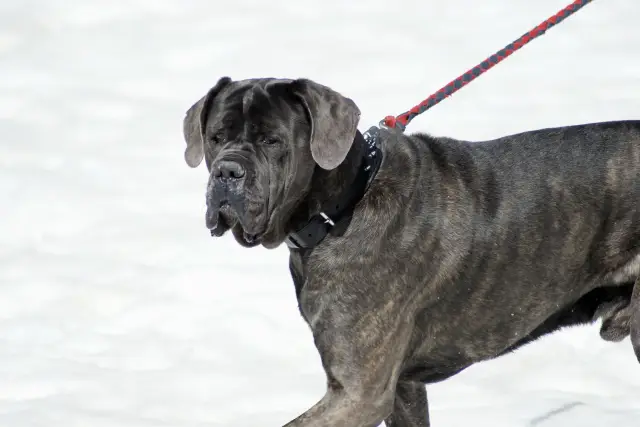
- Neapolitan Mastiff: another loose-skinned Italian giant.
- St. Bernard: a gentle giant for cold climates.

Dogue de Bordeaux fun facts
 Related breedAmerican Bully1980 to 2004 · United StatesModern Era
- The breed is French for "mastiff of Bordeaux"; the FCI standard is numbered 116.
- A schoolteacher, Raymond Triquet, led its revival in the 1960s and 1970s.
- Turner and Hooch (1989) starred a Dogue de Bordeaux and put the breed in front of a worldwide audience.
- The AKC recognised the breed in 2007; the UK Kennel Club gave it championship status in 2016.
- Colours are limited to fawn shades, so any other coat colour is a fault in the show ring.
Frequently asked questions
How big is a Dogue de Bordeaux?
Dogs are 60 to 68 cm tall and weigh at least 50 kg. Bitches are 58 to 66 cm and at least 45 kg (Royal Kennel Club).
How long do Dogue de Bordeaux live?
The atlas data gives 5 to 8 years. UK studies place the breed among the shortest-lived, and an earlier owner survey reported a median of 3.8 years.
Is the Dogue de Bordeaux aggressive?
The standard calls for a breed that is brave without being aggressive. Individual behaviour depends on breeding, socialisation and training.
Are Dogue de Bordeaux good family dogs?
They can be loyal, calm companions in a home with space and experienced owners. Their size means children must be supervised.
What are the main health problems?
Heart disease (aortic stenosis, subaortic stenosis, tricuspid valve dysplasia), skin problems, lameness and cancer are described in studies. Ask for heart screening results of the parents.
Do Dogue de Bordeaux drool?
Yes, often a lot, because of the loose lips and jowls.
What colours are they?
Self-coloured fawn, from mahogany to Isabella, with a black mask, a brown mask or no mask. Limited white on the chest and feet is allowed.
Read next
Closest DNABoxer50.5 Mb shared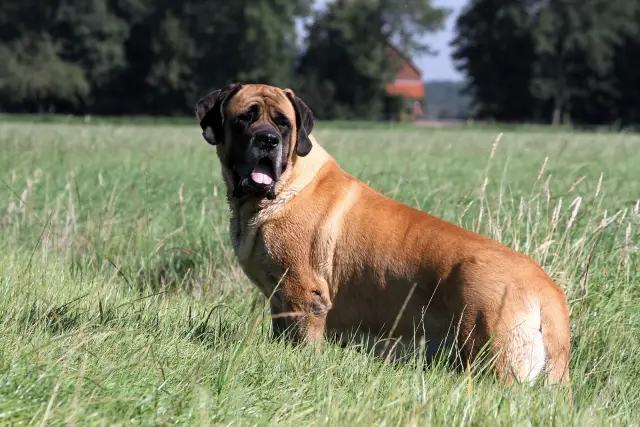 FamilyEuropean MastiffThe whole family
 Adopt a dogDog Shelters in FranceTen big cities checked, how adoption works, fees in euros
Sources (11)
- American Kennel Club, Dogue de Bordeaux breed page and history behind the breed.
- Fédération Cynologique Internationale, Dogue de Bordeaux, standard no. 116.
- Hollmer M. et al., "Aortic stenosis in the Dogue de Bordeaux", Journal of Small Animal Practice, 2008.
- Adams V.J. et al., "Methods and mortality results of a health survey of purebred dogs in the UK", Journal of Small Animal Practice, 2010.
- Lewis T.W. et al., "Longevity and mortality in Kennel Club registered dog breeds in the UK in 2014", Canine Genetics and Epidemiology, 2018.
- McAulay G., Borgeat K., Luis Fuentes V., "An online health survey of Dogue de Bordeaux owners and breeders with special emphasis on cardiac disease", The Veterinary Journal, 2018.
- O'Neill D.G. et al., "Longevity and mortality of owned dogs in England", The Veterinary Journal, 2013.
- Ohad D.G. et al., "The occurrence and suspected mode of inheritance of congenital subaortic stenosis and tricuspid valve dysplasia in Dogue de Bordeaux dogs", The Veterinary Journal, 2013.
- Parker H.G. et al., "Genomic analyses reveal the influence of geographic origin, migration, and hybridization on modern dog breed development", Cell Reports, 2017.
- Royal Kennel Club (UK), Dogue de Bordeaux breed standard.
- Wikipedia, "Dogue de Bordeaux" and "Turner and Hooch" (used for dates and summaries, checked against the other sources listed).