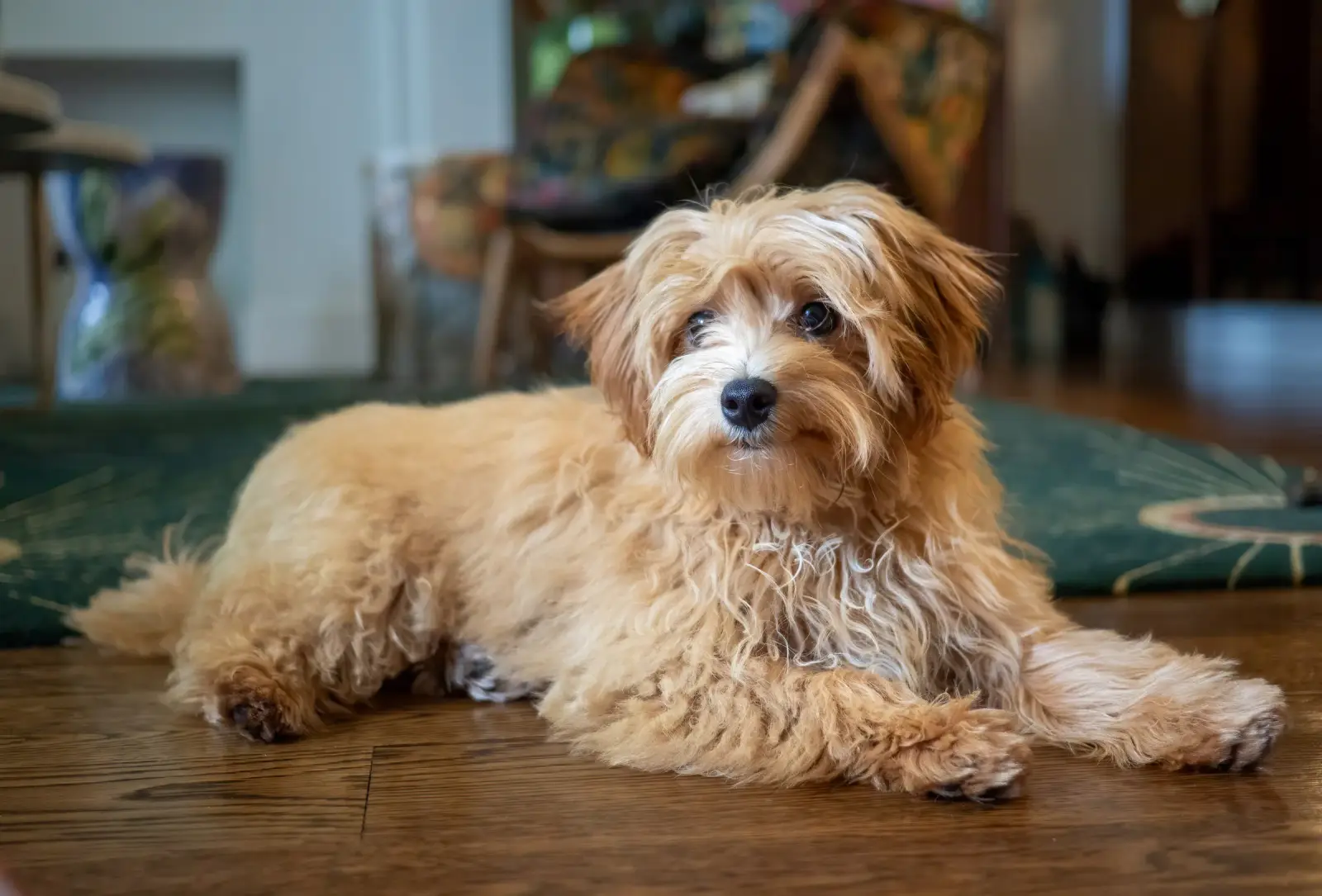
It is not a recognised breed with the FCI, the American Kennel Club or the UK Kennel Club, and none of them publishes a Maltipoo standard. Accounts place its start in the United States in the 1990s, and the atlas data gives 1990 to 2000. It is a small, soft-coated, people-loving dog, often 2 to 7 kg, whose coat and size depend on which parent it takes after. No published health study covers the Maltipoo itself, so this page uses what is known about the cross-breed question in general and about both parents.
Maltipoo quick facts
 Related breedPomsky2011 to 2014 · United StatesModern Era
- What it is
- A cross of a Maltese and a Poodle
- Country of origin
- United States (atlas data)
- Period of development
- 1990 to 2000 (atlas data, medium confidence)
- Other names
- Maltepoo, Moodle; also written Malt-a-poo
- Recognition
- Not recognised by the FCI, the AKC or the UK Kennel Club
- Family
- Modern Crossbreed (atlas grouping by history, not DNA)
- Size
- Follows the Poodle parent; atlas data lists toy
- Weight
- About 2 to 7 kg in breeder descriptions; no kennel club figure exists
- Life span
- Atlas data: 12 to 15 years
- Coat
- Soft; straight, wavy or curly; usually white, cream, apricot or similar


Where it sits in the tree
Modern Era · 1914 to today


Name and origin
 Related breedPuggle1980 to 1990 · United StatesModern Era
"Maltipoo" is a portmanteau of Maltese and Poodle. The same cross also goes by Maltepoo and Moodle. It follows the naming habit that began with the Labradoodle and the Cockapoo, which you can read about on the Cockapoo page. The Maltese is an ancient toy dog of the Mediterranean, and the Poodle is a curly water dog from Germany or France, depending on the account. Both parents are recognised breeds with long records. The cross is not: it has two parents and no standard of its own, which is why the atlas places it in the Modern Crossbreed group and not with its parents.

History
 Same eraAmerican Akita1945 to 1956 · United StatesModern Era
The 1990s start
Most sources agree the Maltipoo was first bred in the United States in the 1990s. Some guides push the start back to the late 1980s. No source names a first breeder, a first litter or a founding date, so the story rests on retelling. Accounts link it to the wider fashion for Poodle crosses that followed the Labradoodle, and the aim was a small lap dog with the Maltese's soft look and the Poodle's lower-shedding coat. The atlas data gives 1990 to 2000 with medium confidence.
Registries, not recognition
Some hybrid registries, such as the American Canine Hybrid Club, accept the Maltipoo. These are private registries that set their own rules. The AKC registers only purebred dogs and does not accept the cross, and the FCI and the UK Kennel Club do not list it either. A Maltipoo "pedigree" is therefore a breeder's or a registry's record, and it does not mean the dog meets a shared standard.
Why the cross is easy to produce
Both parents are small and the matings are simple. The Maltese and the Poodle are even close genetic relatives: in the DNA study by Parker and colleagues (Cell Reports, 2017) the Maltese sits in the Poodle family and shares about 10.7 of DNA with the Poodle. That helps explain why Maltipoos often look like a single type, but it does not make their traits predictable.
Relatives and DNA
 Same familyAmerican Bully1980 to 2004 · United StatesModern Era
The atlas holds no DNA study of the Maltipoo, so there is no DNA chart. Its relatives follow from its parents. The Maltese is a silky white toy dog of the Bichon type. The Poodle is a curly water dog. Their closest relatives are the Havanese, the Bichon Frise and the Coton de Tulear. Other Poodle crosses are the Cockapoo, the Cavapoo and the Goldendoodle. For the wider family, see the Poodle family.
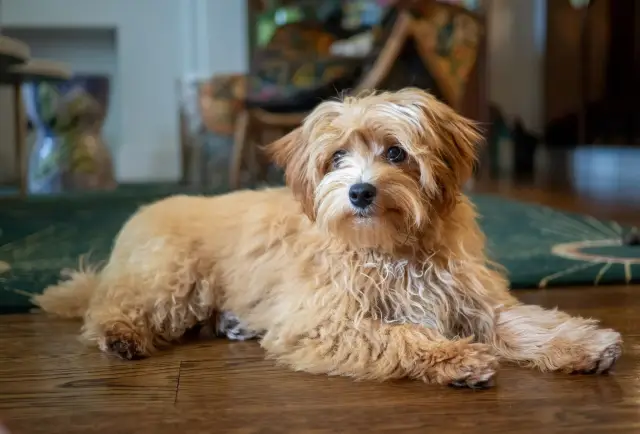 MaltipooMaltese and Poodle crossMaltipooPoodle side of the cross

The breed standard: there is none
 Looks relatedBlack Russian Terrier1949 to 1984 · RussiaModern Era
A is the written ideal a kennel club judges dogs against. No major kennel club has one for the Maltipoo. What follows is what the two parent standards say, which sets the range a Maltipoo can fall in. Clubs that do not list the cross are left out.
| Trait | What the standards say |
|---|---|
| Maltipoo standard | None from the FCI, the AKC or the UK Kennel Club. Hybrid registries may publish their own descriptions |
| Maltese size | FCI (no. 65): males 21 to 25 cm, females 20 to 23 cm, weight 3 to 4 kg. AKC: under 7 lb (about 3.2 kg), 4 to 6 lb (about 1.8 to 2.7 kg) preferred |
| Poodle size, Toy | FCI (no. 172): over 24 to 28 cm. AKC: 25 cm or under. UK Kennel Club: under 28 cm |
| Poodle size, Miniature | FCI: over 28 to 35 cm. AKC: over 25 to 38 cm. UK Kennel Club: 28 to 38 cm |
| Maltese coat | FCI: dense, silky, straight, no undercoat. AKC: single coat, long, flat, silky. UK Kennel Club: straight, silky, never woolly or crimped |
| Poodle coat | Dense, curly, harsh-textured, single layer (FCI, AKC) |
| Maltese colour | Pure white (FCI allows a pale ivory tinge; AKC allows light tan or lemon on the ears) |
Treat any Maltipoo weight range as a breeder's description. A Maltipoo from a Toy Poodle and a Maltese is usually small, and one from a Miniature Poodle may be larger, but no club measures it.
Size, weight and coat
 Related breedCavalier King Charles Spaniel1926 to 1945 · United KingdomModern Era
Size. Size follows the Poodle that was used and the Maltese's own small build. Breeder and guide descriptions put adult Maltipoos at roughly 2 to 7 kg and 20 to 35 cm at the shoulder. These are approximate and vary by source. Puppies from the same litter can end up different sizes, and adult size cannot be read from puppy weight with certainty. Be wary of labels such as "teacup", which are not a recognised size class in any kennel club.
Coat. The Maltese has a long, silky, straight single coat. The Poodle has a dense, curly one. A Maltipoo may get either coat or a blend: straight and silky, soft and wavy, or tight and curly. Coat colours include white, cream, apricot, silver, black and brown, and the coat can lighten or change texture as a puppy grows up.
Generation labels. Breeders use the same labels as for other Poodle crosses. F1 is a Maltese mated to a Poodle. F1b is an F1 mated back to a Poodle or a Maltese. Multigenerational dogs come from crosses bred to each other for several generations. The label describes ancestry and is not a health grade. No published study shows that coat, size or temperament is more predictable in one generation than in another.
Coat, shedding and allergies
 Related breedCzechoslovakian Wolfdog1955 to 1999 · Slovakia, Czech RepublicModern Era
A curly coat holds loose hair until it is brushed out, so many Maltipoos drop little hair around the house, but the coat needs work. Mats form behind the ears, under the legs and around the collar if it is not brushed through to the skin, usually every two to three days. Most owners clip the coat every six to eight weeks or use a groomer, and a shorter clip makes daily care easier. A light-coloured face also stains: tears and saliva can leave rusty marks under the eyes and around the mouth, and wiping the area daily helps. A vet should check any heavy tearing, since blocked tear ducts and eye problems cause it.
On allergies, no breed or cross has been shown to be allergen-free. Dog allergen is made in skin, saliva and urine, and the coat only carries it. Vredegoor and colleagues (Journal of Allergy and Clinical Immunology, 2012) measured the main dog allergen, Can f 1, in hair and homes and found no evidence for calling any breed hypoallergenic. Dogs sold as hypoallergenic, among them Poodles and Labradoodles, had more of it in their hair than other dogs. The study did not test Maltipoos. If someone at home has an allergy, spend time with the individual dog more than once and ask an allergy doctor.
Temperament and training
 Related breedDogo Argentino1928 to 1973 · ArgentinaModern Era
The Maltipoo is usually described as a gentle, affectionate dog that wants to be with its people. The Poodle side adds quick learning and the Maltese side adds a sweet, lap-loving nature, but these are descriptions of the parents and of breeder experience. No temperament study of the Maltipoo exists. Individual dogs vary, and early socialisation counts for a great deal.
The close bond has a cost. Many small companion dogs struggle when left alone for long days, and a Maltipoo that is never practised at being alone may bark, chew or toilet indoors. Teach alone time in small steps from the first weeks, keep training short and reward-based, and give daily walks and play, since a small dog still needs mental work. Toy dogs are often fragile in a crowd of children or a big dog's play, so supervise young children and teach them to pick the dog up properly. House training can take longer in small breeds, and a regular routine and patience matter more than the method.

Grooming and daily care
 Related breedMiniature American Shepherd1968 to 2015 · United StatesModern Era
Grooming is the main running task. Plan to brush every two to three days, check the ears weekly, and book a clip every six to eight weeks. Teeth are the second big job. Small dogs crowd their teeth into small jaws and collect tartar early, so daily brushing from puppyhood and regular vet dental checks are worth it. Across all UK dogs, about 1 in 8 were diagnosed with periodontal disease in a study of 2021, and small breeds are widely reported to be affected more often.
Ears need a weekly look. Both parents have hanging ears with hair that can grow inside the canal, so air flow is limited. Dry the ears after a bath, and see a vet for head shaking, smell, redness or scratching. Nails need trimming every few weeks. Food is best measured, because a small dog gains weight fast and extra kilos load small joints. Use a harness for walks rather than a collar, since small dogs with weak windpipes can be hurt by pulling on a collar.
Health
 Related breedNeapolitan Mastiff1946 to 1949 · ItalyModern Era
Most Maltipoos live healthy lives. No published study measures the health of the Maltipoo, so this section is in three parts: what research says about crosses, what is known about the two parents, and what you can ask a breeder.
The cross-breed question. The popular claim that crosses are healthier than purebreds ("hybrid vigour") is not supported by the evidence as a general rule. Bryson, O'Neill, Brand, Belshaw and Packer ("The doodle dilemma", PLoS ONE, 2024) from the Royal Veterinary College studied 9,402 UK dogs, the Cockapoo, the Labradoodle and the Cavapoo, with their parent breeds. For about 87 percent of the 342 comparisons of common disorders there was no difference between the cross and its parents, and the crosses were worse in some and better in others. The Maltipoo was not in that study, so its result cannot be read across directly. A second study, by Bellumori and colleagues (Journal of the American Veterinary Medical Association, 2013), used 27,254 case records from a US veterinary teaching hospital. Purebred dogs were more likely to have 10 of 24 inherited disorders, mixed-breed dogs were more likely to have one, a ruptured cranial cruciate ligament, and there was no difference for the other 13, which included and kneecap problems. Taken together, a cross has two sets of parent risks and is not reliably healthier or less healthy.
What the parents bring. Both parents are small dogs with known small-dog problems. A VetCompass study of 210,824 dogs in England (O'Neill and colleagues, Canine Genetics and Epidemiology, 2016) found kneecap slipping (patellar luxation) in about 1 in 77 dogs overall, and small breeds were affected more often. The Maltese has the most documented list: Tobias and Rohrbach (Journal of the American Veterinary Medical Association, 2003) listed it among small breeds predisposed to a liver shunt, and white shaker syndrome, tracheal collapse and heart valve disease are reported in small white dogs and small breeds. Toy and Miniature Poodles are listed for prcd-PRA (an inherited eye disease), Legg-Calve-Perthes disease and kneecap problems in the Poodle Club of America health statement of 2024.
| Condition | What it is | How common | What helps |
|---|---|---|---|
| Gum and tooth disease | Plaque, tartar and infection around crowded teeth | About 1 in 8 across all UK dogs (VetCompass 2021); small breeds are widely reported to be higher. No Maltipoo figure | Daily brushing, vet dental checks |
| Kneecap slipping (patellar luxation) | The kneecap slips out of its groove, so the dog skips or holds up a back leg | About 1 in 77 across all UK dogs (VetCompass 2016), higher in small breeds. No Maltipoo figure | Lean weight, a vet check of the knees |
| Collapsing windpipe (tracheal collapse) | The windpipe flattens, causing a honking cough | The Maltese and Poodles appear in small-breed case series; no breed-wide percentage is published | Harness, lean weight, vet treatment |
| Liver shunt | A blood vessel bypasses the liver; signs show in young dogs | Uncommon; the Maltese is a listed predisposed breed (Tobias and Rohrbach 2003). No Maltipoo figure | Bile acid blood tests in slow-growing puppies |
| Progressive retinal atrophy (prcd-PRA) | Inherited loss of vision | A tested condition in Toy and Miniature Poodles; no figure for the cross | DNA test and eye exam of the Poodle parent |
| Heart valve disease | The valve between two heart chambers thickens and leaks in older dogs | Common in small breeds with age; no Maltipoo figure | Heart checks from middle age |
| White shaker syndrome | Whole-body tremors, usually in young adult small white dogs | Uncommon; no figure | Vet examination, steroid treatment |
What helps. Ask for the health checks that belong to both parent breeds, not only a general vet visit. For the Poodle parent that includes the prcd-PRA DNA test and an eye exam, and a knee check for both parents. A breeder who cannot show the tests is not testing.
Life span. The atlas data gives 12 to 15 years. That is a range from the knowledge records and not a measured median. Toy Poodles are reported to live longest of the three Poodle sizes in UK Kennel Club survey data, but no study measures how long Maltipoos live.

Living with a Maltipoo
| Daily reality | Rating | Why |
|---|---|---|
| Exercise per day | Low to medium | Short walks and play; a toy dog |
| Training needs | Medium | Clever and eager; house training can take time |
| Grooming | High | Brushing every few days and a clip every six to eight weeks |
| Shedding | Low to varies | Curly coats shed least; mats are the problem |
| Barking | Medium | Some bark at visitors or when alone |
| Time alone | Poor | A closely bonded companion dog |
| Children | Fair | Gentle, but small and fragile; supervise |
| Other dogs | Good | Varies with socialisation |
| Cats and small pets | Varies | Depends on the dog and the introduction |
| Flat living | Very good | Small and quiet enough for a flat with daily outings |
| Heat tolerance | Fair | A thick coat; a clip and cool-hour walks help |
| Cold tolerance | Fair | Small body; a coat in cold weather helps |
| First-time owner fit | Good | Friendly, but grooming and being left alone need planning |
A great fit if
- You want a small companion dog and are home much of the day.
- You are ready for regular grooming, tooth brushing and ear checks.
- You will meet the mother, and the father if possible.
- You will ask for health tests for both parent breeds.
Think twice if
- You expect a non-shedding, allergy-proof dog.
- You are away at work all day.
- You have young children who may drop or squeeze a small dog.
- You hope that a cross means no health risk.
Before you get one
Ask which Poodle size and what coat the parents have, their ages, their health tests and how they behave with people. Be careful with any seller who offers a "teacup" size, calls the dog hypoallergenic, or promises it is "healthier than a purebred". Small crosses like the Maltipoo also end up in shelters, and an adult dog shows its coat, size and temperament before you commit; see adopting a dog.
Similar breeds to consider
- Maltese. One parent, a recognised breed with a fixed type and a long silky white coat.
- Poodle. The other parent, in three or four sizes.
- Bichon Frise. A small curly-coated companion dog, close to both parents in DNA.
- Havanese. The Maltese's closest DNA relative in the atlas, a small silky companion breed.
- Cavapoo. The Poodle crossed with the Cavalier King Charles Spaniel.

Maltipoo fun facts
- The name is Maltese plus Poodle, and the cross is also called Maltepoo or Moodle.
- The Maltese and the Poodle sit in the same DNA family in the Parker study of 2017.
- No major kennel club has a Maltipoo standard, so "teacup" is a sales word, not a size class.
- A 2024 Royal Veterinary College study found no difference from the parent breeds for about 87 percent of the common disorders it compared, but the Maltipoo was not in it.
Frequently asked questions
What is a Maltipoo?
A cross between a Maltese and a Poodle, first bred in the United States in the 1990s.
Is a Maltipoo a recognised breed?
No. The , the and the UK Kennel Club do not recognise it. Some hybrid registries do.
How big does a Maltipoo get?
It depends on the Poodle used and the individual dog: roughly 2 to 7 kg in breeder descriptions, with no kennel club figure.
Are Maltipoos hypoallergenic?
No breed or cross has been shown to be. A low-shedding coat is not a guarantee, so spend time with the dog first.
Do Maltipoos shed?
Curly coats shed least, straight coats more. All need regular grooming.
Are Maltipoos healthier than purebreds?
Not reliably. A 2024 Royal Veterinary College study of other Poodle crosses found no difference for about 87 percent of the common disorders compared, and there is no published study on the Maltipoo itself.
How long do Maltipoos live?
The atlas data gives 12 to 15 years, a range and not a measured median.
Can a Maltipoo be left alone?
Many struggle with long days alone. Practise short absences from the first weeks.
Read next
 FamilyModern CrossbreedThe whole family
 Adopt a dogDog Shelters in EuropeFind dog shelters in Europe, learn how shelters differ from country to country and why adopting a dog is a good option.
Sources (15)
- American Kennel Club, Maltese breed page and breed standard.
- American Kennel Club, Poodle breed page and breed standard.
- Bellumori T.P. et al., "Prevalence of inherited disorders among mixed-breed and purebred dogs: 27,254 cases (1995-2010)", Journal of the American Veterinary Medical Association, 2013.
- Bryson G. et al., "The doodle dilemma: how the physical health of designer crossbreeds compares to their purebred progenitors", PLoS ONE 19(8), 2024.
- Fédération Cynologique Internationale, Maltese, standard no. 65.
- Fédération Cynologique Internationale, Poodle, standard no. 172.
- O'Neill D.G. et al., "Epidemiology of patellar luxation in dogs attending primary-care veterinary practices in England", Canine Genetics and Epidemiology, 2016 (VetCompass).
- O'Neill D.G. et al., "Prevalence of commonly diagnosed disorders in UK dogs under primary veterinary care: results and applications", BMC Veterinary Research, 2021 (VetCompass).
- Parker H.G. et al., "Genomic analyses reveal the influence of geographic origin, migration, and hybridization on modern dog breed development", Cell Reports, 2017.
- Poodle Club of America, health statement for the AKC, December 2024.
- Tobias K.M., Rohrbach B.W., "Association of breed with the diagnosis of congenital portosystemic shunts in dogs: 2,400 cases (1980 to 2002)", Journal of the American Veterinary Medical Association, 2003.
- The Kennel Club (UK), Maltese and Poodle (Toy) breed information pages.
- Vredegoor D.W. et al., "Can f 1 levels in hair and homes of different dog breeds: lack of evidence to describe any dog breed as hypoallergenic", Journal of Allergy and Clinical Immunology, 2012.
- American Canine Hybrid Club, hybrid registry information.
- Atlas data, Maltipoo knowledge record (dates, life span, lineage).