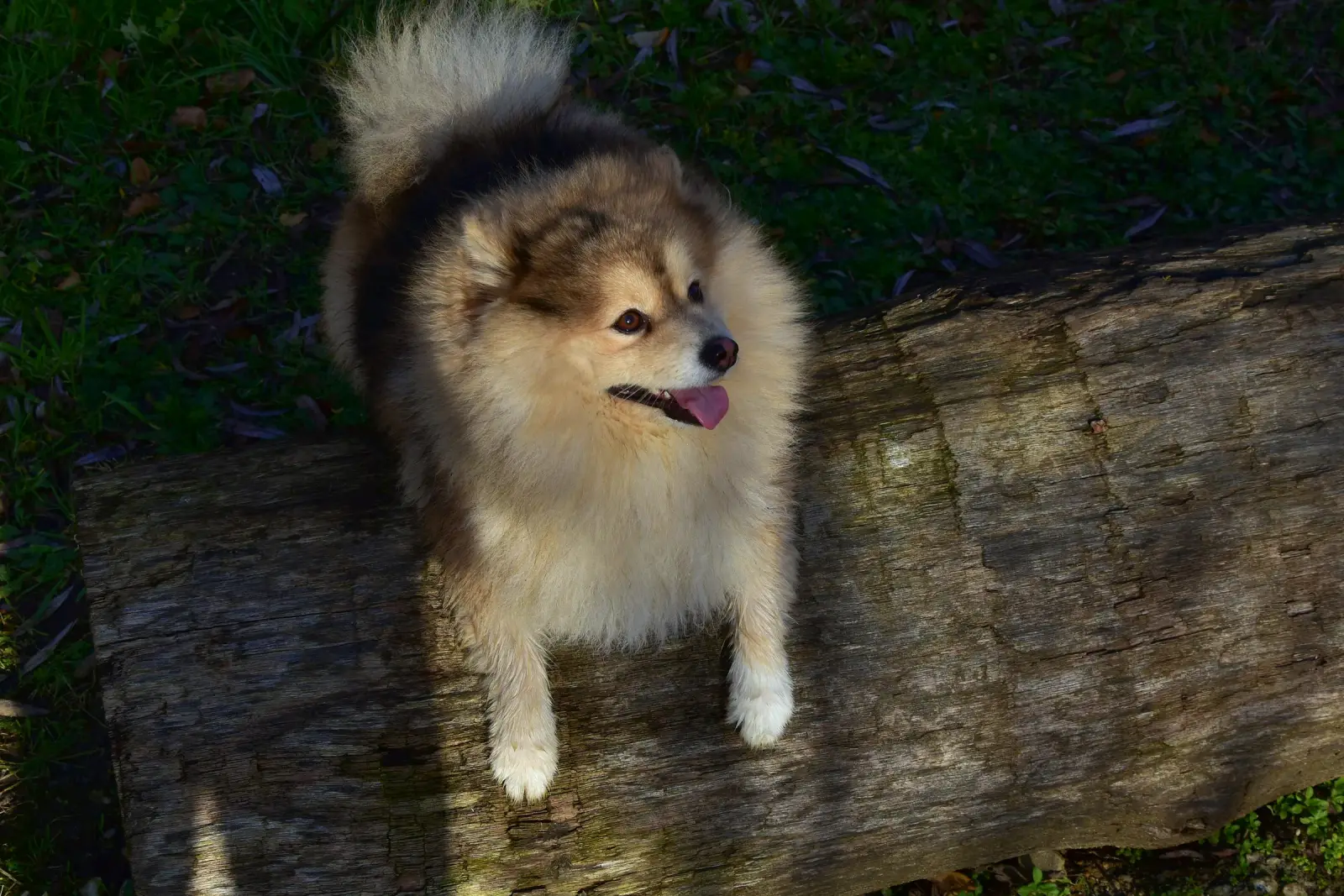
It is not a recognised breed with the FCI, the American Kennel Club or the UK Kennel Club, and none of them publishes a Pomsky standard. It is one of the newest designer crosses: press and breeder accounts place the first deliberate litter in the United States in about 2012, and the atlas data gives 2011 to 2014. It looks like a small Husky, with a thick double coat and often a mask, but size, coat and temperament vary widely. No published health study covers the Pomsky itself, so this page uses what is known about crosses in general and about both parents.
Pomsky quick facts
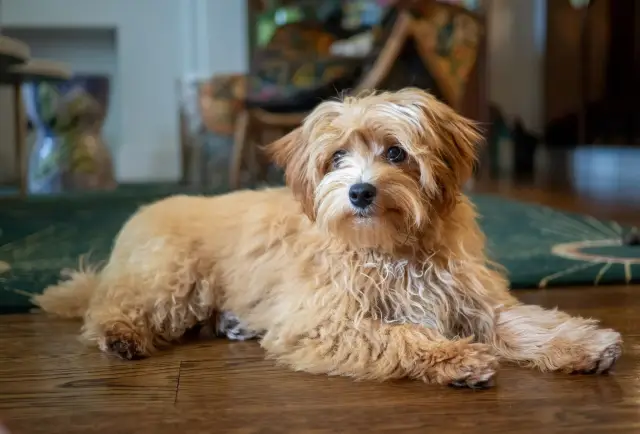 Related breedMaltipoo1990 to 2000 · United StatesModern Era
- What it is
- A cross of a Pomeranian and a Siberian Husky
- Country of origin
- United States (atlas data)
- Period of development
- 2011 to 2014 (atlas data, medium confidence); the first recorded litter is usually dated 2012
- Other names
- Pomeranian Husky
- Recognition
- Not recognised by the FCI, the AKC or the UK Kennel Club
- Family
- Modern Crossbreed (atlas grouping by history, not DNA)
- Size
- Very variable; atlas data lists small
- Weight
- Roughly 5 to 20 kg in breeder descriptions, and the sources disagree; no kennel club figure exists
- Life span
- Atlas data: 12 to 15 years
- Coat
- Thick double coat; sheds
- Parents
- Pomeranian and Siberian Husky


Where it sits in the tree
Modern Era · 1914 to today

Name and origin
 Related breedPuggle1980 to 1990 · United StatesModern Era
"Pomsky" is a portmanteau of Pomeranian and Husky. It is also called a Pomeranian Husky. The two parents are very different. The Pomeranian is a toy spitz of about 1.4 to 3.2 kg (AKC). The Siberian Husky is a sled dog of 16 to 27 kg (AKC and UK Kennel Club). Both are spitz-type dogs with thick coats and erect ears, which is why the cross looks like a small Husky and why breeders chose the pair. Neither parent descends from the cross, so the atlas places it in the Modern Crossbreed group, which groups crosses by history and not by DNA.

History
 Same eraAmerican Akita1945 to 1956 · United StatesModern Era
The first litters, about 2012
Most accounts date the first deliberate Pomsky litter to 2012 in the United States. Some guides point to 2009 and others to a viral internet story of 2011, but these earlier claims are less certain, and one popular tale involved photographs of a different breed. Breeder accounts name two Arizona breeders for the first litter. They are not independent records, so treat the details as retelling. The atlas data gives 2011 to 2014 with medium confidence.
Artificial insemination
The parents differ so much in size that a natural mating is hard. Accounts say breeders use a Husky mother and a Pomeranian father, usually through artificial insemination, because a Pomeranian mother carrying Husky-sized puppies would be at risk. This matters for welfare: a mating that needs a medical procedure is a reason to ask a breeder very careful questions about how the puppies were produced.
Clubs and registries, not recognition
Several private groups, among them the Pomsky Club of America, the American Pomsky Kennel Club and the International Pomsky Association, keep registries and describe the cross. The American Pomsky Kennel Club published its own in 2023, according to its own booklet. These are private organisations with their own rules. The AKC registers only purebred dogs and does not accept the Pomsky, and the FCI and the UK Kennel Club do not list it. A Pomsky "pedigree" is therefore a registry's record and not a kennel club standard.
Relatives and DNA
 Same familyAmerican Bully1980 to 2004 · United StatesModern Era
The atlas holds no DNA study of the Pomsky, so there is no DNA chart. Its relatives follow from its parents. The Siberian Husky belongs to the Asian Spitz family and descends from the Chukotka Sled Dog. The Pomeranian is a small spitz in the Small Spitz family and is the dwarf size of the German Spitz (Parker et al., Cell Reports, 2017). Other crosses of Husky-type dogs are the Northern Inuit Dog and the Argentine Polar Dog, which are listed as siblings in the atlas. See also the Small Spitz family.
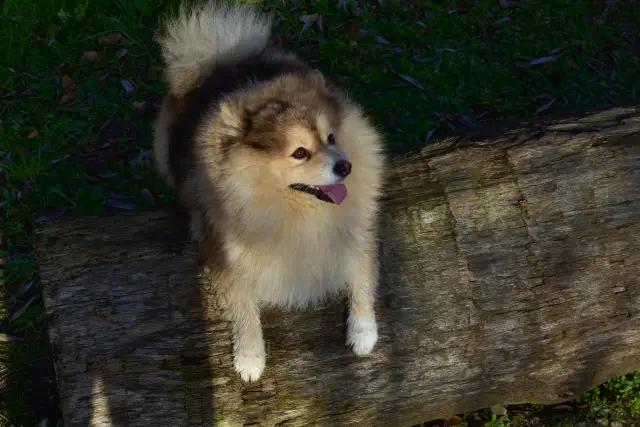 PomskyPomeranian and Husky crossPomskyHusky side of the cross
Sister breeds · 2
- Argentine Polar Dog1950 to 1960
- Northern Inuit Dog1980 to 1990

The breed standard: there is none
 Looks relatedBlack Russian Terrier1949 to 1984 · RussiaModern Era
A breed standard is the written ideal a kennel club judges dogs against. No major kennel club has one for the Pomsky. The parent standards show how wide the range of a Pomsky can be. Clubs that do not list the cross are left out.
| Trait | What the standards say |
|---|---|
| Pomsky standard | None from the FCI, the AKC or the UK Kennel Club. Private registries publish their own, and these differ |
| Pomeranian size | AKC: 3 to 7 lb (about 1.4 to 3.2 kg), 4 to 6 lb preferred for show. UK Kennel Club: dogs 1.8 to 2 kg, bitches 2 to 2.5 kg. FCI (Zwergspitz): 21 cm, with 3 cm tolerance |
| Siberian Husky size | AKC and UK Kennel Club: males 53 to 60 cm and 20 to 27 kg, females 51 to 56 cm and 16 to 23 kg |
| Coat | Both parents have a double coat. Pomeranian: short soft undercoat and long harsh outer coat. Husky: dense, medium length |
| Colour | Pomeranian: many colours. Husky: all colours and markings, including white; is not allowed (UK Kennel Club) |
| Ears and tail | Both parents: erect ears; tail carried over the back (Pomeranian) or brush-like (Husky) |
Size, generations and how the cross varies
 Related breedCavalier King Charles Spaniel1926 to 1945 · United KingdomModern Era
Size. The gap between parents is the main problem for any buyer. A Pomsky can be close to the Pomeranian or much nearer the Husky, and early litters often produced dogs bigger than buyers expected. Breeder and guide descriptions give adult weights from about 5 to 20 kg, and the sources disagree on the range for each generation: one gives F1 dogs at 12 to 20 kg and F2 dogs at 7 to 11 kg, another gives different figures. Puppy size at eight weeks does not reliably predict adult size. Terms such as "teacup" or "mini" are sales words and not a size class in any kennel club.
Generations. Breeders use the same labels as for other crosses.
- F1. A Pomeranian crossed with a Husky.
- F1b. An F1 mated back to one of the parent breeds.
- F2. Two F1 dogs mated together.
- Multigenerational. Pomskies bred to Pomskies for several generations, aiming at a steadier size and look.
The labels describe ancestry. They are not a health grade, and no published study shows how predictable size or coat is in each generation. Breeders say later generations are more consistent in size, but they still vary.
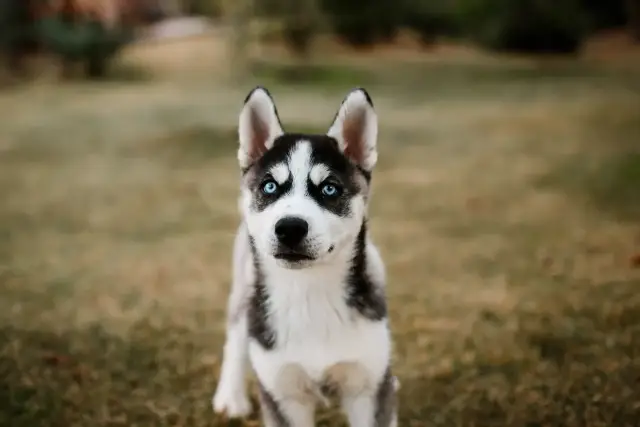
Appearance. Most Pomskies have a wedge-shaped, fox-like face, erect ears and a curled or flat-carried tail. Husky colours and facial masks are common, and blue eyes may appear, as in the Husky parent.
Coat, shedding and grooming
 Related breedCzechoslovakian Wolfdog1955 to 1999 · Slovakia, Czech RepublicModern Era
Both parents have a double coat, a soft undercoat under a longer outer coat, so the Pomsky is a shedding dog. Expect loose hair all year and a heavy seasonal drop, usually in spring and autumn, when the undercoat comes out in clumps. Brush two or three times a week and daily in a heavy shed, with an undercoat rake or slicker brush. Bathe only when needed.
Do not shave a double coat. The coat helps the dog manage both heat and cold, and a shaved coat can grow back patchy. A Pomsky is not a hypoallergenic dog. Dog allergen is made in skin, saliva and urine, not in hair length, and no breed has been shown to be allergen-free. If someone at home has an allergy, spend time with the individual dog first.
The Pomeranian side adds one specific coat concern. Alopecia X, a progressive hair loss with darkening skin, is described in Pomeranians, and its cause is unknown. No study shows how often it occurs in the cross.
Temperament and training
 Related breedDogo Argentino1928 to 1973 · ArgentinaModern Era
The Pomsky is usually described as bright, energetic and talkative. Both parents are spitz-type dogs, and both are independent thinkers. The Husky is a working sled dog that loves to run, digs, howls and can be hard to recall. The Pomeranian is an alert, bold small dog that barks readily. A Pomsky can inherit any mix of these, so noise is common, and this is a dog that suits owners who accept it. These are descriptions based on the parents, not measurements of the cross, and individual dogs vary widely.
Training needs patience. A Husky-type mind is independent and bored easily, so keep sessions short and rewarding, and begin early. Expect a clever dog that tests rules. A secure fence matters: many Husky-type dogs dig and slip out, and one with strong prey drive chasing a squirrel may not return. Keep a young Pomsky on a lead or in a fenced area until recall is reliable. Early socialisation helps with the Pomeranian's tendency to bark at strangers.

Exercise and daily care
 Related breedMiniature American Shepherd1968 to 2015 · United StatesModern Era
The Pomsky needs more activity than its small size suggests. Plan on at least an hour of daily exercise, including some off-lead running in a safe place and mental work such as puzzle feeders or scent games. A bored Pomsky digs, chews and howls. Heat matters: a thick double coat and a Husky ancestry make hot weather hard, so walk in the cool hours and never leave the dog in a car or a warm room. Small ones can also be hurt by large dogs in rough play, and children need to be taught how to handle a smaller body.
Teeth, ears and nails need the usual care. Brush the teeth often, since small dogs collect tartar, check the ears weekly, and trim nails every few weeks. Feed measured meals: both parents can put on weight if over-fed, and extra weight makes kneecap and windpipe problems worse.
Health
 Related breedNeapolitan Mastiff1946 to 1949 · ItalyModern Era
Most Pomskies live healthy lives, but no published study measures the health of the Pomsky. This section has three parts: what research says about crosses, what is known about the two parents, and what you can ask a breeder.
The cross-breed question. The popular claim that crosses are healthier than purebreds ("hybrid vigour") is not supported as a general rule. Bryson, O'Neill, Brand, Belshaw and Packer ("The doodle dilemma", PLoS ONE, 2024) from the Royal Veterinary College studied 9,402 UK dogs, the Cockapoo, the Labradoodle and the Cavapoo, with their parent breeds. For about 87 percent of the 342 comparisons of common disorders there was no difference between the cross and its parents. The Pomsky was not in that study, so its result cannot be read across directly. Bellumori and colleagues (Journal of the American Veterinary Medical Association, 2013) used 27,254 case records from a US veterinary teaching hospital. Purebred dogs were more likely to have 10 of 24 inherited disorders, mixed-breed dogs were more likely to have one, and there was no difference for the other 13, which included and kneecap problems. A cross has two sets of parent risks and is not reliably healthier or less healthy.
The Pomeranian parent. O'Neill and colleagues (Canine Genetics and Epidemiology, 2016), using data from England, found kneecap slipping (patellar luxation) in 6.5 percent of Pomeranians, and the odds were 6.5 times higher than in crossbred dogs. A 2024 retrospective study of tracheal collapse in small-breed dogs counted Pomeranians among the affected breeds. Lewis and colleagues (Canine Genetics and Epidemiology, 2018) gave a median life span of 12.2 years for Pomeranians in UK Kennel Club data.
The Husky parent. The Siberian Husky Club of America lists three eye conditions of concern: juvenile cataracts, corneal dystrophy and progressive retinal atrophy. A French screening study of 10 breeds (1997 to 2017) found hip dysplasia in about 5 percent of Siberian Huskies, about 1 in 20.
| Condition | What it is | How common | What helps |
|---|---|---|---|
| Kneecap slipping (patellar luxation) | The kneecap slips out of its groove | 6.5 percent of Pomeranians, about 1 in 15 (VetCompass 2016); no figure for the cross | Knee checks, lean weight, vet treatment |
| Collapsing windpipe (tracheal collapse) | The windpipe flattens, causing a honking cough | Reported in Pomeranians in small-breed case series; no breed-wide percentage | Harness, lean weight, vet care |
| Alopecia X | Progressive hair loss with dark skin, mostly on the body and tail | Cause unknown; described in Pomeranians; no figure | Vet diagnosis; avoid claimed cures |
| Hip dysplasia | A loosely fitting hip joint | About 1 in 20 Siberian Huskies (French study 1997 to 2017); no figure for the cross | Hip scoring of parents, lean weight |
| Juvenile cataracts | Cloudiness in the lens that can start young | Listed by the Siberian Husky Club of America; no figure | Eye exams of the Husky parent |
| Corneal dystrophy | Clouding or deposits in the clear front of the eye | Listed by the breed club; no figure | Eye exams |
| Progressive retinal atrophy | Slow loss of the light-sensing cells | Listed by the breed club; no figure | Eye exam, DNA test where available |
| Gum and tooth disease | Tartar and infection around crowded teeth | About 1 in 8 across all UK dogs (VetCompass 2021); no figure for the cross | Daily brushing, vet dental checks |
What helps. Ask for the health checks of both parents: hip scores and eye exams for the Husky, and knee checks for the Pomeranian. Ask how the puppies were bred and whether the mother is the Husky. A breeder who cannot show the tests is not testing.
Life span. The atlas data gives 12 to 15 years. That is a range and not a measured median. The Pomeranian median in UK Kennel Club data was 12.2 years, and no study measures how long Pomskies live.

Living with a Pomsky
| Daily reality | Rating | Why |
|---|---|---|
| Exercise per day | High | Husky energy in a smaller body; an hour or more |
| Training needs | High | Clever but independent; recall is hard |
| Grooming | High | Brushing several times a week and heavy seasonal shedding |
| Shedding | High | Double coat |
| Barking | High | Both parents are vocal; howling is common |
| Time alone | Poor | Bored dogs dig, chew and howl |
| Children | Fair | Playful, but a smaller dog needs gentle handling |
| Other dogs | Fair | Varies with socialisation and size |
| Cats and small pets | Varies | Husky prey drive can show |
| Flat living | Fair | Possible for a small one with plenty of outings, but noise travels |
| Heat tolerance | Poor | Thick double coat |
| Cold tolerance | Very good | Thick double coat |
| First-time owner fit | Fair | Friendly, but energy, noise and escape habits need planning |
A great fit if
- You want an active, talkative dog and enjoy long walks in all weather.
- You accept hair on every surface and a daily brush in a heavy shed.
- You have a secure garden or fence.
- You will ask a breeder detailed questions about the parents and how the puppies were bred.
Think twice if
- You want a quiet, low-maintenance lap dog.
- You live in a hot climate without air conditioning.
- You are away at work all day.
- You expect a guaranteed small size or a calm temperament.
Before you get one
Ask for the size and health records of both parents, which one is the mother, and how the puppies were bred. Be careful with any seller promising a "teacup" or "mini" size, a guaranteed adult weight, or a dog that is hypoallergenic. Crosses like the Pomsky also end up in shelters, and an adult dog shows its size, coat and temperament before you commit; see adopting a dog.
Similar breeds to consider
- Pomeranian. One parent, a recognised toy spitz of fixed size.
- Siberian Husky. The other parent, a medium sled dog.
- Alaskan Klee Kai. A recognised small Husky-type breed, listed as a descendant of the Husky.
- American Eskimo Dog. A white spitz in three sizes, a relative of the Pomeranian.
- Northern Inuit Dog. A larger Husky-type dog with a wolf-like look.

Pomsky fun facts
- The name is Pomeranian plus Husky, and the cross is also called a Pomeranian Husky.
- The first deliberate Pomsky litter is usually dated 2012, so the cross is only about a decade old.
- A Pomeranian can weigh as little as 1.4 kg, while a Husky can reach 27 kg, so sizes in a litter can be very different.
- The cross is a good example of why "mini" and "teacup" are sales words: no kennel club measures them.
Frequently asked questions
What is a Pomsky?
A cross between a Pomeranian and a Siberian Husky, first bred in the United States around 2012.
Is a Pomsky a recognised breed?
No. The , the and the UK Kennel Club do not recognise it. Several private registries do.
How big does a Pomsky get?
It varies a lot. Breeder descriptions range from about 5 to 20 kg, and no kennel club gives a figure.
Do Pomskies shed?
Yes, heavily. They have a double coat and a big seasonal drop.
Are Pomskies hypoallergenic?
No breed or cross has been shown to be. Spend time with the dog first.
Are Pomskies healthier than purebreds?
Not reliably. A 2024 Royal Veterinary College study of other crosses found no difference for about 87 percent of the common disorders compared, and there is no published study on the Pomsky itself.
How long do Pomskies live?
The atlas data gives 12 to 15 years, a range and not a measured median.
Do Pomskies bark a lot?
Many do, and howling is common. Both parents are vocal.
Read next
 FamilyModern CrossbreedThe whole family
 Adopt a dogDog Shelters in EuropeFind dog shelters in Europe, learn how shelters differ from country to country and why adopting a dog is a good option.
Sources (16)
- American Kennel Club, Pomeranian breed page and breed standard.
- American Kennel Club, Siberian Husky breed standard and breed information.
- Bellumori T.P. et al., "Prevalence of inherited disorders among mixed-breed and purebred dogs: 27,254 cases (1995-2010)", Journal of the American Veterinary Medical Association, 2013.
- Bryson G. et al., "The doodle dilemma: how the physical health of designer crossbreeds compares to their purebred progenitors", PLoS ONE 19(8), 2024.
- Fédération Cynologique Internationale, Deutscher Spitz (German Spitz), standard no. 97.
- Fédération Cynologique Internationale, Siberian Husky, standard no. 270.
- Frontiers in Veterinary Science, retrospective study of tracheal collapse in small-breed dogs, 2024.
- Lewis T.W. et al., "Longevity and mortality in Kennel Club registered dog breeds in the UK in 2014", Canine Genetics and Epidemiology, 2018.
- O'Neill D.G. et al., "Epidemiology of patellar luxation in dogs attending primary-care veterinary practices in England", Canine Genetics and Epidemiology, 2016 (VetCompass).
- O'Neill D.G. et al., "Prevalence of commonly diagnosed disorders in UK dogs under primary veterinary care: results and applications", BMC Veterinary Research, 2021 (VetCompass).
- Parker H.G. et al., "Genomic analyses reveal the influence of geographic origin, migration, and hybridization on modern dog breed development", Cell Reports, 2017.
- Siberian Husky Club of America, hip screening and eye testing pages.
- Study of canine hip dysplasia prevalence in 10 breeds in France, 1997 to 2017, PLoS ONE, 2020.
- The Kennel Club (UK), Pomeranian and Siberian Husky breed information pages.
- Pomsky Club of America, American Pomsky Kennel Club and International Pomsky Association, registry information (founding dates and standards differ by source).
- Atlas data, Pomsky knowledge record (dates, life span, lineage).