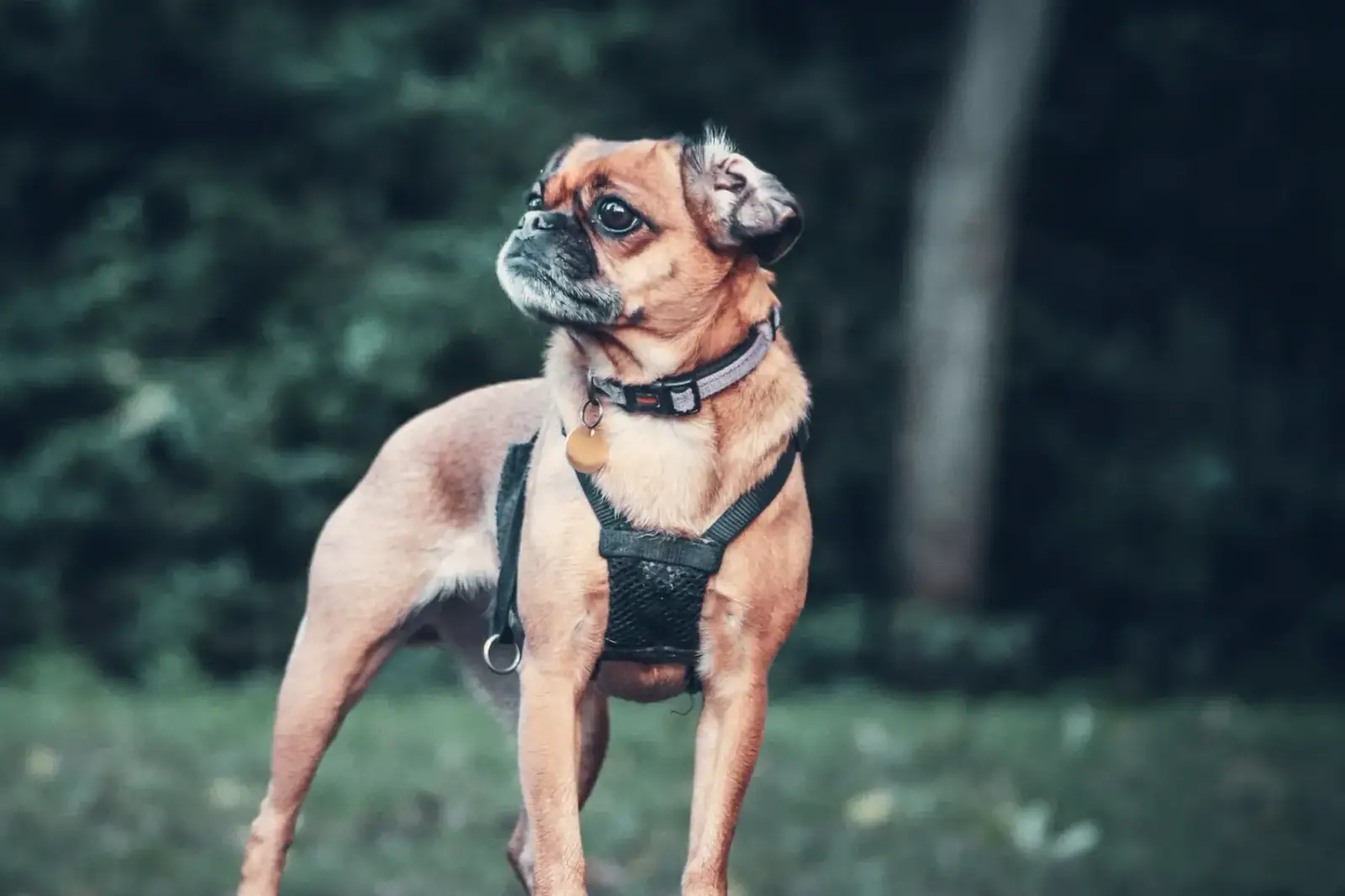
It is not a breed with a kennel-club standard: the FCI, the American Kennel Club and the UK Kennel Club do not recognise it, so no official size, coat or temperament description exists. It appeared in the United States in the late twentieth century as a deliberate cross, and the name is a blend of the two parents. Most Puggles are small, short-coated, sturdy dogs with a longer nose than a Pug, a friendly nature and a hound's appetite. A 2026 Royal Veterinary College study found far fewer breathing problems in Puggles than in Pugs.
Puggle quick facts
 Related breedMaltipoo1990 to 2000 · United StatesModern Era
- What it is
- A cross of a Pug and a Beagle
- Country of origin
- United States; atlas data gives Wisconsin
- Period of development
- 1980 to 1990 (atlas data, medium confidence); other accounts say the 1990s or about 2002
- Other names
- Peagle
- Recognition
- Not recognised by the FCI, AKC or UK Kennel Club; no
- Family
- Modern Crossbreed (atlas grouping by history, not DNA)
- Size
- Small. No official limits, size follows the parents
- Life span
- Atlas data: 10 to 15 years
- Coat
- Short, smooth, dense; shedding varies
Drawn to scale in real centimetres. Its back reaches about 33 cm, your shin; its head about 42 cm, just below your knee.

Where it sits in the tree
Modern Era · 1914 to today
Name and origin
 Related breedPomsky2011 to 2014 · United StatesModern Era
"Puggle" is a portmanteau of Pug and Beagle. The cross also goes by Peagle. It follows the same naming pattern as Cockapoo and Labradoodle, and it belongs to the wave of named crosses that grew in the United States from the 1980s. See dog hybrids for how crossbreds differ from breeds.
The Puggle is a crossbreed, not a breed. A breed is a population that breeds true to a written standard and a . A Puggle litter can produce puppies that look more like one parent than the other, and the "generation" of a Puggle (first cross, second cross or later) changes what to expect. The Pug and the Beagle are two very different dogs: a flat-faced Chinese companion and an English pack hound. See the Pug and Beagle pages.

History
 Same eraAmerican Akita1945 to 1956 · United StatesModern Era
One cross, three dates
The dates for the first Puggles do not agree. The atlas data places the cross in Wisconsin in the 1980s (1980 to 1990, medium confidence). Several breed sites name a Wisconsin breeder, Wallace Havens, as the person who first bred the cross on purpose and coined the name. Some of these give the 1980s and others the 1990s. Wikipedia describes a first planned Pug and Beagle cross in Oklahoma in the 1990s, with the name in print from about 2002. No primary record settles the question, and Pug and Beagle matings had surely happened by accident before any breeder named the result.
What most accounts share is the aim: a dog that keeps the Pug's cheerful, clingy nature but has a longer muzzle and less of the Pug's breathing and eye trouble, with the Beagle's sturdier build and sense of smell.
Registries without a standard
Havens is said to have registered the cross with the American Canine Hybrid Club, a registry for crosses. Such registries keep their own lists. They are not kennel clubs, and none of the big kennel clubs publishes a Puggle standard. Sources also say the sire should usually be the Pug and the dam the Beagle, because a larger Beagle sire can cause trouble for a small Pug dam.
Fashion and a second look, 2000s to 2026
Through the 2000s the Puggle became a popular small crossbreed. In the 2020s the Pug's health came under strict study, and the Puggle came back into view as a possible answer. In 2026 a team led by the Royal Veterinary College published an in-person study of Pugs, Pug and Jack Russell crosses and Puggles; the findings are covered in the Health section.
Relatives and DNA
 Same familyAmerican Bully1980 to 2004 · United StatesModern Era
The atlas data holds no DNA study of the Puggle, so there is no DNA chart. Its relatives follow from its parents. The Pug is a toy dog from East Asia. The Beagle is a scent hound from England. Other named crosses with a short-nosed or small parent include the Cavapoo and the Cockapoo.
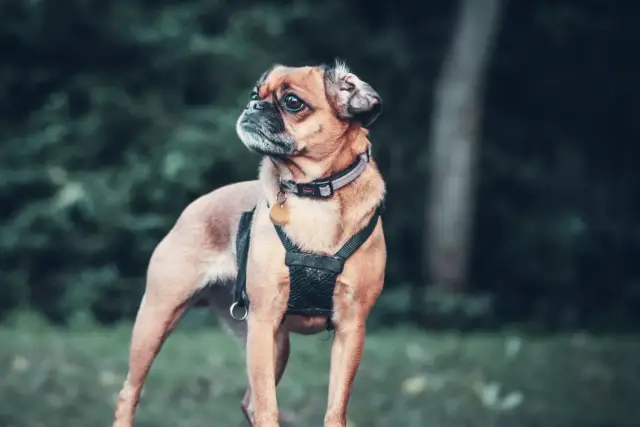 Pugglecrossed with the BeaglePuggleBeagle side of the cross
Sister breeds · 1
- Beagle-Harrier1850 to 1974

No breed standard: what to expect
 Looks relatedBlack Russian Terrier1949 to 1984 · RussiaModern Era
A breed standard is the written ideal that a kennel club judges dogs against. The Puggle has none from a major kennel club, so two dogs sold as Puggles can look quite different. What a Puggle will be like is best guessed from the two parents.
| Trait | Pug | Beagle | Puggle |
|---|---|---|---|
| Weight | Ideal 6.3 to 8.1 kg (UK Kennel Club) | Median adult 18.2 kg in UK vet records | No official figure |
| Height | 10 to 13 inches, about 25 to 33 cm (AKC) | 33 to 41 cm (UK Kennel Club) | No official figure |
| Muzzle | Very short | Long, square | Between the two; varies by puppy |
| Coat | Short, smooth, fawn or black | Short, dense, tricolour or lemon and white | Short; often fawn, tan and white or black and tan |
| Ears | Small, folded | Long, hanging | Folded to semi-hanging |
| Tail | Curled over the back | Carried up, "gay" | Curled or carried up |
Size. A first cross lands between the parents, but there is no rule. A puppy of a small Pug and a large Beagle can end up well above the usual range. Ask for the parents' weights, and meet the mother.
Muzzle. This is the point that matters for health. A longer muzzle tends to come with easier breathing (see Health). Puppies from the same litter can differ, so look at each dog's nose and nostrils and not at the label.
Coat and colour. The coat is short and needs little care. Colours follow the parents: fawn, black, tan and white mixes, and the Beagle's white blaze on the chest or tail tip.
Temperament and training
 Related breedCavalier King Charles Spaniel1926 to 1945 · United KingdomModern Era
The Puggle is usually a sociable, playful, affectionate dog. These are traits of both parents, not measurements of the cross. A Pug lives for its people and a Beagle follows its nose and loves company, so many Puggles are happy, food-focused and clingy.
The nose and the voice. The Beagle half is a scent hound. A Puggle can follow a smell and ignore you, and it may howl or bay when bored or alone, which can bother neighbours. Keep it on a lead or in a secure area. Do not rely on recall near anything interesting.
Food. Both parents love food and gain weight easily. Puggles steal from bins and counters. Measure meals, use part of the daily ration as training treats, and keep food out of reach.
Training. Short, reward-based sessions work. A Puggle can be stubborn, a mix of the Pug's wilfulness and the Beagle's independence. In the 2026 study, owner-rated behaviour profiles were similar across Pugs and the crosses. See dog training basics.
Alone time. Most Puggles dislike being left for long days, and a bored young dog barks, howls or chews. Practise short absences early; see socialising your dog.

Coat, shedding and grooming
 Related breedCzechoslovakian Wolfdog1955 to 1999 · Slovakia, Czech RepublicModern Era
The short coat is easy to keep. Brush weekly with a rubber brush to lift dead hair. Puggles shed, often more than owners expect, because both parents are short-coated shedders. They are not a hypoallergenic cross, and no breed or cross has been shown to be.
- Skin folds. A Puggle with a shorter muzzle may keep some Pug nose folds. Wipe them dry as the vet advises; in the 2026 study no Puggle had nasal fold dermatitis.
- Ears. Hanging ears hold moisture and heat. Check weekly for smell or redness. See dog ear infection.
- Teeth and nails. Small dogs collect tartar early. Brush the teeth and trim the nails every few weeks. See dog grooming.
Health
 Related breedDogo Argentino1928 to 1973 · ArgentinaModern Era
This section starts with the two studies that matter most, then the parents, since a cross can inherit risks from both.
The cross itself. In 2026 a Royal Veterinary College-led study in the journal Animal Welfare (Youens and colleagues) compared 150 UK pet dogs: 51 Pugs, 51 Jugs (Jack Russell and Pug crosses) and 48 Puggles. The main results:
- Breathing. Pugs had significantly more breathing and airway problems than the crosses. Of the Puggles, 97.9 percent graded as free of airway signs, with one dog graded 1. All Jugs graded 0.
- Skin. 38.3 percent of the Pugs had nasal fold dermatitis, against none of the Puggles and one Jug.
- Eyes and joints. Pugs had significantly more eye, skin and musculoskeletal problems than the crosses.
- The likely reason. The crosses had longer muzzles and less narrow nostrils.
- Quality of life, as rated by owners. "Excellent" was chosen for 81.2 percent of Puggles, 92.2 percent of Jugs and 58.8 percent of Pugs.
Read it with its limits. The dogs were UK pets, and the study measured a single time point. It does not show that every Puggle is healthy: a Puggle with a Pug-like face may still have airway trouble. The 2026 study does not support the idea of "hybrid vigour" as a general rule. It points to longer muzzles and more open nostrils.
No large study of the disorders of Puggles in everyday vet records exists. The 2024 Royal Veterinary College survey of doodle crosses (Bryson et al., PLoS ONE) covered Cockapoos, Labradoodles and Cavapoos, not Puggles, and found the crosses were not reliably healthier than their parents.
The Pug parent. O'Neill and colleagues (Canine Genetics and Epidemiology, 2016) studied 2,709 Pugs under primary vet care in England. Of 1,009 Pugs seen in 2013, 68.19 percent had at least one recorded disorder. Overweight or obesity (13.18 percent, about 1 in 8), corneal disorders (8.72 percent, about 1 in 11) and ear infection (7.53 percent, about 1 in 13) were among the most common.
The Beagle parent. O'Neill and colleagues (Companion Animal Health and Genetics, 2025) studied 19,906 Beagles in the UK. Obesity was recorded in 24.27 percent (about 1 in 4), ear infection (otitis externa) in 11.18 percent (about 1 in 9) and dental disorders as a group in 21.48 percent (about 1 in 5). The median age at death was 11.28 years. Beagles also carry inherited conditions with DNA tests, including Lafora disease and Musladin-Lueke syndrome; see the Beagle page.
| Condition | What it is | How common | What to do |
|---|---|---|---|
| Breathing problems (BOAS) | Airway narrowing from a short skull: noisy breathing, heat and exercise intolerance | Puggles 97.9 percent free of airway signs, one graded 1; Pugs significantly worse (2026 study) | Look at nose length and nostrils; ask about noisy breathing in both parents |
| Skin fold infection | Moist, sore skin in nose or face folds | 38.3 percent of Pugs, no Puggles (2026 study) | Wipe folds dry; vet check |
| Eye surface damage | Scratches or ulcers on the clear front of the eye | 8.72 percent of Pugs (2016); fewer eye problems in Puggles (2026) | Vet eye exam if squinting or watering |
| Obesity | Extra weight; harder on breathing and joints | About 1 in 8 Pugs; about 1 in 4 Beagles | Measured meals, daily exercise |
| Ear infection | Wax, moisture and infection in the ear canal | About 1 in 9 Beagles; about 1 in 13 Pugs | Weekly ear checks, vet advice |
| Dental disease | Tartar and gum disease | About 1 in 5 Beagles as a group | Brush teeth, dental checks |
| Inherited disease from the Beagle | Lafora disease, Musladin-Lueke syndrome | No figure for the cross | DNA test of the Beagle parent |
What helps. A cross has two sets of health risks and does not cancel them. Choose a puppy for its own muzzle length, open nostrils and easy breathing, ask for the Beagle parent's DNA tests, and keep the dog lean. A breeder who cannot show them is not testing.
Life span. The atlas data gives 10 to 15 years. This is a wide range from the knowledge record, not a measured median. The UK Beagle study above gave a median age at death of 11.28 years.

Living with a Puggle
 Related breedMiniature American Shepherd1968 to 2015 · United StatesModern Era
| Daily reality | Rating | Why |
|---|---|---|
| Exercise per day | Medium | Daily walks and play; a Beagle's stamina |
| Training needs | Medium | Treat-driven but stubborn; scent distractions |
| Grooming | Low | Short coat, weekly brushing |
| Shedding | Medium to high | Short hair, shed all year |
| Barking and howling | Medium to high | Beagle voice |
| Time alone | Poor | Companion dogs; bored Puggles howl |
| Children | Good | Sturdy and sociable; supervise with small children |
| Other dogs | Good | Pack-minded; varies with socialisation |
| Cats and small pets | Varies | Beagle prey drive |
| Flat living | Good | If barking and howling are managed |
| Heat tolerance | Fair | Depends on muzzle length; avoid heat |
| Cold tolerance | Fair | Short coat; a coat helps in winter |
| First-time owner fit | Fair | Friendly, but food, noise and alone time need work |
A great fit if
- You want a friendly small dog and are home much of the day.
- You like a dog that follows its nose and loves food, and you can manage the weight.
- You will check the puppy's nose and breathing, and the parents' health.
Think twice if
- You are away for long days.
- You live where howling will cause trouble.
- You want a dog that always comes back off the lead.
- You expect a cross to mean no health risk.
Before you get one
Ask for the weight, age and health of both parents, and which is the Pug and which the Beagle. Look at the puppy's nostrils and listen to its breathing. Ask for the Beagle's DNA test results. Be careful with a seller who calls the Puggle a "breed", a "healthier Pug" or hypoallergenic. Crosses like the Puggle also come into shelters, and an adult dog shows its size and temperament before you commit; see adopting a dog.
Similar breeds to consider
- Beagle. One parent, a recognised scent hound with a fixed type.
- Pug. The other parent, a flat-faced toy dog with serious airway risks.
- Cavalier King Charles Spaniel. A small friendly companion, with its own health issues.
- Boston Terrier. A small short-faced companion, another flat-faced option, with its own airway risks.

Puggle fun facts
 Related breedNeapolitan Mastiff1946 to 1949 · ItalyModern Era
- The name is Pug plus Beagle, and the cross is also called Peagle.
- Accounts of the first Puggles give the 1980s, the 1990s and about 2002, in Wisconsin or Oklahoma.
- The atlas data lists the Puggle in the Modern Crossbreed family, which groups crosses by history and not by DNA.
- In the 2026 Royal Veterinary College study, Pugs had significantly more airway disease than the crosses, and only one of 48 Puggles had any airway grade above 0.
- No Puggle in that study had skin fold dermatitis, against 38.3 percent of the Pugs.
Frequently asked questions
What is a Puggle?
A cross between a Pug and a Beagle, first bred on purpose in the United States.
Is a Puggle a recognised breed?
No. The , and UK Kennel Club do not recognise it, and there is no standard.
How big does a Puggle get?
There is no official size. It depends on the parents, so ask the breeder for the size of both.
Do Puggles shed?
Yes. The coat is short, and both parents shed.
Are Puggles healthier than Pugs?
In a 2026 Royal Veterinary College study of 150 dogs, Pugs had significantly more breathing, skin, eye and joint problems than Puggles. A Puggle with a very short muzzle can still have breathing trouble.
Do Puggles bark or howl?
Many do, from the Beagle side. It is worst when they are bored or alone.
Are Puggles good family dogs?
Often, as both parents are friendly. Supervise small children.
How long do Puggles live?
The atlas data gives 10 to 15 years.
Read next
 FamilyModern CrossbreedThe whole family
 Adopt a dogDog Shelters in EuropeFind dog shelters in Europe, learn how shelters differ from country to country and why adopting a dog is a good option.
Sources (10)
- Youens E. et al., "A solution right under our nose? Crossbreeding extreme brachycephalic dogs results in better health outcomes while preserving behavioural profiles and dog-owner relationship quality", Animal Welfare, 2026.
- Vet Times, "Break dog breed shackles, says RVC-led research", 17 August 2026, on the Animal Welfare study of Pugs, Jugs and Puggles led by the Royal Veterinary College.
- MRCVSonline, report on the Royal Veterinary College study of Pug crossbreeds, 2026.
- O'Neill D.G. et al., "Demography and health of Pugs under primary veterinary care in England", Canine Genetics and Epidemiology, 2016.
- O'Neill D.G. et al., "Beagles kept as companion animals in the UK: demography, disorders and mortality", Companion Animal Health and Genetics, 2025.
- Bryson G. et al., "The doodle dilemma: how the physical health of designer crossbreeds compares to their purebred progenitors", PLoS ONE, 2024.
- American Kennel Club, Pug breed information and standard; Beagle breed information and standard.
- The Kennel Club (UK), Pug and Beagle breed standards (parent weights and heights).
- Wikipedia, "Puggle" (origin accounts and dates, compared with other sources).
- Atlas data, Puggle knowledge record (dates, life span, lineage).