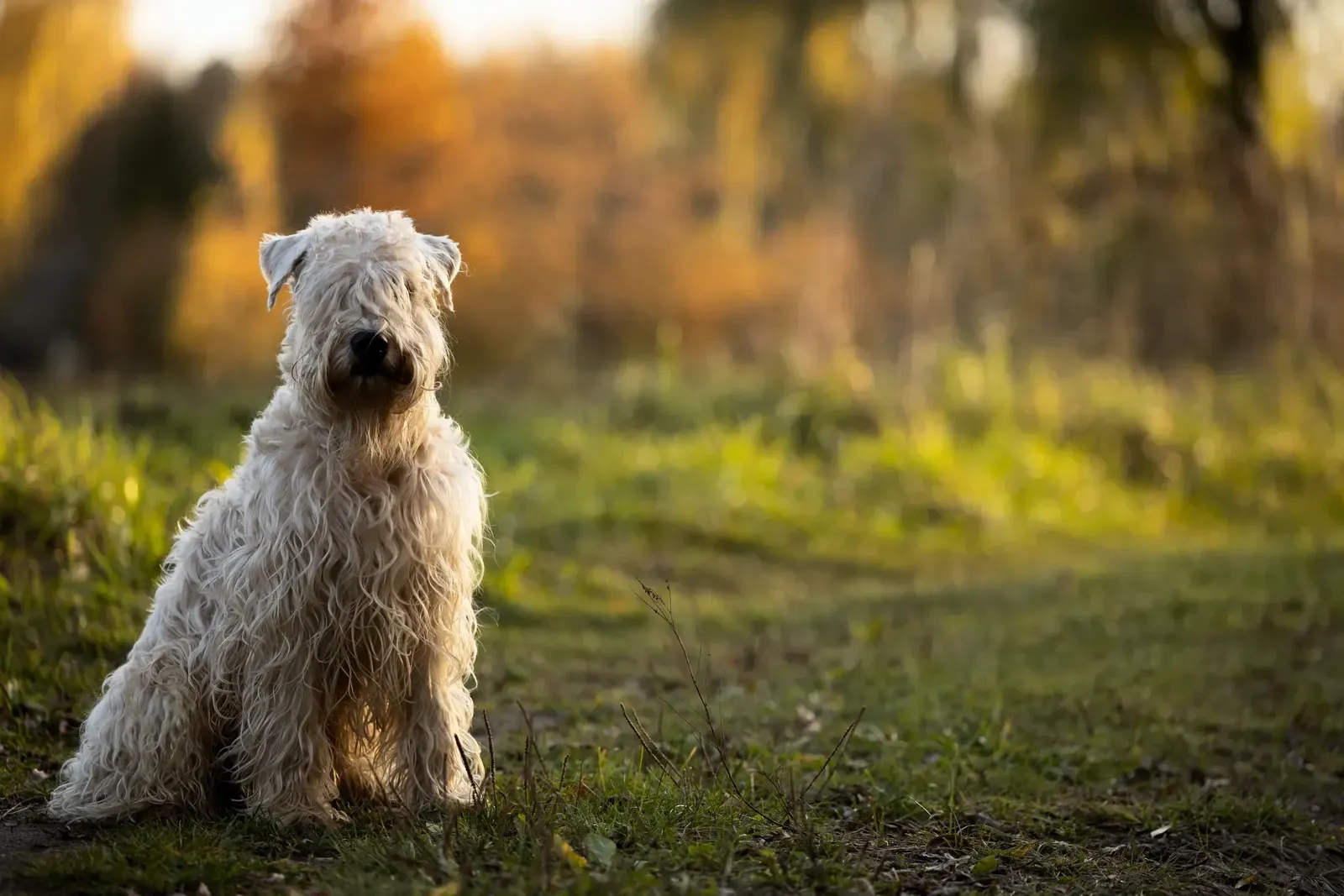
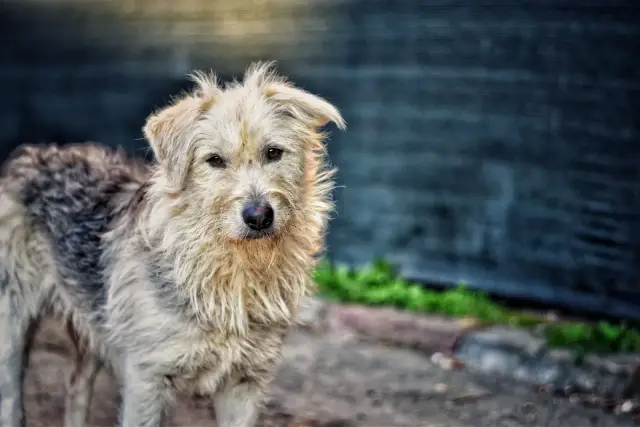
It is cheerful, people-loving and bouncy, with a terrier's stubborn streak. The coat sheds very little but mats quickly, so it needs brushing and combing every day. The breed is best known to vets for two inherited-risk conditions, protein-losing enteropathy (PLE) and protein-losing nephropathy (PLN). Both are worth asking a breeder about before buying a puppy.
Soft-coated Wheaten Terrier quick facts
 Related breedJack Russell Terrier1819 to 1976 · United KingdomIndustrial Revolution
- Closest DNA relatives
- Irish Terrier, Kerry Blue Terrier, Glen of Imaal Terrier
- Other names
- Irish Soft Coated Wheaten Terrier (FCI official name), Irish Soft-coated Wheaten Terrier, Wheaten
- Country of origin
- Ireland
- Period of development
- About 1700 to 1937 (atlas data); Irish Kennel Club recognition 1937
- Type
- Terrier (FCI Group 3, Terriers, standard no. 40; Terrier Group; UK Kennel Club Terrier Group)
- Size
- Medium. FCI standard: dogs 46 to 48 cm at the withers, bitches somewhat less
- Weight
- FCI standard: dogs 18 to 20.5 kg, bitches somewhat less
- Coat
- Single, soft, silky, wavy or loose-curled; low shedding; needs daily care
- Colour
- FCI: a good clear wheaten, from light wheaten to a golden reddish hue; puppies are darker
- Life span
- Atlas data: 12 to 14 years. UK study median: 13.7 years
- Exercise
- Moderate; the UK Kennel Club lists up to 1 hour a day
- DNA group
- "Terrier" , strong support (Parker et al. 2017)
Where it sits in the tree
Early Modern Era · 1600 to 1799
Where does the name Soft-coated Wheaten Terrier come from?
 Related breedStaffordshire Bull Terrier1800 to 1935 · United KingdomIndustrial Revolution
The name describes the coat in two parts. "Soft-coated" is the texture: silky and wavy, unlike the harsh wire coat of most terriers. "Wheaten" is the colour of ripe wheat, a warm pale gold. In Ireland the dog was long called simply the Wheaten, or the Irish Wheaten, and the FCI still lists it as the Irish Soft Coated Wheaten Terrier.
The word "terrier" comes from the Latin terra, earth, because terriers were bred to follow vermin underground. The Wheaten kept the name, although on Irish farms it did far more than ratting.

History of the Wheaten Terrier
 Same eraAiredale Terrier1850 to 1880 · United KingdomVictorian Breed Boom
An Irish farm dog
The Wheaten is one of several old terrier types of Ireland, and the atlas data places its development between about 1700 and 1937, with medium confidence. No exists for those centuries. What the breed literature agrees on is the job: a hardy, medium-sized dog kept on small farms to kill rats, guard the house and stock, and help drive cattle and sheep. The FCI standard infers that the breed has existed for at least 200 years from written references to soft-coated dogs.
A popular story says the Wheaten was the "Poor Man's Wolfhound". Irish law is said to have barred ordinary people from owning hunting dogs such as wolfhounds, so farm families kept a hardy terrier instead. Treat this as folklore: it is repeated widely, but this atlas has no primary record for it. The same goes for the tale that tails were docked to avoid a dog tax.
Cousins of the Irish Terrier and Kerry Blue
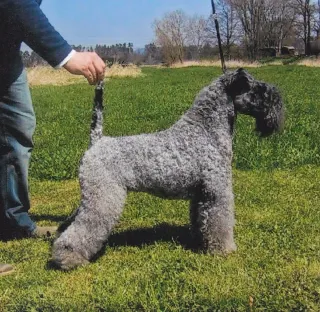
The Wheaten, the red Irish Terrier and the blue-grey Kerry Blue are often described as branches of the same old Irish terrier stock, later kept apart as three breeds: the Soft-coated Wheaten, the Irish Terrier and the Kerry Blue Terrier. The atlas data records the Irish Terrier and Kerry Blue as the Wheaten's sister breeds, and DNA backs this up (see the DNA table below).
Kennel club recognition
| Year | Event |
|---|---|
| 1937 | Irish Kennel Club recognises the breed; first championship show appearance on St Patrick's Day |
| 1943 | The Kennel Club (UK) recognises the breed |
| 1940s | First Wheatens exported to the United States |
| 1962 | Soft Coated Wheaten Terrier Club of America founded |
| 1 May 1973 | Admitted to the American Kennel Club Stud Book |
| 1990s | American Herding Breed Association accepts the Wheaten |
The FCI lists the breed as standard no. 40 (definitive) with Ireland as the country of origin. The Kennel Club's own breed page gives 1943 for UK recognition.
Why two coat styles exist
After the breed reached North America in the 1940s and 1950s, breeders there aimed at a fuller, thicker, more heavily trimmed coat. Irish and British dogs usually carry a silkier, wavier, lighter coat. Wheaten fanciers talk about the "Irish coat" and the "American coat" as a result. The FCI and Kennel Club standards both ask for a soft, silky, wavy or loosely curled coat, not a cotton-wool or woolly one, so the difference is one of degree rather than two different breeds.
Relatives and DNA
 Same familyCairn Terrier1500 to 1910 · United KingdomAge of Exploration
The atlas data lists no parent breeds for the Wheaten: it is a foundation terrier of Ireland, not a recorded cross of named breeds.
Sister breeds
- Irish Terrier. The red-coated cousin. The atlas notes a shared ancestry with the Wheaten.
- Kerry Blue Terrier. The blue-grey cousin, with a curlier coat. Also a shared ancestry.
What does DNA say?
Parker and colleagues (Cell Reports, 2017) analysed 1,346 dogs from 161 breeds and sorted them into 23 clades. The Wheaten sits in the "Terrier" clade with strong support, together with the other terriers of the British Isles. The study also measured shared , long stretches of identical DNA inherited from a common ancestor. More suggests a closer relationship.
Source: Parker et al. 2017, as recorded in this site's breed database.
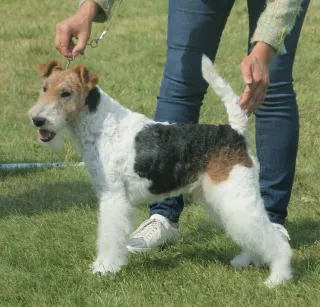
The pattern is tidy. The Irish Terrier tops the list by a wide margin, almost 100 , which fits a shared Irish origin. The Kerry Blue and the Glen of Imaal Terrier, two more Irish breeds, follow. After that the numbers drop to the small figures seen between any two terriers of the wider British family. You can read more about the group on the Terrier family page.
Sister breeds · 2
- Irish Terrier1700 to 1879
- Kerry Blue Terrier1800 to 1922
- Irish Terrier98.7 Mb 4.1%
- Kerry Blue Terrier58.0 Mb 2.4%
- Glen of Imaal Terrier41.9 Mb 1.7%
- Wire Fox Terrier25.3 Mb 1.1%
- Border Terrier12.7 Mb 0.5%
- Bedlington Terrier11.9 Mb 0.5%
- French Bulldog11.7 Mb 0.5%
- American Staffordshire Terrier11.2 Mb 0.5%
- Bulldog10.7 Mb 0.4%
- Jack Russell Terrier10.6 Mb 0.4%
- Toy Fox Terrier10.3 Mb 0.4%
- Staffordshire Bull Terrier9.8 Mb 0.4%
Source: Parker et al. 2017. Percent of the whole genome.
| Breedwith Wheaten | Shared DNA with Wheaten (Mb)Shared DNA (Mb) |
|---|---|
| Irish Terrier | 98.7 |
| Kerry Blue Terrier | 58.0 |
| Glen of Imaal Terrier | 41.9 |
| Wire Fox Terrier | 25.3 |
| Border Terrier | 12.7 |
| Bedlington Terrier | 11.9 |
| French Bulldog | 11.7 |
| American Staffordshire Terrier | 11.2 |
| Bulldog | 10.7 |
| Jack Russell Terrier | 10.6 |
Source: Parker et al. 2017, Cell Reports, shared haplotypes between 161 breeds (1,346 dogs).
The breed standard
 Looks relatedScottish Terrier1700 to 1882 · United KingdomEarly Modern Era
A is the written ideal that kennel club judges compare each dog against. All the major standards describe a sturdy, square, medium-sized terrier that moves with spring and carries a stylish, alert air. The coat is the breed's signature, and show dogs are trimmed to show the outline.
| Trait | What the standards say |
|---|---|
| Size | FCI: dogs 18 to 19 inches (46 to 48 cm) at the withers, bitches somewhat less. Weight for dogs 40 to 45 lb (18 to 20.5 kg) |
| Build | Square, well-balanced, strong and compact; the tail is carried upright |
| Coat | Soft, silky, wavy or loosely curled, single layer, never harsh and never cottony (FCI, UK Kennel Club) |
| Colour | FCI: a good clear wheaten, from light wheaten to a golden reddish hue |
| Head | Long, in proportion to the body, with a strong muzzle; hair on the face falls over the eyes and forms a beard |
| Gait | Free, light and straight, with good reach and drive |
The puppy coat. A Wheaten puppy is not born wheaten. Puppies are often dark, in shades of red, brown or mahogany, and may carry a black or dark mask. As the dog matures, the dark colour fades and the wheat colour comes through, normally by about age three. Wound hair can regrow dark and fade again. A cream-coloured adult can therefore be a darker puppy in photos, which surprises many new owners.
What is a Wheaten Terrier like? Temperament
 Related breedWest Highland White Terrier1800 to 1904 · United KingdomIndustrial Revolution
The Wheaten is a happy, friendly, devoted dog with enough stubbornness to remind you it is a terrier. The AKC calls the breed cheerful, friendly and strongly devoted. Owners often describe the breed's enthusiastic greeting, an exuberant, bouncing welcome in which the dog may jump, twirl or spring straight up to say hello. This is an affectionate trait, and a training problem if left alone, because a bounding 18 kg dog can knock over a toddler or an older person.
- With people. Outgoing and affectionate with family. Many are friendly with visitors once they have jumped up and calmed down, though some are reserved with strangers. Fine as a watchdog (they bark and announce), poor as a guard dog.
- With children. Generally good with children who are old enough to handle a lively dog, when both are taught manners. Supervise young children because of the jumping.
- With other dogs. Usually sociable when well socialised, but terrier feistiness can show with unfamiliar dogs, particularly of the same sex.
- With cats and small animals. The prey drive is strong. Rats, squirrels and stray cats can set off a chase. Cats raised with the dog usually do fine, but strange cats do not.
- Training. Intelligent and keen to please, but headstrong. Positive, short, varied sessions work better than repetition. Harsh methods can cause fear or aggression in this sensitive breed.
Wheatens also have good stamina. Moderate, not extreme, exercise suits them: the UK Kennel Club lists up to 1 hour a day. Walks, play, fetch, agility, scent games and earthdog-style digging games all suit the breed. Without enough exercise and company, a bored Wheaten digs, barks and chases things it should not.
The herding past is real but modest. The breed was accepted into the American Herding Breed Association programme in the 1990s, and some Wheatens still show interest in stock. This history is part of why they are alert and quick to react to movement.

Wheaten Terrier coat care and grooming
 Related breedYorkshire Terrier1850 to 1874 · United KingdomVictorian Breed Boom
The Wheaten's coat sheds little. The loose hair is caught in the coat rather than falling on the floor, which is why many people call the breed low-shedding and why it is often suggested for owners who dislike dog hair at home. No dog is allergy-proof, though, and a coat that holds loose hair will mat if it is not combed out.
- Daily. Brush and comb through to the skin, especially behind the ears, under the legs, on the chest, and in the beard. A metal comb finds mats that a brush slides over.
- Bathing. Bathe as the coat needs it, and comb it out while it is damp.
- Trimming. Many pet Wheatens are clipped short by a groomer on a regular schedule. Show dogs are scissored to a different pattern.
- Beard and face. The beard soaks up water and food and may need washing after meals.
- Time. Plan on a short daily habit, not a weekly chore. The Kennel Club lists grooming as daily.
A matted Wheaten is a painful and sometimes unwell dog: mats pull on skin and hide sores. If a coat is neglected, a short clip is kinder than trying to comb out a thick mat.
Wheaten Terrier health problems
 Related breedAkita1600 to 1931 · JapanEarly Modern Era
Most Wheatens live long, active lives. A 2024 UK study by McMillan and colleagues (Scientific Reports) of 155 breeds found a median life span of 13.7 years for the Soft-coated Wheaten Terrier (620 dogs, 173 deaths, 95 percent confidence interval 13.2 to 14.4). That is above the 12.7 years the study reports for purebred dogs overall. The atlas data range is 12 to 14 years.
The breed does have an unusual health profile. Two protein-losing conditions are well known, and so are a few other conditions that are more common than in the average dog. The information here is general. Talk to your own vet about your own dog.
The two big ones: PLE and PLN
Protein-losing enteropathy (PLE) means protein leaks from the gut instead of being absorbed. Protein-losing nephropathy (PLN) means protein leaks through the kidneys. In the Wheaten both can occur, sometimes together in the same dog and sometimes in different dogs of one family.
In 2000, Littman and colleagues (Journal of Veterinary Internal Medicine) reviewed 222 affected Wheaten Terriers from 1983 to 1997 and found that the disease ran in families, with a female to male ratio of 1.6. In 2013 the same group found variants in two genes, NPHS1 and KIRREL2, associated with PLN, and tested 1,549 Wheaten samples to see how common they were. A DNA test for these variants now exists and is used by some breeders, though a clear result does not rule out PLN completely, because the condition is probably not caused by those two genes alone.
Signs can be vague: weight loss, poor appetite, vomiting, diarrhoea, swollen belly or legs, excess drinking and urinating, or just tiredness. No published figure gives the share of all Wheatens affected, so avoid anyone who quotes you a precise number without a source. Vets use blood tests and a urine protein check to look early, and regular screening can catch it before signs appear.
Other conditions
| Condition | What it is | How common | What helps |
|---|---|---|---|
| Protein-losing enteropathy (PLE) | Protein lost from the gut; weight loss, diarrhoea, swelling | Known breed risk; no published rate | Regular blood tests; vet-led diet and drug treatment |
| Protein-losing nephropathy (PLN) | Protein lost through kidneys; can lead to kidney failure | Known breed risk; DNA variants in NPHS1 and KIRREL2 (Littman 2013) | Urine protein tests; DNA testing of breeding dogs |
| Renal dysplasia | Kidneys that form abnormally in young dogs | Reported in the breed; no published rate | Ask the breeder about the kidney health of relatives |
| Addison's disease | The adrenal glands make too little cortisol; tiredness, vomiting, collapse | Reported more than in the average dog; no published rate | Vet diagnosis and daily hormone replacement; good control is possible |
| Inflammatory bowel disease | Chronic gut inflammation | Reported in the breed | Vet-led diet and treatment |
| Food and skin allergies | Itching, ear infections and gut upsets after certain foods or pollen | Common in the breed according to breed profiles; no rate | Elimination diet under a vet; allergy management |
| Cancer | Several types in older dogs | Part of ageing in most breeds | Early checks of any lump |
A healthy-looking young dog can still carry risk genes, which is why asking a breeder about the health of the whole family matters more than any single test.

Is a Soft-coated Wheaten Terrier right for you? Living with a Wheaten
 Related breedAmerican Bulldog1700 to 1980 · United StatesEarly Modern Era
| Daily reality | Rating | Why |
|---|---|---|
| Exercise | Medium | Up to 1 hour a day (Kennel Club) plus play |
| Training needs | Medium | Clever but headstrong; needs patience and short sessions |
| Grooming | High | Daily brushing and combing plus regular clipping |
| Shedding | Low | Hair is caught in the coat, which then mats |
| Barking | Medium | Alert barker, announces visitors |
| Time alone | Fair | Gets lonely; bored dogs dig and bark |
| Children | Good | Friendly and playful; jumping needs supervision |
| Other dogs | Varies | Usually friendly with socialisation, feisty with strange dogs |
| Cats and small pets | Fair | Strong chase instinct; livestock and rodents are at risk |
| Flat living | Fair | Possible when exercise needs are met |
| Heat tolerance | Fair | Heavy coat; overheats in hot weather |
| Cold and wet tolerance | Good | Farm dog; but wet coats mat |
| First-time owner | Fair | Friendly but needs grooming commitment and firm training |
A great fit if you...
- enjoy a daily brush and comb as a routine;
- want a cheerful, people-focused dog that joins in family life;
- can give a walk plus play every day;
- like the idea of a low-shedding coat and accept the grooming that comes with it.
Think twice if you...
- want a no-grooming dog;
- are away most of the day;
- cannot handle a dog that greets people by jumping;
- have small pets that a terrier might chase.
Before you get one. Ask the breeder for the health history of both parents and close relatives: any PLE, PLN, Addison's disease or kidney trouble, and at what age it appeared. Ask about DNA tests for the PLN variants and whether breeding dogs have had urine protein and blood protein screening. Visit and see the coat in real life. The UK Kennel Club has listed the breed among its vulnerable native breeds in recent years because few puppies are registered each year (WSAVA profile), so expect to wait for a litter from a careful breeder, and breed rescue groups can also place adult dogs.
Similar breeds to consider
- Airedale Terrier: larger, wiry-coated, high-energy terrier.
- West Highland White Terrier: smaller, white, harsher coat.
- Border Terrier: smaller, wiry coat, easier grooming.
- Poodle: another low-shedding coat, with a very trainable temperament.

Soft-coated Wheaten Terrier fun facts
 Related breedBlack Mouth Cur1700 to 1900 · United StatesEarly Modern Era
- The dog is born dark and turns wheaten: a puppy photo and an adult photo of the same dog can look like two different breeds.
- The breed's nickname, "Poor Man's Wolfhound", is folklore, but it is a good one.
- The Irish Kennel Club first showed the breed on St Patrick's Day in 1937.
- The Wheaten Terrier Club of America was founded in 1962 and the AKC admitted the breed on 1 May 1973.
- The Wheaten's closest DNA relative, the Irish Terrier, shares 98.7 Mb with it, nearly twice the figure for the next relative, the Kerry Blue.
Frequently asked questions
Are Soft-coated Wheaten Terriers good family dogs?
Often, yes. They are friendly, playful and devoted, and enjoy children who are old enough to play gently. Their bouncy greeting needs training and supervision around toddlers.
Do Wheaten Terriers shed?
Very little. The hair is caught in the coat instead of falling out, so you must comb it out daily or it will mat.
Are Wheaten Terriers hypoallergenic?
No dog is. The low-shedding coat leaves less hair around the house, but allergens come from skin, saliva and dander too.
How long do Wheaten Terriers live?
A 2024 UK study gives a median of 13.7 years. The atlas data gives 12 to 14 years.
How big do Wheaten Terriers get?
The standard gives 46 to 48 cm at the withers and 18 to 20.5 kg for dogs, with bitches somewhat less.
What health problems do Wheaten Terriers have?
The best known are protein-losing enteropathy and protein-losing nephropathy. Addison's disease, kidney dysplasia, allergies and bowel disease are also reported.
Why does my Wheaten puppy have a dark coat?
Puppy coats start dark and fade to wheat as the dog matures, usually by about age three.
Do Wheaten Terriers bark a lot?
They are alert and announce visitors, and may bark when bored. Training and enough exercise reduce it.
Read next
 Closest DNABorder Terrier12.7 Mb shared
 FamilyTerrierThe whole family
 Adopt a dogDog Shelters in EuropeFind dog shelters in Europe, learn how shelters differ from country to country and why adopting a dog is a good option.
Sources (12)
- Wikipedia, "Soft-coated Wheaten Terrier".
- American Kennel Club, Soft Coated Wheaten Terrier breed page; and Soft Coated Wheaten Terrier history.
- Fédération Cynologique Internationale, Irish Soft Coated Wheaten Terrier, standard no. 40.
- Littman M.P. et al., "Familial protein-losing enteropathy and protein-losing nephropathy in Soft Coated Wheaten Terriers: 222 cases (1983-1997)", Journal of Veterinary Internal Medicine, 2000.
- Littman M.P. et al., "Glomerulopathy and mutations in NPHS1 and KIRREL2 in soft-coated Wheaten Terrier dogs", Mammalian Genome, 2013.
- McMillan K.M. et al., "Longevity of companion dog breeds: those at risk from early death", Scientific Reports, 2024.
- Parker H.G. et al., "Genomic analyses reveal the influence of geographic origin, migration, and hybridization on modern dog breed development", Cell Reports, 2017.
- The Kennel Club (UK), Soft Coated Wheaten Terrier breed standard.
- United Kennel Club, Soft-Coated Wheaten Terrier breed standard.
- World Small Animal Veterinary Association, "Dog breeds: meet the Irish Soft Coated Wheaten Terrier".
- Fogle B., The New Encyclopedia of the Dog, 2009.
- Atlas data, breed records and Parker 2017 shared-haplotype table (this site).